


For decades, management has held one enormous advantage over the board: it knows more about the business
That advantage is structural.
Executives live inside the organisation. They see customers, employees, performance, problems and opportunities every day. Non-executive directors arrive periodically and largely experience the business through information assembled for them by management.
Board packs attempt to close that gap.
Site visits help.
Independent advice can challenge assumptions.
Committee work provides greater depth.
Nevertheless, an information asymmetry remains at the centre of the modern governance model.
Management runs the business and therefore possesses considerably more information about it than the directors responsible for overseeing management.
Artificial intelligence may begin to alter that relationship.
A director equipped with secure, appropriately governed AI could potentially interrogate hundreds of pages of board material in minutes. Historical forecasts might be compared with actual performance, inconsistencies surfaced and competitors benchmarked against management’s claims.
Scenario analysis could test strategic assumptions.
External market information might be examined alongside internal reporting.
Previous board decisions could be compared with subsequent outcomes.
Questions that once required management to commission further analysis could increasingly be explored by directors themselves before the meeting begins.
PwC identified this as one of its 2026 corporate governance trends. Its research found that 35 per cent of directors said their boards had already integrated AI, including generative AI, into oversight activities. PwC argues that the technology could help boards digest large volumes of information, benchmark performance, conduct scenario analysis and reduce their reliance on management as their sole source of insight.
In September 2026, the World Economic Forum went further. It argued that AI could begin reducing one of corporate governance’s defining characteristics: the information asymmetry between boards and executives.
That possibility deserves considerably more attention.
Because if directors acquire their own analytical capability, AI does not merely change board efficiency.
It changes the information relationship between the governors and the governed.
The opportunity is significant.
So are the risks.
Executive Takeaway
AI could give boards something they have historically struggled to obtain at scale: analytical capability that is not entirely mediated through management.
Used well, directors could interrogate board papers more deeply, test assumptions, compare management forecasts with earlier commitments, explore alternative scenarios and arrive at meetings better prepared to challenge.
Yet greater analytical independence does not automatically produce better governance.
AI can hallucinate.
Data can be incomplete.
Confidential information can escape approved environments.
Directors may mistake plausible machine-generated analysis for reliable evidence.
Different directors could arrive at meetings with conflicting AI-generated conclusions.
More subtly, easy access to analysis could tempt boards across the boundary between oversight and management.
The governance question is therefore not whether directors should use AI.
It is how boards can gain greater analytical independence without creating a parallel information system that is less reliable, less secure and less accountable than the management system they are trying to challenge.
Information asymmetry is built into corporate governance
The modern board operates through delegation.
Directors do not manage the company themselves. They appoint executives, approve strategy, oversee risk, monitor performance and hold management accountable.
That division of labour is essential.
It also creates an unavoidable information problem.
Management knows more.
Executives determine much of what reaches the board, how information is organised and which explanations accompany it. Even where there is no intention to mislead, management naturally sees the organisation through its own assumptions and priorities.
This is one reason board information quality matters so much.
PwC’s 2026 Annual Corporate Directors Survey found that 82 per cent of directors see opportunities for management to improve board materials. Directors particularly want stronger synthesis, clearer strategic insight and more forward-looking analysis.
The same survey found that 81 per cent believe their boards could challenge management more effectively on corporate strategy.
Those findings are connected.
A board’s ability to challenge management is constrained by the information environment through which that challenge occurs.
AI could change that environment.
AI gives directors a second analytical lens
Imagine receiving a 400-page board pack on Friday.
Traditionally, directors read the papers, make notes, identify questions and perhaps request additional information through the Company Secretary or management.
Now imagine a secure AI environment capable of working across the same material.
A director might ask:
Which five assumptions appear most important to the proposed strategy?
Where has management changed its forecast during the past 18 months?
Which risks have deteriorated for three consecutive quarters?
What commitments from previous meetings remain unresolved?
How does the proposed investment compare with the return assumptions used for earlier investments?
Which statements in the CEO report appear inconsistent with financial or operational data elsewhere in the pack?
What alternative scenarios should the board consider?
The AI does not make the decision.
It changes the director’s ability to interrogate the information.
PwC’s research on AI use in the boardroom identifies several similar possibilities, including summarising board packs, benchmarking public disclosures, exploring market trends, supporting predictive scenario planning and pressure-testing strategy.
That creates an important shift.
Directors may no longer need management to perform every piece of analysis required to challenge management.
This could make board challenge substantially sharper
Constructive challenge depends on more than director confidence.
It depends on evidence.
A director may suspect that management’s growth assumptions are optimistic. Without alternative analysis, however, the challenge can remain intuitive.
AI could make the conversation more precise.
Instead of asking whether management is being too optimistic, a director might identify that three previous forecasts overestimated growth, compare the current assumptions with market indicators and ask why this forecast should be treated differently.
Likewise, a proposed acquisition could be examined against earlier deals.
A restructuring proposal might be compared with workforce data.
Capital allocation assumptions could be tested under alternative economic scenarios.
Competitive claims might be benchmarked against publicly available information before the meeting.
None of this guarantees that the AI analysis is correct.
It changes the quality of the question.
That distinction matters.
Boards create value through judgement and challenge. AI could give directors more analytical leverage with which to exercise both.
Management’s information advantage has always been a source of institutional power
Governance is partly about information because information affects power.
A person who controls the evidence entering a decision can influence the decision without possessing formal authority over its outcome.
Management has historically occupied a privileged position in this respect.
Executives know the organisation continuously.
They also possess the teams capable of generating analysis.
When the board requests a scenario, management usually produces it.
When directors seek additional performance data, management supplies it.
Questions about competitors often return to management for research.
Consequently, even independent directors frequently challenge management using information largely generated or selected by management.
That does not make the governance model defective.
It does explain why information quality, internal audit, external assurance, independent advice and board access to executives below C-suite level have always mattered.
AI introduces another potential counterweight.
The World Economic Forum’s September 2026 analysis argues that AI could give directors access to analytical capabilities previously concentrated within management, reducing information asymmetry and shifting board-management interaction away from information transfer towards challenge, debate and independent oversight.
That is a potentially profound change.
The board may gradually acquire an analytical capability of its own.
But more information does not mean less asymmetry
There is an important qualification.
AI cannot eliminate management’s information advantage.
Executives still possess context that directors do not.
They know why a customer relationship deteriorated.
They understand which senior executive is struggling.
Management sees the informal signals that never reach structured data.
Operational teams understand the limitations of systems, while leaders can distinguish between an apparent anomaly and a known commercial reality.
An AI system analysing documents sees what exists in those documents and whatever other information it has been permitted to access.
Therefore, directors should not confuse greater analytical capability with equivalent organisational knowledge.
The danger is replacing one asymmetry with another.
Management may understand the business but lack visibility into how directors’ AI tools are interpreting it.
Directors may possess sophisticated analysis without understanding the operational context behind the data.
Both sides could become more confident while becoming less aligned.
AI can narrow an information gap. It cannot abolish the value of context.
The first risk is false confidence
Generative AI is exceptionally good at producing answers that sound coherent.
That characteristic is useful.
It is also dangerous in a boardroom.
A director asking an AI system to analyse a strategic proposal may receive an elegant critique containing hidden errors, inappropriate comparisons or assumptions that were never present in the original material.
The output may look more authoritative than it deserves.
Experienced directors are accustomed to challenging management.
They will increasingly need to challenge machines too.
That requires a different form of scepticism.
Where did this conclusion come from?
Which evidence supports it?
Did the model infer something that was not stated?
Are the comparison companies genuinely comparable?
What information was unavailable?
Could a different prompt produce a materially different conclusion?
PwC warns that AI-generated outcomes can contain inaccuracies and bias, while emphasising that human judgement and scepticism remain essential.
The board should therefore establish a basic principle:
AI-generated analysis may inform director judgement. It should not acquire authority merely because it sounds analytical.
The second risk is confidentiality
Board information is among the most sensitive information an organisation possesses.
Papers can contain:
- Unpublished financial results
- Acquisition discussions
- Litigation
- Workforce plans
- Cyber incidents
- Executive succession
- Commercial strategy
- Regulatory matters
- Intellectual property
- Personal information
Uploading that material into an inappropriate public AI service could create serious confidentiality, privacy, privilege and cybersecurity risks.
PwC explicitly cautions directors against putting sensitive company information into public AI chatbots.
Deloitte’s 2026 research on board use of AI also suggests that governance arrangements are lagging adoption. Nearly half of public companies surveyed had not formally enabled or standardised AI for board activities, while board-specific policies remained uncommon.
That gap matters.
Boards cannot credibly demand disciplined enterprise AI governance while individual directors experiment informally with confidential board information.
Secure infrastructure and clear protocols should come before widespread board adoption.
The board needs its own AI rules
Many companies now have employee AI policies.
The board should not simply assume those rules automatically solve director use.
Directors occupy a different governance position and handle unusually sensitive information.
A board AI protocol should therefore address questions such as:
- Which AI systems may directors use?
- What information may be uploaded?
- Which information is prohibited?
- Can privileged legal material be processed?
- Where are prompts and outputs stored?
- Can providers use board information for model training?
- Who can access retained data?
- Should AI-generated analysis be preserved?
- How should directors verify material outputs?
- What happens when AI analysis contradicts management?
- Can directors use personal AI accounts for board work?
- How should conflicts between different AI outputs be handled?
These are not technology housekeeping questions.
They affect confidentiality, evidence, accountability and board effectiveness.
The board’s first AI governance test may be whether it can govern its own behaviour before governing everybody else’s.
What happens when AI disagrees with management?
This is where the governance issue becomes particularly interesting.
Imagine management recommends a significant acquisition.
The board receives a detailed investment case.
Before the meeting, directors use an approved AI system to examine the proposal against previous acquisitions, public market information and alternative scenarios.
The analysis identifies assumptions that appear unusually optimistic.
What happens next?
Management should not be required to defend itself against an opaque machine simply because the board used one.
Equally, directors should not ignore potentially useful analysis because it did not originate inside management.
PwC recommends that boards develop a plan for handling discrepancies between AI-generated information and management information.
That is sensible.
The board should treat disagreement as a prompt for investigation rather than proof that either side is wrong.
Where did the difference arise?
Are the datasets different?
Has the AI misunderstood context?
Did management use assumptions that directors should challenge?
Is external evidence pointing in another direction?
The goal is not to decide whether management or AI wins.
The goal is to use disagreement to improve the quality of board judgement.
Independent analysis could make management better too
The effect on management deserves attention.
When executives know directors possess greater analytical capability, board papers may improve.
Weak assumptions become harder to hide inside volume.
Inconsistencies across reports become easier to detect.
Repeated forecast misses can be surfaced quickly.
Claims about competitors can be independently tested.
Actions from earlier meetings become easier to trace.
This could create healthier discipline.
Management may need to arrive at meetings better prepared to explain not only its recommendation but also the evidence, assumptions and alternatives behind it.
That is not inherently adversarial.
High-quality management teams should benefit from a board capable of stronger challenge.
Good directors can expose weaknesses before markets, regulators or competitors do.
However, the cultural response matters.
If management begins to see the board’s AI capability as surveillance or distrust, relationships could deteriorate.
The Chair therefore has an important role in establishing the purpose.
Independent analysis should strengthen constructive challenge, not turn the board-management relationship into a contest over who has the smarter machine.
AI could expose weak board papers much faster
Board papers have traditionally benefited from a practical limitation.
Directors have finite reading time.
An overloaded pack may contain repetition, inconsistencies and weak evidence that nobody has enough time to interrogate fully.
AI changes that constraint.
A system can compare hundreds of pages rapidly.
Repeated narrative becomes visible.
Changing definitions can be identified.
A risk described as stable in one report may appear to be deteriorating elsewhere.
Management forecasts can be compared with previous commitments.
Important assumptions buried in appendices can be surfaced.
This creates an interesting governance consequence.
Poor board information may become easier to detect.
PwC’s 2026 directors survey already shows dissatisfaction with management information. Some 82 per cent of directors identify opportunities to improve board materials, with greater demand for synthesis, strategic focus and forward-looking analysis.
AI could increase that pressure.
When directors can interrogate everything, management will need to become much better at explaining what actually matters.
Scenario analysis could become a powerful board tool
Boards often ask management to test alternative futures.
What happens if demand falls?
How does the strategy perform if interest rates remain higher?
What if a major competitor cuts prices?
How exposed is the plan to regulatory change?
Traditionally, scenario analysis can require substantial management preparation.
AI could lower that barrier.
Directors may increasingly be able to explore scenarios themselves, using approved data and clearly defined assumptions.
PwC identifies predictive scenario planning as one of the potential boardroom uses of AI. Its 2026 directors survey also found that directors see scenario analysis, alternative strategic options, clearer metrics and peer benchmarking as ways to strengthen strategy oversight.
Used properly, this could improve board discussion.
Instead of debating a single management forecast, directors can explore the conditions under which the strategy succeeds or fails.
The emphasis moves from prediction towards resilience.
However, scenarios remain only as credible as their assumptions.
AI can generate twenty futures in seconds.
It cannot tell the board which future deserves belief without evidence and judgement.
AI could strengthen institutional memory
Boards suffer from another information disadvantage: turnover.
Directors leave.
Executives change.
Committee memberships rotate.
Eventually, the people discussing a strategic issue may not remember why an earlier board reached a particular conclusion.
Well-maintained minutes and governance records provide institutional memory.
AI could make that memory far easier to interrogate.
A director might ask:
When did the board first discuss this risk?
What concerns were raised?
Which assumptions supported the original investment?
What conditions did directors attach to approval?
Which actions followed?
Did management subsequently deliver them?
How has the board’s position changed?
This could be enormously valuable.
Instead of treating board archives as documents retrieved only when somebody knows what to search for, organisations could make institutional memory more accessible to directors.
The governance requirement remains important.
Source material must be reliable.
Permissions need control.
AI-generated summaries should remain traceable to the underlying record.
Institutional memory becomes more valuable when directors can interrogate it, but only if the institution can trust the memory being interrogated.
The danger is creating a shadow board information system
There is another side to analytical independence.
Imagine every director uses a different AI platform.
One uploads selected board papers.
Another relies on public information.
A third uses an investment-oriented model.
Someone else creates their own assumptions.
Directors then arrive at the meeting carrying different machine-generated versions of reality.
Management has one information environment.
The board now has several.
That does not necessarily improve governance.
It may create fragmentation.
A strong board approach therefore needs enough standardisation to preserve a shared evidential base while allowing directors room for independent thought.
The objective is not uniform conclusions.
Boards need disagreement.
Rather, directors should understand which information is authoritative, which analysis is exploratory and which AI-generated claims require verification.
Independent judgement benefits from multiple perspectives. It suffers when nobody knows which facts are real.
Could AI encourage the board to cross into management?
This may be the most important boundary question.
Better analytical tools can make directors more capable.
Greater capability can also tempt boards to do work management should be doing.
Suppose directors can run their own forecasts.
Should they?
If AI allows them to generate alternative operational plans, should those plans enter board discussion?
Could directors begin interrogating business-unit data continuously between meetings?
At what point does stronger oversight become shadow management?
The governance principle should remain clear.
Management runs the company.
The board governs.
AI should strengthen the board’s ability to test, challenge and oversee management rather than encourage directors to create a competing executive function.
This distinction is particularly important because information asymmetry serves a purpose.
Directors are intentionally removed from daily operations so they can exercise independent judgement.
Eliminating every informational distance between board and management could undermine that independence.
The goal is not to make directors better managers. It is to make them better governors.
Directors will need a new form of AI literacy
Using AI is not the same as understanding it.
A director capable of writing prompts may still lack the judgement required to evaluate an AI-generated conclusion.
Board AI literacy therefore needs to extend beyond basic technology awareness.
Directors should understand:
- How AI outputs can be wrong
- Why source quality matters
- How prompts can shape conclusions
- Why different models may produce different answers
- How confidential information should be handled
- Where bias can enter analysis
- Why apparently precise outputs may contain uncertainty
- When independent verification is necessary
- How AI should support rather than replace director judgement
This capability gap is already visible.
PwC’s 2026 Annual Corporate Directors Survey found that 71 per cent of directors believe their boards need stronger AI skills to provide effective oversight.
The same capability will increasingly be necessary for directors using AI themselves.
A Board Skills Audit can help boards assess whether their collective capabilities remain aligned with a governance environment increasingly shaped by AI, cyber risk, digital transformation and other emerging issues.
Where development is needed, Director CPD Training can then focus on the gaps that matter most.
The Chair has a new boardroom responsibility
AI use could also change Chair leadership.
Traditionally, the Chair manages human contributions.
Who has spoken?
Who is dominating?
Where is challenge weak?
Does management need to provide more information?
Has the board reached a conclusion?
Now another source of analysis may enter the conversation.
A director might say that their AI analysis contradicts management’s forecast.
Another may present an alternative scenario.
Someone else may arrive with external benchmarking generated before the meeting.
The Chair will need to distinguish useful challenge from analytical noise.
That requires disciplines around evidence.
Where did the analysis come from?
Has management seen it?
Is it sufficiently reliable to influence the decision?
Does it introduce genuinely new information or merely another interpretation?
Should the board pause the decision to verify something material?
These questions are likely to become part of board leadership.
The AI-enabled board may require more disciplined Chair leadership, not less.
Board evaluation will need to ask how directors are using AI
Board evaluation should evolve too.
If AI becomes part of how directors prepare, analyse information and test management, its use becomes relevant to board effectiveness.
A future evaluation might ask:
- Are directors using approved AI tools?
- Does AI improve preparation?
- Are directors asking better questions?
- Has information overload reduced?
- Are board discussions becoming more strategic?
- Do directors verify material AI-generated claims?
- Has AI strengthened or weakened collective discussion?
- Are some directors becoming excessively dependent on it?
- Is AI use affecting the boundary between oversight and management?
- Do protocols protect confidential information?
These are not peripheral technology questions.
They concern how the board performs its role.
Lumorus’s Board Evaluation & Assessment examines board effectiveness, decision making, information, dynamics and oversight. As boardroom AI use develops, those questions will increasingly belong inside serious board evaluation.
A board cannot assess its effectiveness honestly while ignoring a tool that may be changing how directors think.
Board AI use needs a governance framework
Boards do not need a hundred-page AI policy.
They do need clear principles.
A practical framework might look like this:
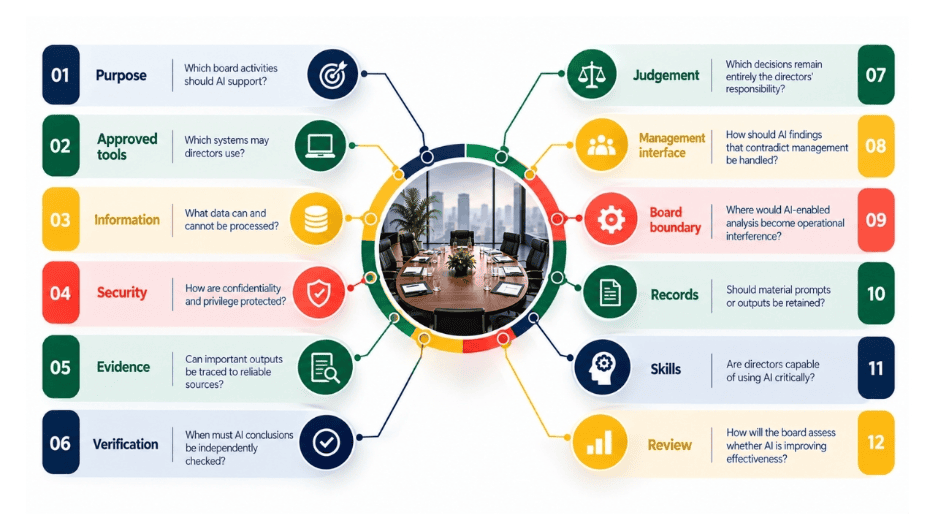
The objective is controlled experimentation.
Boards should learn.
Guardrails should evolve as experience develops.
However, informal adoption without visibility is not a governance strategy.
A boardroom AI protocol should begin with five principles
1. AI augments judgement
No director should outsource fiduciary judgement to a machine.
2. Confidentiality comes before convenience
Sensitive board information should only enter approved environments.
3. Material claims require verification
An AI-generated conclusion should not become board evidence simply because it sounds persuasive.
4. Independent analysis should strengthen challenge, not create shadow management
The board’s role remains oversight.
5. The board should be transparent with itself about AI use
Directors should know how colleagues are using AI in preparation and decision making.
These principles are deliberately simple.
The technology will change.
The governance disciplines should endure.
Ten questions boards should ask before directors start using AI
- What problem are we trying to solve through boardroom AI?
- Which AI tools are approved for director use?
- What board information may safely be processed?
- Can the organisation verify how confidential data is stored and used?
- How will directors test material AI-generated conclusions?
- What happens when AI analysis contradicts management?
- Could AI use cause directors to drift into management?
- Should material AI-supported analysis become part of the board record?
- Do directors have sufficient AI literacy to understand the limitations?
- How will we know whether AI is actually making the board more effective?
The final question matters most.
Adoption is not success.
The governance test is whether the technology improves director judgement, challenge and decision quality.
Seven warning signs boardroom AI is weakening governance
1. Directors use public AI tools with confidential board information
Convenience has overtaken control.
2. AI-generated conclusions enter meetings without source verification
Plausibility is being mistaken for evidence.
3. Different directors rely on different machine-generated facts
The board no longer shares a reliable evidential base.
4. Management first learns about significant AI analysis during the meeting
Challenge risks becoming ambush rather than governance.
5. Directors begin generating operational solutions rather than testing management’s proposals
Oversight is drifting towards execution.
6. AI summaries replace engagement with important board papers
Efficiency has started weakening judgement.
7. Nobody has assessed whether AI is improving board effectiveness
Technology adoption has become an objective in itself.
Several of these symptoms together suggest that the board has adopted AI faster than it has governed its own use.
AI could make board information better by changing management behaviour
There is a wider systemic effect worth considering.
If directors can analyse information more deeply, management reporting may have to improve.
The traditional board pack can contain large amounts of descriptive material because directors have limited capacity to interrogate every page.
AI changes the economics of scrutiny.
Repeated inconsistencies become easier to find.
Unsupported assertions can be tested.
Historical commitments become easier to retrieve.
Management may therefore need to produce papers with clearer evidence, stronger assumptions and more explicit trade-offs.
That would be a positive outcome.
PwC’s 2026 survey found that 82 per cent of directors see opportunities to improve board materials and 81 per cent believe their boards could challenge strategy more effectively.
AI may connect those two problems.
Better analytical capability could increase the pressure for better information.
The ultimate value of boardroom AI may not be that directors read board papers faster. It may be that management has to produce better board papers in the first place.
The information relationship between board and management is changing
For decades, the governance model has relied on an imperfect but workable balance.
Management possesses superior information.
The board possesses formal authority and independent judgement.
Governance mechanisms attempt to bridge the gap.
AI could alter that equilibrium.
Directors may gain stronger independent analytical capabilities while management remains closer to operational reality.
Neither advantage makes the other redundant.
The board’s challenge will be combining them.
Management brings context.
Directors bring distance.
AI can bring analytical reach.
Governance must determine how those three capabilities interact without confusing their roles.
That is the deeper opportunity.
The board-management relationship could move away from management presenting information and directors reacting to it.
Instead, meetings could increasingly become places where competing interpretations of evidence are examined.
That would represent a significant evolution in board effectiveness.
It would also demand better directors.
AI raises expectations of directors, not just their capabilities
The World Economic Forum’s analysis identifies an uncomfortable implication.
If AI enables directors to know more, analyse more and challenge more, should stakeholders expect more from them?
Probably.
Information constraints have historically placed practical limits on oversight.
Those limits will not disappear, but some may weaken.
A director who can interrogate years of board information quickly may find it harder to argue that an important pattern was impossible to see.
Boards with access to sophisticated scenario tools may face greater questions about whether emerging risks were adequately explored.
Greater capability therefore creates greater expectations.
This is not unique to AI.
Governance standards often rise when information becomes easier to obtain.
The more capable the board becomes of knowing, the harder it becomes to defend not asking.
That could be one of AI’s most consequential effects on director accountability.
How healthy is your board before AI changes how it works?
Before boards introduce AI into their own processes, they should understand whether the underlying governance system is already effective.
Technology can amplify strengths.
It can also amplify weaknesses.
A board with poor information may use AI to process poor information faster.
Weak challenge can remain weak even with better analysis.
Directors who lack sufficient capability may become excessively dependent on machine-generated conclusions.
Blurred board-management boundaries could become even less clear.
The Lumorus Board Health Check provides a practical starting point for examining whether the board’s current foundations around information, capability, challenge, accountability and decision making are strong enough for a more AI-enabled operating model.
It is not an AI compliance assessment.
Instead, the diagnostic can help boards identify underlying governance weaknesses before technology adds another layer of complexity.
Where deeper examination is required, a Governance Review or Board Evaluation & Assessment can test how information flows, decision making, board dynamics and oversight operate in practice.
Assess your current position: Take the Lumorus Board Health Check
The Lumorus View
The most interesting effect of AI on corporate governance may not be how boards oversee AI. It may be how AI changes the board itself.
For decades, management’s information advantage has been built into the structure of corporate governance.
That advantage will not disappear.
Executives remain closer to customers, employees, operations and markets.
Yet the board’s analytical dependence on management may begin to weaken.
Directors could gain tools capable of interrogating board packs, testing scenarios, retrieving institutional history and comparing management assertions with external evidence.
Used well, that could produce better challenge.
Board discussions could become less dependent on presentation and more focused on assumptions.
Management information might improve because weak analysis becomes easier to detect.
Directors may arrive better prepared.
Those are meaningful governance gains.
However, the risks are equally real.
AI can manufacture confidence.
Sensitive information can be compromised.
Directors may rely on analysis they cannot explain.
Different tools can produce different versions of reality.
Boards could drift towards management.
The answer is not to prohibit AI from the boardroom.
Nor should directors adopt it simply because management is doing so.
The right approach is more demanding.
Boards should govern their own use of AI with the same seriousness they increasingly expect from management.
That means approved tools, secure information, verification disciplines, clear boundaries and directors capable of challenging machine output as rigorously as they challenge executives.
The prize is not an automated board.
It is a more informed board that remains unmistakably human in its judgement.
The Bottom Line
Boardroom AI is moving from theory towards practice.
PwC reports that 35 per cent of directors say their boards have already integrated AI into oversight activities. Its work identifies potential applications ranging from board-pack analysis and benchmarking to scenario planning and strategic challenge.
Deloitte’s 2026 board AI research shows that adoption remains immature. Nearly half of public companies surveyed had not formally enabled or standardised AI for board activities, while board-specific governance arrangements remain uncommon.
Meanwhile, the World Economic Forum identifies the deeper structural possibility: AI may begin reducing information asymmetry between boards and management.
That possibility should interest every serious governance professional.
Boards have historically relied heavily on the people they oversee to provide the information through which oversight occurs.
AI could loosen that dependency.
However, analytical independence is not the same as governance independence.
Directors still need management context.
Evidence still requires verification.
Confidentiality remains fundamental.
Board-management boundaries still matter.
Human judgement remains accountable.
The question is therefore not whether AI can make directors more powerful.
It can make them more analytically capable.
The governance question is what they do with that capability.
When directors have their own AI, management may lose some of its information advantage.
The board must then prove that greater access to analysis produces better judgement rather than simply greater confidence.
Continue Exploring
- Assess whether your board is ready for a more AI-enabled governance environment: Lumorus Board Health Check
- Examine board information, decision making, accountability and governance architecture: Governance Review
- Evaluate whether board processes and dynamics support effective challenge: Board Evaluation & Assessment
- Identify AI, technology and other emerging capability gaps: Board Skills Audit
- Strengthen the quality of significant board decisions: Board Decision & Risk Assessment
- Build director capability for emerging governance challenges: Director CPD Training
- Create dedicated space for strategic challenge and scenario thinking: Board Strategy Sessions
Lumorus: Better Business, Built on Purpose
Lumorus is a UK headquartered global governance, ESG, Company Secretary and advisory firm supporting organisations across Europe, Africa, Asia, the Caribbean, Canada, the Middle East and international markets.
We believe governance is not paperwork.
It is the allocation, exercise, constraint and accountability of power inside organisations.
AI is beginning to change one of the most important sources of that power: information.
As directors gain access to stronger analytical tools, boards need to consider not only how AI should be governed across the organisation, but how the technology may change their own behaviour, capabilities and relationship with management.
Lumorus helps boards examine whether their governance arrangements remain fit for this changing environment through:
A useful starting question for Chairs is no longer simply whether management is using AI responsibly.
It is this:
If every director arrived at the next board meeting with secure AI capable of interrogating every paper, testing every forecast and comparing every management claim with years of evidence, would the board become better at governing?
If the answer is uncertain, the issue is not simply the technology.
It is board effectiveness.
Take the Lumorus Board Health Check or explore Lumorus Governance to assess whether your board’s information, capability and decision processes are ready for what comes next.
Lumorus: Better Business, Built on Purpose.
Sources
PwC: 2026 Corporate Governance Trends to Watch
PwC identifies AI in the boardroom as a significant 2026 governance trend and reports that 35 per cent of directors say their boards have already integrated AI into oversight activities. It discusses board-pack analysis, benchmarking, scenario planning and the potential to reduce information asymmetry.
PwC: Using AI in the Boardroom
It examines how AI could give directors faster access to independent analysis, including board-pack summaries, external research, strategic pressure testing and scenario planning, alongside risks involving confidentiality, hallucination and board overreach.
PwC: 2026 Annual Corporate Directors Survey
PwC’s September 2026 survey reports significant opportunities to improve board information, strategy challenge and AI capability, including 71 per cent of directors identifying AI as a skill their boards need to strengthen.
World Economic Forum: How AI Could Raise the Standard of Corporate Governance
September 2026 analysis examining how AI could reduce information asymmetry between boards and executives, increase directors’ access to analytical capability and potentially raise expectations of board oversight.
Deloitte: How Boards Are Using AI Today
Deloitte’s July 2026 research examines how directors are using AI for analysis, summarisation and meeting preparation, while finding that boardroom adoption and formal governance arrangements remain immature.