



For years, the sustainability conversation rewarded expansion. More commitments, more targets, more metrics, more disclosure. The emerging test is considerably harder: which sustainability issues actually deserve capital, management attention and board time?
Something important is changing in responsible business.
This should not be mistaken for the end of sustainability. Nor does it mean environmental and social issues have become less important. Instead, the discipline is becoming more demanding.
Companies are increasingly being asked to distinguish sustainability activity that creates strategic, financial or social value from activity that exists mainly because expectations accumulated faster than organisations could challenge them.
McKinsey now describes a sustainability reset, arguing that leading businesses are becoming more selective about decarbonisation investments and concentrating on initiatives with identifiable returns through lower costs, margin protection or reduced risk.
BCG is making a related argument about reporting. Its 2026 work on European sustainability reporting says companies have an opportunity to move from a compliance-led approach towards a strategy-led model in which materiality, business priorities and decision usefulness become more important.
Regulation itself is changing in that direction.
On 3 July 2026, the European Commission adopted revised European Sustainability Reporting Standards that reduce mandatory datapoints by more than 60 per cent and total datapoints by more than 70 per cent. The Commission expects the changes to reduce reporting costs by more than 30 per cent per company while retaining the underlying objectives of the reporting regime.
The UK has also moved.
On 30 September 2026, the Financial Conduct Authority finalised new sustainability disclosure rules for listed companies using a comply-or-explain approach across UK SRS S1 and S2. The regime applies to accounting periods beginning on or after 1 January 2027.
Taken together, these developments point towards a different sustainability era.
The question is moving away from:
How much sustainability activity can the organisation demonstrate?
Towards:
Which sustainability issues materially affect strategy, risk, capital allocation, stakeholders and long-term value, and what is the organisation actually doing about them?
That is not weaker sustainability.
It is better governance.
Executive Takeaway
The sustainability reset is changing the standard by which boards should judge responsible business.
Volume is giving way to materiality. Activity is giving way to outcomes, while reporting is being pushed closer to strategy. Capital is becoming more selective and targets increasingly need credible execution plans.
Stakeholder expectations still matter. However, organisations now need to distinguish between issues that materially affect the business and those that simply add reporting noise.
For boards, several implications stand out:
- Sustainability should be integrated with strategy rather than managed as a parallel programme.
- Materiality should determine where board attention and investment are concentrated.
- Capital allocation requires a clearer sustainability business case.
- Reporting should become shorter, more decision useful and more closely connected to performance.
- Organisations need evidence of impact rather than ever-expanding lists of commitments.
- Stakeholder engagement should influence decisions rather than simply produce consultation records.
- Sustainability targets should be supported by credible capital, ownership and execution plans.
The central governance question is therefore becoming sharper:
Which environmental and social issues should change what this organisation actually does?
The sustainability reset is not an ESG retreat
Public discussion still has a tendency to present sustainability in binary terms.
Companies are either committed or retreating. ESG is either advancing or failing. Regulation is either expanding or being dismantled.
Reality is considerably more complex.
McKinsey’s September analysis captures the change particularly well. It does not argue that businesses should stop investing in decarbonisation. Instead, it observes that stronger organisations are becoming more disciplined about identifying initiatives with credible economic returns and reducing expenditure where the business case remains weak.
That distinction matters.
A renewable-energy investment that reduces exposure to volatile energy markets can create strategic value. Better supply-chain transparency may reduce regulatory or carbon-border exposure, while energy efficiency can lower operating costs.
Product redesign may protect access to important markets. Climate adaptation can protect physical assets, and stronger workforce programmes can improve retention or organisational resilience.
By contrast, programmes with no clear strategic logic, measurable outcome or stakeholder value deserve challenge.
The emerging era therefore requires boards to become more selective rather than less serious.
Responsible business is becoming less about demonstrating activity and more about demonstrating judgement.
Why this reset is happening now
Several forces are converging.
Higher capital costs have made boards more demanding about investment returns. Geopolitical fragmentation has altered energy, supply-chain and trade economics, while climate regulation continues to affect markets through mechanisms such as carbon pricing and border adjustments.
Investors are also asking harder questions about whether sustainability commitments genuinely connect with financial performance.
At the same time, businesses have learned from the first major wave of mandatory sustainability reporting.
That experience has exposed a practical weakness.
More disclosure does not automatically produce better decisions.
BCG’s analysis of European reporting describes a compliance-heavy system in which organisations can report across broad ranges of sustainability topics without always connecting those disclosures clearly with strategy or business priorities.
The result may be lengthy disclosure, significant operational burden and relatively limited value for decision makers.
The next phase is therefore likely to reward something harder.
Focus.
Materiality is moving back to the centre
Materiality should never have been treated simply as a reporting technicality.
It is a resource-allocation discipline.
A serious materiality process asks which environmental, social and governance issues could meaningfully affect the organisation or the people, communities and systems affected by it.
That judgement should influence:
- Strategy
- Risk appetite
- Capital allocation
- Management incentives
- Operational priorities
- Stakeholder engagement
- Board reporting
- External disclosure
Yet organisations can lose that discipline when sustainability becomes an ever-expanding catalogue of issues.
Everything receives a target.
Every target generates data.
Each datapoint creates another reporting obligation.
Eventually, the organisation becomes highly capable of measuring sustainability activity without becoming much better at deciding what matters.
The reset offers an opportunity to correct that.
Lumorus’s ESG Materiality & Risk Assessment helps organisations identify and prioritise the sustainability issues most relevant to strategic resilience, long-term performance and stakeholder impact.
Materiality should answer a basic question:
Where should leadership attention actually go?
The board should not oversee ESG. It should oversee material sustainability consequences
Language matters because it shapes governance.
When boards treat ESG as a separate category, sustainability can become detached from ordinary corporate decision making.
A sustainability committee receives reports. Management presents progress against targets. Directors note the update.
Meanwhile, the significant strategic decisions take place elsewhere.
That model is increasingly difficult to defend.
PwC’s 2026 guidance on board oversight of sustainability takes a more practical position. Boards do not need to resolve every public argument about ESG. Instead, directors need to understand which sustainability issues can materially affect long-term performance and how those issues connect with strategy.
Climate, human rights, geopolitical instability, responsible technology and data privacy ultimately matter because they can affect cost, revenue, financing, market access, resilience and organisational legitimacy.
That is a stronger governance model.
The board is not overseeing an ESG programme.
It is overseeing material risks, opportunities and impacts that happen to include environmental and social issues.
Capital allocation is becoming the real test of sustainability credibility
Commitments are easy to make compared with investment decisions.
A company can publish an ambitious sustainability target without materially changing how capital is allocated.
Eventually, however, strategy reveals itself through where money goes.
McKinsey’s sustainability-reset analysis puts this issue directly on the table. The strongest business cases increasingly prioritise decarbonisation initiatives through cost savings, margin protection and risk reduction rather than emissions volume alone.
That should influence board discussions.
When management proposes a significant sustainability investment, directors should ask:
- What economic value could this create?
- Which strategic risk does it reduce?
- Could it protect access to a market?
- How might regulation change the economics?
- What assumptions underpin the return?
- Which stakeholders benefit or bear the cost?
- What happens if we do nothing?
- How does this compare with alternative uses of capital?
Not every sustainability investment will produce a short-term financial return.
That does not automatically make it unjustifiable.
Some investments protect long-term licence to operate. Others respond to material stakeholder expectations, reduce future liabilities or create measurable social outcomes.
The important point is that the rationale should be explicit.
Sustainability should compete for capital on the strength of its strategic case, not the weakness of its scrutiny.
The strongest business case may be risk avoided rather than revenue created
Return on investment can be interpreted too narrowly.
Some sustainability initiatives create direct income or cost savings.
Others create resilience.
Consider supply-chain traceability, water security, workforce wellbeing, community relationships or climate adaptation.
Their value may emerge through avoiding disruption rather than increasing revenue immediately.
Boards therefore need a broader decision framework.
Relevant benefits can include:
- Reduced regulatory exposure
- Lower operating costs
- Greater energy security
- Improved market access
- Stronger workforce retention
- Reduced community conflict
- More resilient supply chains
- Lower financing risk
- Increased customer trust
- Protection of long-term assets
This is where traditional financial analysis and responsible-impact analysis need to meet.
Sustainability initiatives should not escape commercial scrutiny.
Equally, commercial analysis should not ignore material environmental or social consequences simply because they are harder to express in one financial metric.
Good governance requires both.
The reporting reset matters more than the reporting reduction
The European Commission’s revised ESRS attracted attention because of the scale of simplification.
Mandatory datapoints are being reduced by more than 60 per cent, while total datapoints fall by more than 70 per cent.
The Commission expects reporting costs to decrease substantially.
Those changes matter.
However, the bigger opportunity is not simply producing shorter reports.
It is producing better information.
BCG argues that the revised framework gives organisations an opportunity to reconnect sustainability disclosure with strategic priorities and use materiality more deliberately as a management lens.
That should be welcomed.
A sustainability report containing thousands of datapoints is not automatically informative.
Investors and boards need to understand:
- What is material
- Why it matters
- What has changed
- Which risks are increasing
- Where capital is being deployed
- Which targets remain credible
- Where progress is behind plan
- What management intends to do next
Reporting should illuminate these questions.
When it does not, compliance volume has overtaken decision usefulness.
Lumorus supports organisations through ESG Reporting and Disclosure, helping businesses connect materiality, regulation, data and narrative with credible sustainability reporting.
The UK has chosen proportionality rather than abandoning disclosure
The FCA’s decision on 30 September provides another important signal.
Its final rules require listed companies to report against UK Sustainability Reporting Standards using a comply-or-explain approach across UK SRS S1 and S2.
The regime begins with accounting periods starting on or after 1 January 2027.
This is not deregulation in the simple sense.
Listed companies will still operate within a sustainability disclosure framework aligned with international standards.
The difference lies in the mechanism.
A comply-or-explain approach recognises that circumstances differ and allows issuers to explain rather than pretend uniform compliance always produces better disclosure.
For boards, that increases the importance of judgement.
An explanation cannot simply become a loophole.
Where the organisation does not comply, directors should understand why, whether the explanation is credible and what investors or other stakeholders are likely to infer.
Proportionality does not reduce accountability. It places more accountability on judgement and explanation.
Less disclosure should not mean less evidence
Any simplification exercise carries a risk.
Organisations may conclude that fewer mandatory datapoints mean fewer internal controls or less information are necessary.
That would be a mistake.
External reporting requirements and internal management requirements are not identical.
A metric may not be material enough for public disclosure but could remain important for managing operational risk.
Likewise, an investor may require evidence supporting a statement even where every underlying datapoint does not appear publicly.
Boards should therefore distinguish between:
What must be reported externally
and
What management needs to know internally.
A mature sustainability information system supports decision making first and reporting second.
Where reporting drives the entire architecture, businesses often collect what regulation requests rather than what management needs.
The reset creates an opportunity to reverse that logic.
Targets are entering an era of greater scrutiny
The first ESG era often rewarded ambition.
The next is likely to reward credibility.
McKinsey notes that many sectors remain off track against stated decarbonisation ambitions, while companies are reassessing commitments as economic conditions, technology and implementation challenges evolve.
That creates a difficult board question.
What should happen when a target is no longer credible?
One option is to retain it and hope circumstances improve.
Another is to reduce ambition quietly.
Neither represents especially strong governance.
A better response is to understand why assumptions changed, determine what remains achievable and explain how the revised position affects strategy.
Boards should test:
- Was the original target evidence based?
- Which assumptions have changed?
- Has management execution failed?
- Has regulation altered?
- Has technology developed differently than expected?
- What capital would be required to remain on track?
- Would revising the target improve or weaken long-term performance?
- How should stakeholders be informed?
Changing a target is not automatically evidence of failure.
Maintaining an implausible target can be worse.
Credibility depends less on never changing course than on explaining why the course changed and what happens next.
Responsible impact is moving from promises to evidence
The shift extends beyond climate.
Organisations have made extensive commitments concerning employees, communities, diversity, supply chains and social value.
Increasingly, the test is whether those activities produce measurable outcomes.
That makes impact measurement strategically important.
Lumorus’s Social Impact Measurement and Management helps organisations develop impact frameworks, gather evidence, assess outcomes and improve the effectiveness of responsible-business programmes.
The governance logic is straightforward.
If an organisation claims a programme creates social value, management should understand:
- Who benefits
- What changed
- How much changed
- Whether the outcome can reasonably be connected to the intervention
- What the initiative cost
- Whether another approach might perform better
- What stakeholders themselves think
Without that evidence, responsible impact risks becoming narrative rather than management discipline.
Stakeholder engagement should become more selective and more meaningful
The sustainability reset should not become an excuse to stop listening to stakeholders.
It should improve how organisations listen.
Stakeholder engagement becomes performative when consultation produces large volumes of feedback that have little influence on decisions.
A stronger approach asks what information stakeholders possess that management and the board genuinely need.
Employees may identify workforce consequences that leaders have underestimated.
Communities can see environmental or social impacts before headquarters.
Suppliers may expose implementation problems.
Investors can challenge the relationship between sustainability commitments and long-term value.
Customers may indicate whether sustainability claims influence trust or purchasing behaviour.
Lumorus’s Stakeholder Engagement supports organisations in identifying relevant stakeholders, structuring consultation and connecting stakeholder perspectives with decision making.
The goal is not satisfying every stakeholder demand.
Boards cannot govern by referendum.
Instead, stakeholder information should strengthen management and board judgement.
Sustainability needs to move inside strategy
The clearest evidence of the reset will be whether sustainability stops operating as a parallel planning system.
Many organisations still have:
- A corporate strategy
- A financial plan
- A sustainability strategy
- A climate plan
- A people strategy
- A reporting programme
Each may be sophisticated.
The governance problem is whether they describe the same organisation.
BCG’s argument for moving from compliance to strategy is fundamentally about reconnecting these systems.
PwC makes a similar point by encouraging directors to consider material sustainability issues through the lens of business performance and long-term strategy.
A stronger operating model connects:
Material issue → Strategic implication → Capital decision → Operational owner → Metric → Board oversight → Reported outcome
That is how sustainability becomes management.
Lumorus’s ESG Strategy Development helps organisations connect material sustainability priorities with business objectives, governance and long-term value creation.
Boards should ask what the business would do differently if sustainability genuinely mattered
This is a useful governance test.
Suppose sustainability disappeared from the board agenda tomorrow.
Would anything else change?
Capital allocation change?
Risk appetite move?
Product development alter?
Supply-chain decisions differ?
Executive incentives change?
Acquisition decisions change?
Market-entry decisions change?
If the answer is no, sustainability may be functioning mainly as disclosure.
A material issue should produce consequences.
Perhaps a supplier changes.
An investment is accelerated.
A market is reconsidered.
A product is redesigned.
An asset receives greater protection.
A workforce programme gets additional funding.
A target is abandoned because evidence suggests a different intervention would achieve better results.
This is why the next phase of responsible business is fundamentally a governance issue.
A board should be able to point to decisions that became different because sustainability evidence changed the judgement.
The reset should improve investment decisions
Investors face the same challenge as companies.
ESG integration can become mechanical when long lists of factors are scored without a clear relationship to investment value.
A stronger approach focuses on materiality.
Which environmental or social factors affect cash flows, risk, market access, cost of capital, licence to operate or long-term competitiveness?
That is why sustainability integration belongs inside investment analysis rather than beside it.
Lumorus has previously examined this through ESG Integration in Investment Decisions, focusing on how responsible-impact information can strengthen investment judgement rather than existing as another reporting layer.
For investment committees, the reset should mean fewer generic ESG statements and better questions.
Which issue is financially material?
Where is risk being underpriced?
Could regulation change value?
Does management have credible execution capability?
What evidence supports the sustainability thesis?
How does sustainability affect exit value or long-term resilience?
Those are investment questions.
That is precisely why they belong inside investment governance.
Board oversight should become more concentrated, not less serious
Sustainability agendas expanded rapidly during the past decade.
Boards now face climate, biodiversity, workforce, human rights, community impact, supply-chain standards, responsible technology and multiple disclosure regimes.
No board can give every topic equal attention.
Attempting to do so can create superficial oversight.
PwC’s position is useful. Directors do not need to resolve every argument around sustainability. Instead, they should identify issues capable of affecting long-term performance and ensure those matters are integrated into strategy and oversight.
That means a board should be comfortable saying:
This issue is material and requires board attention.
It matters but can remain with management.
Also it belongs with a committee.
It quires independent assurance.
It no longer deserves the resources currently allocated to it.
Prioritisation is not neglect.
Prioritisation is one of the board’s core governance responsibilities.
Boards need better sustainability information, not more sustainability information
Information overload is not limited to financial reporting.
Sustainability dashboards can contain dozens or hundreds of indicators.
Boards may receive emissions, water, waste, safety, workforce, diversity, community, supplier and compliance measures.
More data can produce less clarity.
A strong sustainability dashboard should tell directors:
- Which material issues are improving
- Which are deteriorating
- Where targets are off track
- What financial consequences are emerging
- Which stakeholder impacts matter
- Where regulation has changed
- Which interventions are working
- What requires a board decision
Trend matters.
Context matters.
Consequence matters.
The board does not need every datapoint management collects.
It needs the information required to exercise judgement.
Sustainability incentives need the same reset
Executive remuneration has increasingly incorporated ESG measures.
In principle, this can strengthen accountability.
Poorly designed measures can do the opposite.
An easy target may reward activity without meaningful outcomes. A metric can become disconnected from strategy, while too many measures dilute accountability.
Boards should therefore ask whether sustainability incentives:
- Address a genuinely material issue
- Have a clear relationship with management performance
- Can be measured reliably
- Avoid unintended consequences
- Are sufficiently challenging
- Support rather than distort strategy
The reset should move remuneration committees away from including sustainability metrics simply because stakeholders expect them.
The better question is whether the measure improves executive accountability for something that actually matters.
Sustainability governance should clarify who owns delivery
Another recurring weakness is distributed responsibility.
Sustainability touches almost every function.
Operations may own emissions.
HR owns workforce issues.
Procurement manages suppliers.
Finance controls investment.
Legal interprets regulation.
Investor relations manages external communication.
The sustainability function coordinates much of this activity.
Without careful design, everyone owns sustainability and nobody owns delivery.
Boards should therefore distinguish between coordination and accountability.
A sustainability leader can provide specialist expertise.
Operational executives should own outcomes within their businesses.
Finance should connect sustainability with capital planning.
Risk should integrate material issues into enterprise risk.
The board should oversee.
Clear accountability matters because sustainability failures often arise not from a lack of policy but from the gap between strategy and execution.
The regulatory simplification creates a test for leadership
There is an uncomfortable question hidden inside the current reset.
What happens when regulation asks for less?
Organisations that acted mainly because reporting frameworks required them to may reduce activity quickly.
Businesses with a strong strategic rationale may behave differently.
They can simplify disclosure while maintaining programmes that lower costs, improve resilience or create value.
Some investments may continue because the underlying business case remains strong.
Others may stop because evidence no longer supports them.
This creates a useful test.
If a sustainability initiative disappears the moment a reporting requirement disappears, was the initiative ever strategically important?
There may be legitimate reasons to reduce effort.
The important issue is whether management can explain the decision.
Regulatory simplification should create more room for judgement.
Boards should ensure that room is used intelligently.
A Practical Sustainability Reset Framework
Boards can structure the next phase around seven questions.
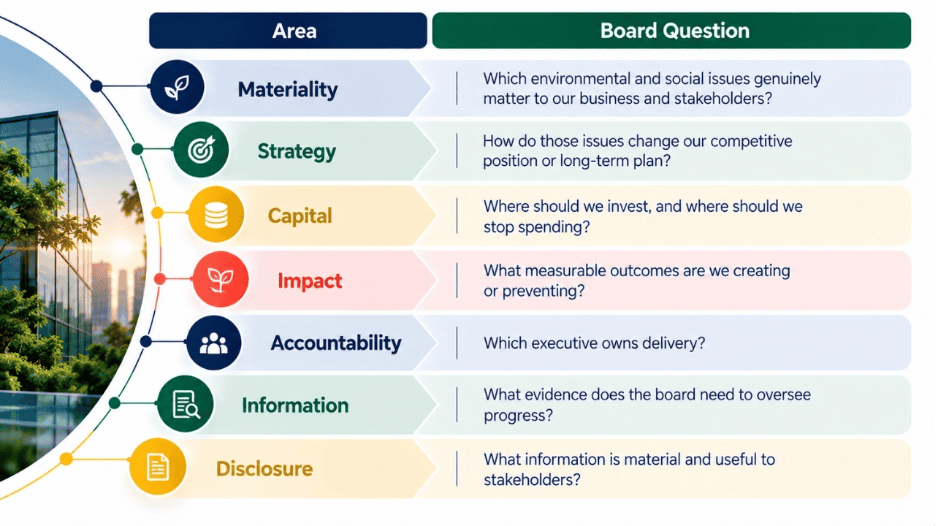
The framework is deliberately straightforward.
The goal is not another sustainability process.
It is better organisational judgement.
Ten Questions Every Board Should Ask During the Sustainability Reset
- Which sustainability issues genuinely affect our strategy?
- Where are we spending money without a sufficiently clear business or impact case?
- Which initiatives reduce cost, risk or strategic vulnerability?
- Which commitments are no longer credible, and why?
- What sustainability information actually changes our decisions?
- Which stakeholder impacts are material enough to require board attention?
- Does management have clear accountability for each major sustainability priority?
- Are executive incentives linked to measures that genuinely matter?
- Could our reporting become shorter without becoming less informative?
- Can we identify decisions that changed because sustainability evidence changed our judgement?
If the final answer is no, sustainability may still be sitting outside strategy.
Seven Warning Signs Your Sustainability Model Needs a Reset
1. The organisation has more targets than clear strategic priorities
Ambition has outrun focus.
2. Sustainability reporting absorbs substantial resources but rarely changes management decisions
Compliance and strategy have become disconnected.
3. The board receives large dashboards without a clear view of materiality
Information volume is substituting for judgement.
4. Capital allocation decisions rarely refer to sustainability evidence
Responsible business remains outside the financial core.
5. Stakeholder consultation produces reports but little visible action
Engagement has become procedural.
6. Sustainability incentives reward activity more clearly than outcomes
Accountability is weak.
7. Management cannot explain which programmes would continue if regulation required less reporting
The strategic rationale remains uncertain.
Several of these symptoms together suggest the organisation does not need another sustainability initiative.
It needs a clearer responsible-impact operating model.
The sustainability reset should strengthen responsible impact, not dilute it
There is a risk that organisations interpret the current environment too simply.
Less reporting becomes less action.
Reduced political enthusiasm becomes reduced responsibility.
Targets are abandoned without serious review.
That would miss the opportunity.
The stronger response is to use simplification to improve quality.
Fewer datapoints can create more attention for material information.
More selective investment can improve execution.
Fewer targets can make accountability clearer.
Better impact measurement can replace broad claims.
A tighter strategic agenda can make sustainability more influential in the decisions that matter.
Responsible impact stripped of performance theatre is not weaker.
It is considerably harder.
An organisation can no longer rely on the size of its sustainability report as evidence of seriousness.
It needs outcomes.
Does Your Board Know Which Sustainability Issues Actually Matter?
The reset eventually becomes a board-effectiveness question.
Materiality requires judgement.
Trade-offs require judgement.
Capital allocation requires judgement.
Changing a target requires judgement.
Explaining non-compliance requires judgement.
Boards therefore need the right information, capabilities and decision processes.
The Lumorus Board Health Check gives Chairs and directors a practical starting point for considering whether the board’s wider governance architecture supports effective oversight of complex and emerging issues.
It is not a sustainability audit.
Instead, it tests foundations such as board capability, information quality, challenge, accountability and decision making.
Where deeper examination is required, organisations can consider a Governance Review or Board Evaluation & Assessment.
Assess your governance foundations: Take the Lumorus Board Health Check
The Lumorus View
The ESG era is not ending.
It is becoming less forgiving.
The previous phase rewarded expansion: more commitments, more data, more disclosure and more policies.
That expansion helped make environmental and social issues visible inside institutions that had often treated them as peripheral.
Visibility was necessary.
It is no longer enough.
The next phase demands judgement.
- Which issues deserve capital?
- Which targets remain credible?
- Which programmes create value?
- Which stakeholder impacts are material?
- Which disclosures help investors understand the business?
- Which commitments should change?
- Where should management stop spending?
These are harder questions because they expose trade-offs.
That is exactly why boards should welcome them.
Responsible business becomes real when sustainability starts changing decisions rather than merely expanding reporting.
The organisations most likely to navigate the reset successfully will not be those that abandon sustainability or defend every inherited commitment.
They will be those capable of distinguishing substance from activity.
Material issues will connect with strategy.
Capital will follow evidence.
Targets will follow credible execution.
Reporting will become more useful.
Stakeholder engagement will inform decisions.
Impact will be measured.
Accountability will become clearer.
That is not the retreat of responsible business.
It is its maturation.
The Bottom Line
Several major developments in 2026 now point in the same direction.
McKinsey describes a sustainability reset in which stronger businesses concentrate decarbonisation investment where the economic case is most credible.
BCG argues that European sustainability reporting should move from compliance towards strategy, using materiality and decision usefulness to reduce unnecessary reporting effort while improving the relationship with business priorities.
PwC advises boards to concentrate on sustainability issues capable of affecting long-term performance rather than attempting to resolve every ESG debate.
Meanwhile, the European Commission has adopted revised ESRS containing materially fewer datapoints, while the FCA has finalised a UK comply-or-explain sustainability disclosure regime for listed companies beginning with accounting periods from 1 January 2027.
The regulatory architecture is evolving.
The strategic test is becoming clearer.
Boards should expect sustainability to answer the same difficult questions as every other serious business priority:
What is material?
What value is at stake?
Who owns delivery?
What capital is required?
What evidence supports the decision?
Which stakeholders are affected?
How will success be measured?
What would cause us to change course?
That is the reset.
The next era of sustainability will not be won by the organisation with the most targets or the longest report. It will favour organisations capable of showing how responsible impact changes strategy, capital allocation and real-world outcomes.
Continue Exploring
- Identify the sustainability issues that genuinely matter to your organisation: ESG Materiality & Risk Assessment
- Connect sustainability priorities with business strategy: ESG Strategy Development
- Build reporting around material and decision-useful information: ESG Reporting and Disclosure
- Understand stakeholder expectations and material impacts: Stakeholder Engagement
- Measure whether responsible-business programmes are creating meaningful outcomes: Social Impact Measurement and Management
- Integrate material ESG information into investment decisions: ESG Integration in Investment Decisions
- Test whether your board has the governance foundations for stronger sustainability oversight: Lumorus Board Health Check
Lumorus: Responsible Impact That Changes Decisions
Lumorus works with organisations seeking to move responsible business beyond disclosure and towards strategy, evidence and measurable impact.
Our Sustainability & Responsibility capabilities include:
The purpose is not to create another layer of sustainability activity.
It is to help organisations determine what matters, integrate it into decision making and demonstrate credible outcomes.
As the sustainability landscape resets, that distinction becomes increasingly important.
Regulation may become more proportionate.
Reporting may become shorter.
Investors may become more selective.
Boards may become less interested in the number of commitments and more interested in whether those commitments are credible.
That places a premium on organisations capable of connecting responsible impact with strategy, capital and accountability.
A useful starting question is simple:
If your organisation removed half of its sustainability metrics tomorrow, would the board know which half actually mattered?
If the answer is uncertain, the problem is probably not that you need more data.
You need greater materiality.
Explore Lumorus Sustainability & Responsibility
Lumorus: Better Business, Built on Purpose.
Sources
McKinsey & Company: The Sustainability Reset: Decarbonization as a Competitive Advantage
McKinsey’s September 2026 analysis examines the shift towards decarbonisation initiatives with clearer economic returns, risk reduction and competitive value.
BCG: Sustainability Reporting in Europe: From Compliance to Strategy
BCG’s 2026 analysis argues for a more strategy-led approach to sustainability reporting based on materiality, decision usefulness and more efficient compliance.
PwC: Effective Board Oversight of Sustainability Strategy
PwC’s 2026 guidance argues that boards should focus on sustainability issues capable of affecting long-term performance and integrate those issues with business strategy and oversight.
European Commission: Revised European Sustainability Reporting Standards
The European Commission adopted revised ESRS on 3 July 2026, reducing mandatory datapoints by more than 60 per cent and total datapoints by more than 70 per cent.
Published on 30 September 2026, the FCA policy statement establishes a comply-or-explain regime against UK SRS S1 and S2 for listed companies, applying to accounting periods beginning from 1 January 2027.