


The investment landscape is changing rapidly.
- Investors are demanding greater transparency.
- Regulators expect stronger governance.
- Climate risk is increasingly recognised as financial risk.
- Social issues are influencing corporate performance.
- Governance failures continue to destroy shareholder value.
Yet many investment funds still treat ESG as a reporting obligation rather than an investment discipline.
That approach is becoming increasingly difficult to justify.
Today, ESG is not simply about ethical investing.
It is about making better investment decisions.
According to the Investment Company Institute (ICI), ESG integration is the systematic consideration of financially material environmental, social and governance factors throughout the investment process to improve investment analysis and portfolio management.
Read More: ESG Integration in Investment Decisions
ESG integration is not the same as ESG investing
One of the most common misconceptions is that ESG integration and sustainable investing are the same.
They are not.
ESG investing often reflects investor preferences or specific sustainability objectives.
ESG integration strengthens investment analysis by considering material ESG risks and opportunities alongside traditional financial metrics.
It asks a different question.
How could environmental, social and governance issues influence investment performance?
That shift changes ESG from a compliance exercise into a governance and investment tool.
Good investment decisions require better information
Investment decisions have always relied on information.
- Financial statements.
- Market data.
- Economic forecasts.
- Industry analysis.
Today, ESG data has become another critical source of decision-making insight.
According to the CFA Institute, integrating ESG considerations into investment analysis enables investors to identify risks and opportunities that may not be captured through traditional financial analysis alone.
Investment funds that ignore material ESG risks risk overlooking factors that influence long-term value creation.
Materiality should drive ESG integration
Not every ESG issue is relevant to every investment.
Materiality matters.
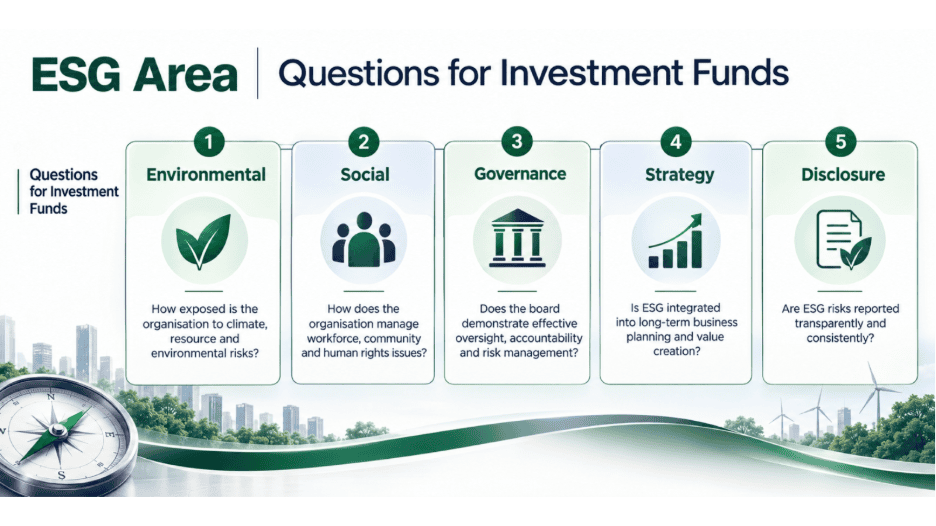
An effective ESG Materiality & Risk Assessment helps investment managers distinguish between issues that influence investment performance and those that are unlikely to affect long-term value.
Material ESG Factors Investors Should Assess
Materiality improves investment discipline.
It also improves governance.
Governance remains the strongest predictor of long-term resilience
Environmental and social performance matter.
Governance determines whether organisations can respond effectively to both.
Weak governance often leads to:
- Poor board oversight.
- Weak risk management.
- Ineffective capital allocation.
- Compliance failures.
- Reputational damage.
- Strategic misalignment.
Strong governance enables organisations to identify emerging risks, allocate resources effectively and respond confidently to changing market conditions.
For investment funds, governance quality should therefore remain a central component of investment analysis.
ESG integration should influence investment strategy
Many organisations publish ESG reports.
Fewer integrate ESG into investment decision making.
Effective ESG integration should influence:
- Investment selection.
- Portfolio construction.
- Risk management.
- Stewardship.
- Shareholder engagement.
- Long-term capital allocation.
This requires more than collecting ESG data.
It requires a clear ESG Strategy Development process that aligns sustainability objectives with investment strategy and fiduciary responsibilities.
Stakeholder engagement strengthens investment decisions
Investment decisions do not occur in isolation.
- They affect shareholders.
- Employees.
- Communities.
- Customers.
- Regulators.
Meaningful Stakeholder Engagement helps investment funds understand emerging risks, changing stakeholder expectations and broader market trends that may influence portfolio performance.
Listening has become an investment capability.
Not simply a communications exercise.
Reporting should demonstrate how ESG informs investment decisions
Investors increasingly expect funds to explain not only what ESG policies exist but how ESG influences investment outcomes.
Transparent ESG Reporting and Disclosure should demonstrate:
- How ESG risks are identified.
- How material issues influence investment analysis.
- How stewardship activities support long-term value.
- How governance strengthens investment oversight.
- Reporting should explain decisions.
- Not simply describe policies.
The future belongs to funds that integrate governance and investment
- Investment funds face increasing uncertainty.
- Geopolitical instability.
- Climate risk.
- Artificial intelligence.
- Supply chain disruption.
- Changing regulation.
The funds most likely to succeed will not be those collecting the most ESG data.
They will be those using ESG information to make better investment decisions.
Because ESG integration is ultimately not about sustainability reporting.
It is about investment quality.
And investment quality begins with governance.
Lumorus: Better Business, Built on Purpose
At Lumorus, we believe ESG should strengthen investment decisions rather than simply satisfy reporting requirements.
Lumorus is a UK headquartered global governance, ESG, company secretary and advisory firm supporting organisations across Europe, Africa, Asia, the Caribbean, Canada, the Middle East and international markets.
We help investment funds, financial institutions and organisations integrate ESG into governance, strategy and investment decision making to support sustainable long-term value creation.
Our ESG expertise includes:
Whether you are developing an ESG investment framework, strengthening stewardship practices or improving ESG reporting, Lumorus can help you embed sustainability into investment decisions that create long-term value.
Visit Lumorus to learn how we can help strengthen your ESG governance and investment capability.
Website: lumorus.com
Email: [email protected]
Together, we can build better business: one that performs with purpose, leads with integrity and creates lasting value.
Sources
- Investment Company Institute (ICI) – ESG Integration in Investment Management
- CFA Institute – How to Integrate ESG Considerations in Investments