


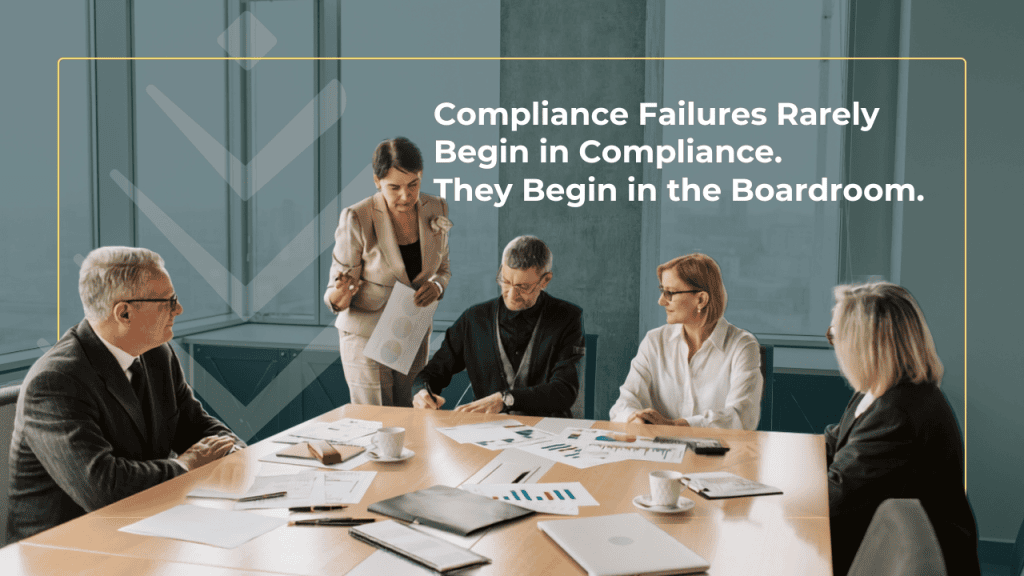
Most compliance failures are not caused by a lack of regulation.
They are caused by:
- Poor governance.
- Policies existed.
- Controls were documented.
- Committees were established.
- Yet organisations still failed.
Why?
Because compliance is ultimately a board responsibility.
The board determines organisational culture.
- Approves strategy.
- Oversees risk.
- Challenges management.
- Monitors performance.
When board management is weak, regulatory compliance inevitably suffers.
Compliance is therefore not simply a legal function.
It is an outcome of effective governance.
According to KPMG, boards should move beyond viewing compliance as a box-ticking exercise and instead embed it into strategy, culture and organisational decision making.
Read More: Corporate Governance Support
Compliance begins with board oversight
Many organisations treat compliance as the responsibility of legal teams, compliance officers or internal audit.
Those functions are essential.
They do not own governance.
Boards do.
Directors are ultimately responsible for ensuring the organisation operates within its legal and regulatory obligations.
That responsibility cannot be delegated.
An effective board should continually ask:
- Are we receiving reliable compliance information?
- Do we understand our principal regulatory risks?
- Is management escalating issues early enough?
- Are controls working as intended?
Does organisational culture encourage compliance or conceal problems?
These are governance questions.
Not operational ones.
Good board management creates a culture of compliance
Compliance is not created by policies alone, it is created by leadership. Boards influence organisational behaviour through the decisions they make, the questions they ask and the standards they set.
According to governance commentator Arden Phillips, effective boards strengthen compliance by providing active oversight, accountability and constructive challenge rather than relying solely on management assurances.
Where boards actively engage with compliance, organisations are more likely to identify issues before they become regulatory failures.
What effective board management looks like
Strong compliance depends on disciplined governance processes.
How Board Management Strengthens Regulatory Compliance
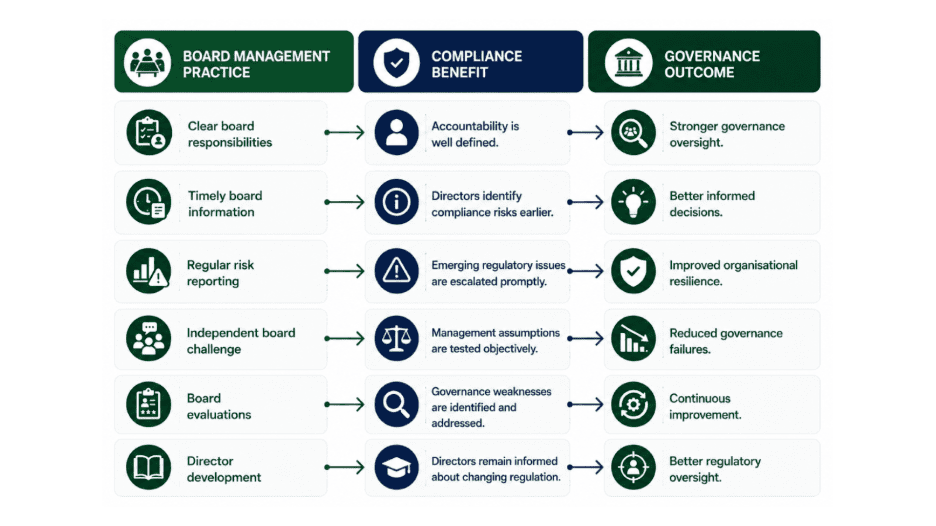
Compliance improves when governance improves.
Information quality determines oversight quality
Boards can only oversee what they can see.
- Incomplete reporting.
- Late papers.
- Fragmented information.
- Inconsistent data.
These weaken regulatory oversight.
An effective Governance Infrastructure ensures directors receive accurate, timely and relevant information to support informed decision making.
Good governance depends as much on information quality as it does on director capability.
Board decisions shape regulatory outcomes
Every significant compliance failure can be traced back to a series of decisions. Some decisions involved insufficient challenge. Others reflected poor risk oversight. Some were based on incomplete information.
A structured Board Decision & Risk Assessment enables organisations to examine how decisions are made, whether risks are properly considered and whether governance processes support regulatory compliance.
Better compliance begins with better board decisions.
Capability matters as much as compliance frameworks
Regulation changes continuously, boards must evolve with it. Directors who lack current governance knowledge may unintentionally expose organisations to regulatory risk.
Regular Director CPD Training helps directors remain informed about legislative developments, governance expectations and emerging risks.
Similarly, a Board Skill Audit enables organisations to assess whether the board possesses the expertise required to oversee increasingly complex regulatory environments.
Governance capability is a compliance control.
Board evaluations strengthen regulatory confidence
High-performing boards continuously assess their effectiveness not because regulation requires it, because governance demands it.
A structured Board Evaluation helps identify weaknesses in oversight, board dynamics, committee effectiveness and information flows before they become governance failures.
Combined with regular Governance Reviews, board evaluations help organisations build governance systems capable of adapting to changing regulatory expectations.
Compliance is a governance outcome, not a governance objective
The strongest organisations do not pursue compliance as an end in itself.
- They pursue effective governance.
- Compliance follows.
- When boards receive reliable information.
- Exercise independent judgement.
- Challenge management constructively.
- Develop director capability.
- Continuously improve governance.
Regulatory compliance becomes stronger as a natural consequence. Because compliance is not created by policies, it is created by governance.
Lumorus: Better Business, Built on Purpose
At Lumorus, we believe governance is not paperwork.
It is the allocation, exercise, constraint and accountability of power inside organisations.
Lumorus is a UK headquartered global governance, ESG, company secretary and advisory firm supporting organisations across Europe, Africa, Asia, the Caribbean, Canada, the Middle East and international markets.
We help boards strengthen governance systems that improve regulatory oversight, enhance decision making and build lasting organisational resilience.
Our governance expertise includes:
Whether you are strengthening board oversight, improving governance processes or preparing for increasing regulatory scrutiny, Lumorus can help you build governance systems that support confident, compliant and accountable decision making.
Website: lumorus.com
Email: [email protected]
Together, we can build better business: one that performs with purpose, leads with integrity and creates lasting value.
Sources
- KPMG – Boardroom Questions: Moving Beyond Compliance
- Arden Phillips – The Board’s Role in Compliance Oversight and Accountability
- OECD – G20/OECD Principles of Corporate Governance
- The Chartered Governance Institute UK & Ireland – Guidance on board responsibilities, governance and regulatory compliance.