


Many organisations invest heavily in Corporate Social Responsibility programmes.
Very few evaluate them properly.
That is becoming a serious strategic weakness.
Across industries, businesses are increasingly expected to demonstrate not only that they are investing in social impact initiatives, but that those initiatives are creating measurable value for communities, stakeholders and the organisation itself.
The problem is that many CSR programmes are still managed through activity reporting rather than impact evaluation.
Organisations measure:
- Money spent
- Events organised
- Donations made
- Volunteers engaged
But these metrics alone do not answer the most important question:
Did the programme actually create meaningful impact?
That distinction matters enormously.
As stakeholder scrutiny increases, organisations are under growing pressure to demonstrate that CSR is credible, measurable and strategically aligned rather than symbolic or performative.
The strongest organisations now treat CSR evaluation as a governance and performance discipline rather than a communications exercise.
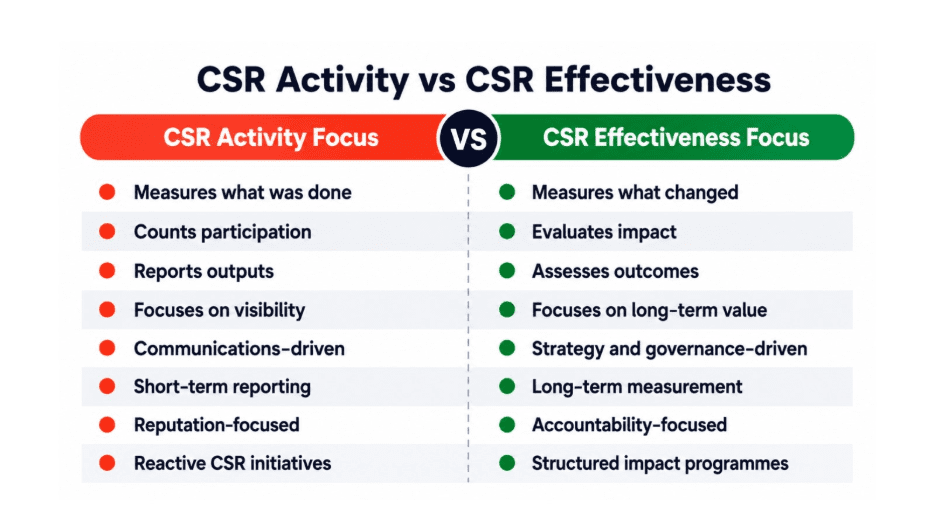
CSR Activity Is Not the Same as CSR Impact
One of the biggest mistakes organisations make is confusing activity with effectiveness.
A CSR programme may appear highly active while delivering very little long-term value.
This happens because many organisations focus on outputs instead of outcomes.
For example:
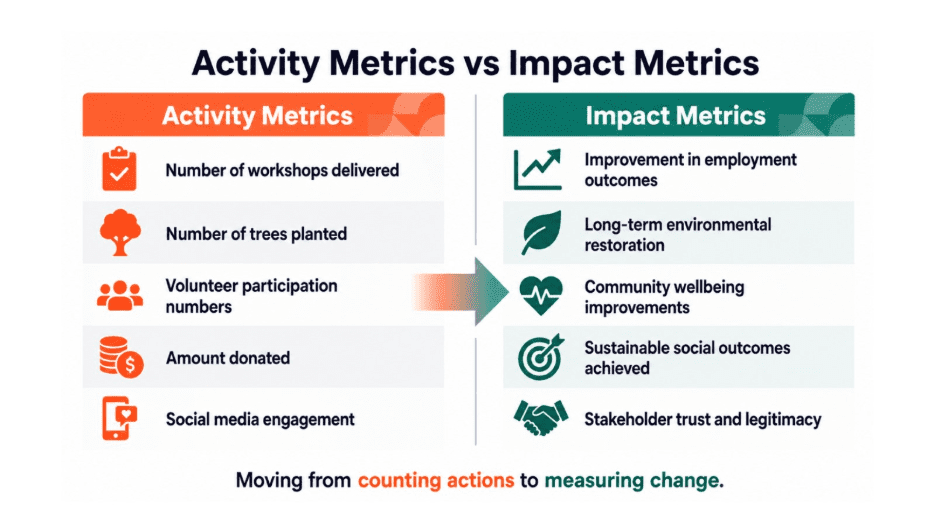
Activity metrics are easier to report. Impact metrics are harder to evaluate properly.
But without impact evaluation, organisations cannot determine whether CSR investments are genuinely effective.
According to Healium’s CSR evaluation framework, organisations increasingly require structured metrics, impact tracking systems and outcome-based evaluation models to assess whether CSR initiatives are delivering meaningful value over time.
CSR Activity vs CSR Effectiveness
Why CSR Measurement Matters More Than Ever
CSR expectations have evolved significantly.
Stakeholders increasingly expect organisations to demonstrate:
- Measurable social impact
- Governance oversight
- Transparency
- Accountability
- ESG alignment
- Long-term sustainability outcomes
Investors, regulators, communities and employees are asking more difficult questions about corporate impact.
This means CSR programmes can no longer rely solely on goodwill narratives or brand positioning.
They must show evidence.
Strong CSR evaluation helps organisations:
- Understand programme effectiveness
- Improve resource allocation
- Identify weak initiatives
- strengthen stakeholder trust
Simprove ESG reporting credibility
- Support long-term strategic planning
- Reduce reputational risk
Without measurement, organisations often continue funding programmes that generate visibility but little meaningful impact.
The Governance Problem Behind Weak CSR Evaluation
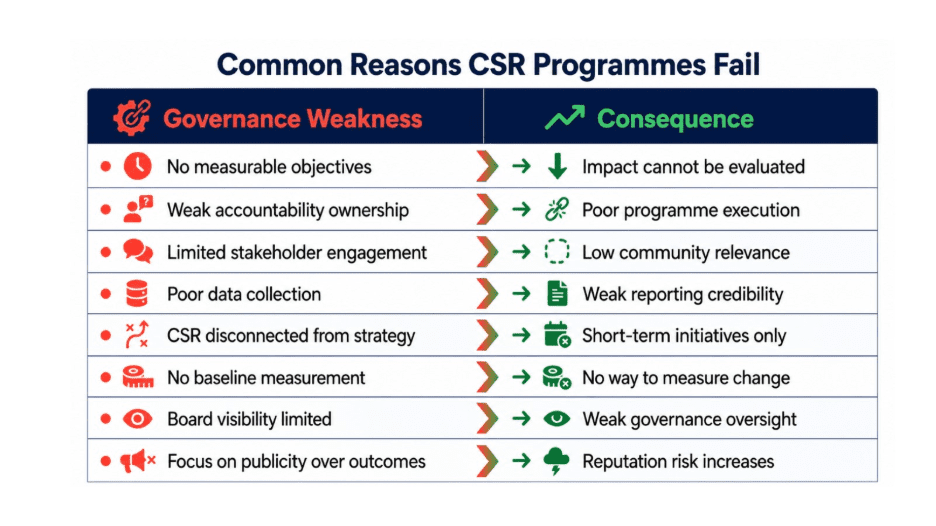
Many CSR programmes fail not because intentions are weak, but because governance structures are unclear.
Common problems include:
- No clear accountability ownership
- Weak measurement frameworks
- Inconsistent reporting standards
- Poor stakeholder engagement
- Fragmented programme oversight
- Lack of baseline data
- Limited board visibility
This creates a major governance issue.
Boards often approve CSR budgets and public commitments without receiving robust evidence demonstrating programme effectiveness.
As ESG scrutiny increases globally, this creates reputational and strategic risk.
Strong CSR governance requires organisations to move beyond symbolic reporting towards structured impact oversight.
Common Reasons CSR Programmes Fail
What Effective CSR Evaluation Actually Looks Like
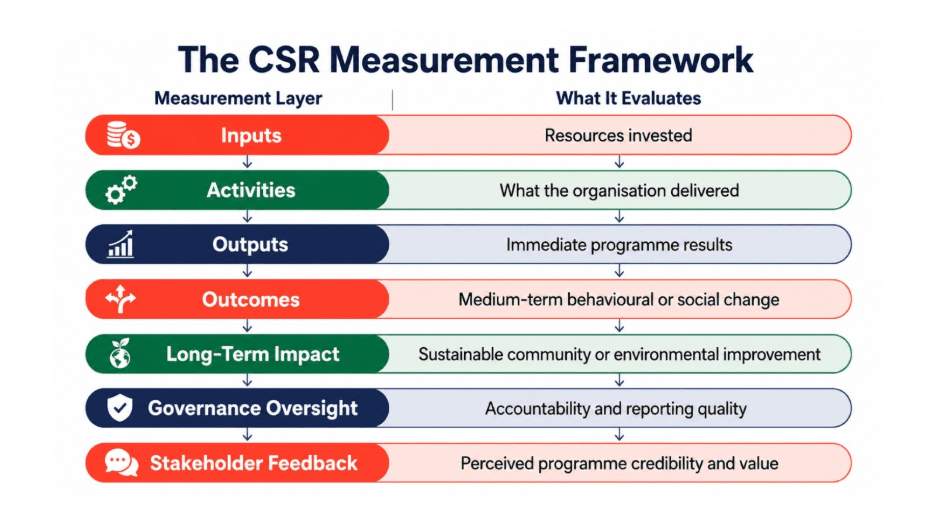
Effective CSR evaluation requires organisations to measure three levels simultaneously:
1. Inputs
Resources invested into the programme.
Examples include:
- Funding
- Staff hours
- Partnerships
- Technology
- Training resources
2. Outputs
Activities delivered directly through the programme.
Examples include:
- Workshops conducted
- Beneficiaries reached
- Community projects completed
- Volunteer hours recorded
3. Outcomes and Impact
The long-term change created through the programme.
Examples include:
- Improved education outcomes
- Employment growth
- Environmental improvement
- Community resilience
- Increased stakeholder trust
- Social wellbeing improvement
This is where many organisations struggle most.
Outputs are visible quickly. Impact often takes years to evaluate properly.
According to Purple Griffon’s CSR measurement analysis, organisations increasingly require integrated CSR metrics that combine qualitative and quantitative evaluation methods to assess social responsibility performance effectively.
The CSR Measurement Framework
Why Stakeholder Feedback Matters
Many organisations evaluate CSR programmes internally without involving the communities or stakeholders affected directly.
This creates distorted measurement.
A programme may appear successful internally while delivering limited practical value externally.
Strong CSR evaluation includes:
- Stakeholder surveys
- Beneficiary feedback
- Community consultation
- Employee engagement data
- Partner organisation input
This improves legitimacy because impact is assessed not only through organisational reporting but through external experience and perception.
The organisations with the strongest CSR credibility are usually the organisations willing to measure uncomfortable truths honestly.
Case Study: The CSR Programme That Looked Successful but Was Not
A large organisation invested significantly in youth employability programmes across several communities.
Initial reporting appeared positive.
The organisation highlighted:
- Training sessions delivered
- Attendance figures
- Volunteer engagement
- Media coverage
- Sponsorship visibility
However, a deeper impact assessment later revealed that very few participants secured long-term employment outcomes after programme completion.
The programme generated activity, but limited sustained impact.
Following the review, the organisation redesigned the initiative around measurable employment outcomes, employer partnerships and long-term participant tracking.
The second phase produced fewer headline numbers but significantly stronger social impact outcomes.
This illustrates a critical lesson in CSR governance: visibility is not the same as effectiveness.
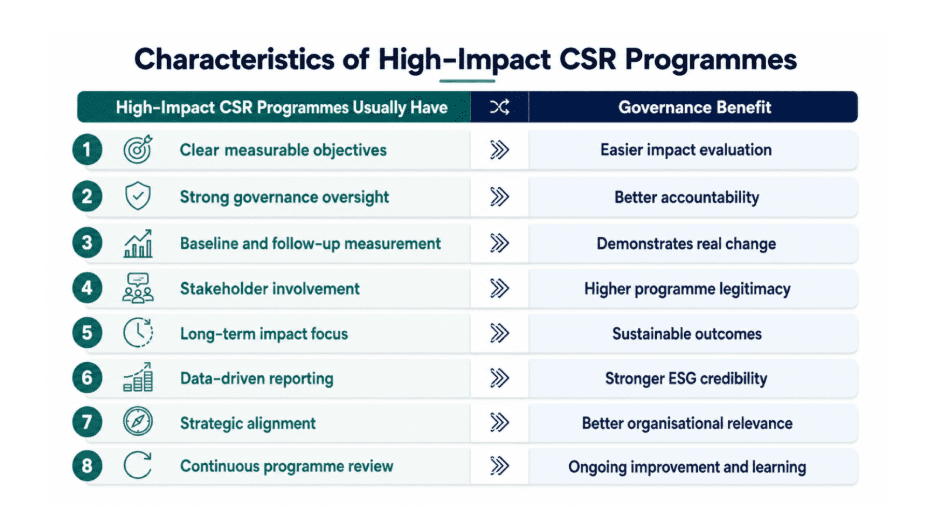
Characteristics of High-Impact CSR Programmes
Why Boards Must Become More Involved in CSR Oversight
CSR is increasingly becoming a governance issue rather than simply a corporate affairs function.
Boards are now expected to oversee:
- ESG and sustainability risks
- Social impact credibility
- Stakeholder accountability
- Reputational exposure
- Ethical business conduct
- Long-term societal impact
This means boards require stronger visibility over CSR effectiveness, measurement frameworks and programme governance.
Top organisations increasingly integrate CSR oversight into broader ESG governance structures rather than treating CSR as a standalone philanthropic activity.
This improves accountability and ensures social impact programmes support wider organisational purpose and long-term strategy.
The Future of CSR Will Be Measurable
The future of CSR is shifting away from symbolic responsibility towards measurable impact and governance accountability.
Stakeholders no longer simply ask whether organisations are doing good.
They ask:
- What changed?
- Who benefited?
- How do you know?
- What evidence exists?
- What long-term value was created?
The organisations best positioned for the future will not necessarily be the organisations spending the most on CSR.
They will be the organisations measuring impact most intelligently, governing CSR most seriously and aligning social investment most strategically.
Because ultimately, responsible business is not defined by intention alone.
It is defined by measurable outcomes, accountability and trust.
Lumorus: Better Business, Built on Purpose
At Lumorus, we believe Being Good is Better for Business.
We help organisations lead with integrity, govern with confidence and create value that lasts. Through our work across Governance Advisory, Company Secretary Service and ESG-Social Impact Consulting, we support boards, executives and leadership teams to strengthen accountability, improve decision making and build resilient, responsible organisations.
With offices and expert teams across the UK, Africa, the Caribbean, Latin America and Canada, and clients operating globally, Lumorus brings international perspective, specialist expertise and practical judgement to every engagement.
Whether you are strengthening ESG oversight, evaluating CSR effectiveness, improving social impact governance or building more credible sustainability strategies, Lumorus is here to help you move from intention to action.
Together, we can build better business: one that performs with purpose, leads with integrity and creates lasting value for people, planet and profit.
To continue the conversation, visit:
www.lumorus.com
[email protected]
Sources
- Healium — How to Evaluate the Success of CSR Programs: Metrics and Evaluation Methods 2025
- Purple Griffon — How to Measure Corporate Social Responsibility