


Funding is becoming harder to secure when organisations can explain what they did but cannot prove what changed
Many organisations can describe their social impact activity in impressive detail.
They know how much money was invested, how many people participated, how many training sessions took place and how many communities were reached. Annual reports contain photographs, beneficiary stories and statistics that demonstrate considerable activity.
Yet one question often remains unanswered:
What changed because of the intervention?
That distinction has become increasingly important as funders, impact investors, governments, foundations and corporate partners place greater emphasis on measurable outcomes, accountability and value for money.
The OECD’s Evaluation Systems in Development Co-operation 2023 describes evaluation as critical to understanding what worked, what did not, why and for whom. Importantly, the OECD also links credible evaluation with future decision making, resource allocation, accountability and evidence of value for money.
Meanwhile, the investment market is moving in the same direction. The Global Impact Investing Network’s 2025 research argues that investors increasingly need impact information that is transparent, comparable and useful for decision making. Its work reflects a market in which impact measurement is moving closer to the allocation of capital itself.
The implication is significant.
An organisation may be doing valuable work and still struggle to secure funding if it cannot demonstrate that value convincingly.
This does not mean every funding decision is driven by an impact scorecard. Funders consider mission alignment, leadership, financial resilience, strategic fit, relationships and many other factors. However, where organisations compete for scarce capital, weak impact evidence makes the funding case harder to defend.
Impact measurement is therefore no longer simply a reporting exercise. It is becoming part of the infrastructure through which organisations establish credibility, compete for capital and justify continued investment.
Read More: Social Impact Measurement and Management
Executive Takeaway
Weak impact measurement can weaken an organisation’s funding position because funders increasingly need evidence that capital is producing meaningful outcomes.
The most common weaknesses include:
- Measuring activities instead of outcomes
- Collecting large amounts of data without a clear Theory of Change
- Using indicators that do not reflect the real objective
- Counting beneficiaries without understanding what changed for them
- Reporting only positive findings
- Failing to establish a credible baseline
- Ignoring stakeholder perspectives
- Confusing correlation with causation
- Producing impact evidence only when a funding application is due
- Failing to use evaluation findings to improve programmes
The strongest impact measurement systems do something different.
They connect purpose, outcomes, indicators, evidence, learning, governance and resource allocation.
As a result, they answer the questions funders increasingly care about:
What problem are you addressing?
What changed?
How do you know?
What did your organisation contribute?
What have you learned?
Why should more capital follow?
The funding environment is moving towards evidence
Impact capital is growing, but so are expectations.
The GIIN’s 2025 State of the Market, based on 429 organisations across 54 countries, found continued growth in impact investing assets and reported that investors were directing capital towards areas such as financial inclusion, healthcare, housing and clean energy. The wider direction is clear: investors are increasingly allocating money with an explicit intention to produce measurable social or environmental benefit.
The scale of the market reinforces the point. The GIIN estimated global impact investing assets under management at US$1.571 trillion in 2024, with more than 3,900 organisations managing impact capital.
As more capital enters the market, expectations around evidence are becoming more sophisticated.
The GIIN’s research notes continuing challenges around fragmented metrics, inconsistent impact data and comparability. At the same time, investors are increasingly incorporating impact criteria into formal investment governance and subjecting impact-management processes to third-party verification.
This should matter to any organisation seeking:
- Grants
- Philanthropic capital
- Social investment
- Blended finance
- Impact investment
- Corporate partnerships
- Government contracts
- Development finance
- Sustainability-linked capital
The funding proposition is changing.
A compelling mission may open the conversation.
Credible evidence increasingly helps keep the conversation going.
Activity is not the same as impact
This is the most common measurement problem.
An organisation may report:
- £2 million invested
- 10,000 people trained
- 500 businesses supported
- 50 community projects delivered
- 20,000 volunteer hours completed
These figures can be useful.
However, they describe inputs and outputs.
They do not necessarily demonstrate impact.
A funder evaluating a skills programme, for example, may ultimately want to know whether participants found employment, increased their income, remained in work or developed capabilities that improved their long-term prospects.
The distinction looks like this:
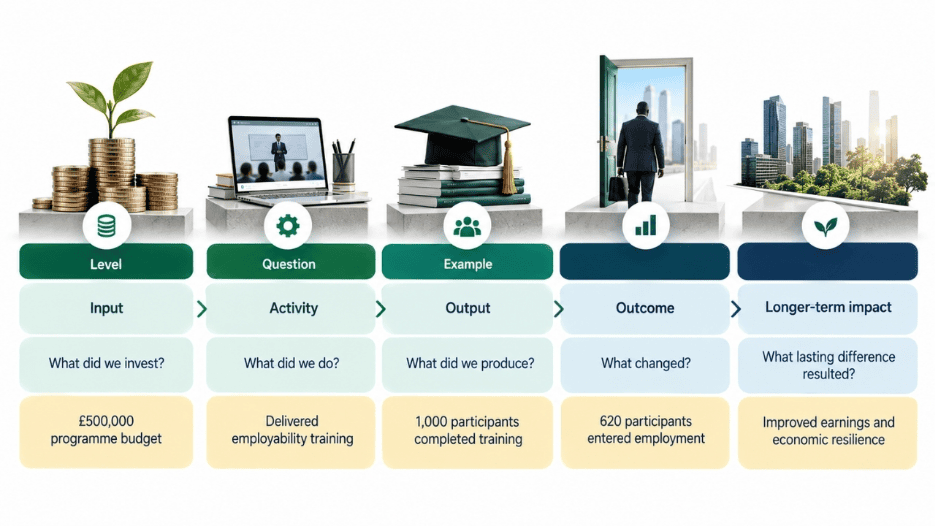
Weak measurement often stops in the middle of this chain.
That creates an uncomfortable funding problem.
If Organisation A says it trained 1,000 people while Organisation B can demonstrate that its programme increased sustained employment among a clearly defined beneficiary group, the second organisation presents a stronger evidence proposition.
The first may still be doing excellent work.
It simply has a harder time proving it.
This is why Lumorus Social Impact Measurement and Management focuses on impact frameworks, data collection, outcome evaluation and continuous improvement rather than activity reporting alone.
Weak measurement creates a funding confidence gap
Funders face their own governance pressures.
A foundation must explain why grants were allocated.
An impact investor needs to demonstrate that its portfolio is producing the intended impact.
Governments need evidence of value for money.
Corporate foundations need to justify expenditure to leadership, boards and stakeholders.
Therefore, organisations seeking funding are not simply asking funders to believe in their mission.
They are asking funders to accept responsibility for deploying capital towards it.
That changes the evidence requirement.
The OECD’s work on evaluation uses six widely recognised lenses for evaluating interventions: relevance, coherence, effectiveness, efficiency, impact and sustainability. These criteria reflect the kinds of questions that serious funders and evaluators increasingly ask.
They want to know:
- Is the intervention addressing the right problem?
- Does it fit with other relevant activity?
- Is it achieving its objectives?
- Is the use of resources efficient?
- What wider difference has it created?
- Are the results likely to last?
A weak impact report may answer only one of these questions.
A strong measurement framework gives funders a much clearer basis for judgement.
The real cost of weak measurement is not just a rejected grant
The consequences extend much further.
Poor impact evidence can affect:
Funding renewal
Existing funders may hesitate to continue programmes where results remain unclear.
Funding growth
An organisation may secure pilot funding but struggle to make the case for expansion.
Investor confidence
Impact investors need evidence that both financial and impact objectives are being managed seriously.
Partnerships
Corporates and foundations increasingly want credible evidence before associating their name with a programme.
Board confidence
Directors may question whether resources are being allocated to initiatives that genuinely work.
Strategic decisions
Management cannot confidently scale, redesign or stop programmes when the evidence base is weak.
Reputation
Overstated impact claims can damage stakeholder trust if scrutiny exposes weak evidence.
Consequently, weak measurement can create an unusual situation.
The organisation may be spending money on impact while simultaneously weakening its ability to attract the next round of money.
Impact measurement should influence capital allocation, not simply justify it afterwards
One of the most important shifts in impact practice is from measurement to measurement and management.
The difference matters.
Measurement asks:
What happened?
Management asks:
What should we do differently because of what happened?
The OECD’s Evaluation Systems in Development Co-operation stresses both accountability and learning. Evaluation should not merely prove results to external audiences. It should generate evidence that improves future policies, programmes and resource allocation.
Similarly, Impact Europe argues that impact measurement and management helps impact investors make better use of deployed capital, increase credibility and reduce unintended harm.
That means impact evidence should help organisations answer difficult internal questions:
- Which programmes should receive more funding?
- Which interventions need redesign?
- Which activities produce little measurable value?
- Which beneficiary groups are being underserved?
- Which outcomes justify expansion?
- Where should resources be reduced or stopped?
A measurement system that never changes a decision is probably not being used to manage impact.
The Theory of Change is where credible measurement should begin
Organisations sometimes start by asking which metrics they should collect.
That is usually too early.
Before selecting indicators, leadership needs to understand how the intervention is expected to create change.
A strong Theory of Change sets out the relationship between:
- The problem
- The intervention
- Activities
- Outputs
- Short-term outcomes
- Longer-term outcomes
- Assumptions
- External influences
The Bridgespan Group’s 2024 guide to measurement, evaluation and learning places Theory of Change at the centre of effective measurement and recommends linking organisational and field-level outcomes with communication to funders.
This is critical because bad metrics often originate from an unclear impact model.
If an organisation cannot explain how its activities should lead to the intended outcome, collecting more data will not solve the problem.
It will simply produce more numbers.
A Theory of Change forces leadership to make the causal logic explicit.
For funders, that improves confidence because they can see not only what the organisation intends to achieve, but why its intervention has a reasonable chance of achieving it.
Good measurement does not mean collecting everything
A common reaction to weak impact evidence is to collect more data.
That can make the problem worse.
Organisations may create extensive reporting systems containing dozens or hundreds of indicators, only to discover that teams cannot maintain the data or decision makers cannot interpret it.
The stronger approach is selective.
Metrics should relate directly to:
- Material outcomes
- Strategic objectives
- Funding requirements
- Stakeholder priorities
- Decision-making needs
The GIIN’s IRIS+ system reflects this logic by providing curated core metric sets and standardised indicators that help impact investors connect intentions with measurable outcomes.
However, no framework should be applied mechanically.
Context matters.
An education intervention, community health programme and sustainable agriculture investment will require different evidence.
The question is not:
How many metrics can we report?
It is:
Which evidence will tell us whether meaningful change occurred?
The strongest impact measurement systems combine standardisation with context
Comparability matters to funders.
If every organisation invents its own definitions and indicators, investors struggle to compare programmes or portfolios.
However, excessive standardisation creates another problem because social impact is highly contextual.
The GIIN’s 2025 report on impact performance measurement identifies this tension directly. Among the major challenges explored are what should be standardised, what should remain customised, how impact data should be structured and how longer-term outcomes can be measured within shorter investment horizons.
A mature framework therefore uses both.
Standard measures where comparability matters
These may include recognised indicators, sector benchmarks or commonly understood definitions.
Context-specific measures where meaning matters
These should reflect the particular people, geography, intervention and outcomes involved.
The result should allow funders to compare performance without stripping the programme of its context.
Beneficiary numbers can create false confidence
Large beneficiary numbers look persuasive.
They can also be misleading.
Suppose one organisation reports reaching 100,000 people while another reaches 10,000.
The first programme appears ten times more impactful.
However, that conclusion may be wrong.
Important questions remain:
- What does reached mean?
- Did beneficiaries receive a meaningful intervention?
- Did their circumstances change?
- Was the change temporary or sustained?
- Were some people counted more than once?
- Were the people most in need actually reached?
- Would the outcome have happened anyway?
Volume is not impact.
Funders increasingly need information about depth, duration and quality of change, not simply scale.
For this reason, organisations should define beneficiary metrics carefully and avoid presenting participation as though it automatically demonstrates outcome.
Attribution is difficult, but pretending it does not matter is worse
Social change rarely has one cause.
Employment may improve because of a training programme, economic growth, family support, government policy or several factors working together.
Health outcomes may depend on clinical interventions, income, housing, education and behaviour.
Therefore, organisations should be cautious about claiming that they caused every observed improvement.
The stronger concept is often contribution.
What evidence suggests that the organisation contributed materially to the outcome?
Impact Europe highlights the importance of assessing contribution at both the investee and investor level, including whether support strengthens organisational capacity, financial resilience and impact-management capability.
This type of honesty strengthens credibility.
Funders do not necessarily expect perfect causal proof for every intervention.
They do expect organisations to understand the difference between evidence and assertion.
Stakeholder evidence is part of impact evidence
An organisation should not define success entirely from inside the organisation.
The people affected by an intervention have information that management cannot obtain from operational dashboards alone.
Stakeholder engagement can reveal:
- Whether the intervention addresses the real problem
- Whether access barriers exist
- Which outcomes matter most
- Whether unintended harm has occurred
- Why some participants succeed while others do not
- Whether benefits are likely to last
This is why Lumorus Stakeholder Engagement connects stakeholder mapping, consultation, dialogue and feedback with decision making rather than treating engagement as a communications exercise.
Impact measurement becomes stronger when people affected by the programme help shape what success means.
It also becomes more credible.
A report produced entirely by the organisation about the organisation will rarely carry the same weight as evidence that includes beneficiary and stakeholder perspectives.
Weak data governance can undermine strong programmes
Impact measurement depends on data.
Therefore, impact governance should ask the same questions organisations increasingly ask about financial and ESG information:
- Who owns the data?
- How is it collected?
- Which definitions are used?
- Who checks quality?
- How are errors corrected?
- Can results be traced to supporting evidence?
- Are privacy requirements being respected?
- Has the methodology changed?
- Can the same metric be reproduced next year?
Poor data governance creates serious problems.
Different teams may use different definitions.
Beneficiary numbers may be duplicated.
Survey response rates may be too low to support broad conclusions.
Positive outcomes may be recorded while negative or neutral results disappear.
None of these issues necessarily indicates deliberate manipulation.
However, they weaken credibility.
Strong ESG Reporting and Disclosure therefore depends on reliable data collection, analysis and reporting processes rather than persuasive narrative alone.
Funders increasingly need evidence they can use, not reports they can admire
An impact report can look excellent without being useful.
Beautiful graphics, emotional case studies and ambitious language can strengthen communication, but they should not replace decision-useful evidence.
The GIIN’s current work on impact performance reflects growing demand for impact data that supports comparison and investment decision making.
For organisations seeking funding, useful reporting should make it easier to understand:
- What was expected
- What actually happened
- Which outcomes were achieved
- Which were missed
- What the intervention cost
- Who benefited
- What the organisation learned
- What will change next
That final point matters.
Funders should be able to see that evidence influences management.
Otherwise, impact reporting becomes a retrospective communications product rather than part of organisational learning.
Honest reporting can strengthen rather than weaken the funding case
Many organisations fear that admitting weak results will make them less attractive to funders.
That can encourage selective reporting.
Only successful outcomes appear.
Failures disappear.
Targets are revised quietly.
Case studies replace data.
This may improve the report temporarily, but it weakens governance.
A credible organisation should be able to explain:
- What worked
- What did not
- Why
- What was learned
- What will change
The OECD’s evaluation framework explicitly treats learning as one of the core purposes of evaluation, alongside accountability. Evaluation provides evidence about both successful and unsuccessful approaches so that future decisions can improve.
Sophisticated funders understand that not every programme works perfectly.
What matters is whether management recognises weak performance and responds intelligently.
Failure hidden is a governance problem.
Failure examined can become organisational learning.
Strong impact measurement improves the funding story
The relationship between impact measurement and funding is not merely defensive.
Good evidence can actively strengthen the organisation’s capital proposition.
It can help leadership demonstrate:
Credibility
Claims are supported by evidence rather than aspiration.
Effectiveness
Funders can see whether programmes are achieving intended outcomes.
Scalability
Management can identify which interventions are worth expanding.
Value for money
Resources can be connected more clearly with results.
Learning capability
The organisation can show how evidence improves decisions.
Governance maturity
Boards and executives can demonstrate oversight over impact commitments.
Transparency
Funders can see both progress and areas requiring improvement.
These qualities reduce uncertainty.
Funding ultimately involves a judgement about future performance.
The more credible the evidence from previous performance, the stronger the basis for that judgement.
A stronger funding case connects money with outcomes
A useful impact funding framework can be summarised as follows:
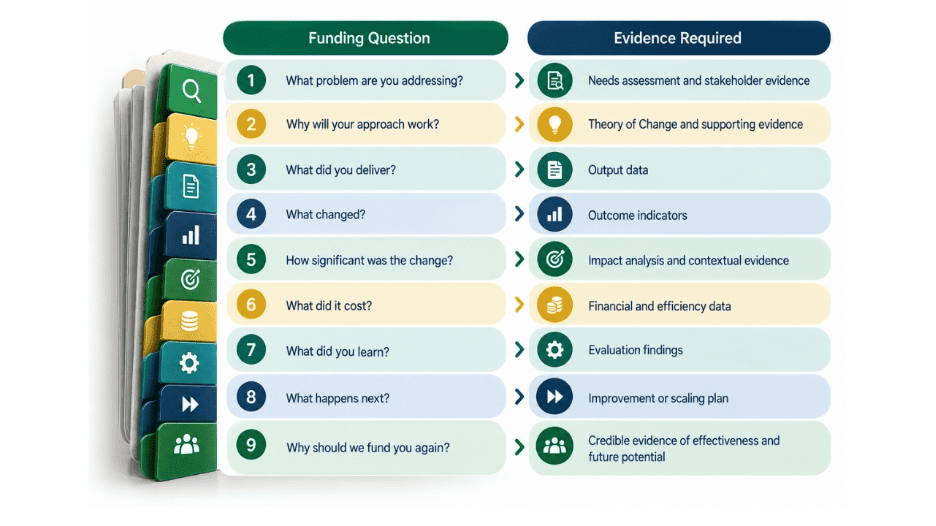
The funding application should therefore be the final expression of an evidence system that already exists.
It should not be the moment when the organisation first tries to work out what impact occurred.
Boards should govern impact measurement, not leave it entirely to programme teams
Impact measurement is often treated as a technical matter.
There are methodologies, surveys, indicators and datasets involved, so that assumption is understandable.
However, impact measurement also raises governance questions.
Boards overseeing significant social or sustainability programmes should understand:
- What outcomes the organisation is trying to create
- Which measures define success
- Whether evidence is credible
- Whether programmes are delivering value
- Where resources should be increased or reduced
- Which claims appear externally
- What management is learning from evaluation
This matters because funding decisions, reputational claims and strategic commitments may all depend on the evidence.
The board does not need to select every indicator.
It does need confidence that the system can distinguish activity from achievement.
Impact measurement should begin before the programme starts
One of the most damaging mistakes is waiting until the programme is nearly complete before thinking about measurement.
By then, critical information may no longer be available.
There may be:
- No baseline
- No comparison point
- No consistent beneficiary definition
- No consent for relevant data
- No agreed outcome indicators
- No method for tracking change over time
The organisation is then forced to reconstruct impact retrospectively.
A stronger process begins at design.
Before implementation, leadership should establish:
- The problem being addressed
- The Theory of Change
- Expected outcomes
- Relevant indicators
- Baseline information
- Data collection methods
- Responsibility for measurement
- Reporting frequency
- Evaluation points
- How findings will influence decisions
This makes measurement part of programme governance rather than an afterthought.
A practical impact measurement maturity model
Organisations can assess where their current approach sits.
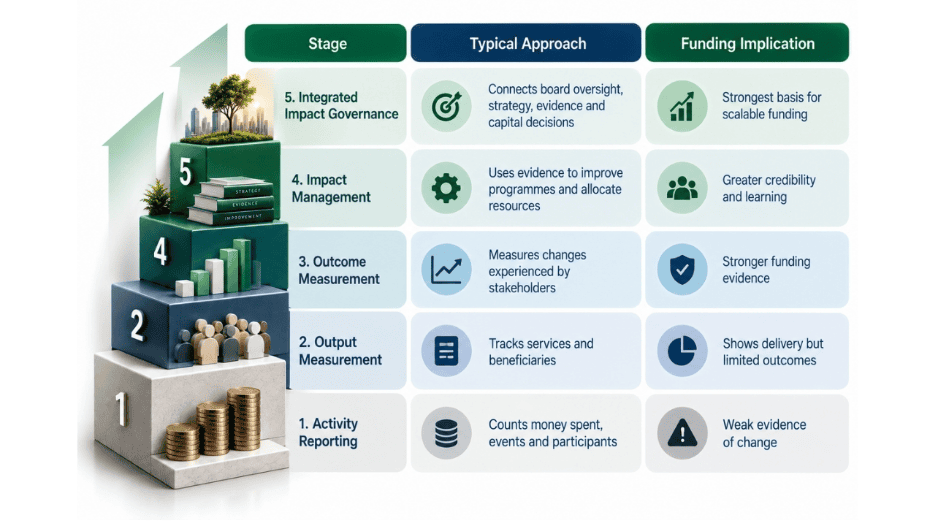
Many organisations believe they have mature impact measurement because they produce detailed reports.
However, reporting volume is not maturity.
The real test is whether measurement influences decisions.
Ten warning signs your impact measurement is weakening your funding case
1. Your largest numbers are all activity numbers
High participation does not prove positive outcomes.
2. You cannot explain your Theory of Change clearly
If the causal logic is unclear, the metrics will usually be unclear too.
3. There is no reliable baseline
Without a starting point, demonstrating change becomes much harder.
4. Different teams define impact differently
Inconsistent definitions weaken comparability and trust.
5. Beneficiary voices appear only in case studies
Stakeholder evidence should inform measurement, not merely communications.
6. Impact data is gathered just before reporting deadlines
That usually indicates measurement is not embedded in management.
7. Every programme appears successful
Real evaluation normally reveals variation.
8. Nothing is ever stopped because of impact evidence
If weak evidence never changes resource allocation, measurement may not be influencing management.
9. The board sees stories but little outcome evidence
Governance oversight remains incomplete.
10. Funding applications contain claims the organisation could not easily substantiate
This creates credibility and reputational risk.
Several of these signs together should trigger a deeper review of the impact measurement system.
What a funding-ready impact measurement framework should contain
A credible system does not need to be unnecessarily complicated.
However, it should contain enough structure to produce decision-useful evidence.
Clear objectives
Define precisely what change the programme is intended to create.
A credible Theory of Change
Explain why the intervention should produce those outcomes.
Material indicators
Measure the outcomes that matter rather than everything that can be counted.
Baseline data
Establish the starting position wherever feasible.
Stakeholder evidence
Include the perspectives of the people affected.
Quantitative and qualitative evidence
Numbers explain scale, while qualitative evidence can help explain why and how change occurred.
Regular review
Do not wait until the end of the programme.
Independent evaluation where appropriate
Greater independence may be justified for material programmes or significant claims.
Transparent limitations
Explain uncertainty rather than hiding it.
Management response
Turn findings into decisions, actions and resource allocation.
That final step converts measurement into management.
The strongest organisations ask a harder question: what should we stop funding?
Impact measurement conversations often focus on demonstrating success.
That misses half the value.
If a programme consistently produces weak outcomes, leadership needs to decide whether it should:
- Be redesigned
- Target a different group
- Use another delivery model
- Receive less funding
- Be discontinued
This is where governance becomes uncomfortable.
Programmes develop internal champions.
Communities may expect continuity.
Leaders may have publicly supported the initiative.
Stopping activity can therefore feel like failure.
However, continuing to invest scarce capital in an intervention that does not work is not responsible impact management.
The OECD’s evaluation work makes the link between evidence, organisational learning and future resource allocation explicit.
Strong impact governance is therefore not simply about proving that programmes deserve funding.
It is also about identifying where funding should move elsewhere.
Impact measurement is increasingly becoming investment infrastructure
For impact investors, the connection between evidence and capital allocation is becoming even more direct.
The GIIN’s Fund-Level Impact Decision-Making Tools were designed specifically to help asset allocators compare potential impact across sectors, geographies and timeframes. The objective is to make impact information more useful when deciding where capital should go.
Likewise, the Impact Performance Reporting Norms emerged from consultation involving more than 350 asset managers, asset owners, allocators, advisers and assurance providers, reflecting growing demand for clearer and more consistent reporting of impact performance to capital providers.
For organisations seeking investment, the message is important.
Impact measurement is gradually becoming part of investment infrastructure.
Weak measurement may therefore affect more than the quality of an annual report.
It can affect the organisation’s ability to compete for capital.
Why Lumorus treats impact measurement as a management discipline
At Lumorus, social impact measurement is not treated as an exercise in producing attractive impact claims.
The purpose is to help organisations understand whether programmes are creating meaningful change, use that evidence to improve performance and communicate results credibly to funders and stakeholders.
Our Social Impact Measurement and Management work can support organisations with:
- Impact assessment framework development
- Theory of Change
- Social impact mapping
- Indicator development
- Data collection and analysis
- Impact evaluation
- Stakeholder engagement
- Reporting and communication
- Strategic improvement
- Continuous learning
The distinction between measurement and management is important.
Measurement tells leadership what happened.
Management determines what happens next.
That is where impact evidence creates organisational value.
How impact measurement connects with wider ESG governance
Social impact does not operate independently of sustainability strategy.
For many organisations, strong measurement needs to connect with:
ESG Strategy Development
Impact priorities should align with the organisation’s broader strategy rather than sit alongside it.
Stakeholder Engagement
Stakeholders can help define material outcomes and identify unintended effects.
ESG Reporting and Disclosure
Impact claims should be supported by reliable evidence and clear reporting methods.
Social Impact Measurement and Management
Outcome evidence should feed back into strategy, funding and continuous improvement.
When these capabilities operate together, social impact becomes easier to govern, easier to explain and harder to exaggerate.
The Lumorus View
Weak impact measurement costs organisations more than funding. It costs them the ability to know whether their own strategy is working.
Funding is simply where the weakness often becomes visible.
A funder asks for evidence.
The organisation provides activity statistics.
An investor asks about outcomes.
Management presents case studies.
The board asks whether a programme should scale.
Nobody can answer with sufficient confidence.
At that point, the problem is not communications.
It is governance.
Organisations that take impact seriously should be able to distinguish between:
- What they intended
- What they delivered
- What changed
- What they contributed
- What they learned
- What they will do differently
That is what credible impact measurement provides.
It does not eliminate uncertainty.
It makes uncertainty governable.
Seven questions leadership should ask before the next funding round
Before approaching funders, investors or strategic partners, boards and executives should ask:
- Can we explain the social problem using credible evidence?
- Do we have a clear Theory of Change?
- Are we measuring outcomes rather than only activity?
- Can we demonstrate how stakeholders experienced the intervention?
- Do we understand what worked, what did not and why?
- Has impact evidence changed any management or funding decisions?
- Could we substantiate every major impact claim if a funder challenged it?
If several answers are no, more storytelling will not solve the problem.
The measurement system needs strengthening.
The Bottom Line
Funding decisions are becoming more evidence conscious.
The OECD has long connected evaluation with accountability, organisational learning and resource allocation, while current GIIN research shows that impact investors increasingly need transparent, comparable and decision-useful evidence.
Organisations that cannot produce that evidence face a growing disadvantage.
They may still secure funding because mission, leadership, relationships and strategic fit remain important. However, when capital becomes competitive, the organisation that can demonstrate credible outcomes presents funders with a stronger basis for confidence.
Strong impact measurement therefore needs to do more than decorate the annual report.
It should help leadership decide what works, where resources should go, what needs improvement and which claims can genuinely be defended.
The most important shift is simple:
Stop measuring how busy the organisation has been and start measuring what changed because the organisation was there.
Because once funding becomes scarce, activity is rarely enough.
Evidence matters.
Continue Exploring
- Measure and manage meaningful social outcomes: Social Impact Measurement and Management
- Build sustainability into business strategy: ESG Strategy Development
- Understand what stakeholders actually value: Stakeholder Engagement
- Strengthen the evidence behind ESG claims: ESG Reporting and Disclosure
- Explore Lumorus Sustainability & Responsibility: Sustainability & Responsibility
Lumorus: Better Business, Built on Purpose
Lumorus is a UK headquartered global governance, ESG, Company Secretary and advisory firm supporting organisations across Europe, Africa, Asia, the Caribbean, Canada, the Middle East and international markets.
We help organisations strengthen the governance systems behind responsible business, sustainability and social impact so that ambition can be translated into measurable outcomes and credible evidence.
Our Sustainability & Responsibility capabilities include:
- ESG Integration in Investment Decisions
- ESG Materiality & Risk Assessment
- ESG Strategy Development
- ESG Reporting and Disclosure
- Stakeholder Engagement
- Social Impact Measurement and Management
For organisations competing for grants, investment, corporate partnerships or other forms of purpose-driven capital, credible impact measurement can strengthen both accountability and the funding proposition.
The objective should not be to produce larger impact numbers.
It should be to produce better evidence about what changed, why it changed and what the organisation should do next.
Could your organisation prove the impact behind its funding case if an investor or funder challenged every major claim tomorrow?
Explore Lumorus Social Impact Measurement and Management or contact Lumorus to discuss how stronger impact measurement can improve decision making, accountability and funding readiness.
Email: [email protected]
Lumorus: Better Business, Built on Purpose.
Sources
- OECD: Evaluation Systems in Development Co-operation 2023 – Analysis of how evaluation strengthens impact, accountability, learning and future resource allocation.
- OECD: The Role of Evaluation – Guidance on evaluation as a mechanism for accountability, learning and evidence-based decision making.
- OECD: Evaluation Criteria – The OECD DAC criteria of relevance, coherence, effectiveness, efficiency, impact and sustainability.
- GIIN: Data, Direction and Decisions – 2025 research on transparent, comparable and decision-useful impact performance information.
- GIIN: State of the Market 2025 – Research based on 429 organisations across 54 countries examining the growth and allocation of impact investment capital.
- GIIN: Sizing the Impact Investing Market 2024 – Estimate of US$1.571 trillion in global impact investing assets under management.
- GIIN: IRIS+ – Tools, core metric sets and guidance designed to translate impact intentions into measurable results.
- Bridgespan: Measurement, Evaluation and Learning – Guidance on Theory of Change, outcome measurement and communicating impact to funders.
- Impact Europe: How Impact Funds Are Scaling – Analysis of impact measurement, standardisation, credibility and the use of impact information by investors.
- Impact Frontiers: Impact Performance Reporting Norms – Reporting norms developed through consultation with asset managers, asset owners, allocators and other impact-market participants.