


Middle East expansion is increasingly a governance decision, not simply a market-entry decision
The Middle East has become one of the most strategically important expansion markets for international businesses.
Saudi Arabia is reshaping its economy through large-scale diversification and investment. The UAE continues to strengthen its position as an international business, financial and investment hub, while Qatar, Bahrain, Oman and other Gulf markets are developing their own economic transformation agendas.
International companies are responding.
Saudi Arabia’s Regional Headquarters programme alone had attracted more than 750 international companies by August 2026, according to the country’s Ministry of Investment, exceeding its original target of 500 companies by 2030. (misa.gov.sa)
However, entering the Middle East is not simply a question of establishing an entity, appointing local leadership and pursuing commercial opportunities.
The governance environment matters.
Companies need to understand ownership structures, board responsibilities, local partners, sustainability expectations, regulatory relationships, data governance, workforce practices, conflicts of interest and the growing importance of ESG disclosure.
The OECD’s work on corporate governance in the MENA region has highlighted several characteristics that remain important to understanding the regional governance environment, including concentrated ownership, significant family and state ownership, transparency challenges, related-party transactions and the substantial economic role of state-owned enterprises. (oecd.org)
At the same time, sustainability expectations are developing. The Saudi Exchange provides ESG disclosure guidance for listed companies and has explicitly positioned ESG as part of the development of Saudi capital markets. Globally, the IFRS Foundation is also tracking rapid jurisdictional movement towards ISSB-based sustainability reporting. (saudiexchange.sa)
The implication for boards is clear.
A Middle East expansion strategy that considers commercial opportunity without considering governance architecture is incomplete.
ESG and governance should therefore be built into market entry from the beginning, not added once operations are established.
Read More: ESG Strategy Development
Executive Takeaway
Firms expanding into Middle Eastern markets should avoid treating the region as a single regulatory or governance environment.
Saudi Arabia, the UAE, Qatar, Bahrain, Oman, Kuwait and other markets have different legal systems, ownership rules, capital-market structures, ESG expectations and business cultures.
Nevertheless, several governance priorities consistently deserve attention:
- Market-entry governance
- Board and subsidiary oversight
- Local ownership and partnership structures
- Conflicts of interest
- Related-party transactions
- Beneficial ownership
- Anti-bribery and corruption controls
- Sustainability and climate reporting
- Workforce and human rights
- Data protection and cyber governance
- Localisation and national workforce policies
- State-owned and sovereign-linked counterparties
- Supply-chain governance
- ESG data quality
- Stakeholder engagement
- Governance reporting
These are not peripheral compliance matters.
They can affect access to contracts, capital, talent, regulators, customers and strategic partners.
For boards, the fundamental question is therefore not simply:
Can we enter this market?
It is:
Do we have the governance capability to operate there responsibly and successfully?
The first mistake is treating the Middle East as one market
There is no single Middle Eastern ESG or corporate governance regime.
That sounds obvious, yet market-entry strategies often become regional too quickly.
A company establishes a Gulf headquarters and then assumes that the governance model can simply be replicated across neighbouring jurisdictions.
In reality, legal structures, foreign investment requirements, capital-market regulation, labour policies, free-zone regimes, tax systems and governance codes vary considerably.
The operating environment in Saudi Arabia is not identical to the UAE. Likewise, the UAE itself contains important distinctions between federal arrangements, individual emirates and financial free zones.
Consequently, firms should develop a regional governance framework with jurisdiction-specific controls.
This approach creates consistency without assuming uniformity.
The group establishes minimum standards, while local governance adapts them to the legal and commercial reality of each market.
Explore More: Corporate Governance Support
1. Governance should be designed before the entity is incorporated
Market-entry teams naturally focus on commercial questions.
Where should the company establish?
Which licence is required?
Should the business operate through a subsidiary, branch, free-zone entity or another structure?
Those questions matter. However, governance design should happen at the same time.
Before incorporation, leadership should determine:
- What authority the local entity will have
- Which decisions remain with headquarters
- Who will sit on the local board
- How directors will be selected
- What management can approve independently
- Which matters require group consent
- How conflicts will be handled
- What information headquarters will receive
- Who owns regulatory relationships
- How compliance will be monitored
Without these decisions, legal entities can acquire operational authority faster than the governance system can control it.
That becomes particularly dangerous during rapid expansion.
A company may establish several entities across the Gulf within a short period, each with local managers, bank accounts, contracts and regulatory obligations.
Unless decision rights are clear, the group can quickly lose visibility over who has authority to do what.
Good market-entry governance therefore begins before market entry.
Explore More: Company Formation & Structuring
2. Saudi Arabia’s transformation creates opportunity and governance complexity
Saudi Arabia deserves particular attention because the scale of economic transformation is creating significant opportunities for international companies.
The Ministry of Investment’s Regional Headquarters programme encourages multinational companies to establish regional headquarters in the Kingdom. By August 2026, MISA reported that more than 750 companies had joined the programme. (misa.gov.sa)
For multinational boards, this can change the governance significance of Saudi operations.
An entity that was previously a sales office or subsidiary may become a regional decision-making centre.
That raises questions around:
- Regional management authority
- Board composition
- Delegated decision rights
- Group oversight
- Risk management
- Compliance resources
- Data governance
- Workforce strategy
- Regional reporting
- Internal controls
A regional headquarters should not simply have a larger office and more senior executives.
Its governance model must reflect the authority it exercises.
If regional decisions are moving into Riyadh, the corresponding controls, information flows and accountability mechanisms need to move with them.
3. ESG expectations in Saudi capital markets are becoming more visible
Companies should also understand the direction of sustainability expectations in Saudi Arabia.
The Saudi Exchange ESG Disclosure Guidelines were developed to help listed companies navigate ESG disclosure and encourage greater transparency within the Saudi capital market.
Saudi Exchange has been a partner exchange of the UN Sustainable Stock Exchanges Initiative since 2018 and states that it continues to work with listed companies, investors, standards setters, ratings providers and other market participants to advance ESG disclosure. (saudiexchange.sa)
For companies considering future listing, capital raising or substantial institutional investment in the Kingdom, this direction matters.
ESG capability increasingly needs to support:
- Investor relations
- Risk management
- Sustainability reporting
- Corporate governance
- Strategy
- Capital allocation
The stronger approach is therefore to build ESG information systems before disclosure becomes urgent.
Waiting until an investor, regulator or exchange requires the information creates unnecessary reporting risk.
Read More: ESG Reporting and Disclosure
4. Sustainability reporting is becoming more globally connected
Middle East expansion should also be considered within the wider movement towards internationally comparable sustainability information.
The IFRS Foundation’s jurisdictional work shows that jurisdictions around the world continue to adopt, use or consider sustainability disclosure requirements based on the ISSB Standards.
The Foundation updates its jurisdictional information as national regulatory approaches become finalised. As of September 2026, the global picture remains one of significant but uneven movement towards greater comparability. (ifrs.org)
For multinational companies, this creates an important governance challenge.
The organisation may need to satisfy:
- Home-country requirements
- Local Middle Eastern requirements
- Stock-exchange expectations
- Investor information requests
- Lender requirements
- Group sustainability standards
These obligations should not produce five different ESG datasets.
The better approach is a group-wide sustainability information architecture capable of supporting multiple reporting requirements.
That requires consistent:
- Definitions
- Data ownership
- Methodologies
- Controls
- Evidence
- Approval processes
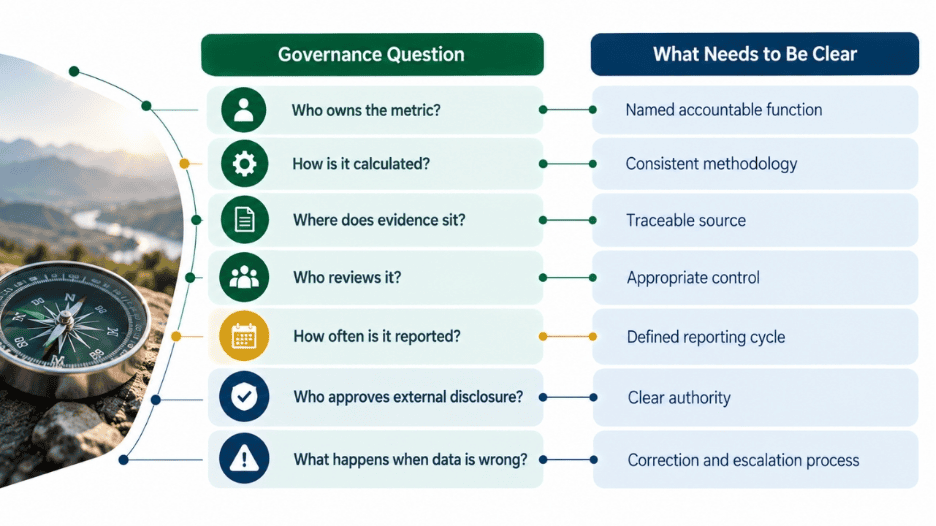
ESG reporting becomes much easier when the organisation first builds ESG information governance.
5. Concentrated ownership changes the governance landscape
One of the most important structural characteristics of corporate governance across parts of the Middle East is concentrated ownership.
The OECD’s analysis of corporate governance in MENA identified significant family and state ownership among listed companies in the region. It also highlighted challenges involving transparency, beneficial ownership and related-party transactions. (oecd.org)
For international firms, this matters when selecting:
- Joint-venture partners
- Distributors
- Suppliers
- Acquisition targets
- Strategic investors
- Local representatives
A business may be dealing with a company, but the governance risk may ultimately depend on the individuals, family interests or state institutions behind it.
Due diligence should therefore go beyond legal ownership.
Companies need to understand:
- Ultimate beneficial ownership
- Control rights
- Family relationships
- Political exposure
- Related companies
- Board relationships
- Government connections
- Commercial dependencies
This is particularly important where the local partner will hold board seats, approve payments, introduce government relationships or participate in procurement.
Knowing who owns the company is not enough. The board needs to understand who can influence it.
6. Related-party transactions deserve heightened attention
Concentrated ownership can also increase the importance of related-party governance.
The OECD has identified related-party transactions and beneficial ownership as continuing transparency challenges within parts of the MENA corporate landscape. (oecd.org)
This creates practical implications for multinational firms.
A supplier proposed by a local executive may be connected to another shareholder.
A property lease may involve an affiliated business.
A distributor may share ownership with a local partner.
None of these arrangements is automatically improper.
The governance question is whether the relationship has been identified, disclosed and managed appropriately.
Companies should therefore establish:
- Conflict declarations
- Related-party registers
- Independent approval processes
- Procurement controls
- Board escalation thresholds
- Recusal requirements
- Appropriate disclosure
The purpose is not to assume misconduct.
It is to prevent undisclosed relationships from influencing corporate decisions.
7. State ownership requires a different stakeholder map
The role of the state in Middle Eastern economies is another important governance consideration.
Governments, sovereign wealth funds and state-owned enterprises can be major investors, customers, partners and market participants.
The OECD Guidelines on Corporate Governance of State-Owned Enterprises 2024 emphasise professional ownership, transparency, board autonomy, responsible business conduct and a level playing field between state-owned and private enterprises. (oecd.org)
For companies expanding into the Middle East, the practical lesson is important.
The organisation may encounter government influence through several different channels:
- Regulators
- State-owned customers
- Sovereign investors
- Government procurement
- State-backed developers
- Public-private partnerships
- Economic development agencies
These relationships need careful governance because the same institution may carry commercial, strategic and public-policy significance.
A normal customer-management model may therefore be insufficient.
The board should understand the stakeholder architecture surrounding material state-linked relationships.
8. Anti-bribery controls must be designed for the actual business model
International expansion frequently increases corruption risk because companies become dependent on unfamiliar intermediaries and local relationships.
The risk is rarely solved by another policy document.
Effective controls need to reflect how business is actually won and delivered.
Particular attention should be paid to:
- Agents
- Consultants
- Distributors
- Customs intermediaries
- Government-facing advisers
- Joint-venture partners
- Sponsorship arrangements
- Gifts and hospitality
- Procurement
- Facilitation risks
The critical governance question is:
Who represents the company when the company is not in the room?
A third party acting on behalf of the organisation can create legal and reputational exposure even where senior leadership did not authorise improper behaviour.
Consequently, firms need risk-based due diligence, clear approval requirements, contractual protections and continuing monitoring.
Due diligence performed once at onboarding is not enough where the relationship is high risk.
9. Workforce localisation is an ESG and strategy issue
Workforce strategy deserves more attention within Middle East ESG discussions.
Governments across the Gulf have placed increasing emphasis on national employment, skills development and economic participation.
For multinational companies, localisation should therefore be treated as more than an HR compliance requirement.
It affects:
- Talent strategy
- Leadership succession
- Skills transfer
- Community legitimacy
- Government relationships
- Operating resilience
A company that enters a market while relying indefinitely on imported senior expertise may satisfy immediate operational needs but fail to build long-term institutional capability.
The stronger approach develops local talent deliberately.
Boards should therefore ask:
- Which roles can be localised?
- What capabilities need to be developed?
- How will knowledge transfer occur?
- Are local employees progressing into leadership?
- Is succession planning aligned with localisation goals?
This converts a regulatory requirement into organisational capability.
10. Human rights governance needs to extend into the supply chain
Middle East expansion can also create workforce risks within contractors and supply chains.
These risks vary significantly by country, industry and workforce model. Therefore, companies should avoid broad assumptions about the region and instead conduct risk-based due diligence.
Particular attention may be required where operations rely heavily on:
- Migrant labour
- Labour agencies
- Construction contractors
- Facilities providers
- Security providers
- Low-wage outsourced workers
The governance challenge is straightforward.
A multinational may have excellent employment standards for its own staff while significant workforce risks sit one contractual layer away.
Boards should therefore understand:
- Recruitment practices
- Contractor standards
- Worker grievance mechanisms
- Accommodation where relevant
- Health and safety
- Working conditions
- Supply-chain monitoring
- Escalation of serious incidents
A code of conduct is useful.
However, contracts, monitoring, worker feedback and remediation determine whether the standard actually operates.
11. Stakeholder engagement requires cultural intelligence
Stakeholder engagement in the Middle East should not be reduced to government relations.
Businesses may need to understand a wide range of stakeholders, including:
- Regulators
- Ministries
- Sovereign investors
- Customers
- Local partners
- Employees
- Communities
- Chambers of commerce
- Industry bodies
- Investors
- Suppliers
The importance of relationships in business does not weaken governance.
It makes governance around relationships more important.
Companies need to understand who owns each relationship, what commitments have been made and how material stakeholder concerns reach decision makers.
This becomes especially important when local executives possess strong personal networks.
Those networks can be commercially valuable.
However, corporate relationships should remain institutional rather than belonging entirely to individuals.
Explore More: Stakeholder Engagement
12. ESG materiality should reflect regional reality
Global ESG frameworks can provide useful structure, but they should not replace local materiality analysis.
A European materiality assessment should not simply be copied into a Middle Eastern subsidiary.
Environmental and social priorities can differ substantially by sector and geography.
Depending on the business, material issues may include:
- Water scarcity
- Extreme heat
- Energy use
- Climate adaptation
- Workforce localisation
- Migrant-worker welfare
- Data protection
- Supply-chain resilience
- Biodiversity
- Waste
- Community impacts
- Gender participation
- Cyber risk
The correct question is not:
Which ESG topics are popular internationally?
It is:
Which sustainability issues can materially affect this business and the stakeholders around it?
That requires evidence.
A robust ESG Materiality & Risk Assessment should therefore combine global expectations with local regulation, stakeholder perspectives and operational exposure.
13. Water deserves greater board attention
Water is a particularly important environmental consideration in many Middle Eastern markets.
The region contains some of the world’s most water-stressed environments, while economic growth, urbanisation and climate pressures can intensify demand.
For businesses in water-intensive sectors, the issue can affect:
- Operating costs
- Business continuity
- Supply chains
- Community expectations
- Capital investment
- Reputation
A company may have relatively modest global water consumption while operating a facility in a location where each unit of water has much greater environmental significance.
Boards should therefore avoid assessing environmental performance only through consolidated group totals.
Location matters.
Water governance should consider:
- Local scarcity
- Source
- Consumption
- Efficiency
- Recycling
- Discharge
- Supplier exposure
- Future availability
The same principle applies to other environmental issues.
Materiality depends on context, not merely volume.
14. Climate risk in the Middle East is both physical and transitional
Climate governance should also reflect the distinctive economic and physical characteristics of the region.
Physical risks may include:
- Extreme heat
- Water stress
- Flooding
- Infrastructure disruption
- Worker exposure
- Cooling requirements
Transition risks can include:
- Changing energy policy
- Carbon-related requirements
- Investor expectations
- Customer decarbonisation
- Technology shifts
- Supply-chain changes
For companies operating in energy-intensive industries, these factors can materially affect project economics.
Therefore, climate analysis should feed into:
- Site selection
- Capital expenditure
- Insurance
- Business continuity
- Supply chains
- Workforce planning
- Long-term strategy
Climate should not sit solely within the sustainability report.
If the issue can alter the economics of an investment, it belongs in the investment decision.
Read More: ESG Integration in Investment Decisions
15. ESG data needs governance before it needs design
Many companies discover their ESG data weaknesses only when preparing a report.
By then, the problem is expensive to correct.
A regional business may collect energy data differently from headquarters. Workforce categories may not align, while supplier information may be incomplete and environmental data may sit with facilities teams rather than sustainability teams.
The result is a reporting exercise dominated by reconciliation.
Companies expanding into the Middle East should establish ESG data governance early.
This becomes increasingly important as sustainability reporting moves closer to mainstream corporate reporting.
Explore More: ESG Reporting and Disclosure
16. Data protection and cyber governance belong on the market-entry agenda
Digital expansion creates another governance challenge.
New Middle Eastern operations may collect customer, employee and commercial information while connecting local systems with global technology infrastructure.
That raises questions around:
- Data ownership
- Access rights
- Cyber security
- Third-party systems
- Cross-border transfers
- Incident response
- Local regulatory requirements
- Board oversight
The mistake is to treat data compliance as an IT implementation issue after incorporation.
Data flows should be mapped before systems become embedded.
Boards should understand what sensitive information the new business will hold, where it will be stored, who can access it and what happens if systems fail.
Cyber governance is now corporate governance.
The geographic expansion of the organisation should therefore be accompanied by an equivalent expansion in information oversight.
17. Local boards need real purpose
Multinational companies sometimes establish subsidiary boards primarily because the legal structure requires them.
That can create ceremonial governance.
Meetings take place.
Minutes are produced.
Resolutions are approved.
Yet meaningful decisions happen elsewhere.
This model creates two problems.
First, directors may hold legal responsibilities without receiving enough information or authority to fulfil them effectively.
Second, headquarters may believe it has governance oversight simply because a board exists.
A stronger subsidiary governance framework should define:
- The purpose of the local board
- Reserved matters
- Reporting lines
- Director responsibilities
- Information requirements
- Meeting frequency
- Escalation thresholds
- Relationship with the parent board
Not every subsidiary requires the governance structure of a listed company.
However, every board should have a clear reason for existing.
Read More: Board & Shareholder Meetings
18. Board composition should follow risk, not convenience
Who sits on the local or regional board matters.
Appointments are sometimes driven by availability, hierarchy or legal necessity.
A better approach starts with the risks and responsibilities of the entity.
For a significant Middle Eastern regional operation, the board may need access to expertise in:
- Regional regulation
- Finance
- Commercial strategy
- Risk
- Sustainability
- Technology
- Local markets
- Workforce matters
Independence of judgement also matters.
The OECD’s analysis of MENA corporate governance has long identified board effectiveness, disclosure and ownership structures as important elements in strengthening regional corporate governance.
International firms should apply the same discipline to subsidiary boards that they expect from their wider governance system.
A local board should not merely represent management hierarchy.
It should strengthen oversight.
19. Family-owned counterparties require sophisticated governance, not suspicion
Family businesses are an important part of the Middle Eastern corporate landscape.
Many are sophisticated, professionally managed and commercially significant.
The governance issue is therefore not whether a business is family owned.
It is whether the international company understands how authority operates within it.
Important questions include:
- Who controls strategic decisions?
- Which family members hold executive roles?
- How is succession handled?
- Does the board exercise genuine authority?
- Are related companies involved?
- Who can bind the organisation?
- How are conflicts managed?
Formal titles may not always reveal the complete decision-making structure.
Consequently, counterparty due diligence should examine both legal governance and practical influence.
This is not unique to the Middle East.
However, it becomes particularly important in markets where ownership can be concentrated and business relationships are long term.
20. The Company Secretary function becomes more important as regional complexity grows
Rapid expansion creates governance administration at scale.
New entities generate:
- Statutory obligations
- Director appointments
- Board meetings
- Registers
- Licences
- Powers of attorney
- Regulatory filings
- Shareholder decisions
- Governance calendars
If each jurisdiction develops its own systems, the regional governance model can fragment quickly.
The Company Secretary function should therefore create central visibility while preserving local compliance.
That requires:
- Entity management
- Governance forward planning
- Compliance calendars
- Board administration
- Statutory records
- Action tracking
- Local professional support
For groups expanding across several Middle Eastern jurisdictions, Company Secretary Outsourcing can provide additional capacity while maintaining a more consistent governance model.
Technology can improve visibility, but professional expertise remains necessary where local rules, board judgement and regulatory interpretation are involved.
21. Regional expansion increases the importance of delegated authority
One of the least discussed governance risks in international expansion is delegated authority.
As local businesses grow, management naturally needs greater freedom to make decisions.
The danger is that authority evolves informally.
A country manager begins signing larger contracts.
A regional executive approves appointments.
Procurement thresholds expand.
Local teams enter strategic partnerships.
Eventually, the actual decision-making model no longer matches the formal governance framework.
Boards should therefore review delegated authorities as the business scales.
The framework should cover:
- Contracts
- Capital expenditure
- Hiring
- Banking
- Procurement
- Litigation
- Partnerships
- Related-party transactions
- Regulatory settlements
- Public commitments
Delegation should enable management to act.
It should not make accountability difficult to trace.
22. Incentives need to reinforce the governance model
Expansion creates strong commercial pressure.
New regional teams may be expected to grow revenue quickly, secure major customers and demonstrate that the investment case was correct.
Those incentives can create unintended behaviour.
If remuneration rewards only sales growth, managers may take excessive third-party, compliance or credit risk.
If ESG commitments are ambitious but performance incentives ignore them, sustainability remains secondary.
Boards should therefore examine whether incentives reinforce:
- Ethical conduct
- Risk management
- Compliance
- Customer outcomes
- ESG priorities
- Long-term value creation
Culture follows what leadership rewards.
A policy may say that responsible business matters.
The incentive system reveals how much it really matters.
23. Social impact should be measured, not merely announced
International companies often make substantial commitments to local employment, community programmes, education, entrepreneurship and supplier development.
These initiatives can strengthen the social contribution of regional expansion.
However, expenditure is not impact.
A company may spend millions on skills development without knowing whether participants moved into sustainable employment.
Likewise, a supplier programme may train hundreds of businesses without understanding whether they became more commercially resilient.
Companies should therefore connect major social investments with:
- Clear objectives
- Theory of Change
- Baseline evidence
- Outcome indicators
- Stakeholder feedback
- Periodic evaluation
- Management action
Social Impact Measurement and Management can help organisations move from reporting what they spent towards understanding what actually changed.
That distinction matters to governments, communities, investors and boards.
24. Governance should connect the regional entity with the global organisation
A well-governed subsidiary should not become a governance island.
Headquarters needs visibility.
However, excessive central control can make local decision making slow and ineffective.
The better model balances autonomy with accountability.
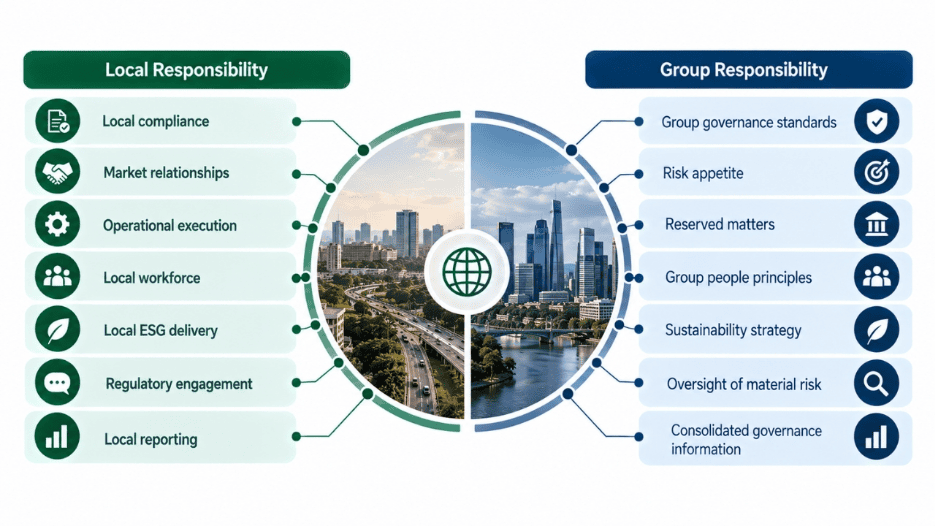
The objective is neither complete decentralisation nor excessive control.
It is governed autonomy.
Local management should know where its authority begins and where it ends.
Headquarters should know when intervention is required.
A Middle East ESG and governance readiness framework
Before approving expansion, boards and executive teams should assess the proposed operating model across several areas.
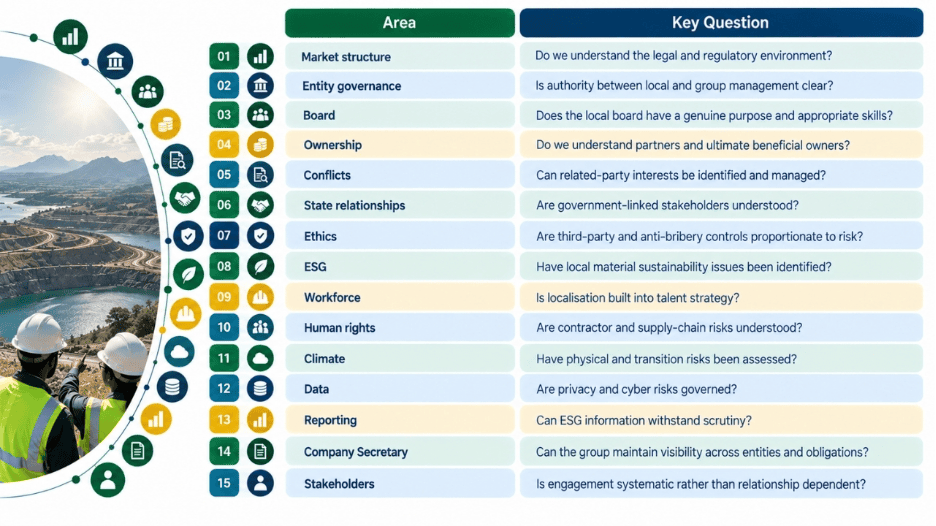
Several weak answers should delay confidence, even where the commercial opportunity looks compelling.
Ten questions boards should ask before approving Middle East expansion
1. Do we understand who will actually hold power?
Legal structures and practical authority are not always the same.
2. Have we mapped our state and government-linked relationships?
Material relationships need clear ownership and oversight.
3. Do we know our partners?
Beneficial ownership, conflicts and influence should be understood before agreements are signed.
4. Are ESG risks reflected in the investment case?
Material sustainability costs should not appear only after approval.
5. Does the subsidiary board have a clear mandate?
A board without purpose creates governance theatre rather than governance.
6. Is local talent development part of the strategy?
Sustainable expansion requires institutional capability, not permanent dependency.
7. Can we trust the ESG data?
External claims should be supported by controlled evidence.
8. Are third parties governed after onboarding?
Risk changes throughout the relationship.
9. Can headquarters see what is happening?
Local autonomy still requires group visibility.
10. Would the governance model still work if growth happened twice as quickly as expected?
Scalability is the real test of market-entry governance.
What good Middle East expansion governance looks like
A mature operating model should create several outcomes.
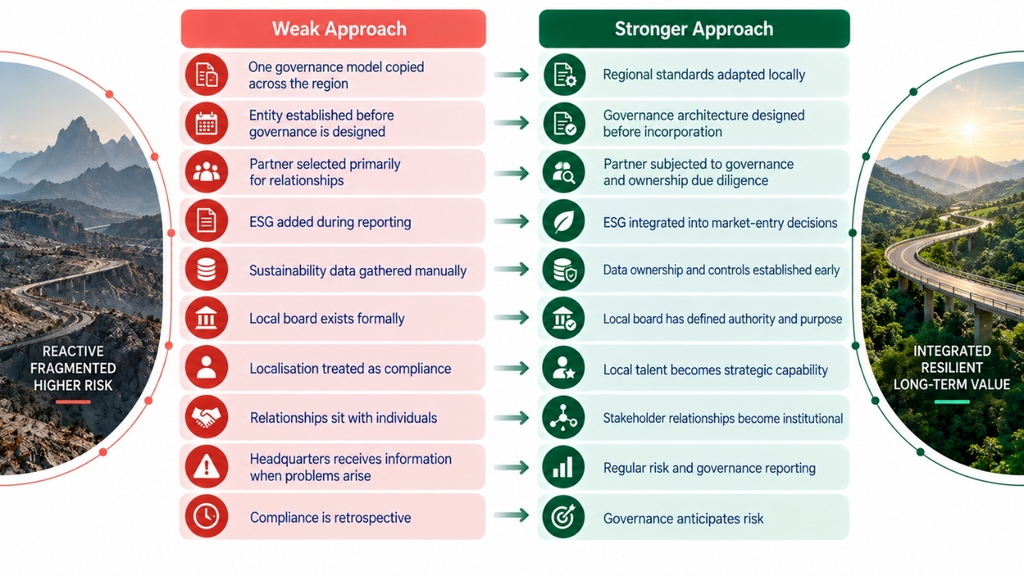
The difference is not bureaucracy.
It is institutional control.
The Lumorus View
The greatest mistake companies can make when expanding into the Middle East is assuming that commercial sophistication automatically removes governance complexity.
The region contains some of the world’s most ambitious economic transformation programmes, sophisticated investors, rapidly developing capital markets and increasingly influential global businesses.
That creates extraordinary opportunity.
It also raises the standard expected of companies entering those markets.
The right response is not to import a foreign governance model without adaptation. Nor should companies abandon global standards in the name of local practice.
The stronger approach combines both.
Maintain clear principles around:
- Integrity
- Accountability
- Board oversight
- Human rights
- Sustainability
- Transparency
- Conflicts
- Risk
Then design the operating model around local law, institutions, stakeholders and commercial reality.
This is governance-led expansion.
It recognises that market entry is ultimately an allocation of corporate power.
The company is creating new decision makers, new entities, new relationships and new risks. Governance determines how those powers are exercised and constrained.
The Bottom Line
The Middle East is becoming more important to global corporate strategy.
Saudi Arabia’s economic transformation is attracting international companies at significant scale, while the UAE remains a major hub for capital, trade and regional operations. Other Gulf markets are pursuing their own investment and diversification strategies.
However, expansion brings governance complexity.
The OECD’s regional governance work highlights the importance of ownership, transparency, related-party transactions and state involvement, while the Saudi Exchange ESG Guidelines demonstrate the growing relevance of sustainability within regional capital-market development. Globally, the IFRS Foundation continues to document the movement towards more consistent sustainability disclosure.
For firms entering the region, the governance agenda should therefore include:
- Market-entry structure
- Board effectiveness
- Decision rights
- Beneficial ownership
- Related-party transactions
- State relationships
- Anti-bribery controls
- ESG materiality
- Workforce strategy
- Human rights
- Climate and water risk
- ESG data
- Cyber governance
- Stakeholder engagement
- Subsidiary oversight
None of these issues should be considered after the expansion decision has already been made.
They are part of the decision.
The companies most likely to build durable Middle Eastern businesses will not simply understand where the commercial opportunity lies. They will understand how power, relationships, accountability and sustainability operate around that opportunity, then build their governance accordingly.
Continue Exploring
- Build ESG into your expansion strategy: ESG Strategy Development
- Identify the sustainability risks that matter: ESG Materiality & Risk Assessment
- Strengthen relationships with critical stakeholders: Stakeholder Engagement
- Improve the quality of sustainability information: ESG Reporting and Disclosure
- Integrate ESG into capital and investment decisions: ESG Integration in Investment Decisions
- Measure the social outcomes of regional investment: Social Impact Measurement and Management
- Strengthen subsidiary and corporate governance: Corporate Governance Support
- Establish the right entity structure: Company Formation & Structuring
- Build scalable regional Company Secretary support: Company Secretary Outsourcing
Lumorus: Better Business, Built on Purpose
Lumorus is a UK headquartered global governance, ESG, Company Secretary and advisory firm supporting organisations across Europe, Africa, Asia, the Caribbean, Canada, the Middle East and international markets.
We help boards and leadership teams build the governance architecture required for responsible international growth.
For organisations expanding into the Middle East, that can include support across:
- ESG strategy
- Materiality and risk assessment
- Sustainability reporting
- Stakeholder engagement
- Social impact measurement
- Corporate governance
- Entity structuring
- Board and shareholder governance
- Company Secretary support
- Multi-jurisdiction governance
Our approach is deliberately governance-led.
Market expansion creates more than revenue opportunities. It creates new entities, decision rights, regulatory relationships, stakeholders, information flows and accountability.
Those elements need to be designed.
Is your Middle East expansion strategy commercially ambitious but governance ready?
Explore Lumorus to discuss how stronger ESG, governance and Company Secretary infrastructure can support responsible growth across Middle Eastern markets.
Email: [email protected]
Lumorus: Better Business, Built on Purpose.
Sources
- OECD: Corporate Governance in MENA – Regional analysis covering ownership concentration, transparency, capital markets, board governance and state-owned enterprises.
- OECD: Overview of Corporate Governance in MENA – Detailed analysis of concentrated ownership, beneficial ownership, related-party transactions, disclosure and state ownership.
- OECD Guidelines on Corporate Governance of State-Owned Enterprises 2024 – International benchmark covering professional state ownership, board responsibilities, transparency, sustainability and responsible business conduct.
- Saudi Exchange: ESG Disclosure Guidelines – ESG guidance developed for Saudi listed companies and capital-market participants.
- Saudi Ministry of Investment: Regional Headquarters Programme – Official information on Saudi Arabia’s Regional Headquarters initiative.
- Saudi Ministry of Investment: Regional Headquarters Growth – August 2026 update reporting that more than 750 international companies had joined the programme.
- IFRS Foundation: Use of ISSB Standards by Jurisdiction – Current jurisdictional information on adoption and other use of IFRS Sustainability Disclosure Standards.
- IFRS Foundation: Inaugural Jurisdictional Guide for ISSB Standards – Framework supporting globally consistent approaches to the adoption and use of ISSB sustainability disclosure standards.