


Africa’s resource opportunity is significant. So is the governance burden that comes with it
Africa sits at the centre of several of the world’s most important resource conversations.
Critical minerals are becoming increasingly important to the energy transition, technology, mobility and defence. Oil and gas remain economically significant in many markets, while governments across the continent are also seeking greater local value from natural resources.
For extractive-sector companies, the commercial opportunity is substantial.
However, expansion into African markets also brings a demanding ESG agenda.
The OECD’s work on responsible mineral supply chains makes the underlying tension clear. Minerals can generate employment, government revenue and local development. Yet poorly governed supply chains can also be linked to human rights abuses, corruption, conflict financing and environmental damage. The OECD further notes that these risks can disrupt supply and deter investment.
At the same time, the EITI Progress Report 2025 argues that decisions being made now about contracts, revenues, environmental impacts and benefit sharing will help determine whether extractive industries support stability and development or deepen existing challenges.
Therefore, ESG should not be treated as a reporting exercise after a company has entered the market.
Instead, it should shape the entry strategy itself.
For mining, oil, gas and critical-mineral companies expanding into Africa, the strongest approach is to ask five questions early:
- What environmental and social risks could stop the project?
- Which stakeholders can materially affect the licence to operate?
- How will ownership, revenue and governance arrangements withstand scrutiny?
- What value will the operation create locally?
- Can the board demonstrate that these issues are being governed, not merely reported?
Companies that answer those questions well will be better placed to secure capital, maintain legitimacy and build durable operations.
Read More: ESG Strategy Development
The ESG priorities at a glance
Extractive-sector expansion in Africa requires a much broader lens than emissions reporting.
The most important priorities generally include:
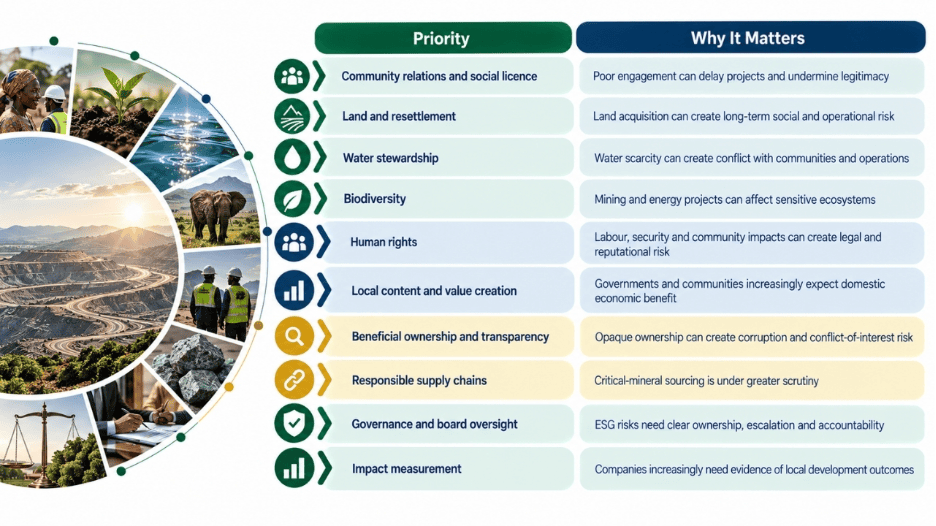
The common theme is straightforward.
ESG risk in the extractive sector is operational risk, governance risk and investment risk at the same time.
1. Community relations should be treated as strategic infrastructure
Few ESG issues matter more in extractive industries than the relationship between the company and the communities affected by its operations.
A mine, pipeline or processing facility can operate under a valid legal licence and still lose its practical licence to operate if communities believe that land, livelihoods, environmental impacts or promised benefits have been handled unfairly.
The IFC Performance Standards place stakeholder engagement at the heart of environmental and social risk management. The framework expects companies to identify affected communities, disclose relevant information and maintain engagement throughout the project lifecycle.
Therefore, community engagement should not begin only when opposition appears.
A stronger process starts during project design and continues through construction, operation, closure and post-closure obligations.
Companies should therefore build systems for:
- Stakeholder mapping
- Community consultation
- Grievance management
- Community agreements
- Local employment expectations
- Livelihood impacts
- Cultural heritage
- Ongoing disclosure
- Monitoring and feedback
The IFC’s guidance on grievance mechanisms is particularly useful because it treats grievance systems as part of project risk management rather than simply as complaints boxes. Effective mechanisms can identify emerging problems early and create a route for resolution before conflict grows.
For boards, the important question is not simply whether stakeholder engagement took place.
Instead, directors need to know whether management has enough information to understand where community confidence may be weakening.
Explore More: Stakeholder Engagement
2. Land acquisition and resettlement require early governance attention
Land issues can derail otherwise commercially attractive projects.
The IFC Performance Standard 5 recognises that land acquisition and involuntary resettlement can create long-term hardship, loss of livelihoods and social disruption. It therefore emphasises avoiding displacement where possible, reducing impacts and restoring livelihoods where displacement cannot be avoided.
The IFC’s 2023 Good Practice Handbook on Land Acquisition and Involuntary Resettlement goes further by setting out practical expectations around planning, baseline data, stakeholder engagement, livelihood restoration, implementation and monitoring.
For extractive companies expanding into Africa, this creates several governance priorities.
Boards and management should understand:
- Who holds formal and customary rights over land
- Which households may be displaced
- Whether livelihoods depend on affected land or natural resources
- How compensation will be determined
- What restoration commitments are being made
- Who is responsible for monitoring outcomes
- What happens when affected communities reject proposed arrangements
Land issues often become governance failures when companies treat them as transactions rather than long-term relationships.
For example, a compensation payment does not automatically restore a livelihood.
Likewise, a signed agreement does not automatically establish legitimacy.
The company therefore needs evidence that resettlement and livelihood commitments have produced the intended outcomes.
3. Water should be treated as a strategic resource, not an operating input
Water risk can become one of the most serious constraints on extractive projects.
Mining and processing can require substantial water use, while oil and gas operations can create additional risks involving contamination, wastewater and ecosystem impacts.
The key governance challenge is competing demand.
A technically available water source may also support agriculture, domestic use or local ecosystems.
Therefore, water management needs to consider:
- Physical availability
- Seasonal variability
- Competing community needs
- Water quality
- Catchment-level impacts
- Drought exposure
- Closure liabilities
- Regulatory expectations
Strong companies do not assess water solely at site level.
Instead, they consider the wider watershed and the combined pressure created by other users.
This matters because water scarcity can quickly become a social issue.
If communities believe that an extractive project is receiving preferred access while local supply is deteriorating, the issue can become political and reputational.
Boards should therefore expect water reporting to include more than consumption volumes.
They should also receive information about local scarcity, community reliance, ecological limits and emerging conflict.
Read More: ESG Materiality & Risk Assessment
4. Biodiversity risk is moving closer to mainstream project governance
Extractive projects can have significant impacts on ecosystems.
Land clearing, infrastructure development, water use, tailings, pollution and access roads can all affect biodiversity directly or indirectly.
The IFC Performance Standards include a dedicated standard on biodiversity conservation and the sustainable management of living natural resources.
For companies expanding into Africa, biodiversity risk becomes particularly important where projects affect:
- Protected areas
- Sensitive habitats
- Critical ecosystems
- Water-dependent landscapes
- Indigenous or community-managed land
- Species of conservation concern
A weak assessment can create regulatory delays and financing problems.
More importantly, biodiversity impacts can damage community relationships where local livelihoods depend on natural resources.
Therefore, biodiversity should be integrated into:
- Site selection
- Project design
- Environmental impact assessment
- Capital planning
- Closure planning
- Restoration
- Board reporting
The strategic question is not simply whether the project can reduce damage.
Rather, it is whether the company understood the ecological value at risk before committing capital.
5. Human rights due diligence must extend beyond direct operations
Extractive-sector human rights risks can arise through labour practices, security arrangements, land impacts, suppliers and local business partners.
The OECD’s responsible mineral supply-chain guidance highlights risks including serious human rights abuses, corruption, conflict financing and financial crime. It places responsibility on companies to identify, prevent, reduce and account for harmful impacts across operations and business relationships.
The OECD’s newer Due Diligence Essentials for Responsible Minerals reinforces the same message. As demand for transition minerals grows, companies face increasing pressure to identify and manage environmental, social and governance risks systematically rather than treating them as isolated incidents.
A strong due diligence process should cover:
- Labour rights
- Contractor practices
- Security providers
- Conflict exposure
- Child labour
- Forced labour
- Gender-based risk
- Community rights
- Indigenous Peoples where relevant
- Supply-chain practices
The board should also understand how incidents are escalated.
After all, a human rights policy has limited value if the organisation does not know how concerns reach decision makers.
6. Beneficial ownership transparency is becoming a core governance issue
Ownership structures are particularly important in extractive industries because licences, concessions and access to natural resources can create significant economic value.
The EITI’s beneficial ownership standard is built around a simple principle: the public should be able to know who ultimately owns and controls extractive companies.
The EITI argues that beneficial ownership transparency can reduce corruption risk, identify conflicts of interest, support taxation and encourage responsible investment.
Under the 2023 EITI Standard, implementing countries are expected to disclose beneficial ownership information for extractive companies, particularly where higher risks may exist.
For companies entering African markets, ownership transparency should therefore be considered before partnerships are signed.
Due diligence should examine:
- Ultimate beneficial owners
- Politically exposed persons
- Local joint-venture partners
- Licence holders
- Intermediaries
- Agents
- Related-party structures
The board should be particularly cautious where the commercial reason for a local partner is unclear.
Opaque ownership is not simply a compliance issue.
It can also become a corruption, licence and reputational risk.
7. Contract and licence transparency deserves greater board attention
The extractive sector often involves complex contracts, production-sharing arrangements, concessions and infrastructure agreements.
The EITI Progress Report 2025 highlights contract transparency as increasingly important to analysing revenue sharing, strengthening accountability and understanding whether countries are capturing appropriate value from their natural resources.
For companies, transparency creates both opportunity and scrutiny.
Boards should therefore assume that key terms may eventually become visible to governments, civil society, investors and communities.
That means decision makers need confidence around:
- How licences were awarded
- Who participated in negotiations
- Which intermediaries were involved
- The economic rationale
- Fiscal terms
- Community obligations
- Local content commitments
- Infrastructure arrangements
Poorly governed contracting can create liabilities long after the original negotiation team has moved on.
Strong companies therefore treat contract approval as a governance process rather than a purely commercial one.
8. Local content should be viewed as part of the business model
One of the most important expectations facing extractive companies across Africa is local value creation.
Governments and communities increasingly want natural resources to create more than tax revenue.
They expect benefits through:
- Employment
- Local procurement
- Skills development
- Supplier development
- Infrastructure
- Processing
- Value addition
- Technology transfer
The EITI’s work on the Lobito Corridor illustrates this broader shift. The organisation has been examining how mining-linked infrastructure across Angola, the Democratic Republic of Congo and Zambia can support domestic value addition while strengthening transparency around licensing, infrastructure agreements, revenue and local benefits.
This is a strategic issue for companies.
A business model built entirely around extraction and export may be commercially efficient in the short term but politically weak over the long term.
Local content therefore needs clear governance.
Boards should understand:
- What has been promised
- Whether local suppliers can meet requirements
- Which skills gaps exist
- How procurement decisions affect local development
- Whether commitments are measurable
- What happens if targets are missed
The strongest local-content strategies align development goals with operational reality.
9. ESG commitments need to influence capital allocation
Extractive companies can produce excellent ESG strategies while approving investments that contradict them.
That is one of the clearest signs that sustainability has not been integrated into governance.
For example, a company may commit to lower water intensity while approving a high-water project in a stressed catchment.
Another may commit to biodiversity protection while selecting a site that creates avoidable habitat loss.
A third may announce strong community commitments while failing to budget adequately for livelihood restoration.
This is why ESG priorities should be considered during investment approval rather than after final project design.
A strong capital process should ask:
- What are the material ESG risks?
- How do they affect project economics?
- What mitigation costs are required?
- Which commitments create long-term liabilities?
- Could community or regulatory opposition delay the project?
- Are closure costs adequately funded?
This connects sustainability directly with the economics of the investment.
Explore More: ESG Integration in Investment Decisions
10. Environmental due diligence needs to extend into supply chains
Extractive companies increasingly operate within supply chains subject to scrutiny well beyond the mine or wellhead.
The OECD Handbook on Environmental Due Diligence in Mineral Supply Chains provides guidance on embedding environmental issues into responsible-business due diligence. It builds on wider OECD standards covering responsible sourcing and harmful environmental impacts.
This becomes particularly important for companies dealing in critical minerals.
Customers may increasingly expect evidence regarding:
- Origin
- Traceability
- Environmental performance
- Human rights
- Conflict exposure
- Processing conditions
- Chain of custody
The OECD and IEA’s 2025 report on critical-mineral traceability warns that overlooking social and environmental harms in mineral supply chains can ultimately disrupt the supply needed for clean-energy technologies.
Traceability therefore has a commercial purpose.
It helps companies demonstrate where materials came from, which standards apply and whether supply-chain risks have been addressed.
11. Climate transition creates both opportunity and governance tension
The energy transition is increasing demand for many minerals found in African markets.
At the same time, oil and gas companies face growing scrutiny over long-term asset viability, emissions and transition planning.
Together, these pressures create a difficult governance environment.
A critical-mineral company may benefit from the transition while still generating substantial environmental and social impacts.
Similarly, an oil and gas company may operate an economically important project while facing increasing pressure over emissions and long-term demand.
Boards therefore need to avoid simplistic ESG narratives.
A transition-aligned mineral is not automatically sustainable.
Likewise, an oil or gas project cannot be assessed through emissions alone where energy security, government revenue and development considerations are also material.
The better approach is transparent governance of the trade-offs.
Boards should consider:
- Transition scenarios
- Asset resilience
- Emissions
- Local economic importance
- Capital allocation
- Community impacts
- Closure liabilities
- Technology pathways
The objective is not to produce a perfect answer.
Instead, it is to ensure that the decision is explicit, evidence based and accountable.
12. Community investment should be measured by outcomes
Extractive companies often invest heavily in local communities.
Typical programmes include:
- Schools
- Clinics
- Training
- Enterprise support
- Water infrastructure
- Scholarships
- Agricultural support
These programmes can generate substantial social value.
However, expenditure alone does not prove impact.
A company may report that it built five schools, but the stronger question is whether educational access or outcomes improved.
Similarly, a supplier-development programme should be assessed not only by the number of businesses trained but by whether suppliers became commercially stronger.
That is why Social Impact Measurement and Management matters.
Companies should connect community investment with:
- A clear Theory of Change
- Baseline information
- Outcome indicators
- Stakeholder evidence
- Regular evaluation
- Management action
This strengthens credibility with both communities and investors.
More importantly, it helps management determine which programmes should continue, scale or stop.
13. Boards need a clearer ESG oversight model
Many extractive companies have substantial ESG teams.
However, that does not automatically mean ESG is well governed.
The board needs clarity over:
- Which issues it oversees directly
- Which matters sit with committees
- Which executives own delivery
- What information reaches directors
- Which issues require escalation
- How commitments are monitored
A useful model might look like this:
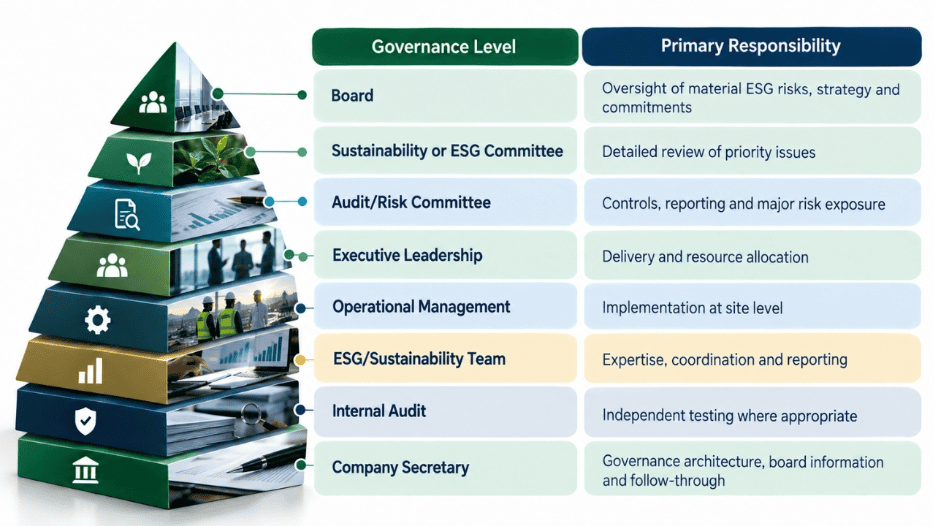
The board should also avoid excessive fragmentation.
If climate sits with one committee, communities with another and risk with a third, directors may lose sight of how the issues interact.
The objective is integrated oversight.
14. ESG data needs the same discipline as financial data
Extractive-sector ESG reporting increasingly influences investors, lenders, regulators and governments.
Therefore, data quality matters.
Boards should understand:
- Who owns each material metric
- How data is collected
- Which methodology is used
- Who checks it
- Whether assumptions are documented
- How errors are corrected
- Whether reported figures can be reproduced
This is particularly important for:
- Emissions
- Water
- Safety
- Community investment
- Local employment
- Diversity
- Land disturbance
- Rehabilitation
- Social impact
A professionally produced sustainability report cannot compensate for weak underlying data.
Explore More: ESG Reporting and Disclosure
15. Closure planning should begin before the project starts
Closure is one of the most underestimated ESG issues in extractive industries.
A mine or energy project may operate for decades, which can make closure feel distant during investment approval.
However, many of the most important closure decisions are made much earlier.
These include:
- Site design
- Waste management
- Rehabilitation
- Financial provisioning
- Infrastructure decisions
- Community dependency
- Workforce transition
If a company waits until production is declining, its options may already be limited.
The board should therefore understand closure liabilities from the beginning.
This is both an environmental and social issue.
For example, a community that becomes economically dependent on one mine can face significant disruption when operations end.
Responsible expansion should therefore consider the full project lifecycle.
A practical ESG readiness framework for African expansion
Before entering a new African market, extractive companies should test their readiness across the following areas.
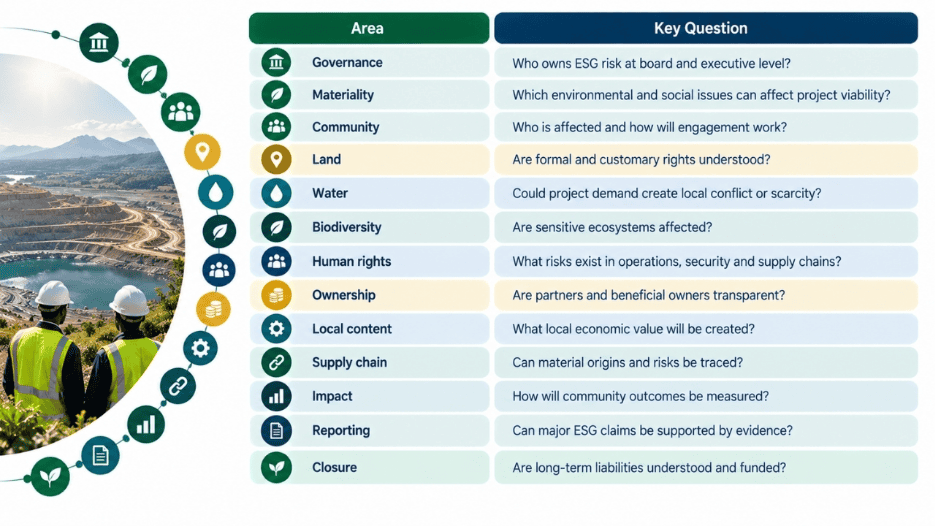
If several answers remain unclear, the ESG work is not yet ready to support expansion.
Ten questions boards should ask before approving African expansion
Boards should ask:
- Which ESG risks could materially delay or derail the project?
- Have affected communities been identified and engaged early enough?
- Are land and livelihood risks properly understood?
- Could water or biodiversity constraints affect project viability?
- Do we know the ultimate beneficial owners of our partners?
- What local content and value-creation commitments are realistic?
- Can we trace high-risk minerals and suppliers where necessary?
- Are ESG costs reflected in the investment case?
- Can we demonstrate the intended social and economic outcomes?
- Does the board receive enough information to challenge management effectively?
These questions should be asked before capital is committed, not after controversy begins.
The Lumorus View
The greatest ESG mistake extractive companies can make when entering Africa is to treat sustainability as a compliance programme sitting beside the commercial strategy.
In extractive industries, ESG is part of the commercial strategy.
Community opposition can delay production, while weak beneficial ownership controls can create corruption risk.
Water constraints can affect operations, and poor local-content planning can weaken government relations.
Human rights failures can undermine financing and reputation.
Meanwhile, biodiversity issues can affect permitting, while poor impact evidence can weaken the company’s social licence.
This is why governance matters.
The strongest companies connect ESG with:
- Investment approval
- Board oversight
- Enterprise risk
- Capital allocation
- Community relationships
- Supply-chain due diligence
- Management incentives
- Reporting
- Impact evaluation
That creates a more realistic approach to responsible expansion.
It also creates better business.
The Bottom Line
Africa’s extractive opportunity is real, particularly as global demand for critical minerals grows and countries seek greater domestic value from natural resources.
However, expansion without strong ESG governance can create substantial operational and reputational risk.
The OECD, IFC and EITI all point in broadly the same direction: responsible extractive investment requires stronger due diligence, transparency, community engagement and accountability.
For companies expanding into African markets, the most important ESG priorities are therefore not confined to emissions or disclosure.
They include:
- Community legitimacy
- Land
- Water
- Biodiversity
- Human rights
- Beneficial ownership
- Local value creation
- Responsible supply chains
- Governance
- Social impact
- Closure
The common thread is governance.
Someone must own the risk, while someone else must provide effective challenge.
Management must also monitor the outcome, and the board needs enough evidence to know whether the system is working.
The companies most likely to succeed over the long term will understand a simple truth: access to resources may come through a licence, but durable operations depend on legitimacy, accountability and trust.
Continue Exploring
- Build a stronger ESG strategy for market expansion: ESG Strategy Development
- Identify material environmental and social risks: ESG Materiality & Risk Assessment
- Strengthen stakeholder relationships: Stakeholder Engagement
- Improve ESG reporting and disclosure: ESG Reporting and Disclosure
- Measure community and social outcomes: Social Impact Measurement and Management
- Embed ESG into investment decisions: ESG Integration in Investment Decisions
Lumorus: Better Business, Built on Purpose
Lumorus is a UK-headquartered global governance, ESG, Company Secretary and advisory firm supporting organisations across Europe, Africa, Asia, the Caribbean, Canada, the Middle East and international markets.
We help organisations strengthen the governance systems behind responsible growth, particularly where market expansion creates greater environmental, social and regulatory complexity.
For extractive-sector companies, our Sustainability & Responsibility capabilities can support:
- ESG Strategy Development
- ESG Materiality & Risk Assessment
- Stakeholder Engagement
- ESG Reporting and Disclosure
- Social Impact Measurement and Management
- ESG Integration in Investment Decisions
Our approach is governance-led.
That means connecting ESG risks with board oversight, executive accountability, capital allocation and measurable outcomes rather than treating sustainability as a separate reporting function.
Is your African expansion strategy built around resource access alone, or does it also account for the governance, community and sustainability conditions required to operate successfully over the long term?
Explore Lumorus Sustainability & Responsibility or contact Lumorus to discuss how stronger ESG governance can support responsible expansion into African markets.
Email: [email protected]
Lumorus: Better Business, Built on Purpose.
Sources
- OECD: Responsible Mineral Supply Chains – Guidance on human rights, conflict, corruption and environmental risks in mineral supply chains.
- OECD: Due Diligence Essentials for Responsible Minerals – Guidance on responsible mineral due diligence and emerging ESG risks.
- OECD: Handbook on Environmental Due Diligence in Mineral Supply Chains – Practical guidance on integrating environmental considerations into supply-chain due diligence.
- OECD and IEA: The Role of Traceability in Critical Mineral Supply Chains – Analysis of traceability and ESG risk in critical-mineral supply chains.
- IFC: Performance Standards on Environmental and Social Sustainability – International standards covering risk management, labour, resource efficiency, communities, land, biodiversity and Indigenous Peoples.
- IFC: Performance Standard 5 on Land Acquisition and Involuntary Resettlement – Guidance on resettlement, compensation, livelihood restoration and community engagement.
- IFC: Good Practice Handbook on Land Acquisition and Involuntary Resettlement – Practical project guidance covering planning, baseline data, engagement and livelihood restoration.
- EITI: Progress Report 2025 – Analysis of extractive-sector transparency, corruption risk, local value, revenue governance and responsible mineral supply chains.
- EITI: Beneficial Ownership – Guidance on ownership transparency and corruption risk in extractive industries.
- EITI: 2023 Standard Requirements – Requirements covering licences, contracts, beneficial ownership and wider extractive-sector transparency.
- African Development Bank: Sustainability and ESG – African Development Bank sustainability framework and regional priorities around resilient growth and value chains.