


Organisations rarely fail because they do too little. They often fail because they measure the wrong things.
Every year brings another sustainability report.
Another community initiative.
Another employee wellbeing programme.
Another environmental commitment.
Another set of impressive numbers.
The organisation appears busy.
It appears responsible.
It appears to be making progress.
But appearance is not the same as achievement.
One of the biggest challenges facing ESG and social impact today is that organisations have become increasingly effective at demonstrating activity, while remaining less effective at proving that any of it has created meaningful change.
The distinction is not academic.
It determines whether governance is creating value or simply creating evidence of effort.
According to the OECD, organisations increasingly need to distinguish between outputs and genuine outcomes if they are to demonstrate that their activities create measurable social, environmental or economic value.
Read More: ESG Reporting & Disclosure
Visibility is easy. Impact is difficult.
Most organisations can tell you what they delivered.
Few can confidently explain what changed because of it.
There is an important difference.
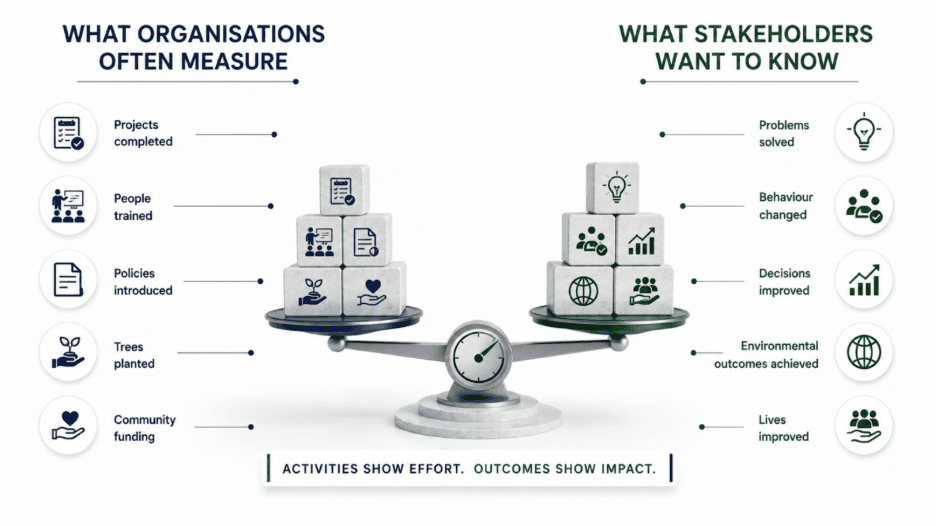
One measures effort.
The other measures effectiveness.
That difference separates reporting from accountability.
Activity creates confidence. Evidence creates credibility.
Activity is visible.
Impact is not always immediately visible.
This explains why organisations naturally gravitate towards reporting activities.
Activities are easier to count.
Easier to communicate.
Easier to celebrate.
Impact requires organisations to answer more uncomfortable questions.
Did anything actually improve?
Who benefited?
Would the same outcome have occurred anyway?
How much of the observed change can genuinely be attributed to our intervention?
According to the OECD’s work on impact management, these are the questions that distinguish meaningful impact measurement from simple performance reporting.
Optics are becoming easier to produce than proof
Technology has transformed corporate communication.
Producing polished ESG reports has never been easier.
Dashboards.
Infographics.
Interactive websites.
Professional videos.
Real-time updates.
These tools improve transparency.
But they can also create an unintended consequence.
The quality of communication can begin to overshadow the quality of performance.
Good storytelling should never become a substitute for good governance.
Governance changes the questions leaders ask
Weak governance asks:
What did we deliver this year?
Strong governance asks:
- Which initiatives created lasting value?
- Which activities produced little measurable change?
- What evidence supports our conclusions?
- Should resources be redirected?
- Are we solving the problems we set out to address?
These questions are more difficult.
They are also more useful.
They shift attention from visibility to effectiveness.
Real impact requires disciplined measurement
Meaningful impact rarely happens by accident.
It requires organisations to understand the full chain of change.
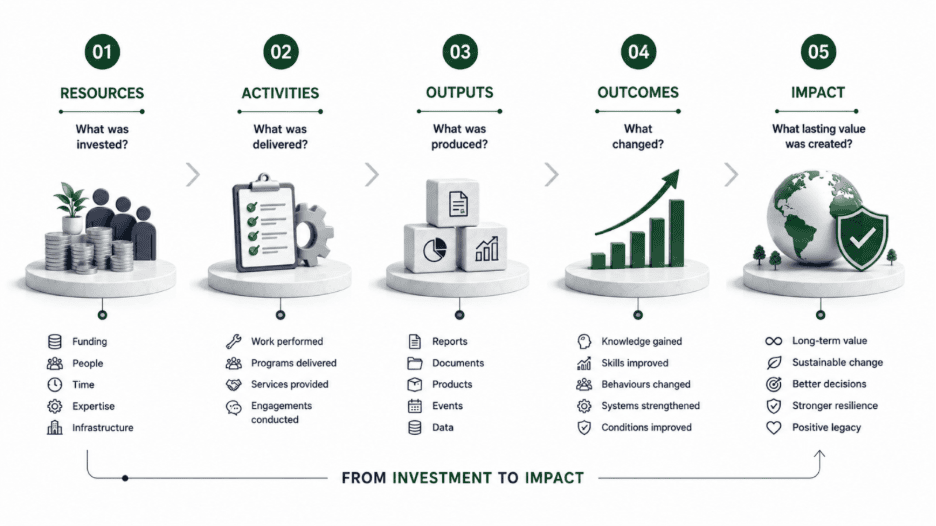
Many organisations stop measuring halfway through the process.
The strongest organisations continue until they understand whether lasting change has occurred.
That is where learning begins.
Read More: Materiality Assessment
The organisations that build trust are those willing to test their own assumptions
Stakeholders no longer judge organisations simply by the volume of activity they report.
Increasingly, they ask whether those activities produced meaningful results.
Investors want evidence.
Regulators expect accountability.
Communities want lasting change.
Employees increasingly want purpose supported by proof rather than aspiration.
Trust is becoming evidence based.
Impact should influence strategy, not simply reporting
Too often, organisations measure impact at the end of a project.
Leading organisations use impact evidence throughout decision-making.
It informs investment.
Shapes strategy.
Challenges assumptions.
Improves future programmes.
According to the OECD, impact measurement creates the greatest value when it becomes part of organisational learning rather than simply an external reporting exercise.
Impact should not sit inside the sustainability report.
It should influence how the organisation is governed.
Good governance is ultimately judged by outcomes
Boards are responsible for more than approving ESG strategies.
They are responsible for ensuring those strategies produce measurable value.
This requires oversight that extends beyond activity reports.
It requires curiosity.
Challenge.
Evidence.
And the willingness to distinguish between what looks impressive and what genuinely creates change.
Because in the long run, stakeholders remember outcomes far longer than they remember activity.
Explore More
Lumorus: Better Business, Built on Purpose
Lumorus is a UK headquartered global governance, ESG and advisory firm supporting organisations across Africa, Europe, Asia, the Caribbean, Canada and other international markets.
For more than 10+ years, Lumorus has helped boards, leadership teams and regulated organisations strengthen governance, ESG accountability, board effectiveness and organisational resilience across multiple industries and jurisdictions.
If your organisation is reporting activity but struggling to demonstrate meaningful impact, it may be time to ask a different question.
Not What did we do?
But What changed because we acted?
Visit: lumorus.com
Email: [email protected]