


Here is a question most ESG consultants will not ask their clients: if your social impact claims were cross-examined at your next Annual General Meeting, how many would survive?
Not reviewed. Not benchmarked against a framework. Cross-examined with the expectation that every number has a source; every outcome has a verified cause, and every beneficiary count reflects a precisely defined and consistently applied definition.
For most organisations, the honest answer is very few. That is not an indictment of intent. Most organisations investing in social impact work genuinely want to make a difference. The problem is not motivation or intent. It is that the measurement systems built to capture that difference were never designed to withstand serious scrutiny. They were designed to produce a report.
And there is a significant gap between those two things.
The Claim Is Not the Evidence
Social impact language has developed a particular fluency that moves quickly from activity to assertion. Organisations do not just deliver training programmes. They transform livelihoods. They do not just fund community initiatives. They drive systemic changes. They do not just employ local staff. They create economic opportunities.
None of those translations are necessarily wrong. But they are claims, not evidence. And the distance between the activity and the assertion is precisely where accountability breaks down.
The Global Impact Investing Network found that less than 35% of organisations publishing social impact reports use independently verified measurement frameworks. A separate analysis found that ESG disclosures were considered genuinely rigorous by only 29% of institutional investors surveyed, with the majority describing them as largely narrative rather than substantive.
The sector has become skilled at producing documents that look like evidence but cannot stand up to real scrutiny. That is a different skill from actually producing it.
What a Cross-Examination Would Actually Reveal
Take a common impact claim: an organisation states it has improved economic resilience for 8,000 households across three regions.
A cross-examination does not question whether the work happened. It questions what the claim actually means.
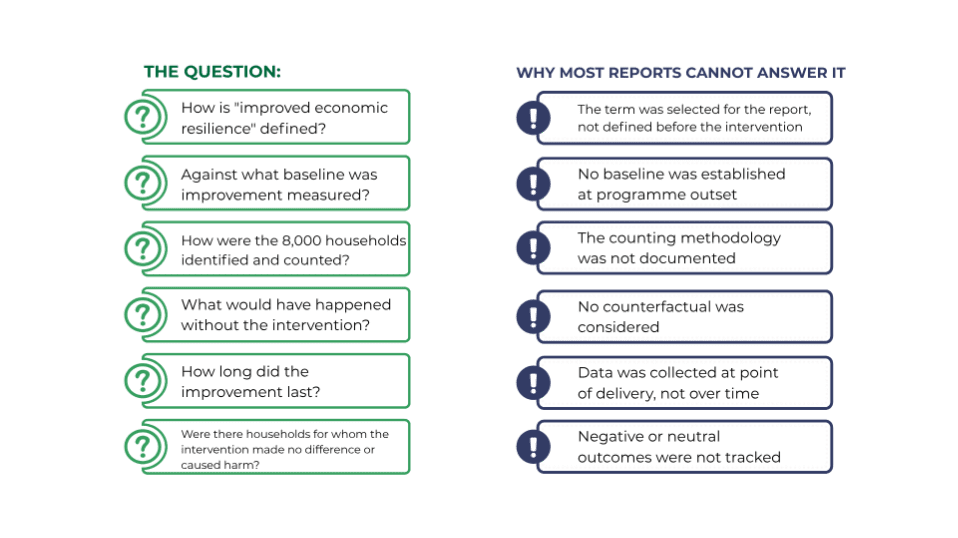
Every one of those questions is reasonable. None of them should be difficult to answer if the measurement system was designed for accountability rather than reporting. Most were never asked.
The Measurement Design Problem
The root issue is not dishonesty. It is that social impact measurement is almost universally designed backwards. Organisations complete their programmes, then decide what to measure. They select metrics that reflect what they did rather than what they were trying to change. They collect data at the point that is most convenient rather than the point that is most informative.
The result is a body of evidence that is internally consistent but externally unverifiable. It answers the question of what happened. It does not answer the question of what it means.
A study by the Stanford Social Innovation Review found that 71% of social sector organisations could not demonstrate a causal link between their programmes and the outcomes they claimed. A further 58% acknowledged using metrics primarily because they were straightforward to collect rather than because they reflected genuine change.
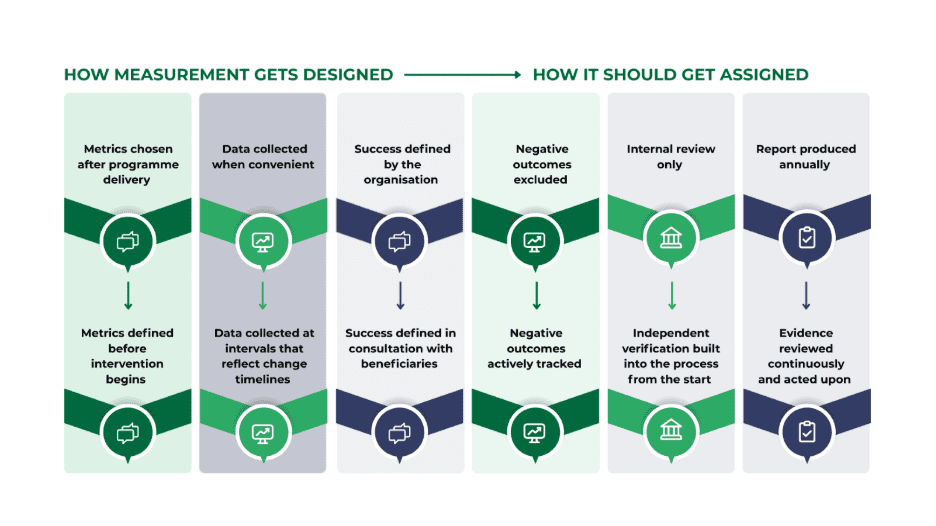
That gap is not detailed. It is the difference between impact reporting and impact accountability.
The Independence Problem
There is a further layer that rarely gets examined. Even when organisations commission external evaluations, the independence of those evaluations is frequently compromised before the work begins.
Evaluators are selected by the organisations being evaluated. Scope is agreed in advance, often excluding the areas of greatest sensitivity. Draft reports are reviewed internally before publication. Findings that reflect poorly on flagship programmes are softened, reframed, or omitted entirely in the final version.
None of these are unusual. In fact, most of it is considered standard practice across the sector. But standard practice is not the same as rigorous practice. The external validation that organisations hold up as proof of credibility is, in many cases, a process that was shaped, scoped, and softened before the first interview was conducted.
A review of social impact claims across 150 organisations found that in 74% of cases, material gaps between reported outcomes and independently verified results had never surfaced to senior leadership or boards. The reports had circulated. The gaps did not exist.
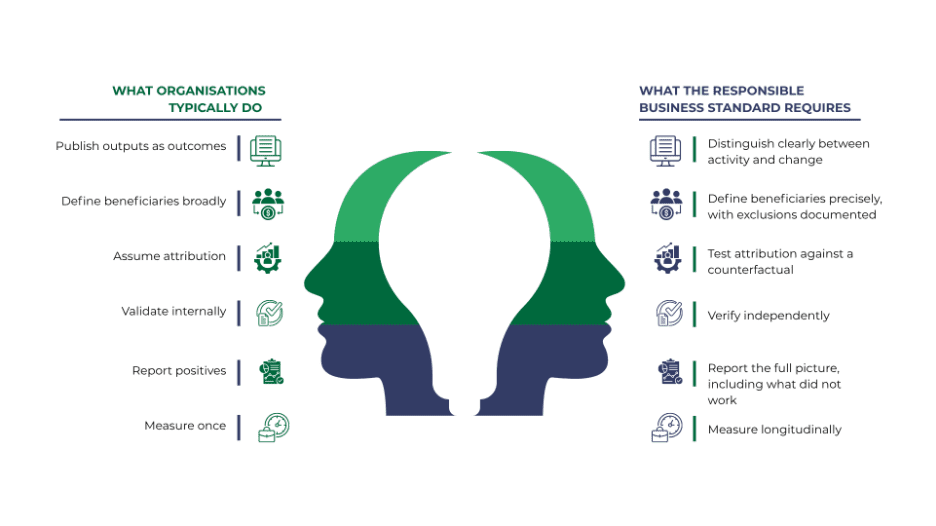
What the Responsible Business Standard Actually Requires
This is where Lumorus enters the conversation, and it is worth explaining what Lumorus eSg-Social Impact Practice actually does, because it is not a standard ESG-Social Impact consultancy.
Lumorus is a governance and responsible business firm working with organisations across UK, Europe, South Asia, Canada & Africa. Within its ESG practice, Lumorus offers two services purpose built for social impact accountability: Social Impact Strategy and MEAL, which stands for Monitoring, Evaluation, Accountability and Learning.
The Social Impact Strategy service designs impact programmes built for accountability from the outset, not retrofitted for reporting after the fact. Outcomes are defined before delivery begins; baselines are set to make change measurable, and the theory of change is constructed to be tested rather than narrated.
The MEAL service is where measurement becomes rigorous. It is anchored in the proprietary ESG Social Taxonomy developed by Lumorus. That taxonomy exists because standard ESG frameworks were not built to answer the hard questions. They were built to create comparability across organisations, which is a different objective entirely. Comparability without accuracy produces rankings that look meaningful and measure almost nothing.
At the centre of the MEAL service is a proprietary social impact technology platform that collects, verifies and analyses impact data in real time across geographies and programme types. It creates an auditable data trail from programme activity to reported outcome, the kind of trail that holds up when a shareholder, regulator or investor starts asking questions.
The people absorbing the cost of poorly measured interventions are not investors or regulators. They are the communities the programmes were designed to serve.
The Cost of the Performance
The organisations that continue producing impact reports designed to reassure rather than account are not just creating reputational exposure, though that exposure is real and growing as investors and regulatory scrutiny tightens.
They are also making worse decisions. Programmes that are not working continue to receive resources. Communities that are not being served continue to be counted as beneficiaries. Leadership continues to operate on the basis of data that does not reflect reality.
And when that gap eventually becomes visible, whether through an investor challenge, a regulatory review, or simply a programme that fails in public, the distance between what was claimed and what was true becomes very difficult to explain.
“The organisations that get this right build something more durable than a good report. They build a credibility that survives scrutiny precisely because it was designed to invite it.”
Would Yours Hold Up?
The organisations that get this right build measurement systems that surface what is not working as readily as what is, programmes that adapt based on evidence, and a credibility with stakeholders that survives scrutiny precisely because it was designed to invite it.
That is what social impact accountability is supposed to look like. It is achievable. But only when the process starts with the question that matters: would this hold up under cross-examination?
Lumorus builds the social impact measurement infrastructure to make sure it does. If your organisation is ready to move from reporting to genuine accountability, that is exactly what the work Lumorus was built for.
lumorus.com | [email protected]
Citations & Sources
- Global Impact Investing Network. Evidence on the Financial Performance of Impact Investments. 2023.
- New Philanthropy Capital. Rethinking Charity Accountability: What Good Impact Reporting Looks Like? 2023.
- Stanford Social Innovation Review. Drowning in Data: Why Social Sector Measurement Misses What Matters? 2023.
- Institute of Chartered Secretaries and Administrators. Corporate Governance Failures and Board Evaluation Outcomes. 2023.
Published by Lumorus · 7 min read