



The Most Dangerous Governance Recommendation Is the One Everybody Agrees With but Nobody Owns
A governance review can identify the right problem, recommend the right solution and still achieve remarkably little.
The board receives a well-structured report. Directors recognise the findings, management accepts the recommendations and the Company Secretary records the agreed actions.
Six months later, the same weaknesses remain.
Board papers continue to arrive late, accountability between committees and executives remains uncertain, and decisions are still followed by lengthy periods of administrative chasing.
Nothing was necessarily wrong with the review.
The failure occurred between recognising the problem and implementing the solution.
This distinction is becoming increasingly important as organisations invest in board performance reviews, governance diagnostics, compliance assessments and responsible-impact programmes.
These exercises can generate valuable insight. However, their contribution to organisational performance depends on what happens afterwards.
A finding is not an improvement. A recommendation is not a decision. An approved action is not evidence that the underlying problem has been resolved.
The real test is whether an organisation can establish who has authority to make the decision, who is accountable for implementation, what evidence will demonstrate completion and when the result will be reviewed.
Without that chain, governance can become highly effective at diagnosing weaknesses while remaining surprisingly ineffective at correcting them.
The issue extends beyond board performance.
Company Secretary functions routinely manage the transition between board decisions and management actions. Responsible-impact programmes face similar challenges when assessments produce recommendations that do not translate into operational change.
Across these areas, the same governance principle applies.
Insight creates value only when it changes decisions, responsibilities and outcomes.
For boards and executive leadership, the question is no longer simply whether the organisation has identified its weaknesses.
It is whether those weaknesses have an accountable route to resolution.
Read More: Lumorus Board Evaluation & Assessment
Executive Takeaway
Governance improvement often fails at the point where findings should become accountable action.
A board review may identify ineffective reporting, unclear responsibilities or weaknesses in decision making. Similarly, a Company Secretary assessment can reveal fragmented processes, while a responsible-impact review may identify material environmental or social issues requiring management attention.
The challenge is not simply deciding what needs to change.
It is establishing a reliable route from insight to implementation.
Every significant recommendation should answer four questions:
- Who decides? Identify the board, committee or executive with authority to approve the change.
- Who delivers? Assign operational responsibility to someone with the authority and resources to implement it.
- What proves completion? Define the evidence required to demonstrate that the agreed change has occurred.
- When will it be reviewed? Establish the appropriate date and governance forum for assessing effectiveness.
These responsibilities should remain distinct.
Boards oversee and challenge management. Executives deliver operational change, while Company Secretaries support governance processes, records and follow-through without automatically becoming responsible for every action they coordinate.
Responsible-impact programmes require the same discipline.
The objective is not to produce more recommendations, action registers or progress reports.
It is to create an organisation capable of acting on what it learns.
1. Why Governance Recommendations Fail After the Review
Most governance reviews do not fail because their recommendations are obviously wrong.
Instead, problems often emerge during implementation.
A review identifies weaknesses in board information quality. Directors accept the finding, and management agrees to improve reporting.
However, the recommendation is recorded simply as improving board papers.
No executive is explicitly accountable for redesigning the reporting process. The organisation has not agreed what better information should contain, while the next board meeting approaches without a clear implementation timetable.
Eventually, the Company Secretary begins chasing departments for updates.
Some changes may occur, but the original weakness remains largely intact.
This is a common governance design problem.
Recommendations frequently describe desirable outcomes without establishing the decisions and responsibilities required to achieve them.
Consequently, organisations can confuse agreement with commitment.
A board may support a recommendation without formally determining the action required. Management may accept responsibility collectively without identifying a single accountable executive.
Meanwhile, progress reports describe activity rather than demonstrating that the original problem has changed.
The result is an improvement programme that appears active but produces limited evidence of improvement.
The gap between finding and follow-through is fundamentally a gap in accountability.
The UK Corporate Governance Code 2024 provides an important reference point.
Its approach to board performance reviews reinforces the importance of assessing board effectiveness, while the accompanying FRC guidance addresses acting on review results.
The Code also emphasises governance reporting that explains board decisions and outcomes in the context of strategy and objectives.
These expectations point towards a broader principle.
Governance quality should not be judged solely by the existence of processes.
It should also be judged by what those processes enable the organisation to achieve.
2. The Four-Part Accountability Chain: From Finding to Follow-Through
Every material governance recommendation should move through four connected responsibilities.
The Governance Accountability Framework
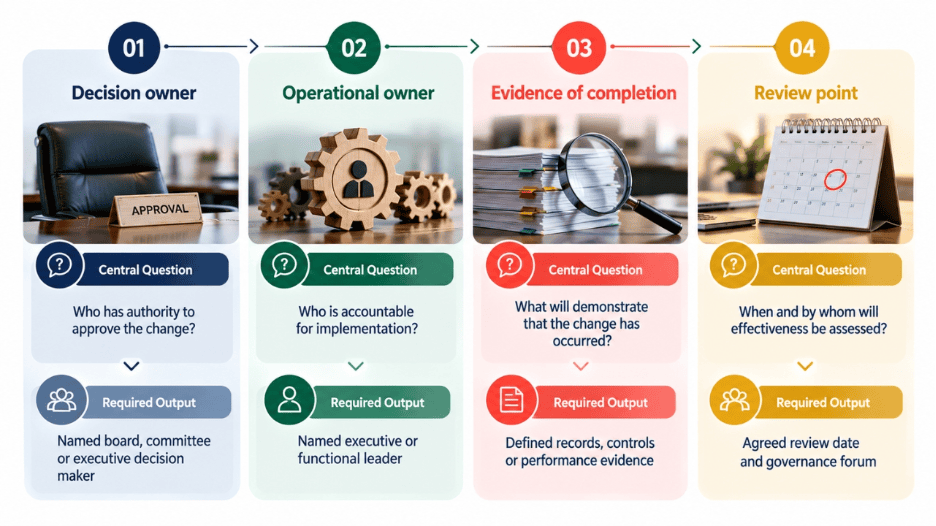
The framework is deliberately practical.
Its purpose is to prevent recommendations from becoming disconnected from the people and processes responsible for delivering them.
Decision ownership establishes authority
Not every governance improvement requires board approval.
Some decisions sit within management’s delegated authority. Others require a committee or full board decision because they affect governance structures, strategy, risk appetite or reserved matters.
The first responsibility is therefore to establish who is authorised to approve the proposed response.
Without that clarity, recommendations can remain trapped between governance forums.
Operational ownership establishes responsibility
Once the decision has been made, implementation should sit with someone capable of delivering it.
That person needs the necessary authority, resources and access to information.
Assigning responsibility to someone who cannot control the outcome creates accountability in name rather than substance.
Evidence establishes whether change has occurred
A recommendation should not be considered complete simply because management reports that an activity has taken place.
Instead, the organisation should determine what evidence demonstrates that the intended improvement has been implemented.
For material issues, that may also require testing whether the change is working.
The review point closes the accountability loop
Finally, the organisation needs an agreed point at which progress and effectiveness will be examined.
A review date ensures that recommendations remain visible and that incomplete actions can be challenged.
A recommendation without a decision owner is an aspiration. Without an operational owner, it is an orphan. evidence, it is a claim. Without review, it is a promise nobody has to revisit.
3. Board Oversight Must Not Become Management Delivery
One of the most persistent weaknesses in governance improvement is the confusion between oversight and execution.
Boards are responsible for providing direction, exercising oversight and making decisions within their authority.
Management is ordinarily responsible for implementing strategy and delivering operational change.
Company Secretaries support the governance process by coordinating meetings, recording decisions, maintaining appropriate records and facilitating accountability.
These roles are connected, but they are not interchangeable.
Consider a board performance review that identifies weak risk reporting.
Directors may determine that the organisation requires more useful information about emerging risks, mitigation plans and their implications for strategy.
However, the board should not ordinarily become responsible for designing the operational reporting system.
That responsibility may sit with the Chief Risk Officer, Chief Financial Officer or another executive, depending on the organisation’s structure.
The board’s role is to challenge the proposed response, examine progress and determine whether the resulting information is adequate.
Similarly, the Company Secretary may ensure that the recommendation appears in the action register and returns to the board at the appropriate time.
Nevertheless, recording and coordinating an action should not transfer operational accountability to the Company Secretary.
Boards weaken accountability when they attempt to manage what executives should deliver. They weaken oversight when they approve recommendations without examining what happened next.
Effective governance requires a clear boundary between the two.
The G20/OECD Principles of Corporate Governance 2023 provide an international reference point for board responsibilities, accountability and oversight.
For practical governance improvement, the lesson is straightforward.
Directors should demand evidence of progress without becoming the people responsible for producing it.
Read More: Lumorus Board Decision & Risk Assessment
4. Worked Example: How a Board Review Finding Becomes a Completed Improvement
Consider a fictional organisation whose independent board performance review identifies weaknesses in board information.
Directors report that papers arrive too close to meetings, strategic proposals contain inconsistent financial analysis and management recommendations do not always distinguish clearly between matters requiring approval and those presented for information.
The review recommends strengthening board reporting.
That finding is useful.
However, it does not yet establish how the organisation will change.
A stronger response follows four stages.
Stage One: Name the Decision Owner
The Chair presents the recommendation to the board alongside a proposed response.
Directors agree that management should introduce a revised board-paper standard, including clearer decision requests, financial implications, material risks and alternative options.
The board approves the direction of improvement.
Decision owner: Board of Directors.
Stage Two: Assign Operational Delivery
The Chief Executive appoints the Chief Financial Officer to lead implementation, supported by the executive team and Company Secretary.
Management becomes responsible for applying the new standard to relevant papers.
The Company Secretary advises on board requirements, coordinates the meeting process and monitors the agreed implementation timetable.
However, responsibility for preparing adequate management analysis remains with the executives submitting the papers.
Operational owner: Chief Financial Officer.
Stage Three: Define Evidence of Completion
Successful implementation requires more than producing a new template.
Evidence should demonstrate that the standard has been adopted and is being used.
For this example, the organisation agrees to examine:
- Approval and communication of the revised board-paper standard.
- Management guidance explaining the requirements.
- A sample of board papers prepared under the new process.
- Evidence that papers are submitted within the agreed timetable.
- Director feedback on the clarity and usefulness of information.
Evidence of completion: Documented implementation and an assessment of board papers produced under the revised arrangements.
Stage Four: Establish the Review Point
The board agrees to review the change after two meeting cycles.
Directors assess whether papers arrive on time, proposals are clearer and information supports better discussion and challenge.
Review point: The second scheduled board meeting following implementation.
The Final Test: Has the Original Problem Been Resolved?
Suppose papers now arrive on time but continue to lack useful financial analysis.
Management has improved one aspect of the process, but the underlying weakness remains partly unresolved.
The board should therefore require further action rather than closing the recommendation prematurely.
The purpose of follow-through is not to complete an action register. It is to correct the weakness that made the action necessary.
This distinction separates genuine governance improvement from administrative completion.
5. Board Performance Reviews: The Report Is the Beginning, Not the Result
Board performance reviews can provide valuable insight into the effectiveness of directors, committees, leadership arrangements and governance processes.
However, the real value of a review depends on whether its findings influence subsequent decisions.
A board may identify weaknesses in its composition, information quality, succession planning or committee effectiveness.
Each finding requires a different response.
A skills gap may need consideration by the nominations committee. Weaknesses in board information could require management to improve reporting, while unclear committee responsibilities may demand changes to terms of reference.
The organisation should not treat every recommendation as a general responsibility of the board or Company Secretary.
Instead, each finding should be matched with the authority required to approve the change and the person responsible for implementation.
Board Performance Reviews
Lumorus’s Board Evaluation & Assessment capability supports boards in examining their effectiveness and identifying priorities for improvement.
The critical next step is to translate those priorities into accountable actions.
A well-designed response should clarify which matters require board decisions, which should be delegated to management and how progress will be reviewed.
This helps prevent board performance reviews from becoming periodic exercises that identify familiar weaknesses without producing lasting change.
Boardroom Intelligence: Looking Ahead
Boardroom Intelligence is part of Lumorus’s forthcoming conversation about board insight and governance effectiveness.
Further details will be introduced in due course.
For now, the central principle remains that better insight should support clearer decisions, stronger accountability and more disciplined follow-through.
Explore: Board Performance Reviews and Board Evaluation & Assessment
Related Service: Board Strategy Sessions
6. Company Secretary Hand-Offs: Where Accountability Can Quietly Disappear
The transition from a board decision to management action is one of the most important stages in the governance process.
It is also a point at which responsibility can become unclear.
A board approves a policy change, but several departments must implement it. A committee requests additional information, yet nobody is explicitly assigned responsibility for producing it.
Similarly, a statutory obligation may involve finance, legal, local management and external advisers.
The Company Secretary often coordinates these hand-offs.
That work is essential, but it should not make the function the default owner of every outstanding task.
A strong hand-off should identify the decision, the person responsible for delivery, the information required and the point at which completion will be reviewed.
Consider a board decision to revise the organisation’s delegated authority framework.
The Company Secretary may record the resolution and coordinate the implementation timetable.
However, the Chief Executive or another designated executive should own the operational changes, including communication to management and alignment with approval processes.
The board should subsequently receive appropriate confirmation that the revised arrangements have been implemented.
Without this distinction, the Company Secretary can become responsible for chasing work that other executives have the authority and obligation to complete.
The Company Secretary should preserve the chain of accountability, not become the substitute for missing accountability.
This is particularly important for organisations managing multiple entities and jurisdictions.
As governance obligations become more complex, informal hand-offs can create delays, inconsistent records and uncertainty over responsibility.
Read More: The Company Secretary Is Often the Control Nobody Realises They Depend On
7. CoSec Retainer and CoSec Hub: Two Distinct Roles in Governance Follow-Through
Organisations need both professional capability and reliable operating processes to maintain governance continuity.
These requirements are connected, but they are not identical.
CoSec Retainer: Professional Governance Capacity
The CoSec Retainer provides ongoing Company Secretary and governance support through experienced professionals.
Depending on the agreed service scope, this may include board administration, compliance coordination, statutory support and related governance responsibilities.
A retainer arrangement can strengthen continuity and provide additional capacity, particularly where organisations manage multiple entities or face increasing governance demands.
However, external professional support should not automatically inherit management accountability for every action being coordinated.
Clear responsibility remains essential.
The retainer supports the governance function. It does not remove the need for executives and directors to fulfil their respective responsibilities.
CoSec Hub: Connected Governance Infrastructure
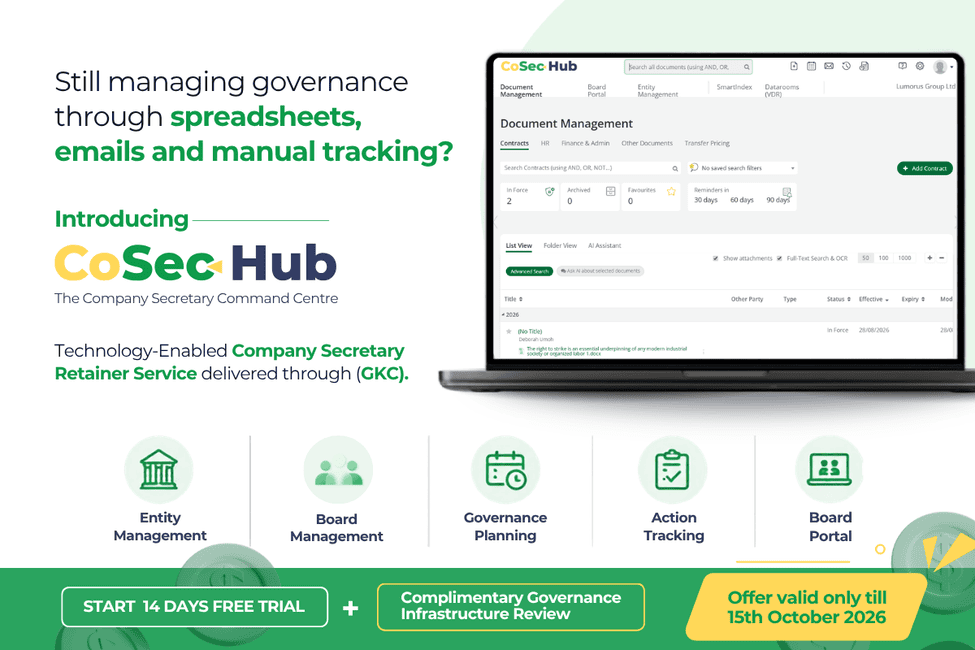
CoSec Hub provides the technology environment supporting Company Secretary operations, governance workflows, records and related service delivery.
Its published service model includes entity management, board operations, compliance coordination, governance documentation and action tracking.
These capabilities can help organisations maintain visibility over obligations and governance hand-offs.
Importantly, the platform forms part of a wider Lumorus operating model that combines technology, the CoSec Retainer and Governance Knowledge Centres.
This brings professional support and infrastructure into a coordinated environment.
The governance principle remains straightforward.
Technology can make an action visible. Professional expertise can help coordinate and interpret it. The accountable executive must still deliver the underlying change.
For organisations seeking stronger governance continuity, the distinction between these responsibilities should shape how services and processes are designed.
Explore: CoSec Hub, The Company Secretary Command Centre
Read More: Company Secretary Outsourcing
8. Responsible Impact: An Assessment Is Not an Outcome
The same ownership problem appears in sustainability and responsible-impact work.
An organisation may conduct a materiality assessment, identify significant environmental and social issues and develop a responsible-business strategy.
Those activities can improve understanding.
However, they do not automatically produce better environmental or social outcomes.
Consider a fictional business whose stakeholder engagement identifies concerns about the effects of its operations on local communities.
Management accepts the finding and commits to strengthening its approach.
What happens next?
If no executive owns the response, the commitment may remain a statement of intent.
Even where activities are undertaken, the organisation may struggle to demonstrate whether conditions have improved.
A stronger process establishes the decision required, the person accountable for delivery, the evidence needed and the point at which progress will be assessed.
For example, management might approve a revised community engagement programme with defined responsibilities, resources and an implementation timetable.
Evidence should then go beyond the number of meetings held.
The organisation should examine whether stakeholder concerns were addressed, commitments were delivered and the intervention produced meaningful change.
Engagement is an activity. Impact is a consequence. Governance must connect the two.
This is why responsible-impact management requires the same discipline as board improvement.
Material findings should influence decisions, capital allocation, operational priorities and accountability.
Through its ESG Materiality & Risk Assessment and Social Impact Measurement and Management services, Lumorus supports organisations in identifying material issues and developing approaches to assessing outcomes.
ImpactOS: Looking Ahead
ImpactOS is part of Lumorus’s forthcoming responsible-impact conversation.
Further information will be introduced at the appropriate stage.
For now, the governing principle is clear: responsible-impact findings should lead to accountable decisions and evidence of change, rather than ending with assessment and reporting.
Read More: Lumorus ESG Strategy Development
9. Why Evidence of Completion Must Be Defined Before Work Begins
Organisations frequently discover too late that they have not agreed what completion means.
A policy has been approved, so an action is marked complete.
Training has been delivered, and a recommendation is closed.
A reporting process has been introduced, prompting management to declare the improvement finished.
These activities may be necessary.
However, they do not always demonstrate that the original problem has been resolved.
Suppose a board review identifies weak management accountability.
Introducing a new action register may improve visibility, but the underlying problem will persist if executives continue to miss deadlines without explanation or consequence.
Likewise, a responsible-impact programme may complete every planned activity without producing the intended stakeholder outcome.
Evidence therefore needs to reflect the purpose of the recommendation.
A useful distinction is between three levels of completion.
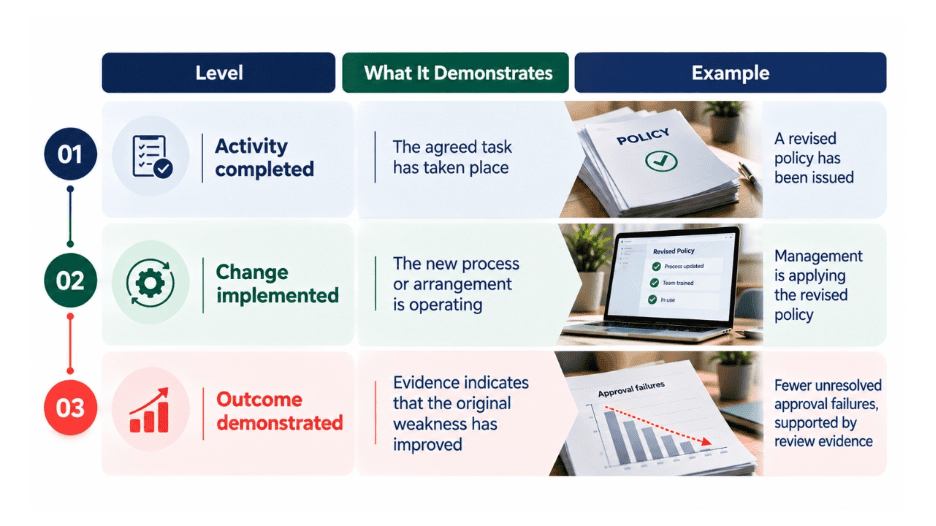
Not every recommendation requires extensive measurement.
However, material improvements should have evidence proportionate to their importance and risk.
This approach also strengthens assurance.
Where internal audit, risk or another independent function reviews implementation, it should be able to examine more than management’s statement that an action is complete.
Completion should be defined by evidence, not optimism.
10. The Review Point Is Where Accountability Becomes Real
Assigning an action is only the beginning.
Accountability becomes meaningful when the responsible person knows that progress and results will be examined.
This does not mean boards should review every operational task.
Instead, review arrangements should reflect the importance of the issue and the level at which accountability sits.
A material board performance review recommendation may return to the board or relevant committee.
An operational Company Secretary improvement might be reviewed by the General Counsel or Chief Executive.
A responsible-impact initiative could be assessed through management performance reviews, a sustainability committee or another appropriate governance forum.
The essential requirement is that somebody with the right authority examines the evidence and determines whether further action is necessary.
Review dates should also be realistic.
A process change may be ready for assessment after one or two operating cycles. By contrast, a social-impact intervention may require a longer period before meaningful outcomes can be observed.
The organisation should distinguish between implementation milestones and effectiveness reviews.
That prevents premature closure while avoiding unnecessary delays.
A review point is not simply a deadline. It is the moment at which the organisation tests whether its decision produced the intended change.
The Governance Action Chain: A Practical Decision Framework
The following framework can be applied to board performance reviews, Company Secretary hand-offs and responsible-impact recommendations.
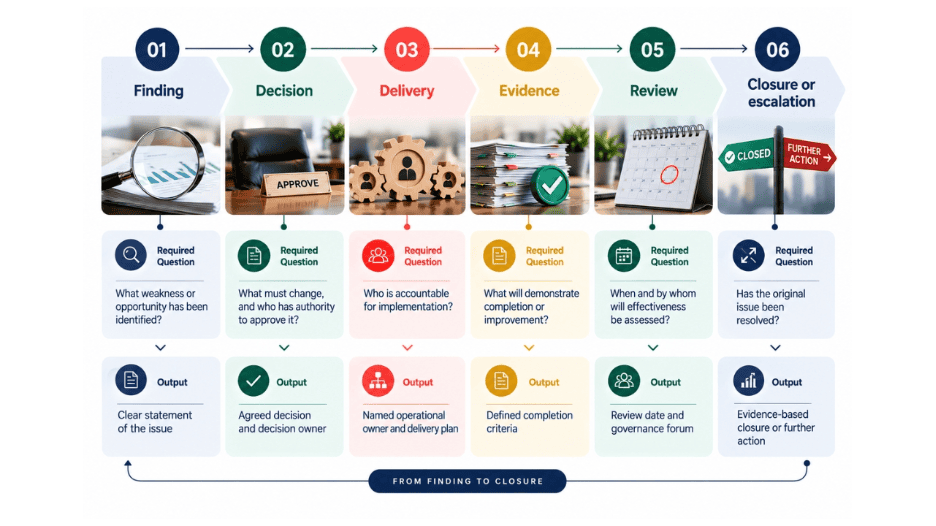
The framework should remain proportionate.
A routine administrative improvement may require a simple action record.
A material governance weakness may require formal board oversight, management reporting and independent validation.
The principle remains consistent.
Every significant finding should have a clear route from insight to accountable change.
Five Warning Signs Your Organisation Has a Follow-Through Problem
1. Recommendations Are Approved Without Named Owners
The organisation agrees that change is necessary but does not establish who must deliver it.
2. The Company Secretary Becomes Responsible for Chasing Every Action
Coordination is replacing management accountability.
3. Progress Reports Describe Activity Rather Than Improvement
Leadership receives updates on meetings, policies and training without evidence that the original weakness has changed.
4. Actions Are Closed Without Testing Effectiveness
Completion is treated as an administrative status rather than a governance judgement.
5. The Same Findings Reappear in Successive Reviews
Recurring recommendations suggest that earlier actions may not have addressed the underlying causes.
Where these patterns persist, the organisation may need to review its approach to decision rights, delivery ownership and performance monitoring.
A Short Governance Follow-Through Checklist
Before accepting or closing a material governance recommendation, ask:
- Is the finding clear enough to support a specific decision?
- Have we identified the person or body authorised to approve the change?
- Is one executive or function accountable for delivery?
- Does the operational owner have the necessary authority and resources?
- Have we defined evidence of implementation and effectiveness?
- Is there an agreed review date and appropriate governance forum?
- Will the action remain open if the original weakness has not been resolved?
A recommendation that cannot pass this test may need further design before implementation begins.
The Lumorus View
The problem with many governance improvement programmes is not that organisations fail to identify weaknesses. It is that they fail to design the accountability required to correct them.
Boards commission reviews, executives approve plans and organisations invest in assessments.
These activities can be valuable.
However, their purpose is not to produce reports. It is to improve how institutions make decisions, exercise authority and deliver outcomes.
That requires a clear separation between oversight and execution.
Boards should approve matters within their authority, challenge management and examine evidence of progress.
Executives should own implementation.
Company Secretaries should support the governance process, preserve decision records and help maintain accountability without becoming the default owners of management’s obligations.
Responsible-impact teams should apply the same discipline to environmental and social commitments.
An assessment identifies what matters.
A decision determines what will change.
Management delivers the intervention.
Evidence establishes whether the intended result has occurred.
The relevant governance forum then decides whether the issue can be closed.
This is the difference between having a governance improvement programme and actually improving governance.
At Lumorus, that principle connects our work across Board Performance Reviews, Company Secretary support and responsible impact.
The focus is not simply on producing better findings.
It is on helping organisations establish clearer decisions, stronger accountability and more credible evidence of progress.
Good governance is not demonstrated by the number of recommendations an organisation accepts. It is demonstrated by the quality of the changes those recommendations produce.
The Bottom Line
A board review can identify a weakness without correcting it.
A Company Secretary can record a decision without becoming responsible for its delivery.
A responsible-impact assessment can identify a material issue without producing a measurable improvement.
These distinctions matter because governance depends on more than insight.
It depends on the allocation of authority, the exercise of responsibility and the ability to demonstrate results.
Every material recommendation should therefore answer four questions.
Who decides?
Who delivers?
What proves completion?
When will the result be reviewed?
If those questions remain unanswered, the organisation has not yet moved from finding to follow-through.
It has simply moved from one document to another.
The real measure of governance is not what an institution discovers about itself, but what it has the discipline to change.
Continue Exploring
- Strengthen board effectiveness and translate review findings into improvement priorities: Board Evaluation & Assessment
- Examine governance structures, decision rights and accountability arrangements: Governance Review
- Improve the quality of board decisions and risk oversight: Board Decision & Risk Assessment
- Support governance coordination and board processes: Corporate Governance Support
- Explore professional Company Secretary support and connected governance infrastructure: CoSec Hub
- Identify material environmental and social issues requiring management attention: ESG Materiality & Risk Assessment
- Strengthen evidence of social outcomes: Social Impact Measurement and Management
Sources and Further Reading
1. Financial Reporting Council: UK Corporate Governance Code 2024
The Code provides the UK framework for listed-company governance, including board responsibilities, performance reviews, accountability and internal controls. Its principles are relevant to the distinction between board oversight and management delivery.
Source: UK Corporate Governance Code 2024
2. Financial Reporting Council: Corporate Governance Code Guidance
The guidance addresses the Chair’s responsibilities, board performance reviews, information quality and acting on the results of reviews. It also discusses monitoring and evaluating the effectiveness of governance and control arrangements.
Source: FRC Corporate Governance Code Guidance
3. OECD: G20/OECD Principles of Corporate Governance 2023
The Principles establish internationally recognised expectations concerning board responsibilities, disclosure, oversight and accountability.
Source: G20/OECD Principles of Corporate Governance 2023
4. Lumorus: Board Evaluation & Assessment
Lumorus’s board evaluation capability provides a route for assessing board effectiveness and identifying areas requiring governance improvement.
Source: Board Evaluation & Assessment
5. Lumorus: Governance Review
The governance review service supports organisations in examining governance structures, responsibilities and effectiveness.
Source: Governance Review
6. CoSec Hub: The Company Secretary Command Centre
CoSec Hub combines governance infrastructure with professional Company Secretary support through a retainer model and Governance Knowledge Centres.
Source: CoSec Hub
7. Lumorus: Social Impact Measurement and Management
Lumorus’s responsible-impact capability supports organisations in assessing social outcomes and strengthening impact management.
Source: Social Impact Measurement and Management
Lumorus: Better Business, Built on Purpose
Lumorus is a UK headquartered global governance, ESG, Company Secretary and advisory firm supporting organisations across Europe, Africa, Asia, the Caribbean, Canada, the Middle East and international markets.
Our work across Board Performance Reviews, Company Secretary services and Responsible Impact supports organisations seeking to connect governance insight with practical improvement.
Through our Board Evaluation & Assessment capability, we help boards examine effectiveness and identify priorities.
Our CoSec Retainer provides professional governance support, while CoSec Hub supports connected Company Secretary operations.
Within Responsible Impact, our ESG Strategy Development and Social Impact Measurement and Management services help organisations connect material priorities with action and evidence.
Looking ahead, Boardroom Intelligence and ImpactOS will form part of Lumorus’s wider conversation about governance insight and responsible impact. Further details will follow.
For organisations seeking a practical starting point, the most important question is not whether the next review will identify something useful.
It is whether the organisation is prepared to act on what it already knows.
From finding to follow-through, accountability is what turns insight into improvement.
Lumorus: Better Business, Built on Purpose.