


Artificial intelligence is no longer a future finance capability.
It is rapidly becoming part of the operational architecture of the modern finance function.
Across global organisations, CFOs are now under pressure to move beyond automation and begin using AI to strengthen forecasting, operational visibility, governance reporting, risk oversight and strategic decision making. According to Boston Consulting Group, finance leaders are increasingly shifting AI investment away from experimentation towards enterprise wide operational deployment.
But this transformation is creating a governance problem many organisations are still underestimating.
Finance functions are becoming more technologically sophisticated faster than governance infrastructure is evolving to support them. AI is accelerating decision making, data processing and operational visibility, yet many organisations still lack clear governance frameworks around accountability, oversight, risk escalation and AI enabled decision controls.
This creates a growing institutional contradiction.
The finance function is becoming more intelligent operationally while governance systems remain fragmented administratively.
Why AI Is Reshaping the CFO Function
The finance function has traditionally been built around control, reporting accuracy, compliance, and operational discipline. AI is now fundamentally changing how those responsibilities are executed.
According to BCG, leading finance organisations are increasingly using AI to improve forecasting accuracy, automate reporting workflows, strengthen financial planning, and accelerate operational insight generation. This is allowing finance teams to shift away from repetitive manual processing towards higher value strategic analysis and decision support.
But AI is also changing the expectations placed on CFOs themselves.
Finance leaders are no longer expected simply to report historical performance. Increasingly, they are expected to deliver predictive insight, operational visibility, scenario modelling, and strategic responsiveness at speed.
This means the CFO role is evolving from financial steward towards enterprise intelligence leader.
The Shift from Automation to Strategic Finance Infrastructure
Many organisations still think about AI inside finance primarily as an efficiency tool.
That framing is already outdated.
The most advanced finance functions are no longer using AI simply to automate transactional activity. They are using it to strengthen enterprise wide decision infrastructure, improve governance visibility and support faster strategic execution.
According to McKinsey, organisations integrating AI into core finance operations are significantly more likely to improve forecasting capability, reduce reporting delays and strengthen operational responsiveness across leadership teams.
This shift matters because finance increasingly sits at the centre of organisational visibility and survival..
CFOs now oversee not only financial reporting, but also ESG data integrity, operational resilience metrics, regulatory disclosures, governance reporting and enterprise performance intelligence. As AI capabilities expand, finance functions are becoming more deeply integrated into enterprise governance architecture itself.
That means finance transformation is no longer simply a technology issue.
It is becoming a governance infrastructure issue.
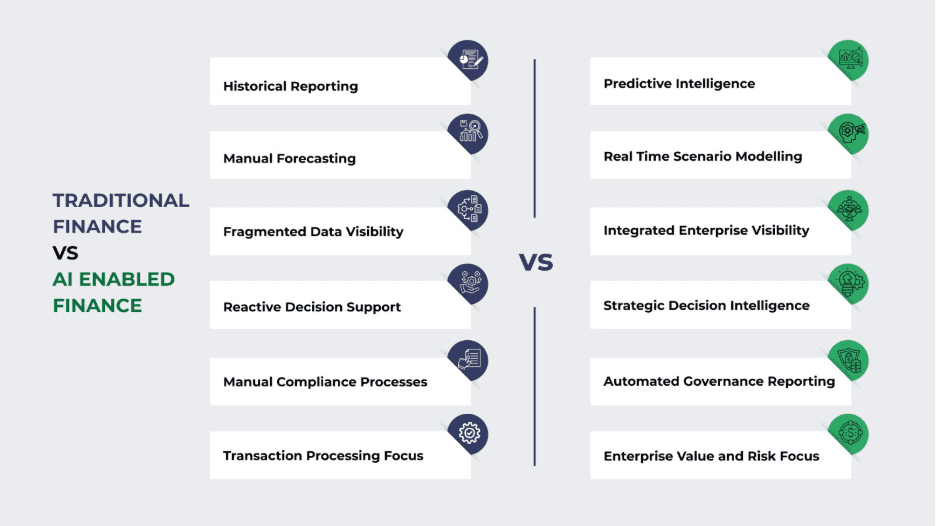
Traditional Finance vs AI Enabled Finance
Key Insight:
AI is not simply changing finance operations. It is reshaping how governance visibility, strategic oversight and organisational accountability function inside modern enterprises.
Why AI Governance Is Becoming a CFO Issue
Many organisations still treat AI governance as a technology issue owned primarily by IT or digital transformation teams.
That assumption is increasingly becoming dangerous.
As AI becomes embedded into forecasting, financial controls, reporting systems and enterprise decision support, CFOs are becoming central actors in AI governance whether organisations recognise it or not.
Governance failures around AI increasingly emerge through weak accountability structures, unclear ownership models, poor oversight mechanisms and insufficient governance visibility rather than purely technical failures.
This creates new responsibilities for finance leaders.
CFOs increasingly need governance systems capable of supporting:
- AI oversight
- Data accountability
- Regulatory transparency
- Model governance
- Risk escalation
- Decision traceability
- Operational resilience
- Enterprise accountability
Without those governance systems, AI adoption can increase operational speed while simultaneously weakening institutional oversight.
That is the governance risk many organisations still fail to recognise early enough.
The Governance Risks Most Finance Functions Still Underestimate
AI creates significant opportunities for finance transformation.
But it also creates governance exposure if organisations scale technology faster than governance capability.
Common governance risks increasingly include:
- Weak AI accountability structures
- Limited visibility into automated decisions
- Poor model governance
- Inconsistent data quality
- Fragmented reporting oversight
- Regulatory compliance exposure
- Weak escalation mechanisms
- Unclear governance ownership
One of the largest risks facing organisations adopting AI at scale is the absence of clear governance infrastructure capable of supporting transparency, accountability, and responsible operational oversight.
These governance weaknesses often remain invisible during early implementation phases.
The real exposure typically emerges later during audits, regulatory scrutiny, operational failures or investor examination.
That is why governance maturity increasingly matters as much as technological capability.
What High Performing AI Enabled Finance Functions Look Like
The strongest finance functions increasingly treat AI as part of broader governance and operational infrastructure rather than isolated technology deployment.
They focus not only on automation capability, but also on governance discipline, accountability structures, and operational visibility.
High performing AI enabled finance functions typically prioritise:
- Strong governance controls
- Clear accountability ownership
- Integrated enterprise data visibility
- Structured AI oversight frameworks
- Transparent escalation mechanisms
- Board level reporting visibility
- Cross functional governance coordination
Organisations achieving the strongest AI outcomes are usually those combining technology investment with governance maturity, operational discipline, and structured accountability systems.
This is particularly important inside regulated industries where AI related governance failures may create legal, operational, and reputational consequences simultaneously.
Why Governance Infrastructure Matters More Than Ever
AI is accelerating the operational speed of organisations.
But faster decision making without stronger governance systems creates institutional risk.
This is why governance infrastructure is becoming increasingly important inside finance transformation programmes. Organisations need governance systems capable of sustaining visibility, accountability and oversight as AI becomes embedded into operational workflows.
This includes:
- Governance reporting structures
- Decision traceability systems
- AI oversight frameworks
- Compliance visibility
- Cross functional governance coordination
- Audit readiness mechanisms
- Operational accountability systems
Without these structures, organisations risk building intelligent operational systems on top of weak governance foundations.
That combination rarely ends well.
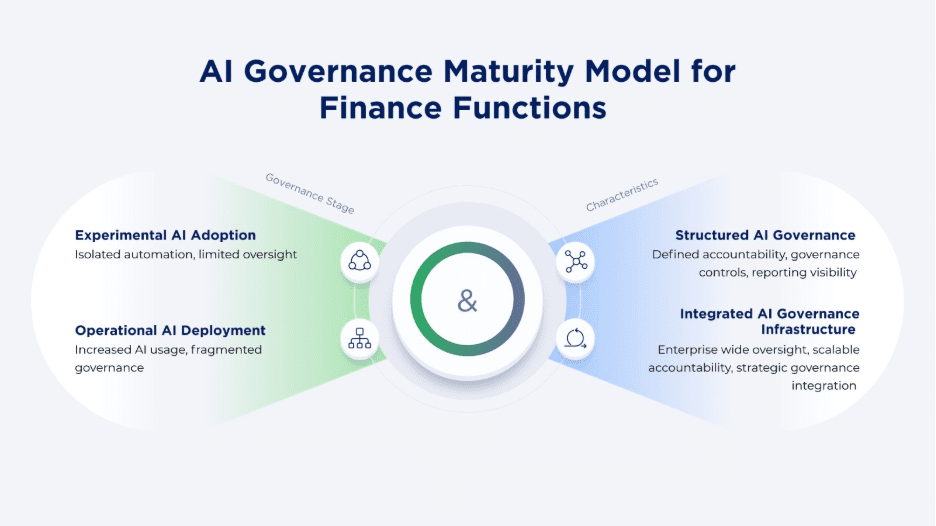
AI Governance Maturity Model for Finance Functions
High Performing Organisations Treat AI Governance as Strategic Infrastructure
The strongest organisations increasingly recognise that AI governance should function as operational infrastructure rather than compliance administration.
It must be:
- Structured
- Transparent
- Accountable
- Scalable
- Operationally resilient
- Strategically integrated
This is particularly important for multinational organisations, regulated industries, investor backed businesses and governance intensive sectors where operational decisions increasingly depend on AI enabled systems and enterprise data visibility.
Organisations creating the greatest value from AI are not necessarily those investing the most aggressively in technology. They are often the organisations combining AI capability with disciplined governance, operational integration, and enterprise wide accountability structures.
AI transformation without governance maturity creates exposure.
AI transformation supported by governance infrastructure creates advantage.
Why Lumorus Focuses on Governance Infrastructure and Accountability
Lumorus is a UK headquartered global governance, ESG and advisory firm supporting organisations across Africa, Europe, Asia, the Caribbean, Canada and other international markets.
For more than 10+ years, Lumorus has supported boards, leadership teams and regulated organisations across governance transformation, board effectiveness, governance infrastructure and organisational accountability.
As organisations adopt AI across finance, governance and operational systems, our work increasingly focuses on helping organisations strengthen:
- Governance infrastructure
- AI governance frameworks
- Board oversight capability
- Accountability systems
- Governance visibility
- Risk oversight structures
- Organisational resilience
- Decision traceability systems
We believe governance systems must evolve at the same speed as organisational technology capability.
Because operational intelligence without governance discipline eventually creates institutional vulnerability.
What Next?
Lumorus is a UK headquartered global governance, ESG and advisory firm supporting organisations across multiple jurisdictions and regulated environments.
We help organisations strengthen governance infrastructure, accountability systems and board oversight capability as AI, finance and operational complexity continue to evolve.
To explore Lumorus governance, AI oversight and organisational resilience solutions, visit:
www.lumorus.com [email protected]
Sources
- Boston Consulting Group — The CFO’s AI Agenda: From Automation to Advantage