



A board should be concerned if every recommendation from its independent evaluation can be neatly assigned to one person, given a deadline and marked complete.
Clear accountability is essential to effective governance, but not every weakness in board performance is an operational problem with an individual solution. Some of the most consequential findings concern how directors exercise judgement together, challenge assumptions and respond when disagreement becomes uncomfortable.
A board may have the right committee structure, appropriate policies and experienced directors while still struggling to question management’s strategic assumptions. Equally, its members may demonstrate strong individual competence without creating an environment in which alternative views receive serious consideration.
These weaknesses rarely disappear because somebody updates a policy or attends a development session.
Instead, they require changes in collective behaviour, the quality of boardroom discussion and the conditions under which directors make decisions.
This distinction matters because board evaluations can create a misleading sense of progress when organisations concentrate on recommendations that are easiest to implement and report.
A revised committee charter can be approved, while a board development programme can be scheduled and recorded as complete. However, a finding that directors avoid challenging a dominant colleague may remain unresolved because nobody has established how the board will confront the behaviour.
The easiest recommendations to close are not necessarily the ones that matter most.
For boards preparing for their next evaluation, the challenge is therefore to distinguish between recommendations that require implementation and those that require sustained improvement in collective judgement.
Both need accountability, but they do not need identical approaches.
That is where board performance reviews become more than a periodic governance exercise. Properly designed, they provide an opportunity to examine not only what the board does, but how it thinks, challenges and reaches decisions.
Read More: Lumorus Board Evaluation & Assessment
Executive Takeaway
Board evaluation recommendations generally fall into two broad categories.
The first concerns structural, procedural or operational improvements, such as revising committee responsibilities, strengthening board information or addressing skills gaps. These recommendations can usually be assigned to a decision owner, an implementation owner and a defined completion date.
The second concerns collective board effectiveness, including the quality of disagreement, willingness to challenge assumptions, influence of established relationships and ability to make difficult decisions.
Such findings require a different approach.
Although the Chair and relevant committees may lead the response, improvement depends on the board’s collective participation rather than the completion of an individual task.
A mature board evaluation follow-up process should therefore:
- Distinguish between implementable recommendations and collective development priorities.
- Establish clear accountability without treating collective behaviour as an administrative task.
- Give the Chair responsibility for facilitating improvement while recognising the obligations of every director.
- Define evidence of progress through boardroom practice, decision quality and observed behavioural change.
- Revisit significant findings over several board cycles rather than closing them prematurely.
- Use independent challenge where appropriate to assess whether improvement is genuine.
The purpose of a board evaluation is not to produce an impressive completion rate. It is to strengthen the board’s ability to govern.
1. Why Conventional Action Tracking Is Not Enough for Board Development
Action tracking is a valuable governance discipline.
When a board evaluation identifies an outdated committee charter, unclear reporting arrangements or a gap in director induction, the response can usually be defined with reasonable precision.
The board or relevant committee approves a change, somebody is assigned responsibility for implementation and evidence is produced to demonstrate completion.
However, the same approach becomes less effective when a recommendation concerns collective behaviour.
Consider a finding that directors do not challenge management’s strategic assumptions sufficiently.
Who should own that recommendation?
The Chair has an important leadership responsibility, but meaningful improvement also depends on the willingness of individual directors to ask difficult questions and engage constructively with opposing views.
Management must provide information that supports challenge, while the board as a whole needs to create an environment in which disagreement is taken seriously.
Assigning the recommendation solely to the Chair may simplify the action register without accurately reflecting how improvement must occur.
Alternatively, recording every director as an owner can dilute accountability because collective responsibility is not accompanied by a clear process for change.
The weakness lies in treating a behavioural issue as though it were a conventional administrative task.
Some board evaluation findings require an action plan. Others require a deliberate change in how the board operates.
A mature review process recognises both categories and establishes different methods for assessing progress.
2. Two Types of Board Evaluation Recommendations
The distinction between implementable and developmental findings provides a useful starting point for board evaluation follow-through.
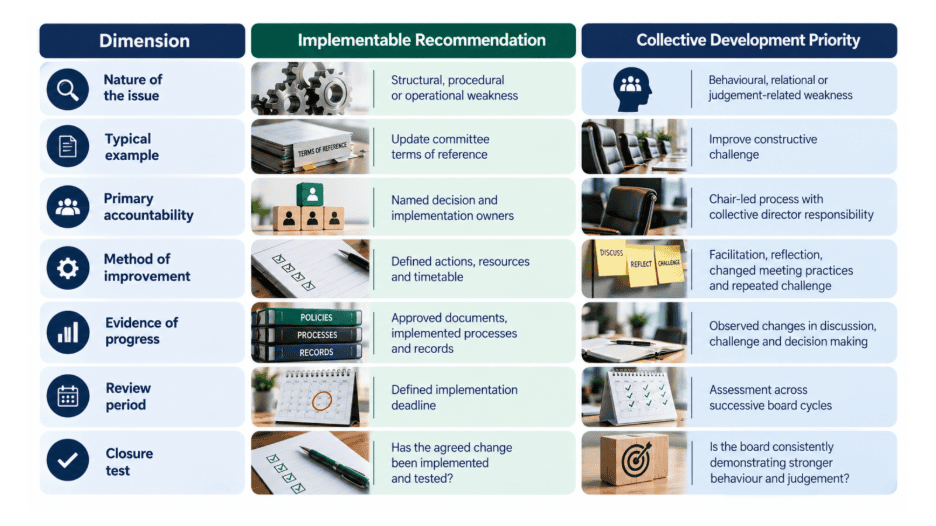
These categories are not mutually exclusive.
A finding concerning weak board challenge may require structural improvements, such as clearer agenda design or better information, alongside changes in director behaviour.
Similarly, a recommendation to strengthen succession planning may involve formal procedures and more difficult conversations about director contribution, tenure and future board composition.
The purpose of classification is therefore not to place every finding into a rigid category.
Instead, it helps boards determine which elements can be implemented through specific actions and which require continuing collective development.
Good governance requires enough structure to create accountability and enough judgement to recognise when a problem cannot be solved through structure alone.
3. The Boardroom Behaviours That Evaluations Must Be Willing to Examine
Some of the most important weaknesses in board effectiveness are difficult to observe through formal governance documents.
A board may meet regularly, receive comprehensive papers and maintain a well-designed committee structure.
Yet those arrangements reveal little about whether directors challenge one another effectively.
The quality of boardroom judgement depends partly on how members behave when the evidence is incomplete, interests differ or a proposal carries significant consequences.
Several areas deserve particular attention.
The Quality of Constructive Disagreement
Effective boards need directors who can question assumptions without turning disagreement into personal conflict.
However, some boards mistake harmony for effectiveness.
A meeting may appear orderly because directors avoid challenging the Chair, Chief Executive or an influential colleague.
Such restraint can reduce the quality of debate, particularly when decisions involve strategic uncertainty or significant risk.
The question is not whether directors disagree frequently.
Rather, it is whether important assumptions receive appropriate scrutiny before decisions are made.
The Influence of Established Relationships
Long-standing professional relationships can support trust and efficient communication.
Nevertheless, they can also make difficult conversations harder.
Directors may hesitate to challenge colleagues with whom they have worked for many years, especially when personal loyalty begins to influence professional judgement.
An independent evaluation should be capable of examining whether these relationships strengthen or constrain effective oversight.
The Treatment of Minority Views
A board does not need unanimity to make a sound decision.
However, minority views should receive appropriate consideration, particularly where they identify material risks or challenge the assumptions underlying a proposal.
The real issue is whether disagreement influences the quality of deliberation or is simply acknowledged before the majority position prevails.
The Chair’s Influence on Discussion
The Chair plays a central role in creating the conditions for effective boardroom debate.
Agenda design, meeting management, the handling of dissent and the allocation of speaking time can all influence how directors contribute.
Yet responsibility for constructive engagement does not rest with the Chair alone.
Every director must exercise independent judgement and participate in the board’s collective work.
A board’s effectiveness is revealed not only by the decisions it reaches, but by the quality of challenge that precedes them.
Explore More: Lumorus Board Strategy Sessions
4. Why the Chair Cannot Be the Sole Owner of Collective Board Behaviour
When an evaluation identifies weaknesses in boardroom dynamics, the Chair is often assigned responsibility for addressing them.
That is understandable.
The Chair leads the board, shapes meeting practices and has significant influence over the conditions in which directors exercise judgement.
However, assigning sole ownership to the Chair can oversimplify the problem.
Constructive challenge requires participation from every director.
Independent judgement cannot be delegated, while a culture of thoughtful disagreement depends on the willingness of board members to question established assumptions.
The Chair can create space for discussion, encourage quieter directors to contribute and ensure that opposing views are considered.
Nevertheless, the Chair cannot personally deliver independent thinking on behalf of the board.
The distinction is between leadership accountability and collective behavioural responsibility.
A useful approach is to make the Chair accountable for leading the development process while recognising that the board collectively owns the required change in behaviour.
Where the evaluation raises concerns about the Chair’s own conduct, leadership of the follow-up should sit with an appropriate independent director or another suitable governance mechanism.
That distinction is particularly important because a Chair should not be expected to independently validate improvements in behaviour that they may have contributed to shaping.
Collective responsibility should not become an excuse for weak accountability, but neither should accountability be simplified until it misrepresents the nature of the problem.
The Financial Reporting Council’s UK Corporate Governance Code 2024 and accompanying guidance provide relevant expectations concerning board leadership, effectiveness, performance reviews and director contribution.
These principles reinforce the need to consider board performance as a collective governance responsibility rather than simply a collection of individual tasks.
5. Worked Example: A Board That Avoids Difficult Strategic Challenge
Consider a fictional listed company whose independent board performance review identifies a recurring concern.
Directors possess appropriate technical experience, attend meetings consistently and demonstrate strong preparation.
However, strategic proposals from management rarely receive sustained challenge.
Several directors acknowledge privately that the Chief Executive’s recommendations are generally accepted without sufficient examination of alternatives.
The Chair maintains an orderly meeting environment, but discussions tend to move towards consensus before competing assumptions have been fully explored.
The review concludes that the board needs to strengthen constructive challenge.
The Conventional Response
The recommendation is assigned to the Chair, with an action to improve boardroom discussion.
A development session is scheduled, directors attend and the action is subsequently marked complete.
The organisation has demonstrated activity.
However, it has not established whether the board’s decision making has changed.
A Stronger Development Response
A more thoughtful process begins by identifying the behavioural change required.
The board agrees that significant strategic proposals should receive clearer examination of assumptions, alternative options and material risks.
Rather than relying solely on a training session, the Chair introduces more deliberate opportunities for challenge during strategic discussions.
Management is asked to present the reasoning behind its preferred recommendation alongside credible alternatives.
Directors also agree to examine how dissenting views are handled and whether the meeting process allows sufficient time for difficult questions.
Who Is Accountable?
Development lead: Chair, supported by the Company Secretary and, where appropriate, an independent facilitator.
Collective responsibility: Every director, through their contribution to discussion, challenge and decision making.
Management responsibility: Provide decision-quality information and engage constructively with board scrutiny.
What Would Demonstrate Progress?
Evidence might include improved quality of strategic papers, more substantive discussion of alternatives and greater participation across the board.
Director feedback could provide additional insight, while observation of subsequent meetings may help assess whether established patterns are changing.
However, the board should not equate a higher number of questions with better challenge.
The real test is whether discussion becomes more rigorous, relevant and influential in shaping decisions.
When Should the Finding Be Reviewed?
The board agrees to examine progress after several strategic meetings rather than treating the development session as the completion point.
An independent follow-up may be appropriate where the original finding was significant or where internal relationships could affect the reliability of self-assessment.
The recommendation should remain a development priority until there is credible evidence that the board’s collective behaviour has improved.
This approach does not abandon accountability.
It applies accountability in a way that reflects the nature of the problem.
6. The Difference Between Completing an Action and Improving Board Judgement
Board evaluation follow-up often relies on action registers.
These records can provide useful visibility over responsibilities, deadlines and progress.
However, an action register is not a complete measure of board effectiveness.
A recommendation to update committee terms of reference can be assessed through formal approval and subsequent implementation.
By contrast, a finding concerning weak strategic challenge cannot be resolved simply by recording that directors attended a workshop.
The distinction becomes clearer when boards separate three levels of progress.
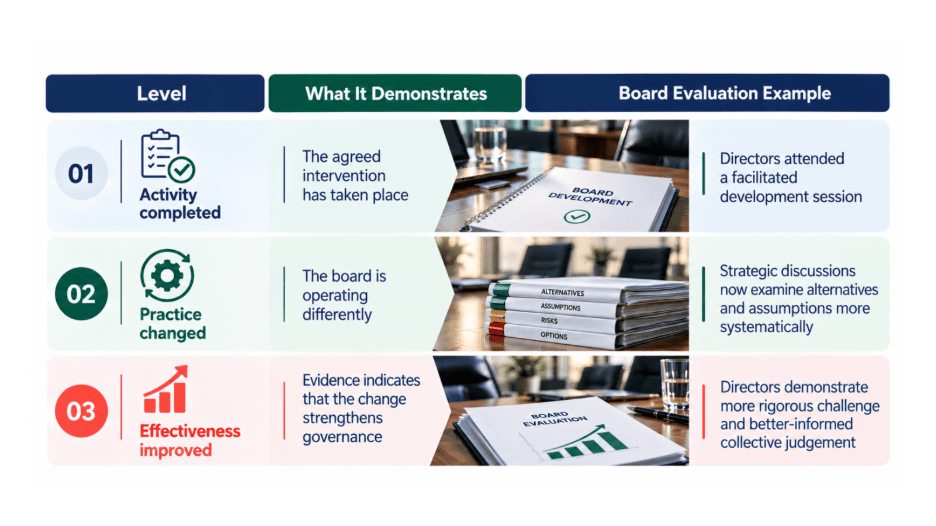
Each level matters.
Activities can create the conditions for improvement, while changes in practice provide evidence that the board is responding.
However, the ultimate objective is stronger governance effectiveness.
Boards should therefore avoid treating completion statistics as a substitute for judgement.
An action register showing that every recommendation has been closed may look impressive.
Nevertheless, the most consequential behavioural weaknesses may remain unresolved if the board has not tested whether its decision making has changed.
The measure of progress is not how many actions have been closed, but whether the board is governing more effectively.
7. How to Follow Through on Collective Board Development
Collective development priorities require a more thoughtful follow-up process than conventional administrative recommendations.
A practical approach can be organised around five stages.
Stage One: Define the Behavioural Finding Precisely
Recommendations should identify the behaviour that requires improvement rather than rely on broad statements about board culture.
For example, strengthening board dynamics is too vague to support meaningful follow-through.
A more useful finding might identify that directors rarely challenge the assumptions underlying major strategic proposals.
Precision helps the board understand what needs to change.
Stage Two: Identify the Development Lead
The Chair will often be responsible for facilitating collective improvement.
However, where the finding concerns the Chair’s own effectiveness, an appropriate independent director should lead the response.
This creates accountability for the development process without implying that one person can deliver the collective behavioural change.
Stage Three: Agree the Required Change in Practice
The board should identify what stronger behaviour would look like during meetings and decision making.
This might involve better consideration of alternative strategies, more deliberate engagement with minority views or clearer separation between information sessions and decision discussions.
The objective is to make the desired improvement observable.
Stage Four: Create Opportunities to Practise
Behavioural change rarely occurs through one intervention.
Boards may need facilitated discussions, revised meeting practices, reflection after significant decisions or structured opportunities for directors to challenge assumptions.
Development should be connected to real board work rather than treated as an activity separate from it.
Stage Five: Review Evidence Over Time
Progress should be assessed through appropriate observation, director feedback and examination of how significant decisions are approached.
Where the original finding is sensitive, independent follow-up can help provide a more credible assessment.
Collective development requires discipline, but that discipline should support better judgement rather than reduce board behaviour to a checklist.
Read More: Lumorus Director CPD Training
8. Independent Board Evaluation Should Examine What Formal Governance Cannot Reveal
Formal governance documents can demonstrate whether a board has appropriate structures.
They cannot, by themselves, establish whether those structures are working effectively.
A committee may have a comprehensive charter but struggle to challenge management.
Similarly, a board may include directors with relevant expertise while failing to draw effectively on their different perspectives.
Independent board performance reviews can provide an opportunity to examine these less visible dimensions.
Interviews, document reviews and appropriate observation can help identify patterns that directors may find difficult to recognise from within the boardroom.
However, the value of independence depends on the review’s willingness to address uncomfortable findings.
A report that avoids sensitive issues may be easier to receive, but it is unlikely to provide the full benefit of an independent assessment.
The same principle applies to follow-through.
Where recommendations concern collective behaviour, the board should be willing to examine whether its own perceptions of improvement are supported by credible evidence.
Independent challenge can be particularly valuable when long-standing relationships or established patterns of discussion are part of the problem.
An effective evaluation should be capable of identifying the weaknesses that the board’s existing habits make difficult to see.
The FRC Corporate Governance Code Guidance offers relevant guidance on board performance reviews, including their scope, conduct and follow-up.
For boards preparing an evaluation, the central question should not be whether the review will confirm that formal governance arrangements exist.
It should be whether the process will examine how effectively directors use those arrangements to exercise judgement.
9. Why Board Evaluation Preparation Matters Before the Review Begins
Boards often concentrate on evaluation follow-up after the review report has been presented.
However, several important decisions should be made before the assessment begins.
The board needs to establish what it wants to learn, which aspects of effectiveness deserve particular attention and how findings will be handled.
It should also consider whether the evaluation will examine collective behaviour alongside formal structures and processes.
Without this preparation, a review can become dominated by matters that are easy to measure.
Committee composition, meeting frequency, agenda structure and policy compliance are all relevant.
Nevertheless, they provide only part of the picture.
A board seeking meaningful improvement should also be prepared to examine the quality of challenge, the influence of relationships, the handling of dissent and the effectiveness of collective judgement.
Preparation should therefore include agreement on how different types of findings will be followed through.
Operational recommendations may require named implementation owners and completion dates.
Collective development priorities need appropriate leadership, opportunities for changed practice and credible review arrangements.
Making this distinction before the evaluation begins helps ensure that the eventual report leads to the right form of action.
A board should decide how seriously it intends to use an evaluation before it decides how to conduct one.
10. The Board Performance Review Readiness Toolkit: A Practical Starting Point
For boards preparing their next evaluation, the quality of preparation can shape the value of the entire exercise.
An effective review should do more than confirm compliance with governance expectations.
It should help directors examine whether the board’s composition, processes, relationships and collective judgement remain appropriate for the organisation’s circumstances.
Lumorus has developed a complimentary Board Performance Review Readiness Toolkit to help organisations approach this preparation more thoughtfully.
The resource is intended for boards, Chairs, Company Secretaries and governance leaders considering an upcoming review.
It provides a starting point for examining the questions that should be considered before an evaluation gets underway.
For organisations seeking a more meaningful review process, the essential preparation questions include:
- What are the most important aspects of board effectiveness that the evaluation should examine?
- Are directors prepared to discuss collective behaviour as well as formal governance structures?
- How will the review distinguish operational recommendations from development priorities?
- Who will lead follow-through where findings concern the board collectively?
- What evidence will demonstrate that boardroom behaviour and judgement have improved?
- How will significant findings remain visible beyond the initial action plan?
These questions help move the conversation from evaluation compliance towards genuine board development.
Complimentary Resource: Board Performance Review Readiness Toolkit
Prepare for your next board evaluation with a more thoughtful approach to governance effectiveness, collective judgement and meaningful follow-through.
Access the Board Performance Review Readiness Toolkit
11. Seven Warning Signs That a Board Evaluation Is Becoming an Administrative Exercise
1. Every Recommendation Is Treated as a Task
The board assumes that all findings can be resolved through individual ownership and completion dates, even when the underlying issue concerns collective behaviour.
2. The Chair Is Assigned Responsibility for Every Behavioural Finding
Leadership accountability is confused with the collective responsibilities of directors.
3. Development Activities Are Treated as Evidence of Improvement
Workshops and training sessions are recorded as complete without examining whether boardroom practice has changed.
4. Difficult Findings Are Rewritten Into Comfortable Recommendations
Sensitive concerns about challenge, relationships or influence are converted into vague actions that avoid the underlying issue.
5. Completion Rates Become the Main Measure of Success
The board celebrates the number of closed recommendations without testing whether governance effectiveness has improved.
6. Collective Development Priorities Disappear Between Evaluations
Behavioural findings receive attention immediately after the report but are not revisited during subsequent board cycles.
7. The Same Weaknesses Reappear in Successive Reviews
Recurring findings suggest that earlier interventions may not have addressed the causes of the problem.
Several of these warning signs together indicate that the evaluation follow-up process may be too administrative for the issues it is intended to address.
A Practical Framework for Board Evaluation Follow-Through
Boards can use the following framework to distinguish between recommendations that require implementation and those that require collective development.
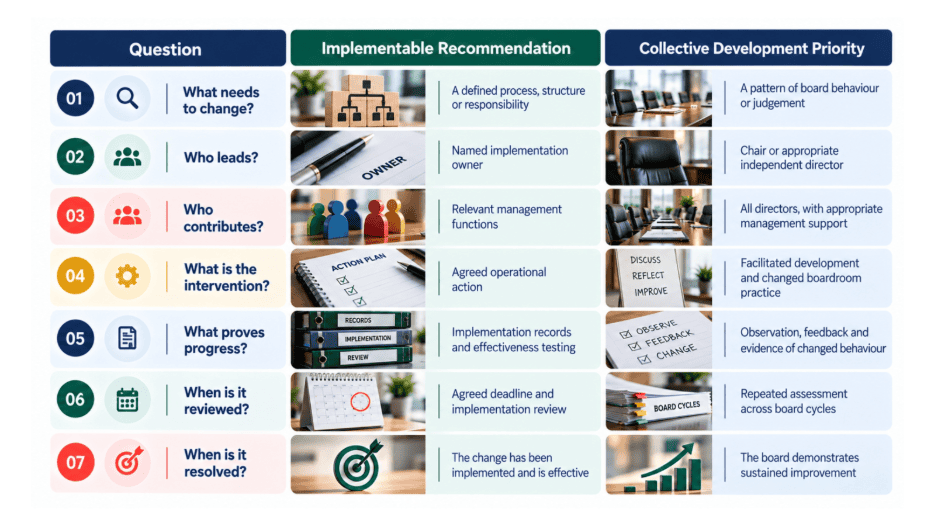
This framework is a practical governance tool rather than a formal regulatory classification.
Its value lies in preventing boards from applying a single administrative method to fundamentally different types of improvement.
A Short Board Evaluation Readiness Checklist
Before commissioning the next review, the Chair, Company Secretary and board should consider:
- Have we agreed what the evaluation needs to reveal beyond formal compliance?
- Will the process examine boardroom challenge, relationships and collective judgement?
- Are we prepared to receive uncomfortable findings?
- Can we distinguish implementable recommendations from collective development priorities?
- Have we agreed how sensitive behavioural findings will be led and reviewed?
- Will evidence of changed practice matter more than action closure rates?
- Have we established how improvement will be revisited after the evaluation?
A board that can answer these questions thoughtfully is better positioned to use its review as an instrument of improvement rather than a periodic governance formality.
The Lumorus View
Board performance reviews should not be judged by how neatly their recommendations fit into an action register.
Their value lies in whether they help directors understand how effectively they exercise judgement together.
Some recommendations will require straightforward implementation.
A committee charter may need revision, a skills gap may require attention or management reporting may need improvement.
These matters benefit from clear owners, deadlines and evidence of completion.
However, the most consequential findings may concern the quality of boardroom challenge, the influence of established relationships or the board’s willingness to question assumptions.
Such weaknesses cannot always be resolved through an individual action.
They require sustained attention to collective behaviour.
The Chair has a critical leadership role, but every director must contribute to the improvement.
Equally, the Company Secretary can support the process without becoming responsible for changing how directors think and interact.
Independent evaluation should help boards confront these distinctions rather than conceal them beneath conventional action tracking.
At Lumorus, our approach to Board Evaluation & Assessment recognises that board effectiveness depends on both sound governance structures and the quality of collective judgement.
Strong boards need reliable processes, but they also need the confidence to disagree, challenge and reconsider established assumptions.
The purpose of board development is not to make every recommendation easy to close. It is to make the board more capable of governing well.
The Bottom Line
A board evaluation can identify a weakness without necessarily revealing a simple solution.
Some findings require policies, procedures and clearly assigned implementation responsibilities.
Others demand something more difficult.
Directors may need to challenge familiar assumptions, reconsider established relationships or change how they respond to disagreement.
These are collective responsibilities that cannot always be reduced to individual tasks.
A strong evaluation follow-up process should recognise the distinction while retaining enough discipline to test whether improvement is occurring.
The board should be able to demonstrate not only that actions have been completed, but that its capacity for sound judgement has strengthened.
The most important recommendation may be the one that cannot be neatly closed, because it requires the board to change how it governs together.
For boards preparing their next evaluation, that is a distinction worth considering before the review begins.
Prepare for Your Next Board Performance Review
An effective board evaluation begins with the right questions.
Before commissioning a review, boards should consider what they want to understand about their effectiveness, how collective behaviour will be examined and what meaningful improvement should look like.
Lumorus’s complimentary Board Performance Review Readiness Toolkit provides a practical starting point for that preparation.
Whether your organisation has an evaluation approaching or is beginning to plan its next review, the resource can help frame a more thoughtful discussion.
Get the Complimentary Board Performance Review Readiness Toolkit
For organisations seeking professional support, Lumorus also provides Board Evaluation & Assessment, Board Strategy Sessions and Director CPD Training.
A better board evaluation should lead to better board judgement, not simply a better action register.
Continue Exploring
- Assess board effectiveness, composition and collective performance: Board Evaluation & Assessment
- Examine governance structures, decision rights and accountability: Governance Review
- Strengthen strategic discussion and collective board engagement: Board Strategy Sessions
- Support director knowledge and professional development: Director CPD Training
- Improve board decision processes and risk oversight: Board Decision & Risk Assessment
- Prepare for an upcoming board evaluation: Complimentary Board Performance Review Readiness Toolkit
Sources and Further Reading
1. Financial Reporting Council: UK Corporate Governance Code 2024
The UK Corporate Governance Code provides a framework for board leadership, effectiveness, accountability and governance reporting. Its provisions address annual board performance reviews and the role of independent external evaluation for relevant listed companies.
Source: UK Corporate Governance Code 2024
2. Financial Reporting Council: Corporate Governance Code Guidance
The guidance addresses board performance reviews, the responsibilities of the Chair, director contribution and the importance of acting on evaluation findings.
Source: FRC Corporate Governance Code Guidance
3. OECD: G20/OECD Principles of Corporate Governance 2023
The Principles provide an international reference point for board responsibilities, independent judgement, effective oversight and accountability.
Source: G20/OECD Principles of Corporate Governance 2023
4. Financial Reporting Council: Guidance on Board Effectiveness
The FRC’s governance guidance addresses boardroom dynamics, the quality of debate, constructive challenge and the contribution of individual directors to collective board effectiveness.
Source: FRC Corporate Governance Code Guidance
5. Lumorus: Board Evaluation & Assessment
Lumorus supports boards in examining governance effectiveness, board composition, decision processes and priorities for improvement.
Source: Board Evaluation & Assessment
6. Lumorus: Board Strategy Sessions
Lumorus provides facilitated board strategy sessions designed to support strategic discussion, alignment and effective governance engagement.
Source: Board Strategy Sessions
7. Lumorus: Board Performance Review Readiness Toolkit
A complimentary resource for boards, Chairs and governance professionals preparing for an upcoming board performance review.
Source: Board Performance Review Readiness Toolkit
Lumorus: Better Business, Built on Purpose
Lumorus is a UK headquartered global governance, Company Secretary, ESG and advisory firm supporting organisations across international markets.
We believe board effectiveness depends on more than compliance with formal governance arrangements.
It requires independent judgement, constructive challenge, sound decision processes and a willingness to examine how directors work together.
Through our Board Evaluation & Assessment, Board Strategy Sessions and wider corporate governance advisory services, we support organisations seeking to strengthen board performance and institutional accountability.
Our work recognises that governance improvement is not always a matter of assigning tasks and closing recommendations.
Sometimes, the most important progress occurs when a board becomes more willing to challenge assumptions, engage with disagreement and exercise judgement collectively.
For boards preparing their next evaluation, our complimentary Board Performance Review Readiness Toolkit offers a practical starting point.
Better board evaluations should produce better boards, not simply completed action plans.
Lumorus: Better Business, Built on Purpose.