



Ask a non-executive director whether the board has an action register, and the answer will probably be yes. Ask whether they can explain the current status of every significant action, who is accountable and when the board will examine the result, and the conversation may become more difficult.
That difference deserves attention.
Boards spend considerable time examining strategy, challenging management proposals and approving decisions. Yet the value of those discussions depends partly on what happens after directors leave the meeting.
A recommendation may be accepted, an action recorded and responsibility apparently assigned. Several months later, the same matter returns to the board because implementation has stalled, ownership has changed or nobody established what successful completion should look like.
The organisation may have a functioning action register, but that does not necessarily mean it has effective action governance.
For Chairs, CEOs and non-executive directors, the distinction is significant. A board that cannot see the progress of its own decisions may struggle to distinguish management activity from meaningful delivery.
Equally, a Company Secretary who repeatedly chases outstanding actions may be compensating for unclear executive accountability rather than operating an effective governance process.
The question is not whether actions are being recorded. It is whether directors have sufficient visibility to know what has changed, what remains unresolved and where intervention is necessary.
This is particularly relevant following board performance reviews and governance assessments, where recommendations can lose momentum between the presentation of findings and their implementation.
A useful starting point is simple: every priority should have one accountable lead, an observable sign of progress and a confirmed board or committee agenda date.
Without those elements, an action may remain visible on paper while becoming increasingly difficult to govern.
Read More: From Finding to Follow-Through: Who Owns Governance and Impact Improvements?
Executive Takeaway
Board action tracking should provide directors with clear, reliable information about the implementation of significant decisions and recommendations.
An effective approach does not require the board to supervise every operational task. Instead, it enables directors to concentrate on a manageable number of priorities that matter to governance effectiveness, strategic delivery and organisational risk.
For each priority, the board should be able to identify:
- One accountable lead: The individual responsible for ensuring the agreed response is delivered or, for collective board development, the person responsible for leading the improvement process.
- An observable sign of progress: Evidence that implementation is advancing or that the intended improvement is becoming visible.
- A return date: The board or committee meeting at which progress, effectiveness or the need for further action will be examined.
The Company Secretary can coordinate records, reporting and meeting arrangements, but operational delivery should remain with the relevant executive.
Chairs should ensure that significant board development recommendations receive sustained attention, while non-executive directors should challenge progress without taking over management responsibilities.
A good action register tells directors what is outstanding. A strong governance process helps them judge whether the organisation is doing what it agreed to do.
1. Why Board Action Registers Can Create False Confidence
Action registers are a familiar feature of corporate governance.
They record decisions, responsibilities, deadlines and progress, providing continuity between meetings and helping Company Secretaries maintain an accurate record of outstanding matters.
However, the existence of a register can create more confidence than the underlying information justifies.
Consider an action recorded as follows:
Improve the quality of board reporting. Status: In progress.
The entry tells directors that somebody recognises the need for improvement, but it does not establish who is responsible, what has changed or when the board will assess the result.
Another action may appear as completed because management introduced a new reporting template.
Yet directors could still be receiving papers that lack meaningful analysis, clear decision requests or credible alternatives.
The administrative task has been completed, while the original governance weakness remains.
This distinction matters because the board’s responsibility extends beyond receiving updates.
Directors need enough information to challenge whether agreed improvements are being delivered and whether those improvements are producing the intended effect.
The Financial Reporting Council’s UK Corporate Governance Code 2024 provides a relevant foundation. Provision 22 addresses the importance of acting on board performance review results, while the Code’s wider principles emphasise effective board leadership, accountability and governance outcomes.
The accompanying FRC Corporate Governance Code Guidance also encourages boards to examine how well evaluation outcomes have been acted upon.
These expectations reinforce an important principle.
Recording a recommendation is an administrative step. Demonstrating that the recommendation has been addressed is a governance responsibility.
2. The Three-Part Test Every Board Priority Should Pass
Boards do not need complicated reporting systems to improve action visibility.
They need clarity about the information that matters.
A practical approach is to apply three questions to every significant action.
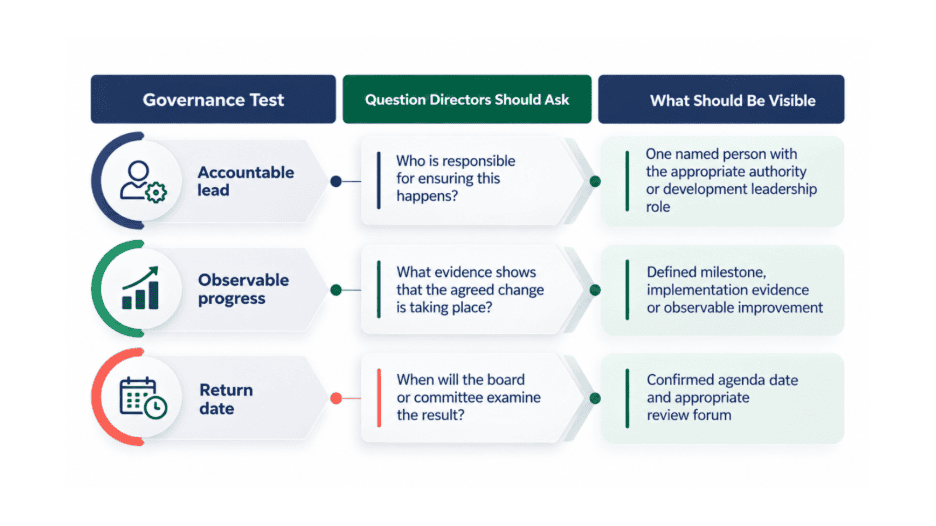
These elements should be established when the action is agreed, rather than reconstructed when directors request an update.
One Accountable Lead
Every material action needs a clearly identified person responsible for moving it forward.
For an operational recommendation, that individual will ordinarily be a relevant executive.
Where the issue concerns board effectiveness, the Chair or an appropriate independent director may lead the development process.
The distinction is important because leadership accountability does not always mean personal responsibility for every element of delivery.
One Observable Sign of Progress
Progress should be defined through evidence rather than reassurance.
A revised policy, completed implementation milestone or tested control may demonstrate progress on an operational action.
For a behavioural recommendation, directors may need to examine changes in meeting practices, constructive challenge or the quality of decision making.
The evidence should reflect the nature of the issue.
One Return Date
Every significant recommendation should have an agreed point at which the board or relevant committee will revisit it.
That date should appear in the forward agenda, not merely in an administrative register.
Without a return point, the action can remain indefinitely in progress while more immediate business occupies directors’ attention.
An action without a return date is a commitment with no reliable moment of accountability.
3. Keep the Board’s Priority List Short Enough to Govern
One of the less obvious weaknesses in board action tracking is excessive volume.
A comprehensive register may contain dozens of items, ranging from routine administrative requests to significant governance reforms.
While recording these matters can be useful, presenting them all as equivalent board priorities makes effective oversight more difficult.
Directors have limited meeting time.
Their attention should be directed towards the actions that materially affect governance effectiveness, strategic execution, risk management and organisational accountability.
Routine operational tasks can be managed through appropriate executive processes, with exceptions escalated where necessary.
The board should therefore distinguish between its priority improvement actions and the wider administrative record.
A useful approach is to maintain a short, actively reviewed set of material priorities supported by a more detailed operational register.
There is no universally appropriate number of board priorities.
The correct volume depends on the organisation’s circumstances, the seriousness of the findings and the board’s capacity to examine progress properly.
However, every item retained for board-level review should justify the attention it receives.
If the priority list is too long for directors to discuss meaningfully, it is probably too long to function as an effective oversight tool.
This does not mean important issues should disappear from view.
Instead, the organisation should establish clear reporting thresholds, appropriate delegation and escalation arrangements.
Such discipline allows the board to concentrate on matters where its judgement and oversight add the greatest value.
4. Board Oversight Must Remain Distinct From Management Delivery
Clear action ownership is essential, but boards should avoid confusing oversight with execution.
A board may approve a recommendation to improve management reporting, strengthen risk controls or revise the organisation’s delegated authority framework.
Nevertheless, directors should not ordinarily become responsible for implementing those operational changes.
The Chief Executive and relevant management functions should own delivery within the organisation’s delegated authority arrangements.
The board’s role is to establish expectations where appropriate, challenge the proposed response and assess evidence of progress.
Company Secretaries support this process by maintaining decision records, coordinating action reporting and ensuring that significant matters return to the appropriate governance forum.
However, the function should not automatically become the accountable owner of every outstanding management action.
The G20/OECD Principles of Corporate Governance 2023 provide an international reference point for the board’s responsibilities concerning strategic guidance, management oversight and accountability.
A practical allocation of responsibilities might look like this:
This separation protects accountability.
When the board becomes too involved in implementation, management responsibility can become blurred.
Conversely, where directors accept vague progress reports without challenge, oversight becomes ineffective.
Good governance requires management to deliver and the board to know whether delivery has occurred.
Read More: A Good Company Secretary Helps Make the Meeting Worth Recording
5. Worked Example: A Board Review Recommendation That Never Quite Gets Completed
Consider a fictional listed company whose independent board performance review identifies weaknesses in succession planning.
Directors agree that the organisation needs a clearer view of future leadership requirements and potential successors for critical executive roles.
The recommendation is accepted and entered into the board action register.
However, the action is recorded simply as strengthening succession planning, with the status marked in progress.
Six months later, the board receives a presentation describing several management development activities.
Directors are told that the organisation has made good progress, but no agreed succession framework has been presented.
The underlying concern remains unresolved.
What Went Wrong?
The recommendation was accepted without establishing the specific decision required, the accountable executive, the evidence of progress or the date on which the board would assess the outcome.
Consequently, management activity was reported without a clear connection to the original finding.
A Stronger Approach
The board agrees that the nominations committee will oversee the response, while the Chief Executive, supported by the relevant human resources leader, will be accountable for developing the executive succession framework.
Management is required to identify critical roles, assess succession risks and present an appropriate development and contingency approach.
The nominations committee will examine the proposed framework at its next scheduled meeting, with a further review after implementation.
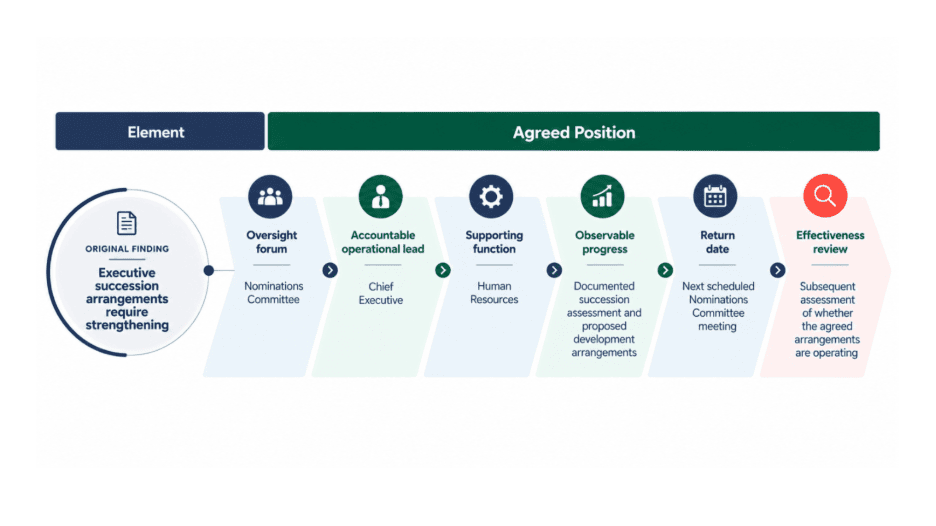
The Company Secretary ensures that the recommendation and review dates are properly recorded.
Management remains responsible for producing the work, while the committee examines its adequacy.
What Would Completion Actually Mean?
The recommendation should not be closed merely because a presentation has been delivered.
Directors should determine whether the agreed succession arrangements have been established and whether material gaps are being addressed.
Where improvement requires a longer period, the committee can record implementation as complete while retaining oversight of continuing development.
The difference is that the board now has a basis for judging progress rather than simply receiving an assurance that work is underway.
6. Not Every Board Review Finding Can Be Closed Like an Administrative Task
Action tracking becomes more complex when a recommendation concerns collective board behaviour.
An independent evaluation may identify weaknesses in constructive challenge, the handling of dissent or the influence of established relationships on decision making.
Such findings do not always lend themselves to one operational owner or a conventional completion date.
The Chair may lead the response, but meaningful improvement depends on the participation of directors collectively.
A development session can be scheduled and completed, yet the board may still avoid difficult conversations.
Similarly, a new agenda format may create more time for strategic discussion without necessarily improving the quality of challenge.
These findings require a different form of accountability.
Rather than assigning a director responsibility for completing the behaviour change, the board should establish a development lead, agree what stronger practice would look like and revisit the issue over successive meetings.
Observable evidence might include more substantive consideration of alternatives, greater participation in strategic discussions or more effective handling of minority views.
However, the board should avoid simplistic measures, such as assuming that more questions automatically mean better challenge.
The objective is stronger collective judgement.
Some recommendations require implementation. Others require the board to change how it governs together.
Both need follow-through, but forcing them into the same administrative model can conceal the difference.
The FRC’s guidance on board performance reviews recognises the importance of evaluating board dynamics, decision making, information quality and the effectiveness of follow-up.
For Chairs and non-executive directors, the implication is clear.
The action register should support governance improvement without becoming the sole definition of success.
7. What UK and Canadian Governance Guidance Tells Us About Follow-Through
The importance of acting on board evaluation findings is recognised across established governance markets, although the applicable frameworks and legal requirements differ.
United Kingdom: Acting on Review Results
Under the UK Corporate Governance Code 2024, relevant listed companies are expected to undertake rigorous board performance reviews and address identified weaknesses.
Provision 22 specifically places responsibility on the Chair to act on review results, while directors are expected to engage with the process and address their development needs.
The FRC Corporate Governance Code Guidance also encourages consideration of how effectively evaluation outcomes have been implemented.
For boards, this means that the review report should not be treated as the end of the process.
Its findings should influence subsequent governance decisions and development priorities.
Canada: Follow-Up as Part of Board Assessment
Canadian guidance similarly recognises the importance of evaluation follow-through.
The Government of Canada’s Assessing Board Effectiveness guidance, developed for Crown corporations, identifies follow-up as a core element of effective board assessment.
It emphasises the need to address identified areas of concern and ensure that evaluation information reaches the appropriate individuals.
Although this guidance is not a universal legal requirement for Canadian companies, it provides a useful example of how assessment and follow-through should be connected.
Canadian governance practice also reflects the importance of formal action planning. The Chartered Governance Institute of Canada’s discussion of board evaluations supports the development of action plans following board assessment.
The Wider International Principle
The G20/OECD Principles of Corporate Governance 2023 provide a broader framework for effective oversight, accountability and board responsibilities.
These sources do not prescribe a universal three-field action register.
However, they support the underlying proposition that governance processes should enable meaningful oversight and improvement.
For organisations operating across jurisdictions, the practical lesson is to apply a consistent discipline while respecting local requirements.
A board should not need a regulatory instruction to know that its most important recommendations deserve an owner, evidence of progress and a return date.
8. The Company Secretary’s Role: From Minute Taking to Governance Continuity
Company Secretaries play an important role in ensuring that board decisions remain traceable after meetings conclude.
The function may coordinate agendas, prepare minutes, maintain action records and ensure that unresolved matters return for consideration.
However, the quality of this work depends on more than administrative accuracy.
An effective Company Secretary should be able to identify when an action lacks an accountable owner, when a proposed deadline is unrealistic or when the evidence required for closure has not been defined.
These are not merely clerical concerns.
They affect the board’s ability to exercise oversight.
For example, an action recorded as management to review may be too vague to support reliable follow-through.
A stronger record would identify the relevant executive, the expected output and the meeting at which the matter will return.
The Company Secretary can advise on these weaknesses before the meeting concludes, reducing the risk of ambiguity afterwards.
Nevertheless, the function should not become responsible for delivering actions that belong to management.
The Company Secretary should make accountability visible, not become the organisation’s substitute for it.
This distinction becomes particularly important in complex organisations where multiple committees, subsidiaries and management functions contribute to board decisions.
Connected governance processes and reliable records can support continuity, but they must operate alongside clear decision rights and professional judgement.
Read More: The Company Secretary Is Often the Control Nobody Realises They Depend On
9. Five Warning Signs That Your Board Is Losing Visibility Over Agreed Actions
1. Directors Receive Status Updates Without Evidence
Reports repeatedly describe actions as progressing, but directors cannot establish what has actually changed.
2. Actions Have Multiple Owners but No Clear Accountability
Responsibility is assigned to a department, committee or management team without identifying who must ensure delivery.
3. Important Recommendations Have No Return Date
Actions appear in a register but are not included in the forward agenda for substantive review.
4. The Register Is Too Long to Discuss Meaningfully
Material governance priorities are buried among routine administrative tasks, making effective challenge difficult.
5. Recommendations Are Closed Because Activities Have Occurred
A workshop, policy revision or management presentation is treated as sufficient evidence even where the original weakness remains.
These warning signs do not necessarily indicate that directors or executives are neglecting their responsibilities.
However, they suggest that the organisation’s approach to action governance may need improvement.
10. A Practical Board Action Visibility Framework
The following framework can help Chairs, Company Secretaries and governance committees examine whether significant recommendations are receiving appropriate follow-through.
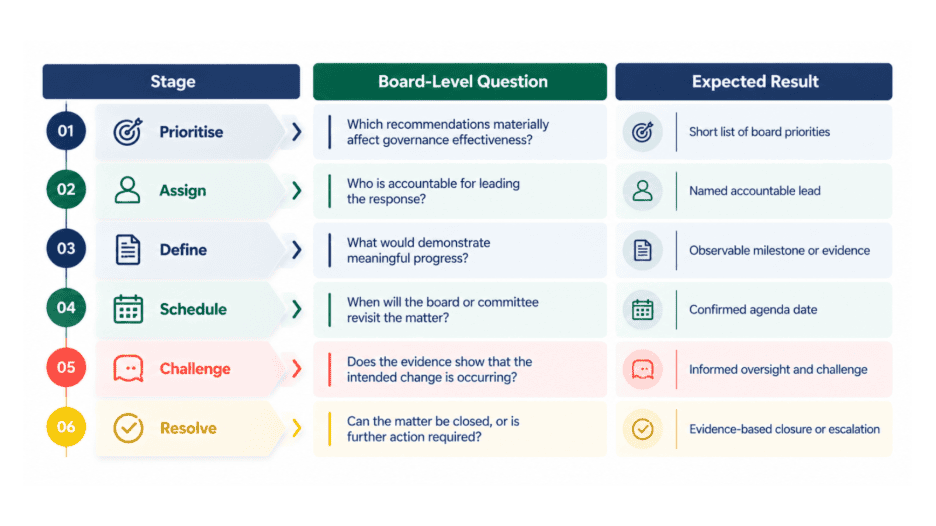
This framework should be applied proportionately.
A routine operational matter may require a simple update, while a significant governance weakness could warrant more detailed reporting and independent validation.
The central requirement is that directors receive information they can use to exercise judgement.
A status report should help the board decide whether progress is sufficient, not merely inform directors that activity continues.
11. Why the Next Governance Review Should Examine Action Visibility
Governance reviews commonly examine board composition, committee structures, decision processes, risk oversight and policies.
However, an equally important question is whether the organisation has reliable arrangements for implementing and reviewing agreed decisions.
A board may have an appropriate committee structure and a comprehensive governance framework while still struggling to maintain visibility over outstanding actions.
That weakness can affect decision quality, management accountability and institutional trust.
Through its Governance Review service, Lumorus examines governance structures, policies, board dynamics, decision making, risk management and areas requiring improvement.
The published service approach includes interviews, document reviews, stakeholder engagement, gap analysis and tailored recommendations.
For organisations considering a review, action visibility provides a valuable area of enquiry.
Directors should ask whether significant recommendations are properly prioritised, whether accountable leads have sufficient authority and whether progress returns to the right governance forum.
The assessment should also examine whether the board receives evidence that supports challenge, rather than reports designed primarily to demonstrate activity.
The real purpose of a governance review is not to identify everything that could be improved. It is to help the organisation understand which improvements matter and how they will be governed.
Explore: Lumorus Governance Review
Read More: From Finding to Follow-Through: Who Owns Governance and Impact Improvements?
A Short Board Review Readiness Checklist
Before your next board evaluation or governance review, consider whether every director could answer the following questions:
- Can we identify the board’s most important outstanding governance actions?
- Does each priority have one clearly accountable lead?
- Have we defined observable evidence of progress?
- Is there a confirmed board or committee agenda date for reviewing each priority?
- Do directors receive enough information to challenge progress?
- Are management delivery responsibilities separate from board oversight?
- Do we distinguish completed activities from genuine improvement?
- Are collective board development priorities reviewed appropriately over time?
- Can the Company Secretary maintain continuity without becoming responsible for every action?
- Have we examined whether previous board review recommendations produced meaningful change?
A board that struggles to answer these questions may benefit from reviewing its action governance arrangements before commissioning another evaluation.
The Lumorus View
Boards should not confuse the existence of an action register with the exercise of accountability.
A register can be complete, accurate and regularly updated while still failing to provide directors with the information needed for effective oversight.
The underlying problem is often one of governance design.
Recommendations are accepted without clear ownership, progress is described without evidence and significant matters are not consistently returned for review.
The Company Secretary may work hard to maintain the process, but professional diligence cannot substitute for management accountability or board challenge.
At Lumorus, we believe board effectiveness depends on the quality of the connection between decisions, responsibilities and outcomes.
Our Governance Review and Board Evaluation & Assessment services provide opportunities to examine those connections and identify priorities for improvement.
For Chairs, CEOs and non-executive directors, the most useful question is not how many actions remain open.
It is whether the board understands which matters require attention, who is accountable and what evidence will demonstrate that progress is real.
The strength of board oversight is revealed not by how carefully decisions are recorded, but by how effectively their consequences are governed.
The Bottom Line
A recommendation without an owner is difficult to implement.
An action without observable evidence is difficult to assess, while a commitment without a return date is difficult to govern.
These are not minor administrative weaknesses.
They affect the board’s ability to oversee management, respond to evaluation findings and demonstrate that governance improvement is taking place.
For organisations preparing their next board review, the practical starting point is to examine the visibility of existing actions.
Keep the priority list manageable, assign one accountable lead to each material recommendation and establish the evidence that directors should expect to see.
Every significant action should also have a confirmed return point on the board or committee agenda.
A board should never have to wait for the next independent evaluation to discover that its previous recommendations were not implemented.
Effective governance requires directors to know what has been agreed, what has changed and what still requires their attention.
Prepare for Your Next Board Review
Would every director on your board be able to explain the status of your most important agreed actions?
If the answer is uncertain, that is a useful place to begin preparing for your next governance or board performance review.
Lumorus’s complimentary Board Performance Review Readiness Toolkit provides a practical resource for Chairs, Company Secretaries, non-executive directors and governance leaders considering an upcoming evaluation.
It can help frame the questions that should be addressed before the review begins, including how findings will be translated into meaningful improvement.
Download the Complimentary Board Performance Review Readiness Toolkit
For organisations seeking a more detailed assessment, Lumorus’s Governance Review service examines governance structures, board practices, decision processes and accountability arrangements.
A review-scoping conversation provides an opportunity to discuss the organisation’s governance priorities, the questions the assessment should address and the appropriate scope of work.
Explore Governance Review and Arrange a Review-Scoping Conversation
Better board reviews should lead to better decisions, clearer accountability and visible improvement.
Continue Exploring
- Examine your governance structures, decision rights and accountability arrangements: Governance Review
- Assess board effectiveness, collective judgement and governance performance: Board Evaluation & Assessment
- Understand how governance findings should move towards accountable action: From Finding to Follow-Through: Who Owns Governance and Impact Improvements?
- Explore the connection between board processes and decision quality: A Good Company Secretary Helps Make the Meeting Worth Recording
- Examine the risks that Company Secretaries often prevent from reaching the board: The Company Secretary Is Often the Control Nobody Realises They Depend On
- Prepare for your next evaluation: Board Performance Review Readiness Toolkit
Lumorus: Better Business, Built on Purpose
Lumorus is a UK-headquartered global governance, Company Secretary, ESG and advisory firm supporting organisations across international markets.
We believe effective governance requires more than well-designed structures and formal compliance.
It depends on clear decision rights, accountable leadership, constructive boardroom challenge and reliable evidence that agreed actions are being implemented.
Through our Governance Review, Board Evaluation & Assessment and wider governance advisory services, we support boards and executive teams seeking to strengthen governance effectiveness.
Our approach recognises that recommendations have little value unless organisations can translate them into decisions, responsibilities and measurable progress.
For Chairs, CEOs, Company Secretaries and non-executive directors, the first step is understanding whether the board has sufficient visibility over the actions it has already agreed.
Download the Board Performance Review Readiness Toolkit
Discuss Your Governance Review Requirements
A board that cannot see the progress of its own decisions cannot fully govern their consequences.
Lumorus: Better Business, Built on Purpose.
Sources and References
1. Financial Reporting Council: UK Corporate Governance Code 2024
The Code establishes expectations for board leadership, accountability, performance reviews and governance reporting. Provision 22 addresses action on board performance review findings.
Source: UK Corporate Governance Code 2024
2. Financial Reporting Council: Corporate Governance Code Guidance
The guidance discusses board performance reviews, acting on evaluation findings, the Chair’s responsibilities and the importance of governance outcomes. It is supporting guidance rather than a prescriptive action-tracking standard.
Source: FRC Corporate Governance Code Guidance
3. Government of Canada: Assessing Board Effectiveness
This guidance for Crown corporations identifies follow-up as an important element of board assessment and explains why identified concerns should be addressed through an appropriate process.
Source: Assessing Board Effectiveness
4. Chartered Governance Institute of Canada: A Focus on Board Evaluations
The publication discusses board evaluation practices, including the development of formal action plans in response to assessment findings.
Source: A Focus on Board Evaluations
5. OECD: G20/OECD Principles of Corporate Governance 2023
The Principles provide an international framework for board responsibilities, management oversight, accountability and effective corporate governance.
Source: G20/OECD Principles of Corporate Governance 2023
6. Lumorus: Governance Review
Lumorus’s Governance Review service examines board structures, governance policies, committee effectiveness, decision making, risk oversight and areas requiring improvement.
Source: Governance Review
7. Lumorus: From Finding to Follow-Through
This related article examines the gap between identifying governance weaknesses and implementing meaningful improvements, including decision ownership, operational accountability and evidence of completion.
Source: From Finding to Follow-Through: Who Owns Governance and Impact Improvements?
8. Lumorus: Board Effectiveness and the Company Secretary’s Strategic Role
This article examines how Company Secretaries support board decision making, information quality, meeting processes and governance follow-through.
Source: A Good Company Secretary Helps Make the Meeting Worth Recording
9. Lumorus: Board Performance Review Readiness Toolkit
A complimentary resource for boards, Chairs and governance professionals preparing for a board performance review.