


ESG reporting is entering a new era
For years, organisations focused on producing ESG reports.
The emphasis was on disclosure.
Publishing sustainability information became the priority.
Reporting frameworks expanded.
ESG metrics multiplied.
Stakeholder expectations increased.
Today, a more difficult challenge is emerging.
Can organisations prove that their ESG data is accurate?
This question is becoming increasingly important as investors, regulators, customers and stakeholders seek greater confidence in ESG disclosures.
The conversation is shifting from reporting to assurance.
From disclosure to evidence.
From claims to verification.
According to PwC, ESG reporting is rapidly evolving towards the same level of scrutiny and accountability expected of financial reporting, with assurance becoming a critical component of stakeholder confidence.
Read More: ESG Reporting & Disclosure
Why ESG assurance is becoming a strategic priority
Historically, many organisations viewed ESG reporting as a voluntary disclosure exercise.
That environment is changing.
Regulatory expectations continue to evolve.
Stakeholders increasingly demand transparency.
Investors seek greater confidence in reported ESG performance.
Boards are facing increased accountability for sustainability disclosures.
As a result, ESG assurance is becoming a governance issue rather than simply a reporting issue.
According to Connect Earth, organisations are increasingly recognising that ESG data assurance is essential for building trust, reducing reporting risk and improving decision-making.
The challenge is that many organisations were not originally designed to generate assurance-ready ESG data.
What is ESG assurance?
ESG assurance is an independent assessment of ESG disclosures and supporting data.
The objective is to provide confidence that reported information is:
- Accurate
- Reliable
- Consistent
- Verifiable
- Complete
- Supported by evidence
Much like financial audits, ESG assurance focuses on the quality of underlying data and controls.
It examines not only what is reported.
It examines how information is generated, managed and validated.
This distinction matters.
Strong ESG reports do not automatically produce strong assurance outcomes.
Strong governance processes do.
Why many organisations struggle with ESG assurance
Many ESG reporting programmes evolved rapidly.
Data collection often developed organically across different functions.
Environmental information may sit within operations.
Social metrics may be managed by human resources.
Governance information may come from legal, compliance or company secretarial teams.
The result is often fragmented reporting.
According to PwC, one of the most common ESG reporting challenges is inconsistent data quality caused by disconnected processes, fragmented ownership and limited governance controls.
This creates significant assurance challenges.
Because assurance depends on evidence.
And evidence depends on governance.
The most common ESG data weaknesses
Organisations preparing for assurance frequently encounter similar issues.
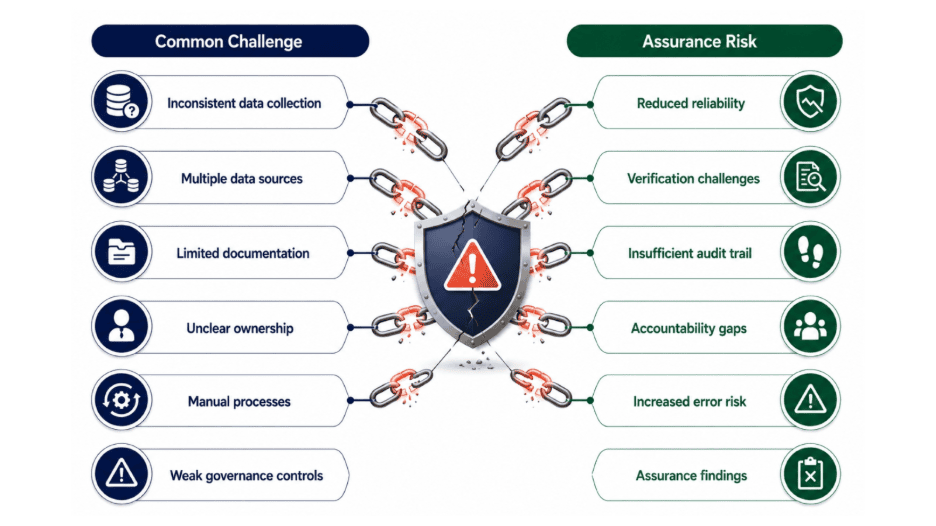
These weaknesses often remain hidden until assurance begins.
By then, remediation can become costly and time consuming.
Start with governance, not reporting
One of the biggest mistakes organisations make is focusing solely on disclosures.
The strongest assurance programmes begin with governance.
Questions worth asking include:
- Who owns ESG data?
- Who validates ESG information?
- Who approves disclosures?
- How are changes documented?
- What controls exist?
- How are risks escalated?
Without clear governance structures, assurance becomes significantly more difficult.
According to the International Federation of Accountants (IFAC), governance, accountability and internal controls are becoming increasingly important foundations for credible sustainability reporting.
Good ESG assurance starts long before reporting begins.
Create a clear ESG data ownership model
One of the most common causes of assurance failure is unclear accountability.
ESG data often originates from multiple departments.
Without defined ownership, inconsistencies emerge.
A strong governance model should clearly define:
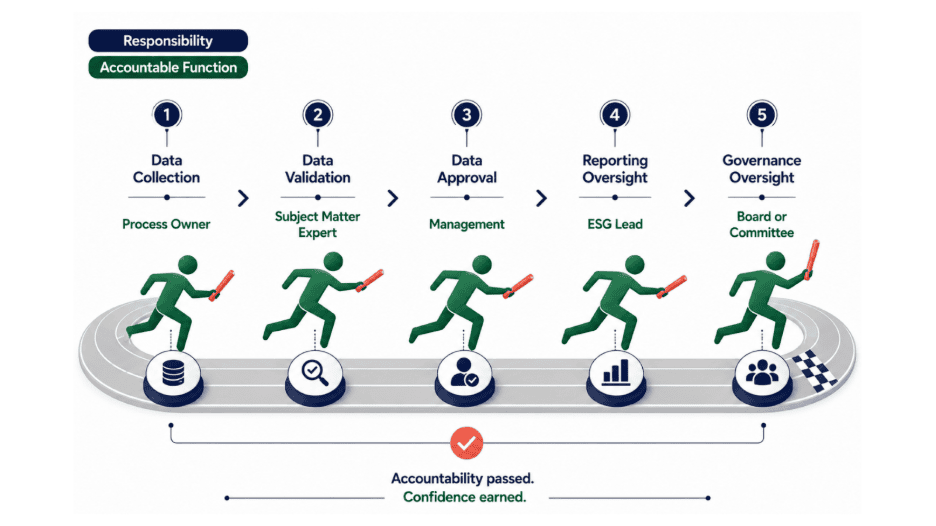
When ownership is clear, accountability becomes stronger.
When accountability is stronger, data quality improves.
Build evidence alongside data
Many organisations focus on collecting metrics.
Fewer focus on collecting evidence.
Assurance requires both.
For every material ESG metric, organisations should be able to demonstrate:
- Source information
- Calculation methodologies
- Supporting documentation
- Approval processes
- Data controls
- Historical records
According to Connect Earth, organisations that prepare evidence alongside data collection are significantly better positioned for assurance reviews and external scrutiny.
Evidence transforms reporting into credibility.
Strengthen internal controls
Financial reporting is supported by established control environments.
ESG reporting increasingly requires similar discipline.
Key controls may include:
- Data validation procedures
- Review and approval workflows
- Change management controls
- Version control processes
- Periodic reconciliations
- Governance oversight reviews
As assurance expectations increase, ESG controls are becoming a critical component of governance maturity.
Boards should be paying closer attention
ESG assurance is no longer simply a management issue.
It is becoming a board issue.
Boards increasingly face questions relating to:
- ESG credibility
- Sustainability commitments
- Climate disclosures
- Social impact claims
- Governance effectiveness
Directors should understand:
- How ESG data is generated
- What controls exist
- Where risks remain
- How assurance findings are addressed
According to the World Economic Forum, board oversight is becoming increasingly important as sustainability reporting moves towards greater accountability and assurance requirements.
Strong oversight strengthens trust.
The future of ESG belongs to organisations that can evidence performance
The direction of travel is clear.
Stakeholders are demanding evidence.
Regulators are increasing scrutiny.
Assurance expectations are growing.
The organisations that succeed will not necessarily be those producing the largest ESG reports.
They will be those producing the most credible ESG data.
Because ultimately, ESG reporting without evidence becomes difficult to defend.
Assurance provides confidence.
Evidence creates trust.
Governance sustains both.
The future of ESG will increasingly belong to organisations that can demonstrate not only what they say, but what they can prove.
Lumorus: Better Business, Built on Purpose
At Lumorus, we believe Being Good is Better for Business.
Lumorus is a UK-headquartered global governance, ESG, social impact and advisory firm supporting organisations across Europe, Africa, Asia, the Caribbean, Canada, the Middle East and international markets.
For more than a decade, we have helped organisations strengthen governance, improve accountability and build ESG frameworks capable of delivering measurable outcomes and credible reporting.
Our expertise includes:
We help organisations move beyond ESG activity towards ESG accountability, evidence-based reporting and long-term value creation.
To explore Lumorus ESG and sustainability solutions, visit:
Together, we can build better business: one that performs with purpose, leads with integrity and creates lasting value for people, planet and profit.