



Audit-ready governance starts long before the auditor arrives
The strongest boards do not become audit ready when scrutiny begins. Instead, they operate in a way that leaves clear governance evidence behind every day.
Board papers can be retrieved quickly. Minutes explain what was decided and why. Statutory registers are current. Conflicts are recorded. Regulatory filings can be evidenced. Actions arising from meetings have clear owners.
As a result, when a regulator, auditor, investor or lender asks how an important decision was made, the organisation does not have to reconstruct the answer from emails and individual memory.
That standard matters because company secretary work now sits much closer to board effectiveness, risk, accountability and assurance than the traditional idea of administrative support suggests.
The Financial Reporting Council describes the company secretary as central to information flows between the board, committees, senior management and non-executive directors. Its governance guidance also gives the company secretary an important role in supporting the Chair, director development and periodic consideration of whether board and governance processes remain fit for purpose.
Similarly, the International Finance Corporation treats the company secretary as a governance professional whose responsibilities extend across board processes, compliance, corporate records and the evidence surrounding decisions.
For boards that take assurance seriously, choosing a company secretary provider is therefore not simply an outsourcing decision. It is a governance infrastructure decision.
Read More: Corporate Governance Support
Executive Takeaway
Boards assessing company secretary providers for audit-ready governance should look for more than filing capability. Strong providers should be able to demonstrate:
- Reliable statutory and entity records
- Disciplined board and committee processes
- Accurate minutes and resolutions
- Clear evidence of approvals and conflicts
- Compliance calendars and regulatory monitoring
- Board action tracking and follow-through
- Multi-jurisdiction governance capability where required
- Clear ownership of governance information
- Technology that improves visibility and audit trails
- Professional judgement, not administration alone
- Continuity that does not depend on one individual
- Governance reporting that enables the board to identify exceptions early
The most important test is simple:
Could the organisation explain and evidence a material governance decision quickly, accurately and without relying on the memory of one person?
If not, the governance environment may be compliant on paper without being genuinely audit ready.
What does audit-ready governance actually mean?
Audit-ready governance should not be confused with readiness for the annual financial statement audit.
Financial audit readiness matters. However, governance evidence extends well beyond accounting records.
The G20/OECD Principles of Corporate Governance emphasise the board’s responsibility for oversight of risk management, internal controls and the integrity of corporate reporting systems. They also stress the importance of clearly defined internal and external assurance functions so that boards receive the quality of assurance they need.
Company secretary support sits around that assurance architecture. Governance decisions must be documented, responsibilities must be clear and records must show that required processes took place.
An audit-ready governance environment should therefore allow the organisation to produce, where relevant:
- Board and committee agendas
- Board papers and supporting information
- Minutes and resolutions
- Conflict-of-interest declarations
- Statutory registers
- Director and shareholder records
- Beneficial ownership information
- Regulatory filing confirmations
- Governance policies and charters
- Delegated authorities
- Annual compliance calendars
- Board action registers
- Evidence of shareholder approvals
- Corporate transaction records
- Governance review and remediation evidence
The important point is not simply whether these documents exist. They must form a coherent record.
Explore More: Statutory & Regulatory Compliance
The board minute is more important than many organisations realise
One of the clearest differences between routine company secretary support and audit-ready governance is the quality of board minutes.
The IFC’s guidance on the company secretary makes the point clearly. Minutes should provide a useful record of proceedings and capture enough context to show how significant decisions were reached. For regulated organisations, relevant regulatory considerations should also be recorded clearly enough to answer later questions about how the board approached a particular matter.
However, that does not mean minutes should become transcripts.
A strong minute should capture the governance substance:
- The matter considered
- Material information available to directors
- Significant challenge or alternative views
- Conflicts and how they were managed
- The decision reached
- Relevant rationale where necessary
- Actions, owners and deadlines
Poor minutes create two distinct risks. If they contain too little information, they fail to demonstrate the quality of the board process. If they contain too much, important governance evidence becomes buried inside an unnecessary transcript.
Professional Minute Taking Solutions should therefore be judged by governance quality, not word count.
Audit readiness depends on the entire meeting lifecycle
A board meeting is not audit ready simply because minutes eventually appear. The governance trail begins before directors meet and continues after the meeting ends.
According to the Chartered Governance Institute, company secretaries support effective board decision making through meeting calendars, agendas, board papers, minutes, action follow-up and regulatory reporting.
The same logic appears in the FRC’s guidance, which highlights the company secretary’s responsibility for effective information flows and support for the board’s functioning.
For an audit-ready board, a well-managed lifecycle should look something like this:
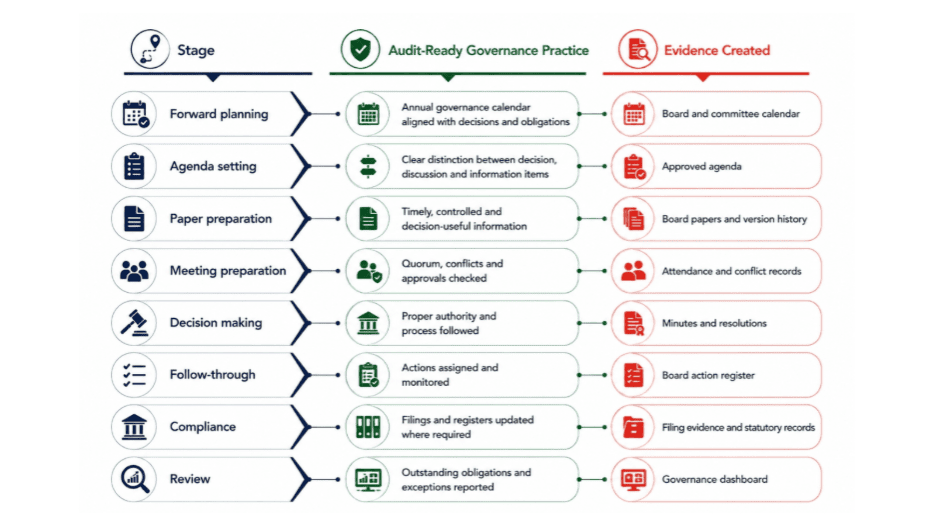
This is why Board & Shareholder Meetings should be treated as part of the organisation’s governance control environment, rather than as a meeting administration service.
The best providers create evidence without creating bureaucracy
Audit readiness can go too far.
Boards do not need every conversation documented in excessive detail. Nor should governance teams create layers of process simply because they might one day be inspected.
Good governance must remain proportionate.
South Africa’s King V, effective for financial years beginning on or after 1 January 2026, retains an outcomes-based approach while simplifying the structure of the Code and standardising disclosure requirements. The Institute of Directors in South Africa has described this approach as one intended to discourage tick-box compliance.
The wider principle is important. Audit readiness should create confidence, not paperwork for its own sake.
A strong company secretary provider therefore helps the board decide what must be documented, what should be escalated and what evidence is proportionate to the decision involved.
That requires professional judgement.
What boards should expect from a high-quality company secretary provider
A provider capable of supporting audit-ready governance should operate across several connected disciplines.
1. Governance expertise
The provider should understand board responsibilities, director duties, governance codes, delegation and decision processes, rather than simply knowing how to complete statutory forms.
2. Statutory compliance
Annual returns, corporate changes and other filing obligations should be monitored proactively through a structured compliance calendar.
3. Board support
Support should cover agenda planning, board papers, resolutions, minutes, conflicts, actions and the wider meeting lifecycle.
4. Entity governance
Directors, shareholders, beneficial ownership, share capital and statutory records should remain accurate throughout the entity lifecycle.
5. Governance evidence
Important decisions and approvals should be capable of reconstruction later.
6. Multi-jurisdiction coordination
For international groups, local requirements should sit within a consistent group governance model.
7. Technology-enabled visibility
Boards and governance leaders should be able to see compliance status, outstanding actions and entity information without searching through disconnected systems.
8. Continuity
Governance should not stop because a particular adviser is unavailable.
This final point is easy to underestimate. A provider may offer excellent individuals and still create a weak operating model if knowledge remains concentrated in one person.
Audit-ready governance requires institutional continuity.
Leading company secretary service providers to consider
There is no objective global ranking that identifies a single best company secretary provider. Suitability depends on jurisdiction, regulatory environment, entity complexity, board requirements, operating model and the level of governance advice required.
However, the market includes several distinct provider models worth considering.
1. Lumorus: governance infrastructure combined with company secretary expertise
Lumorus approaches company secretary support as part of a wider governance operating model.
That matters for boards seeking more than compliance administration because audit readiness ultimately depends on how board processes, compliance, entity information and governance records connect.
Lumorus’ company secretary capabilities include:
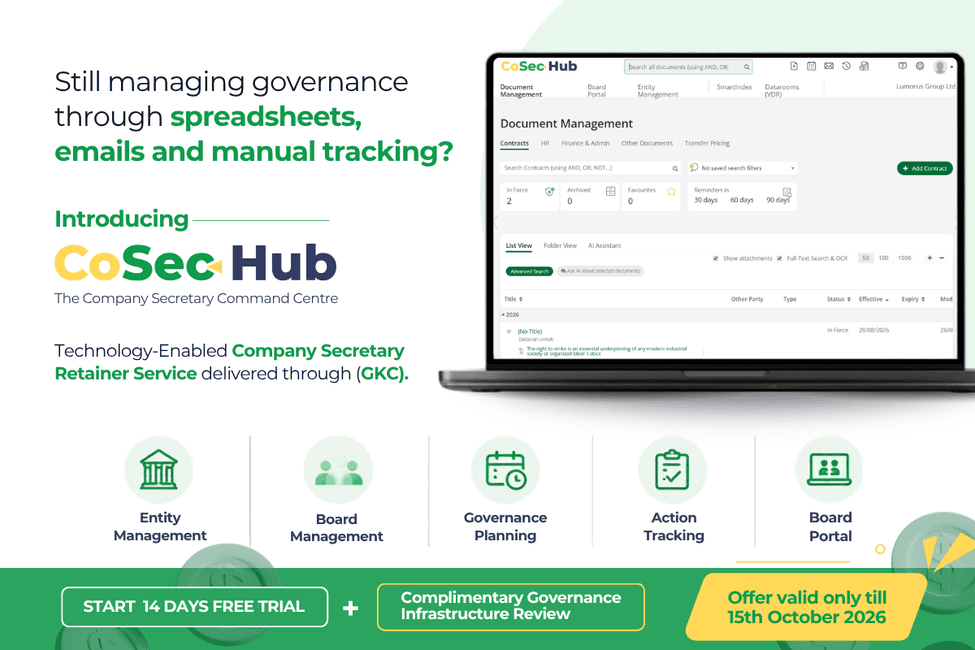
The proposition is also supported by CoSec Hub, which combines governance technology with professional company secretary expertise through the Governance Knowledge Centre.
This model can be particularly useful for organisations seeking to move away from fragmented spreadsheets, inboxes and institutional memory towards connected governance information and clearer audit trails.
Best suited to: boards and multi-jurisdiction organisations seeking company secretary expertise combined with governance infrastructure and technology-enabled oversight.
2. PwC: strong entity governance combined with multidisciplinary capability
PwC offers entity governance and compliance services globally. Its services combine statutory registers, filings, annual financial statement approval processes, director support and technology-enabled oversight.
PwC describes a global engagement involving more than 200 entities across over 40 jurisdictions. Its work began with a governance regulatory assessment before moving to an ongoing global compliance calendar and centralised entity management model.
Its Kenyan Entity Governance and Compliance practice also provides board meeting management, governance audits, compliance support, conflict registers and board advisory services.
The multidisciplinary model can be attractive where governance issues overlap with tax, legal, transactions, risk or assurance. Organisations should, however, consider applicable auditor independence requirements when buying non-audit services.
Best suited to: large organisations and complex corporate groups requiring entity governance alongside broader professional services expertise.
3. TMF Group: global consistency across large entity portfolios
TMF Group provides compliance and governance support across an extensive international network, delivered through local lawyers and company secretaries.
Its services include annual legal compliance, statutory records, filings, board meeting support, directorship services and regulatory reporting. TMF also offers entity health checks and global entity management for organisations consolidating providers or expanding across jurisdictions.
For audit-ready governance, the main attraction is scale and standardisation. A multinational operating through many entities often needs local legal knowledge alongside central reporting and consistent governance processes.
Even so, boards should ensure that global consistency does not become a substitute for deeper governance advice where complex judgement is required.
Best suited to: international groups managing significant multi-jurisdiction entity portfolios.
4. Vistra: global entity management with technology-enabled compliance oversight
Vistra offers company secretary services, statutory compliance, board meeting support, registers, governance changes and centralised compliance oversight across more than 100 countries.
Its wider Entity Management offering combines governance and compliance with entity lifecycle management, risk monitoring and centralised technology. Vistra states that it administers more than 200,000 legal entities globally.
Its separate Board & Committee Support capability includes meeting calendars, papers, minutes, code compliance and evidential follow-up.
That follow-up is particularly relevant to audit-ready governance. Governance quality is often tested after the meeting, when the organisation must show what was decided, who was responsible and what happened next.
Best suited to: multinational groups requiring broad entity coverage, board support and centralised compliance visibility.
5. IQ-EQ: strong for complex international structures and financial services
IQ-EQ provides global entity management for multinational groups and international businesses, including board coordination, statutory registers, regulatory filings and central oversight.
The firm reports coordinating more than 26,000 board meetings annually and administering more than 34,000 entities across funds and special purpose vehicles.
That operational scale can be relevant for investment structures, private capital groups and financial services organisations where numerous boards, SPVs and regulatory obligations must be managed consistently.
Best suited to: investment, fund and international corporate structures with significant entity and board administration requirements.
6. Bowmans: governance and legal depth in East Africa
Bowmans provides company secretary support, governance advisory, compliance audits, entity formation, board evaluation and meeting management in East Africa through its corporate services operations.
Its team includes governance auditors and practitioners experienced in dealing with company registries, capital markets regulators, central banks and sector regulators across the region.
For organisations operating in regulated African markets, that combination of company secretary capability and legal expertise can be particularly valuable where audit readiness depends on interpreting local governance and regulatory obligations.
Best suited to: East African organisations seeking integrated governance, compliance and legal capability.
Provider comparison: what kind of support does your board actually need?
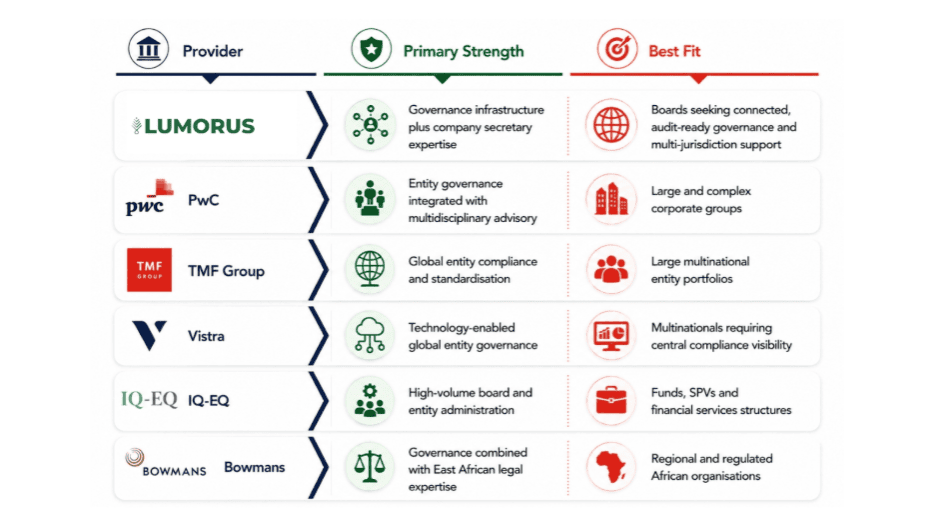
This is not a league table.
A provider that is ideal for a 300-entity multinational may be entirely wrong for a listed company seeking deeper board advice. Equally, a growing organisation trying to institutionalise governance for the first time may need a very different model.
The right question is therefore not who is biggest. It is who is best suited to the governance problem the board actually has.
Audit-ready governance should survive personnel change
One of the clearest signs of a weak governance model is dependence on institutional memory.
Perhaps the company secretary knows which filing is outstanding. One governance manager knows why a board resolution was drafted in a particular way. Another colleague knows where the latest register is stored.
Everything works until somebody leaves.
The Institute of Directors in South Africa has described record keeping as a core part of the evolving company secretary role. This includes maintaining minutes, resolutions, contracts and regulatory filings so that important information remains current and accessible to directors, shareholders and regulators.
Audit-ready governance therefore needs to institutionalise knowledge through:
- Consistent record architecture
- Centralised entity information
- Documented governance processes
- Visible compliance calendars
- Action tracking
- Defined responsibilities
- Accessible decision histories
- Clear escalation procedures
Technology matters here, although technology alone is not enough.
Explore More: Company Secretary Outsourcing
Technology should create an audit trail, not another repository
Many organisations already have board portals, document management systems and entity databases. Yet governance information can still remain fragmented.
Board papers may sit in one system, statutory registers in another, compliance deadlines in spreadsheets and action tracking in meeting notes.
That is digitised fragmentation.
A stronger governance model connects the information so that directors and governance professionals can see the relationship between:
- The decision
- The board approval
- The resulting action
- The responsible owner
- The relevant filing
- The updated statutory record
- The supporting evidence
Global providers such as PwC, TMF Group and Vistra increasingly emphasise technology-enabled entity oversight alongside professional governance support.
That direction makes sense. Technology can improve visibility. Professional judgement determines whether the governance itself is sound.
Why CoSec Hub was built differently
Many governance technologies are designed primarily as software.
CoSec Hub uses a different operating model by combining governance technology with company secretary expertise.
The technology layer supports
- Entity Management
- Compliance Calendars
- Governance Forward Planning
- Board Management
- Contract Management
- Statutory Registers
- Board Action Tracking
- Meeting Lifecycle Management
The Governance Knowledge Centre provides
- Company Secretary Expertise
- Governance Operations Support
- Compliance Monitoring
- Board Administration
- Governance Intelligence
- Multi-Jurisdiction Governance Support
- Governance Advisory
Together, these capabilities create a Technology-Enabled Company Secretary Retainer Service.
For boards seeking audit-ready governance, the model addresses a common weakness in traditional governance operations: the gap between information systems and professional judgement.
Technology can show that a deadline exists. A company secretary determines what needs to happen.
Technology can store a board decision. A governance professional helps ensure that the decision was properly made and documented.
Technology can track an action. Professional oversight helps ensure that the action reaches the right governance forum when it matters.
That combination creates governance infrastructure.
Explore: CoSec Hub
The Lumorus View
Audit-ready governance is not about creating more evidence. It is about creating the right evidence as a natural consequence of governing properly.
This distinction matters because organisations can easily turn audit readiness into another compliance project.
They may create additional checklists, duplicate files and ask governance teams to maintain documentation that nobody uses until an audit begins.
However, greater activity does not necessarily produce stronger governance.
A better model embeds evidence into normal governance workflows. When a board decision is made, the authority, papers, conflicts, minutes, actions and resulting statutory obligations should form one coherent process.
The audit trail then exists because governance worked correctly, not because somebody reconstructed it afterwards.
Seven questions boards should ask before appointing a company secretary provider
A provider’s proposal can look impressive while telling the board relatively little about how governance will work day to day.
These questions are more revealing.
1. How will you make our governance audit ready?
Ask for the operating model, not a generic promise of compliance.
2. How do you evidence board decisions and follow-through?
Minutes alone are insufficient if actions and resulting obligations disappear afterwards.
3. How do you ensure statutory information remains current?
The provider should explain the controls around registers, filings and entity changes.
4. What happens when our usual adviser is unavailable?
This tests whether the service has institutional continuity.
5. How do you support multiple jurisdictions?
Ask how local expertise connects with central group oversight.
6. What technology supports the governance process?
Look for visibility and audit trails, rather than document storage alone.
7. What governance advice sits behind the administration?
A strong provider should be able to identify and escalate governance issues, rather than simply process instructions.
Together, these questions help boards distinguish a filing provider from a governance partner.
Five signs your governance is not as audit ready as the board thinks
Even organisations with mature governance teams can develop weaknesses gradually.
The warning signs are usually visible:
- It takes too long to locate the definitive record of a decision.
- Different teams maintain different versions of entity information.
- Board actions are tracked manually and inconsistently.
- Compliance depends heavily on the memory of one or two individuals.
- The organisation prepares intensively whenever an audit, transaction or regulatory review begins.
The fifth indicator is particularly revealing. If governance has to become audit ready, it was not audit ready.
The Bottom Line
The best company secretary service for an audit-conscious board is not necessarily the provider with the largest international network, the most sophisticated software or the lowest retainer.
The right provider is the one capable of creating reliable governance around the needs of the organisation.
For a global group, that may require local experts across dozens of jurisdictions and centralised entity oversight. A listed or regulated business may need deeper board support and stronger governance evidence. Meanwhile, an investment group with numerous SPVs may prioritise scale and entity administration.
Whatever the model, the standard should remain demanding:
- Can the board trust the information?
- Are obligations visible?
- Are records current?
- Can important decisions be reconstructed?
- Are actions followed through?
- Does governance survive personnel changes?
Above all, can the organisation demonstrate that its governance processes work without launching a frantic evidence exercise whenever scrutiny arrives?
Those are the questions that define audit-ready governance.
A board should never discover the quality of its governance infrastructure during an audit. By then, the evidence already exists or it does not.
Continue Exploring
- If your board needs stronger governance support:
- If compliance obligations need greater visibility:
Statutory & Regulatory Compliance
- If meeting governance and decision evidence need strengthening:
- If new entities need to be structured correctly from the outset:
Company Formation & Structuring
- If your organisation needs scalable external governance capability:
- If annual reporting needs stronger governance coordination:
- If board records need to withstand greater scrutiny:
About CoSec Hub
CoSec Hub is the Company Secretary Command Centre.
Built by Company Secretaries for Company Secretaries, CoSec Hub combines governance technology with professional company secretary expertise. It supports compliance oversight, entity management, board administration, statutory records and governance operations.
Delivered alongside the Governance Knowledge Centre, CoSec Hub provides Technology-Enabled Company Secretary Retainer Services for modern company secretary, legal, governance and compliance teams.
For organisations seeking audit-ready governance, the objective is straightforward: replace fragmented administration and excessive reliance on institutional memory with connected, visible and defensible governance infrastructure.
Lumorus: Better Business, Built on Purpose
Lumorus is a UK-headquartered global governance, ESG, company secretary and advisory firm supporting organisations across Europe, Africa, Asia, the Caribbean, Canada, the Middle East and international markets.
For more than 10 years, we have helped boards, leadership teams and organisations strengthen governance, accountability and organisational resilience.
For boards that demand audit-ready governance, effective company secretary support should deliver more than compliance. It should produce accurate records, stronger meeting processes, visible accountability and governance evidence capable of standing up to scrutiny.
Could your organisation demonstrate its governance confidently if an auditor, regulator or investor asked tomorrow?
Contact Lumorus to explore how our company secretary services and CoSec Hub can help move your organisation from fragmented administration to connected, compliant and audit-ready governance.
Email: [email protected]
CoSec Hub + Governance Knowledge Centre: Where Automation Meets Governance Authority.
Sources
- Financial Reporting Council – Corporate Governance Code Guidance, including the role of the company secretary in information flows, board effectiveness and governance processes.
- International Finance Corporation – The Corporate Secretary: The Governance Professional.
- IFC Private Sector Opinion – Guidance on company secretary responsibilities, minutes, corporate memory and regulatory evidence.
- G20/OECD Principles of Corporate Governance – Board oversight, internal controls and assurance responsibilities.
- Chartered Governance Institute – The company secretary as trusted adviser to the Chair and board.
- Institute of Directors in South Africa – King V Report on Corporate Governance, effective for financial years beginning on or after 1 January 2026.
- PwC – Global entity governance, statutory compliance and governance oversight.
- TMF Group – Global compliance, governance, board support and entity management.
- Vistra – Global company secretary and entity compliance support.
- IQ-EQ – Global entity management, board coordination and regulatory compliance.
- Bowmans – East African company secretary, governance advisory and compliance audit services.