


The governance agenda for UK banks is changing.
Rapidly.
Geopolitical uncertainty remains elevated.
Technology continues to reshape financial services.
Operational resilience has become a regulatory expectation rather than a competitive advantage.
Artificial intelligence is introducing new governance questions.
Meanwhile, regulators expect boards to demonstrate stronger oversight, better decision making and greater accountability.
For UK banks, governance is no longer simply about compliance.
It is becoming a strategic capability.
According to the Bank of England Prudential Regulation Authority, supervisory priorities for 2026 continue to focus on governance and controls, risk management, operational and financial resilience, and data risk in an increasingly uncertain global environment.
Read More: Governance Review
Governance is becoming the first line of resilience
The strongest banks will not necessarily be those with the largest balance sheets.
They will be those with the strongest governance.
The PRA expects boards to demonstrate effective oversight of:
Operational resilience.
Risk governance.
Internal controls.
Data quality.
Decision making.
Regulatory compliance.
These are no longer independent governance topics.
They are interconnected.
Weakness in one area often creates vulnerabilities across the organisation.
Governance has become the framework through which resilience is achieved.
Board decisions are under greater regulatory scrutiny
Boards are increasingly expected to demonstrate not only what decisions they make, but how they make them.
Can directors evidence effective challenge?
Were risks properly considered?
Was sufficient information available?
Were alternative scenarios evaluated?
These questions are becoming central to regulatory supervision.
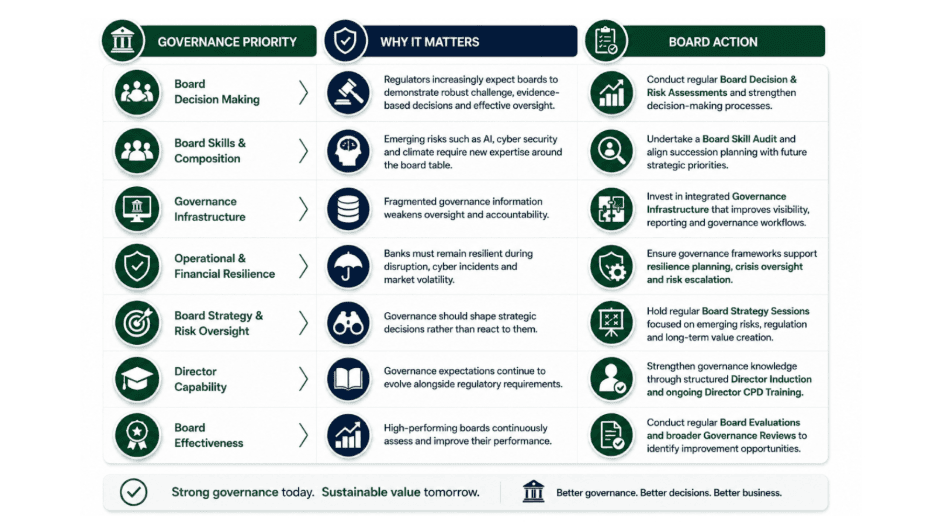
A structured Board Decision & Risk Assessment helps boards strengthen decision quality, improve oversight and ensure governance keeps pace with an increasingly complex risk environment.
According to PwC, the PRA continues to place significant emphasis on robust governance, forward-looking risk management and effective decision-making frameworks while also moving towards more data-enabled supervision.
Board capability will become a competitive advantage
The governance challenges facing banks today differ significantly from those of five years ago.
Cybersecurity.
Artificial intelligence.
Climate risk.
Digital resilience.
Data governance.
Geopolitical instability.
Few boards were originally constituted with these challenges in mind.
This is why many leading financial institutions are reviewing whether their collective capability reflects the risks they now oversee.
A comprehensive Board Skill Audit enables organisations to identify capability gaps, strengthen succession planning and ensure the board possesses the expertise required for future oversight.
Governance capability should evolve at the same pace as organisational complexity.
Governance infrastructure is moving into the boardroom
Governance infrastructure was once considered an operational issue.
Today, it is becoming a board priority.
Banks generate enormous volumes of information.
Board papers.
Risk reports.
Committee decisions.
Regulatory submissions.
Action logs.
Policies.
If governance information is fragmented, board oversight becomes weaker.
Strong Governance Infrastructure enables boards to access reliable information, monitor accountability and strengthen institutional resilience.
Good governance depends on systems.
Not memory.
Strategy and governance can no longer operate separately
Banks continue to operate in an environment characterised by rapid technological change and economic uncertainty.
Governance should not respond after strategy has been developed.
It should shape strategy from the outset.
Regular Board Strategy Sessions provide directors with an opportunity to consider emerging risks, regulatory developments and long-term organisational priorities before strategic decisions are made.
Strong governance is proactive.
Not reactive.
Director development is becoming a governance obligation
Bank boards cannot rely solely on previous experience.
Regulatory expectations continue to evolve.
So do governance risks.
Continuous learning is therefore becoming essential.
New directors should receive a structured Director Induction that equips them to understand the bank’s governance framework, regulatory responsibilities and strategic priorities.
Existing directors should continue strengthening their knowledge through Director CPD Training focused on emerging governance, regulatory and strategic issues.
Effective governance depends upon informed directors.
Board evaluation is becoming a strategic governance tool
Many organisations conduct annual board evaluations.
Too few use the findings to improve governance.
A meaningful Board Evaluation should assess far more than meeting effectiveness.
It should examine:
Board composition.
Decision quality.
Committee effectiveness.
Information flows.
Challenge and debate.
Strategic oversight.
Governance culture.
The strongest boards use evaluation to strengthen future performance rather than simply satisfy governance requirements.
The banks that will lead in 2026 will govern differently
The regulatory landscape continues to evolve.
Technology will continue to reshape financial services.
Risk will continue to emerge from unexpected directions.
The governance question facing every UK bank is therefore straightforward.
Can our governance framework keep pace with the organisation we are becoming?
The institutions that answer yes will not simply comply with regulation.
They will build stronger resilience.
Make better decisions.
Strengthen stakeholder confidence.
And create more sustainable long-term value.
Lumorus: Better Business, Built on Purpose
At Lumorus, we believe governance is not paperwork.
It is the allocation, exercise, constraint and accountability of power inside organisations.
Lumorus is a UK headquartered global governance, ESG, company secretary and advisory firm supporting organisations across Europe, Africa, Asia, the Caribbean, Canada, the Middle East and international markets.
We help boards and financial institutions strengthen governance capability, improve oversight and build governance frameworks that support resilience, accountability and sustainable long-term performance.
Our governance expertise includes:
If your board is preparing for the governance challenges of 2026, now is the time to assess whether your governance framework is capable of supporting the next phase of growth, resilience and regulatory expectation.
Visit Lumorus to learn how we help organisations build stronger boards and better governance.
Website: lumorus.com
Email: [email protected]
Together, we can build better business: one that performs with purpose, leads with integrity and creates lasting value.