


The best compliance tracking system is not the one with the most features
It is the one that prevents governance failures.
That distinction matters.
Many organisations evaluate compliance tracking systems by looking at dashboards, automation capabilities, reporting tools and workflow functionality.
These features are important.
But they are not the real objective.
The purpose of a compliance tracking system is not to track compliance.
It is to create governance visibility.
Because most compliance failures do not occur because organisations are unaware of their obligations.
They occur because obligations become difficult to monitor, coordinate and evidence as organisational complexity increases.
According to governance, risk and compliance software research, organisations are increasingly investing in governance technology because regulatory complexity, risk exposure and accountability expectations continue to grow. The challenge is no longer identifying obligations. The challenge is maintaining visibility over them. (Apono GRC Software Review)
Read More: Statutory and Regulatory Compliance
Governance teams are managing more complexity than ever before
The modern governance function sits at the centre of organisational accountability.
Governance teams are expected to oversee:
- Regulatory filings
- Board activities
- Entity obligations
- Statutory registers
- Corporate actions
- Compliance reporting
- Director changes
- Multi-jurisdiction governance requirements
Each responsibility creates additional obligations.
Each obligation creates additional risk.
As organisations grow, compliance management becomes significantly more complex.
Without a structured compliance tracking system, visibility often deteriorates.
Why spreadsheets are no longer enough
For many years, governance teams successfully managed compliance obligations through spreadsheets, calendars and manual reminders.
For smaller organisations, this approach may still be workable.
As governance complexity increases, however, manual systems become increasingly fragile.
Common challenges include:
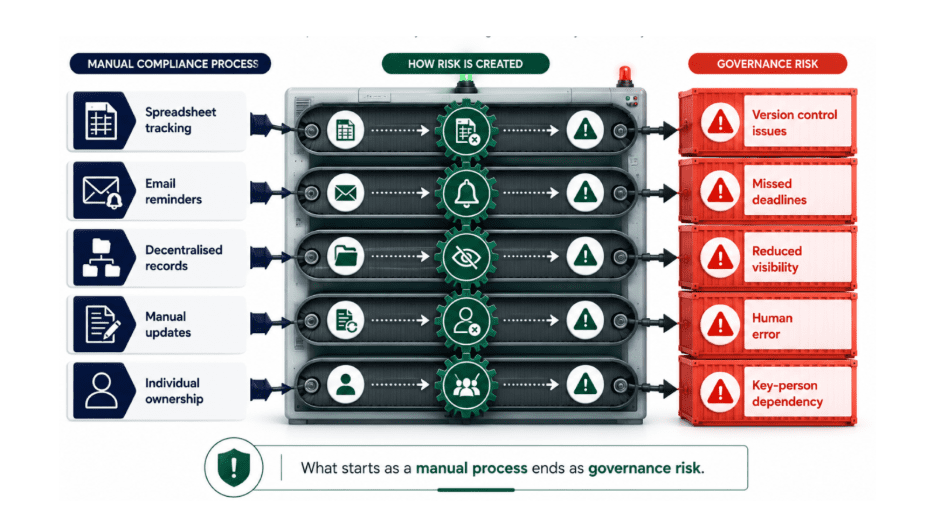
The problem is not the spreadsheet itself.
The problem is that governance complexity eventually outgrows manual oversight.
This is why leading governance teams increasingly view compliance tracking as part of governance infrastructure rather than administrative support.
What makes a compliance tracking system effective?
Many compliance systems focus heavily on task management.
The strongest systems support governance management.
Governance teams should look for systems that provide:
Centralised compliance visibility
Governance teams need a single source of truth.
This should provide visibility over:
- Compliance obligations
- Filing deadlines
- Responsible individuals
- Completion status
- Governance activities
Without centralised visibility, governance becomes fragmented.
Entity Management integration
Compliance obligations rarely exist independently.
They are attached to legal entities.
According to governance and compliance experts, organisations increasingly require integrated entity management and compliance oversight capabilities to manage growing corporate complexity effectively.
An effective compliance tracking system should connect obligations directly to:
- Subsidiaries
- Corporate entities
- Directors
- Shareholders
- Jurisdictions
Read More: Entity Management
Governance Forward Planning
High-performing governance teams do not simply react to deadlines.
They plan governance activity proactively.
A strong compliance tracking system should support:
- Annual governance planning
- Board calendars
- Regulatory cycles
- Governance projects
- Strategic governance initiatives
Governance should be forward-looking.
Not deadline-driven.
Read More: Corporate and Governance Support
Board Action Tracking
Many governance failures occur after decisions are made.
Actions are assigned.
Responsibilities are delegated.
Follow-up becomes inconsistent.
Board action tracking provides accountability by ensuring governance decisions are:
- Assigned
- Monitored
- Reported
- Completed
Good governance requires visibility beyond the board meeting itself.
Read More: Board and Shareholder Meetings
Governance reporting and intelligence
Modern boards increasingly require governance insights rather than governance administration.
A strong compliance tracking system should provide:
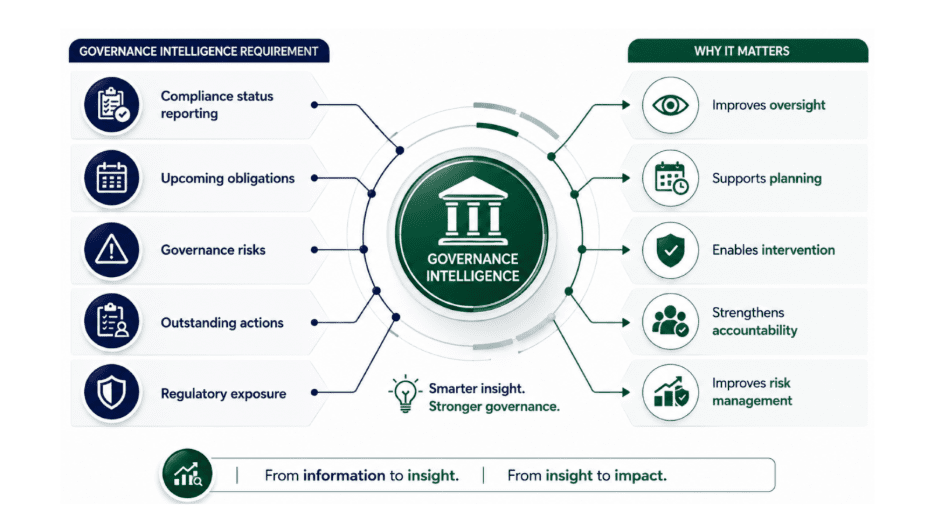
Visibility strengthens governance.
Governance intelligence strengthens decision-making.
The compliance tracking systems governance teams should avoid
Not every compliance solution improves governance.
Some create additional complexity.
Warning signs include:
Systems focused only on task reminders
Compliance is more than reminders.
Governance teams require visibility, accountability and oversight.
Compliance tools disconnected from governance processes
Compliance should not sit separately from:
- Board management
- Entity management
- Governance reporting
- Governance operations
Systems dependent on manual administration
If maintaining the system creates excessive administrative burden, governance teams often stop using it effectively.
Technology should reduce complexity.
Not create it.
The future of compliance tracking is governance infrastructure
The strongest governance teams are increasingly moving beyond standalone compliance systems.
They are adopting governance infrastructure.
This means connecting:
- Compliance Calendars
- Entity Management
- Board Management
- Governance Forward Planning
- Statutory Registers
- Board Action Tracking
- Governance Reporting
According to industry GRC software research, organisations are increasingly seeking integrated governance, risk and compliance capabilities because disconnected systems create fragmented oversight and reduce organisational visibility. (Apono GRC Software Review)
This shift reflects a broader reality.
Compliance management is becoming a governance issue.
Not merely an administrative one.
Why governance teams need more than software
One of the biggest misconceptions in the market is that compliance software alone solves governance challenges.
It does not.
Technology improves visibility.
Technology supports accountability.
Technology enables monitoring.
But governance still requires expertise.
It requires judgement.
It requires interpretation.
It requires governance leadership.
The most effective governance functions combine technology with governance knowledge.
That combination is becoming increasingly important as governance expectations continue to rise.
Why CoSec Hub takes a different approach
CoSec Hub was built around a simple belief.
Governance teams need more than software and more than outsourced administration.
They need governance infrastructure.
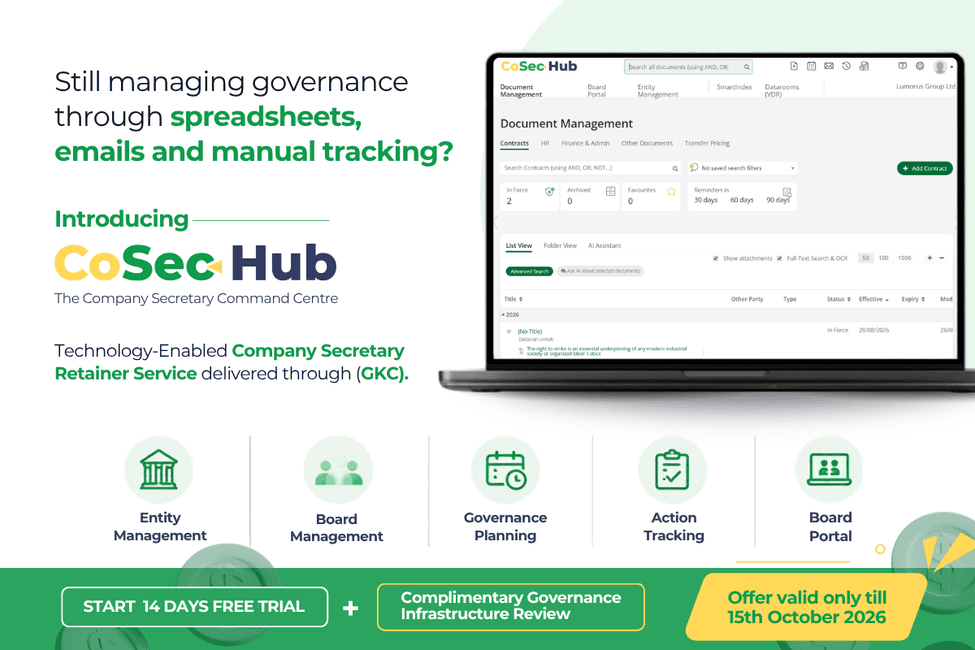
That is why CoSec Hub combines technology and governance expertise through a technology-enabled Company Secretary Retainer Service.
CoSec Hub
The Company Secretary Command Centre supporting:
Governance Knowledge Centre (GKC)
Providing:
- Company Secretary Expertise
- Governance Operations Support
- Compliance Monitoring
- Board Administration
- Governance Intelligence
- Multi-Jurisdiction Governance Support
- Governance Advisory Support
Together, CoSec Hub and the Governance Knowledge Centre (GKC) provide governance infrastructure designed to help governance teams move from fragmented compliance management to connected, auditable and board-ready governance operations.
About CoSec Hub
CoSec Hub is the Company Secretary Command Centre.
Built by Company Secretaries for Company Secretaries, CoSec Hub combines technology and governance expertise to support governance operations, compliance oversight, entity management and board administration.
Delivered through CoSec Hub and the Governance Knowledge Centre (GKC), the service provides technology-enabled Company Secretary Retainer Services designed for modern company secretarial, legal governance and compliance teams.
Lumorus: Better Business, Built on Purpose
Lumorus is a UK-headquartered global governance, company secretarial, ESG and advisory firm supporting organisations across multiple jurisdictions and regulated environments.
We help organisations strengthen governance infrastructure, accountability systems and board oversight capability as governance complexity, regulatory expectations and enterprise risk continue to evolve.
Explore how CoSec Hub and the Governance Knowledge Centre (GKC) can help your organisation move from fragmented administration to connected, auditable and board-ready governance.
CoSec Hub: cosec.lumorus.com
Email: [email protected]
CoSec Hub + Governance Knowledge Centre (GKC): Where Automation Meets Governance Authority.