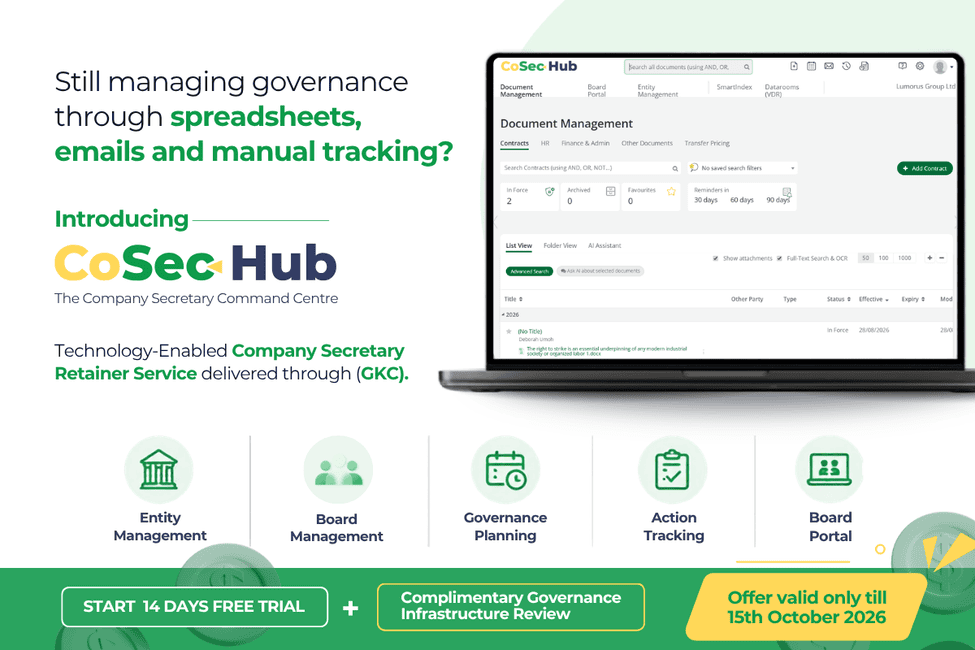




Governance teams are being asked to carry more responsibility on infrastructure built for a simpler organisation
The governance function has changed. In many organisations, the infrastructure supporting it has not.
Company Secretaries and governance professionals now sit closer to board decision making, regulatory risk, entity oversight, internal controls, subsidiary governance, corporate transactions, AI governance and organisational change. Yet many teams still rely on spreadsheets, shared folders, board portals, email, personal calendars and institutional memory to connect those responsibilities.
That mismatch is becoming difficult to ignore.
The Chartered Governance Institute UK & Ireland Governance Market Survey 2026 found that 65% of governance professionals believe the influence of the governance function is increasing, while 66% said supporting board information quality and decision making is becoming more important. At the same time, 74% reported increased workloads and 42% said their governance functions were not adequately resourced.
Entity governance shows similar pressure. The Diligent Global State of Legal Entity Compliance 2026 surveyed more than 300 senior practitioners across 38 jurisdictions and found that 74% had seen their scope expand during the previous two years. Meanwhile, 63% said workload had grown faster than their teams or that their teams had reduced, while 55% still managed entity information through spreadsheets, Word documents and SharePoint.
Most strikingly, 51% had experienced a near-miss entity compliance event.
These figures point to something more serious than administrative pressure.
The governance mandate has outgrown the governance operating model.
For boards, that matters because infrastructure weaknesses do not remain inside the Company Secretary function. Eventually, they affect information quality, regulatory compliance, board decisions, action tracking, entity records, internal controls and the organisation’s ability to demonstrate that governance actually worked.
The solution is not another spreadsheet. Nor is it necessarily another standalone software platform.
Governance teams need connected governance infrastructure that brings together information, processes, technology, accountability and professional judgement.
Read More: Corporate Governance Support
Executive Takeaway
Better governance infrastructure should solve a straightforward but increasingly important problem:
Governance teams should not have to manually connect every part of the organisation’s governance system.
A stronger operating model should connect:
- Entity management
- Statutory and regulatory compliance
- Governance calendars
- Board and committee activity
- Board papers and decisions
- Minutes
- Board action tracking
- Director and shareholder records
- Beneficial ownership
- Statutory registers
- Subsidiary governance
- Delegated authorities
- Governance reporting
- Regulatory change
- Audit evidence
- Professional Company Secretary expertise
When these areas operate separately, skilled governance professionals spend disproportionate amounts of time searching, checking, reconciling and chasing.
Once they are connected, the function can devote more capacity to advising, anticipating risk and improving governance.
The difference is not merely efficiency.
It is governance capacity.
The pressure on governance teams is structural, not temporary
Busy periods are normal in governance.
Annual reporting creates pressure, transactions generate additional work and regulatory changes require implementation. Major board meetings can also compress already demanding schedules.
Recent evidence, however, suggests something more structural is happening.
The governance mandate itself is expanding.
The CGI Governance Market Survey 2026 found that governance professionals are becoming more influential while taking on greater responsibility for board information and decision support. Almost three-quarters of respondents also reported increased workloads.
The Diligent 2026 entity compliance research points in the same direction. Governance mandates are expanding while technology gaps, legacy systems and capacity constraints remain significant.
That creates a fundamental limitation.
Every governance professional has finite time. Consequently, each hour spent reconciling director records, searching for filing evidence or updating several spreadsheets is an hour that cannot be spent helping the Chair prepare for a difficult discussion, challenging a weak board paper or anticipating an emerging governance risk.
Boards should therefore ask a different question.
What type of work is consuming the governance team’s capacity?
The answer often reveals whether the problem is really headcount or infrastructure.
1. Fragmented governance creates an invisible manual-work tax
Manual governance does not always look inefficient.
Updating a spreadsheet may take only a few minutes. Sending an email reminder takes seconds, while checking whether a filing has been completed may require only a short message to a local adviser.
Individually, each task appears small.
Together, they create a substantial manual-work tax.
Diligent’s 2026 research found that 52% of surveyed governance professionals spend at least six hours each week tracking filings, deadlines and record updates.
Across a year, that can represent hundreds of hours of skilled professional capacity.
The real cost is therefore not the spreadsheet itself. It is the higher-value work the organisation does not receive because experienced governance professionals are occupied maintaining fragmented systems.
Typical examples include:
- Rechecking entity information held by several departments
- Chasing local advisers for compliance confirmations
- Comparing board actions against previous minutes
- Updating director information in multiple locations
- Searching email for evidence of an approval
- Recreating governance calendars manually
- Gathering annual-report evidence retrospectively
None of these activities is inherently unnecessary.
The problem is that much of the administrative effort surrounding them should be reduced by better infrastructure.
Better governance infrastructure does not remove governance work. It removes avoidable governance friction.
2. Governance information needs one reliable home
A surprising amount of organisational risk begins with a basic question:
Which record is correct?
Finance may maintain one group structure, while tax holds another. Legal may have its own entity list, the local subsidiary could possess more recent director information and the governance team may be working from a separate record.
As long as nothing significant is happening, these inconsistencies can remain hidden.
Then an acquisition begins.
A lender asks for information.
An auditor requests evidence.
A regulator raises a question.
Suddenly, the organisation must determine which version of its own corporate information can be trusted.
That is not merely a data-management problem. It is a governance problem.
Modern governance infrastructure should establish:
- Which information source is authoritative
- Who owns each category of governance data
- Who may change it
- What evidence supports changes
- How discrepancies are resolved
- How local updates reach the group
- When information is reviewed
The aim is not to create another database.
It is to establish information accountability.
This becomes even more important as corporate regulation moves towards structured, digital information.
Explore More: Statutory & Regulatory Compliance
3. Companies House reform makes governance data more important
The transformation of Companies House illustrates how quickly expectations around corporate information are changing.
Under the Economic Crime and Corporate Transparency Act 2023, the registrar has gained stronger powers to query information, request supporting evidence and improve the accuracy and integrity of the register. The UK Government’s guidance on the role and powers of the Registrar of Companies explains the extent of that shift.
Identity verification represents another significant change. According to Companies House guidance, compulsory identity verification began on 18 November 2025 for new directors and people with significant control, with existing directors and PSCs entering the regime through transitional arrangements.
The direction is clear.
Corporate compliance is becoming more digital, more data driven and more concerned with the integrity of underlying information.
For governance teams, this means maintaining reliable visibility over:
- Directors
- People with significant control
- Identity verification requirements
- Corporate ownership
- Filing obligations
- Entity changes
- Supporting evidence
A filing completed on time is no longer enough if the information behind it is unreliable.
Better infrastructure helps governance teams maintain accurate records continuously rather than correcting them when a deadline becomes urgent.
Read More: Statutory & Regulatory Compliance
4. Boards increasingly need evidence that governance controls are working
The UK Corporate Governance Code 2024 raises the standard further for companies within its scope.
Provision 29 applies to financial years beginning on or after 1 January 2026. It requires boards to monitor their risk management and internal control framework, review its effectiveness at least annually and make a declaration concerning material controls.
Importantly, those controls are not confined to financial reporting. They can include financial, operational, reporting and compliance controls.
The FRC’s Provision 29 guidance reinforces the importance of evidence obtained through monitoring and review when boards assess control effectiveness.
This has a wider implication for governance infrastructure.
Organisations increasingly need to demonstrate:
- What the control is
- Who owns it
- How it operates
- Whether it worked
- What evidence exists
- What happened when it failed
- Whether remediation was completed
Company Secretaries are not internal auditors. However, they frequently sit close to the governance processes and records that enable boards to discharge their responsibilities.
Weak infrastructure makes that evidence difficult to assemble.
Strong infrastructure captures it as governance happens.
5. Audit readiness should become an operating condition
Many organisations still prepare for scrutiny retrospectively.
An audit begins, so records are gathered. A financing transaction starts, which triggers a search for historical approvals. Due diligence requires entity records, shareholder resolutions, director appointments and evidence of key decisions.
This approach creates unnecessary pressure.
A stronger governance model operates differently because evidence is created naturally when governance occurs.
For example:
- A director appointment retains its approval and supporting documents
- A board decision remains connected to the paper considered
- An action shows its owner, deadline and completion evidence
- A statutory filing links to the relevant corporate event
- A conflict retains evidence of how it was handled
- A governance control shows how it was monitored
The result is continuous audit readiness.
Its value extends beyond faster document retrieval. When evidence remains connected to the governance event that created it, the organisation develops a more reliable institutional history.
Evidence created when governance happens is usually stronger than evidence reconstructed when scrutiny arrives.
6. Board information is becoming an infrastructure issue
Board effectiveness depends heavily on information.
Exceptional directors can still govern poorly if information arrives late, lacks context, contains excessive detail or is structured around management’s preferences rather than the decision directors must make.
The FRC Corporate Governance Code Guidance emphasises the importance of effective information flows, including the nature, source, format and frequency of information reaching the board.
Meanwhile, the CGI Governance Market Survey 2026 found that 66% of respondents believe supporting board information quality and decision making is becoming more important.
Better governance infrastructure should therefore support much more than document distribution.
A disciplined meeting lifecycle should connect:
- Forward agenda planning
- Paper deadlines
- Decision requirements
- Supporting information
- Conflict declarations
- Meeting records
- Actions
- Follow-up
A board portal can distribute information.
Governance infrastructure should help turn information into accountable decisions.
Read More: Board & Shareholder Meetings
7. Board actions need the same discipline as board papers
Governance teams often manage the period before a meeting more carefully than the period after it.
Agendas are prepared, papers are coordinated and the meeting takes place. Minutes are then drafted and approved.
After that, the actions begin.
This final stage is where accountability can weaken.
A board may agree that management should review a control, renegotiate a contract, investigate a risk or return with further analysis. If those commitments move into personal task lists or email, visibility can disappear quickly.
Better governance infrastructure should keep actions connected to the decisions that created them.
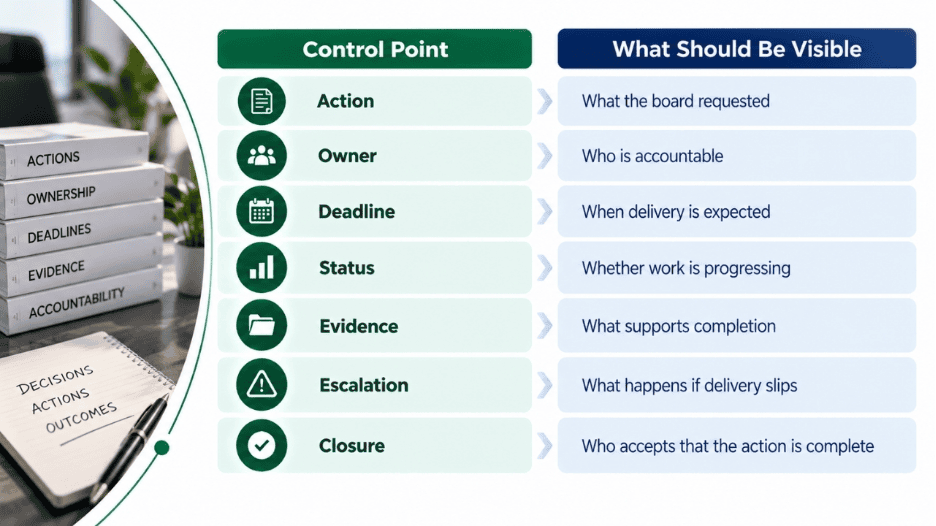
This discipline becomes especially important where actions involve regulatory remediation, cyber risk, internal controls, audit findings or investigations.
A decision without implementation is incomplete governance.
Read More: Minute Taking Solutions
8. Better infrastructure reduces key-person dependency
Some governance functions appear highly effective because experienced people quietly compensate for structural weakness.
They remember which filing is approaching, know which entity record is current and understand which board action remains incomplete. Often, they also know which local adviser has not responded and which approval still needs to be obtained.
That expertise is valuable.
However, the organisation should ask a harder question:
Would the governance process still work if that person became unavailable tomorrow?
If the answer is uncertain, the organisation has key-person dependency.
Better infrastructure reduces that exposure by capturing routine institutional knowledge through:
- Central governance calendars
- Controlled entity information
- Board action systems
- Documented workflows
- Ownership records
- Clear responsibilities
- Accessible evidence
This does not diminish professional expertise. Instead, it protects it.
Experienced Company Secretaries can devote more time to judgement because routine knowledge no longer depends on memory.
Expertise should strengthen the governance system, not become the system.
9. International growth makes fragmented governance infrastructure increasingly dangerous
Multi-jurisdiction organisations encounter the infrastructure problem particularly quickly.
Every country can introduce different requirements concerning directors, ownership, beneficial ownership, annual filings, statutory registers, board procedures and regulatory reporting.
Local expertise therefore remains essential.
However, a group cannot govern effectively if every jurisdiction becomes an information island.
The central function still needs visibility over:
- Which entities exist
- Who governs them
- Who owns them
- Which obligations are due
- Whether filings are current
- Which material actions remain unresolved
- Where local issues require group escalation
The stronger operating model combines local legal and regulatory expertise with central governance visibility.
This approach does not eliminate legitimate jurisdictional differences. Instead, it prevents those differences from creating group blindness.
Explore More: Company Secretary Outsourcing
10. Cyber governance makes information infrastructure a board responsibility
Governance teams hold unusually sensitive information.
Board papers can contain strategy, acquisitions, remuneration, legal advice, investigations, regulatory issues and personal director information. Consequently, the infrastructure used to manage governance records carries material cyber and information-security implications.
The UK Government Cyber Governance Code of Practice sets out actions boards and directors should take across risk management, strategy, people, incident planning, recovery and assurance. It reinforces the principle that cyber risk belongs within organisational governance rather than being treated purely as a technical matter.
For governance teams, practical questions include:
- Who can access board information?
- How are permissions reviewed?
- How quickly is departing-director access removed?
- Where are governance records stored?
- How are confidential documents retained?
- What happens during a cyber incident?
- Can external AI tools access restricted board material?
Better governance infrastructure must therefore be secure infrastructure.
Convenience without information control is not good governance.
11. AI will expose weak governance infrastructure faster
Artificial intelligence offers considerable opportunities for governance teams.
It can assist with regulatory monitoring, document analysis, information retrieval, meeting preparation, workflow automation and governance reporting.
However, AI also depends on the quality of the information beneath it.
If entity data is inconsistent, AI processes inconsistent data. Where governance records are incomplete, automated analysis begins from incomplete evidence. When responsibilities are unclear, a generated recommendation cannot resolve the underlying accountability problem.
The CGI Governance Market Survey 2026 found that 50% of respondents believe AI literacy for boards is becoming more important.
That creates an important sequence.
Organisations should not begin by asking:
How can AI automate governance?
The better question is:
Is our governance information strong enough to automate safely?
Good AI governance begins with good information governance.
12. Better infrastructure enables exception management
One of the most valuable changes technology can create is moving governance teams away from checking everything manually.
Routine governance should become routine.
Professional attention should move towards exceptions.
A connected environment should surface issues when:
- A filing becomes overdue
- A board action misses its deadline
- A director verification remains incomplete
- Ownership information does not reconcile
- An approval is missing
- A governance control fails
- An authority approaches expiry
- A subsidiary falls outside group expectations
This creates a better allocation of professional time.
Instead of spending hours asking whether every task happened, the Company Secretary can concentrate on what did not happen and why.
Manual monitoring asks:
Has everything been done?
Exception management asks:
What requires professional attention?
The second question creates considerably more value.
13. Better infrastructure strengthens governance reporting
Governance reporting becomes difficult when evidence is fragmented.
At year end, Company Secretaries may need to gather information covering board activity, committee work, director changes, board evaluations, governance actions, internal controls and compliance developments.
Where infrastructure is weak, annual reporting becomes an exercise in reconstructing the year.
When systems are connected, evidence accumulates throughout the reporting period.
The annual report can then become an output of governance rather than a retrospective research project.
This direction is consistent with the UK Corporate Governance Code 2024, which places greater emphasis on reporting governance outcomes rather than relying only on descriptions of activities.
The principle also applies beyond listed companies.
Good governance reporting begins with good governance infrastructure.
Read More: Annual Report Services
14. Technology alone will not solve the infrastructure problem
It is tempting to assume that governance infrastructure simply means purchasing better software.
That is not enough.
Technology can automate reminders, centralise entity information, track actions and improve visibility. It cannot independently determine whether the board has enough information, whether a conflict has been managed properly or whether an issue requires escalation.
Those questions require professional judgement.
A mature governance model therefore combines several elements:
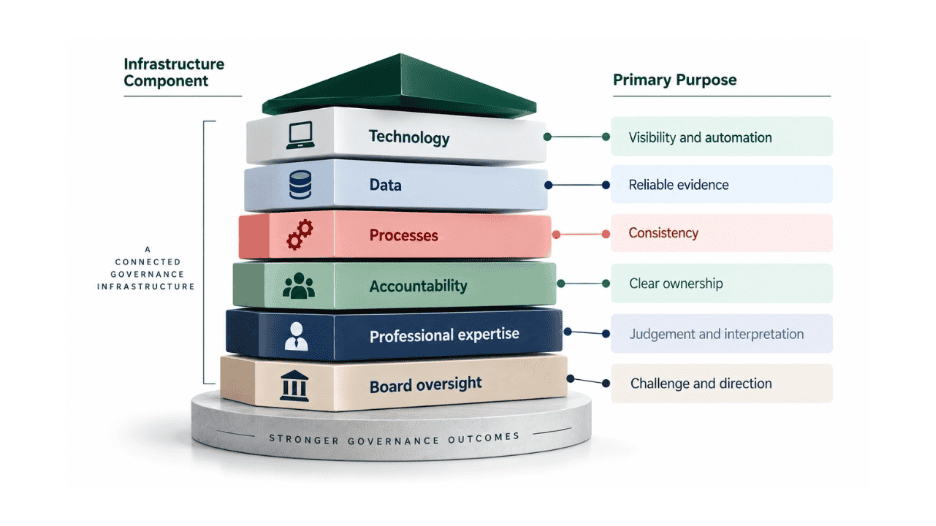
Remove any one of these elements and the system becomes weaker.
Technology without professional judgement risks automating weak processes. Conversely, professional expertise without infrastructure creates excessive dependence on individuals.
The value comes from connecting both.
15. Better governance infrastructure increases organisational resilience
Governance infrastructure becomes particularly valuable when an organisation comes under pressure.
Consider what happens during:
- An acquisition
- A regulatory investigation
- A leadership transition
- Refinancing
- An audit
- Rapid international expansion
- Significant restructuring
- Unexpected absence of key personnel
Each event places pressure on governance information.
The organisation suddenly needs to know what was approved, who owns each entity, which obligations remain open, whether records are current and who possesses authority.
Weak systems struggle precisely when they are needed most.
Strong infrastructure does the opposite. It enables the organisation to retrieve reliable information during uncertainty and respond without first reconstructing its own governance history.
That is why governance infrastructure should be considered part of organisational resilience rather than merely an administrative improvement.
The governance infrastructure maturity model
Organisations can assess their current position using a simple maturity framework.
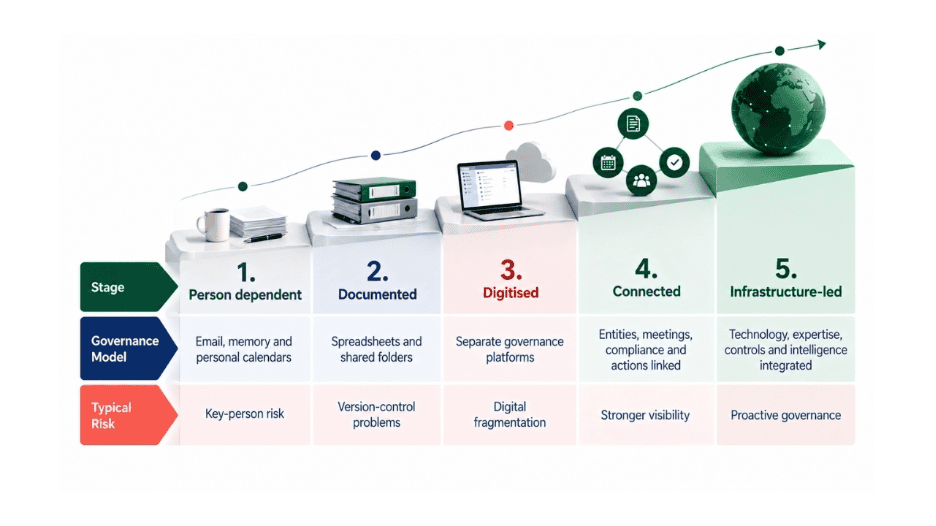
The third stage deserves particular attention.
Many organisations believe they have transformed governance because several processes have become digital.
Yet digital fragmentation remains fragmentation.
The real improvement begins when information can move through the governance lifecycle without repeated manual intervention.
What better infrastructure changes for the Company Secretary
A well-designed operating model should create a visible shift in how professional time is used.
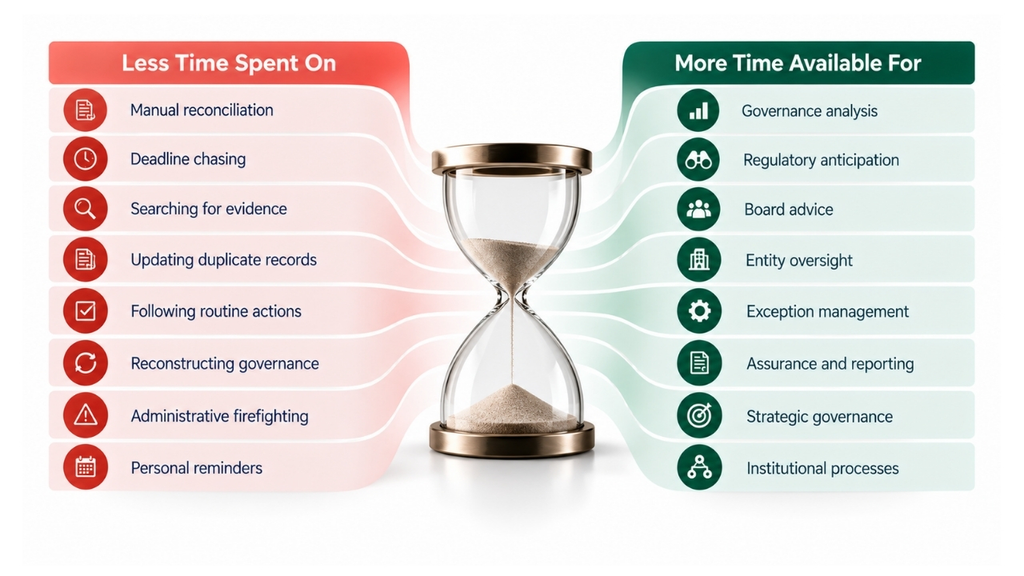
This is one of the strongest commercial arguments for better governance infrastructure.
It does not make the governance function less important.
It allows the function to perform more of the work for which professional expertise is actually valuable.
Seven warning signs your governance infrastructure has fallen behind
1. Governance information has several versions
When teams routinely debate which record is current, information governance is weak.
2. Compliance depends on individual reminders
Critical statutory obligations should not depend primarily on memory.
3. Board actions disappear into emails
Material decisions require visible follow-through.
4. Governance evidence is assembled before audits
Strong evidence should already exist.
5. Subsidiary issues reach headquarters late
Central visibility should identify material exceptions earlier.
6. Every new entity creates proportionately more work
Infrastructure should allow the governance model to scale without requiring the same increase in manual administration.
7. Senior governance professionals spend most of their time chasing
This is often the clearest signal that the operating model is underperforming.
When several of these symptoms exist, the organisation may not need another productivity initiative.
It needs infrastructure redesign.
A practical governance infrastructure health check
Boards, General Counsel and Company Secretaries should ask:
- Can we see every legal entity in one reliable environment?
- Can we identify the next 90 days of significant governance obligations quickly?
- Can we trace a major board decision through to completion?
- Does every material board action have a clear owner?
- Do local and central entity records reconcile?
- Would the governance function continue effectively if a key person became unavailable?
- Can we identify governance exceptions without checking every record manually?
- Does our infrastructure create evidence as governance happens?
- Can our board access reliable information when scrutiny increases?
- Is technology freeing Company Secretaries to spend more time on judgement?
Several negative answers indicate more than an efficiency gap.
They indicate a governance infrastructure gap.
Why CoSec Hub was built around governance infrastructure
Many governance platforms begin with a software proposition.
CoSec Hub begins with the operating model.
Modern governance teams need technology, but they also need professional Company Secretary expertise, governance operations support and reliable access to governance knowledge.
That is why CoSec Hub combines two connected layers.
The CoSec Hub technology layer supports
- Entity Management
- Compliance Calendars
- Governance Forward Planning
- Board Management
- Contract Management
- Statutory Registers
- Board Action Tracking
- Meeting Lifecycle Management
The Governance Knowledge Centre provides
- Chartered Company Secretary expertise
- Governance operations support
- Compliance monitoring
- Board administration
- Governance intelligence
- Multi-jurisdiction governance support
- Governance advisory
Together, these capabilities create a Technology-Enabled Company Secretary Retainer Service.
The distinction is important.
Software can identify that an obligation is overdue. An experienced Company Secretary can determine why it matters, who needs to respond, whether escalation is required and what the board should know.
Technology provides visibility.
Expertise provides judgement.
Connected properly, they create governance infrastructure.
Explore: CoSec Hub
Boards should care because governance infrastructure affects decision quality
It may be tempting to view governance infrastructure as an operational issue for the Company Secretary team.
That would be a mistake.
Weak infrastructure can produce poor board information, unclear decision records, late escalation, incomplete actions, weak subsidiary visibility and difficulty demonstrating controls.
By contrast, stronger infrastructure allows directors to receive better information, understand accountability and access reliable evidence more quickly.
The board does not need to understand every workflow beneath the governance function.
It should, however, expect reliable answers to important questions.
That is the standard modern governance infrastructure should meet.
The Lumorus View
Governance teams do not need better infrastructure because they are failing. They need it because the organisations around them have become more complex than the traditional governance operating model was designed to handle.
That distinction matters.
Company Secretaries have often compensated for structural weaknesses through exceptional professional discipline. They remember deadlines, reconcile conflicting records, chase overdue actions and reconstruct governance evidence when necessary.
This commitment keeps organisations moving, but it can also disguise weaknesses in the underlying model.
A stronger approach builds infrastructure around expertise rather than forcing expertise to substitute for infrastructure.
That means using:
- Technology for visibility
- Data for evidence
- Processes for consistency
- Accountability for execution
- Professional expertise for judgement
- Board oversight for challenge
The result is not more governance bureaucracy.
It is a more governable organisation.
The Bottom Line
Governance teams are carrying broader responsibilities at a time when many organisations are becoming more regulated, international, digital and dependent on reliable information.
The evidence is increasingly clear.
The CGI Governance Market Survey 2026 shows that governance influence and workload are rising while substantial numbers of teams remain under-resourced. Meanwhile, the Diligent Global State of Legal Entity Compliance 2026 shows a profession still relying heavily on manual systems while near-miss compliance events remain common.
Regulatory developments are raising expectations further. The UK Corporate Governance Code 2024 increases the focus on internal controls and supporting evidence, while Companies House reforms are strengthening scrutiny of corporate information.
The answer cannot simply be asking governance teams to work harder.
Nor should organisations respond by adding another disconnected tool.
They need a stronger operating model.
Better governance infrastructure should help Company Secretaries:
- See obligations earlier
- Trust corporate information
- Connect board decisions with implementation
- Reduce key-person dependency
- Identify exceptions faster
- Create audit-ready evidence
- Govern across jurisdictions
- Support directors more effectively
- Spend more time applying professional judgement
The real test is straightforward.
If your governance team disappeared for a week, would the infrastructure continue to show what needs to happen, who is accountable and where the risks are?
If the answer is no, the problem is not simply workload.
The organisation has made people carry responsibilities that should also be carried by the system.
Continue Exploring
- Strengthen your organisation’s governance infrastructure: Corporate Governance Support
- Improve statutory and regulatory oversight: Statutory & Regulatory Compliance
- Strengthen board and shareholder governance: Board & Shareholder Meetings
- Build scalable corporate structures: Company Formation & Structuring
- Add professional Company Secretary capacity: Company Secretary Outsourcing
- Strengthen governance reporting: Annual Report Services
- Create stronger board records: Minute Taking Solutions
- Connect governance technology with Company Secretary expertise: CoSec Hub
About CoSec Hub
CoSec Hub is the Company Secretary Command Centre, built by Company Secretaries for Company Secretaries.
It combines governance technology with Chartered Company Secretary expertise to help organisations manage entity governance, compliance, board administration and governance operations through a more connected operating model.
Rather than relying on disconnected spreadsheets, inboxes, calendars and document repositories, CoSec Hub can bring together:
- Entity Management
- Compliance Calendars
- Governance Forward Planning
- Board Management
- Contract Management
- Statutory Registers
- Board Action Tracking
- Meeting Lifecycle Management
Alongside that technology, the Governance Knowledge Centre provides access to:
- Chartered Company Secretary expertise
- Governance operations support
- Compliance monitoring
- Board administration
- Governance intelligence
- Multi-jurisdiction governance support
- Governance advisory
Together, these capabilities create a Technology-Enabled Company Secretary Retainer Service.
The purpose is not simply to digitise governance administration. It is to create an operating environment in which information, accountability, decisions and evidence remain connected as the organisation grows.
Not software alone. Not traditional outsourcing alone. Connected governance infrastructure.
Visit CoSec Hub to explore how a more connected governance operating model could strengthen your organisation.
Lumorus: Better Business, Built on Purpose
Lumorus is a UK headquartered global governance, ESG, Company Secretary and advisory firm supporting organisations across Europe, Africa, Asia, the Caribbean, Canada, the Middle East and international markets.
We help boards and leadership teams strengthen governance infrastructure, accountability and organisational resilience as regulation, technology and corporate complexity continue to evolve.
Our Company Secretary capabilities include:
For organisations seeking a more connected operating model, CoSec Hub combines governance technology, professional Company Secretary expertise and governance knowledge infrastructure.
Is your governance team genuinely under-resourced, or is too much of its capacity being consumed by infrastructure that no longer matches the organisation?
That distinction matters because adding more people to a fragmented operating model may increase capacity without solving the structural problem.
Better governance starts with a better operating environment.
Explore Lumorus or visit CoSec Hub to strengthen the infrastructure behind your governance function.
Lumorus: Better Business, Built on Purpose.
Sources
- Chartered Governance Institute UK & Ireland: Governance Market Survey 2026 – Research based on 971 governance professionals examining governance influence, board information and decision support, workload, AI literacy and resourcing.
- Diligent: Global State of Legal Entity Compliance 2026 – Global research involving more than 300 senior practitioners across 38 jurisdictions, covering governance workload, entity compliance, technology and operating models.
- Diligent: Global Entity Compliance Benchmark Analysis – Analysis covering expanding governance mandates, manual systems, dedicated platforms, capacity pressures and near-miss compliance events.
- Financial Reporting Council: UK Corporate Governance Code 2024 – The current UK Corporate Governance Code, including Provision 29 and requirements concerning risk management and material internal controls.
- Financial Reporting Council: Corporate Governance Code Guidance – Guidance covering board information, governance processes, risk management, internal controls and effective decision making.
- Financial Reporting Council: Provision 29 Mythbuster – FRC explanation of material controls, monitoring, evidence and the board’s effectiveness declaration.
- UK Government: Role and Powers of the Registrar of Companies – Explanation of enhanced Companies House powers under the Economic Crime and Corporate Transparency Act 2023 and the focus on improving the accuracy and integrity of corporate information.
- Companies House: When You Need to Verify Your Identity – Current guidance covering identity verification requirements for directors and people with significant control.
- UK Government: Cyber Governance Code of Practice – Board-focused guidance covering cyber risk management, strategy, people, incident planning, recovery, assurance and governance oversight.