


ESG risk becomes a governance failure when the board cannot explain who owns it, how it is controlled or why it matters
Most boards no longer need convincing that environmental, social and governance issues can affect business.
The harder question is whether they are governed properly.
A climate risk may sit with sustainability, enterprise risk, operations and finance simultaneously. Human rights exposure can emerge through procurement, supply chains, workforce practices or market entry. Greenwashing risk may begin in marketing but ultimately affect regulatory exposure, reputation and board accountability.
The organisational chart rarely tells the whole story.
That is why ESG risk governance matters.
The G20/OECD Principles of Corporate Governance 2023 state that boards should adequately consider material sustainability risks and opportunities when reviewing and guiding strategy, risk management, disclosure and internal control systems. The Principles also recognise sustainability and resilience as part of the modern corporate governance framework.
Meanwhile, IFRS S1 General Requirements for Disclosure of Sustainability-related Financial Information requires disclosure of the governance processes, controls and procedures used to monitor, manage and oversee sustainability-related risks and opportunities. IFRS S1 also connects governance with strategy, risk management, metrics and targets.
The direction is therefore increasingly clear.
ESG risk is moving out of the sustainability department and into the architecture of corporate governance.
For boards, that changes the central question.
It is no longer enough to ask whether the company has an ESG strategy.
Boards need to understand whether material sustainability risks are identified early, allocated clearly, integrated into enterprise risk management, supported by reliable information and controlled with the same discipline applied to other significant business risks.
Read More: ESG Materiality & Risk Assessment
Executive Takeaway
Effective ESG risk governance requires more than a sustainability committee or an annual ESG report.
Boards need a governance architecture that connects:
- ESG materiality
- Enterprise risk management
- Corporate strategy
- Board and committee responsibilities
- Internal controls
- Sustainability reporting
- Capital allocation
- Executive incentives
- Supply chains
- Human rights
- Climate risk
- Nature-related risk
- Stakeholder information
- Greenwashing controls
- Regulatory change
- Assurance
- Board competence
The central principle is straightforward.
A material ESG risk should be governed with the same seriousness as any other material business risk.
That means somebody owns it, management controls it, the board oversees it and evidence demonstrates whether the system is working.
Where those elements are missing, ESG may be discussed extensively without being governed effectively.
The board’s ESG problem is not a lack of information. It is a lack of integration
Many organisations now generate substantial amounts of sustainability information.
They calculate emissions, conduct materiality assessments, publish targets, collect workforce data, assess suppliers and prepare sustainability disclosures.
Yet more information does not automatically produce better oversight.
A board can receive a 70-page sustainability presentation and still remain unclear about:
- Which risks are financially material
- Which risks are increasing
- Who owns them
- Which controls mitigate them
- Whether controls are effective
- Which assumptions underpin targets
- How ESG affects capital allocation
- What should trigger escalation
This is where ESG reporting and ESG governance diverge.
Reporting describes.
Governance allocates responsibility.
Reporting communicates performance.
Governance determines who is accountable when performance deteriorates.
Reporting may identify a risk.
Governance determines what happens next.
The strongest boards therefore treat sustainability information as an input into governance rather than the endpoint of the process.
Explore More: ESG Strategy Development
1. Start with material ESG risk, not the ESG alphabet
One of the easiest ways to weaken board oversight is to treat every environmental, social and governance issue as equally important.
They are not.
Materiality should create focus.
IFRS S1 focuses on sustainability-related risks and opportunities that could reasonably be expected to affect an entity’s cash flows, access to finance or cost of capital over the short, medium or long term.
The OECD Principles similarly recognise that material sustainability-related information may include environmental and social matters capable of affecting asset values, revenues and long-term growth.
For a mining company, water, community relations, worker safety and environmental liabilities may dominate.
A financial institution may face very different issues around financed emissions, customer outcomes, data, exclusion policies and greenwashing.
Technology companies could place greater weight on energy consumption, human capital, supply chains, privacy and responsible AI.
The board therefore needs a company-specific ESG risk universe.
That assessment should consider:
- Business model
- Geography
- Sector
- Supply chain
- Regulation
- Stakeholder exposure
- Strategic objectives
- Capital requirements
- Physical assets
- Workforce
- Customers
- Reputation
Materiality is not about making the ESG agenda smaller for convenience.
It is about making board attention more intelligent.
Read More: ESG Materiality & Risk Assessment
2. ESG risk should sit inside enterprise risk management
A common governance weakness is allowing ESG risks to operate in a parallel universe.
The organisation has one enterprise risk register and another sustainability risk assessment.
Risk owns one.
The sustainability team owns the other.
This separation may make reporting easier, but it can weaken governance.
If climate transition risk could affect asset values, supply chains or financing costs, why should it sit outside the main risk architecture?
Similarly, material human rights, workforce, environmental or conduct risks should not become secondary simply because they carry an ESG label.
The OECD Principles on sustainability and resilience explicitly connect sustainability matters with risk management and internal controls.
Likewise, IFRS S1 requires disclosure of the processes used to identify, assess, prioritise and monitor sustainability-related risks and opportunities.
The governance implication is important.
Material ESG risks should enter the organisation’s normal risk machinery.
That means:
Risk identification → Assessment → Ownership → Controls → Monitoring → Escalation → Board oversight
Once ESG risk operates through that chain, sustainability becomes part of enterprise governance rather than a separate corporate programme.
3. Boards need clear ownership before they need another committee
When ESG oversight appears weak, organisations sometimes respond by creating a sustainability committee.
That may be appropriate.
However, another committee does not automatically solve an accountability problem.
The first question should be:
Who owns the risk?
The board retains collective responsibility for oversight, even where detailed work is delegated to committees. The G20/OECD Principles place responsibility on boards for strategic guidance, effective monitoring of management and accountability, while recognising that material sustainability matters should be considered when boards perform those functions.
Committee structures should therefore clarify accountability rather than fragment it.
A practical allocation might look like this:
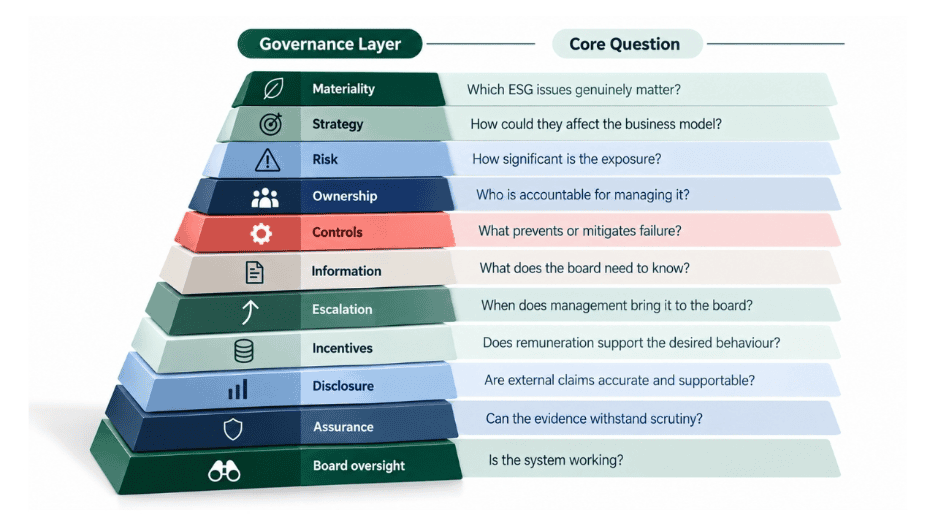
No single model is right for every organisation.
However, ambiguity is rarely a good model.
Explore More: Corporate Governance Support
Boards routinely discuss risk appetite for financial, operational and strategic risks.
ESG risks deserve the same discipline where they are material.
4. ESG risk appetite needs to become explicit
Consider a company operating in a water-stressed region.
How much operational disruption is acceptable before additional investment becomes necessary?
A consumer company sourcing from high-risk jurisdictions faces another question: what level of supplier non-compliance triggers suspension or termination?
Financial institutions may need to determine which sustainability claims they are prepared to make and what evidence is required before those claims reach customers.
Without clear risk appetite, management receives mixed signals.
The board may say sustainability matters while capital allocation rewards the opposite behaviour.
Risk appetite can help translate high-level commitments into practical boundaries.
It should influence:
- Investment decisions
- Market entry
- Supplier standards
- Product development
- M&A
- Lending
- Insurance
- Executive incentives
- Operational thresholds
The purpose is not to reduce every sustainability risk to a numerical limit.
Instead, the board should establish where the organisation is prepared to accept exposure and where it is not.
That is governance.
5. ESG risk needs to reach strategy and capital allocation
A sustainability strategy that does not influence resource allocation has limited power.
Boards should therefore test whether material ESG considerations actually affect investment decisions.
For example:
- Does climate risk influence asset valuations?
- Are transition assumptions incorporated into strategic planning?
- Does water risk affect location decisions?
- Are human rights issues considered during market entry?
- Do acquisitions include ESG due diligence?
- Are significant environmental liabilities reflected in transaction decisions?
- Does the capital plan fund commitments the organisation has publicly made?
The OECD Principles connect sustainability directly with strategy, risk management and corporate resilience.
This matters because the strongest evidence of ESG integration is rarely found in the sustainability report.
It is found in decisions.
If ESG changes what the company says but never changes what the company funds, the board should question how deeply it has been integrated.
Read More: ESG Integration in Investment Decisions
6. Sustainability reporting is becoming a control environment
The global sustainability reporting architecture continues to develop rapidly.
IFRS S1 is built around governance, strategy, risk management, and metrics and targets. It requires disclosure of the processes, controls and procedures organisations use to monitor, manage and oversee sustainability-related risks and opportunities.
Adoption and use are also spreading internationally. As of September 2026, the IFRS Foundation’s jurisdictional profiles and snapshots show jurisdictions across multiple regions progressing with ISSB-aligned sustainability reporting approaches.
The UK has also moved forward. In February 2026, the Government issued UK SRS S1 and UK SRS S2, based on the global ISSB baseline.
Issuing the standards does not by itself mean every UK company is automatically required to apply them. However, their publication is an important development in the UK’s sustainability reporting architecture.
For boards, the underlying message is broader.
Sustainability information is becoming part of corporate reporting infrastructure.
That means ESG data increasingly needs:
- Ownership
- Definitions
- Methodologies
- Controls
- Review
- Evidence
- Governance
- Assurance readiness
The age of treating sustainability data as a collection of numbers assembled shortly before publication is ending.
Read More: ESG Reporting and Disclosure
7. Provision 29 makes ESG reporting controls a board issue
The UK Corporate Governance Code 2024 creates an especially important connection between ESG and internal controls.
Provision 29 applies to financial years beginning on or after 1 January 2026 for companies within the Code’s scope. It requires boards to monitor and review their risk management and internal control framework and make a declaration regarding the effectiveness of material controls.
Crucially, the FRC states that material controls can include controls over reporting, including narrative and ESG reporting controls.
This should change the board conversation.
Suppose an annual report contains a material carbon-emissions figure.
The relevant questions are no longer limited to whether the number appears reasonable.
The board may also need to understand:
- Where the data originated
- Who owns it
- Which methodology was applied
- Which assumptions were used
- Who reviewed it
- What controls operated
- Which systems produced it
- Whether weaknesses were identified
- How evidence supports the disclosure
That is a much more mature governance standard.
ESG reporting is increasingly moving from communications governance towards control governance.
Explore More: ESG Reporting and Disclosure
8. Greenwashing is a governance risk, not merely a marketing risk
A sustainability claim can create risk long before it appears in an annual report.
Marketing may describe a product as sustainable.
Investor relations may publish a transition commitment.
A fund may use environmental terminology in its communications.
Management may announce a net-zero target without a credible implementation pathway.
The governance issue is straightforward.
Who checked the claim?
For FCA-authorised firms, the FCA’s anti-greenwashing rule and guidance require sustainability-related claims about products and services to be fair, clear and not misleading. The rule has applied since 31 May 2024.
Although the regulatory position differs across sectors and jurisdictions, the governance principle travels well.
Material sustainability claims should have evidence behind them.
Boards should therefore understand how significant ESG communications are:
- Developed
- Substantiated
- Reviewed
- Approved
- Updated
- Withdrawn when no longer accurate
The strongest anti-greenwashing control is not cautious wording.
It is governance that prevents unsupported claims from reaching the market in the first place.
9. ESG targets create accountability only when somebody owns the pathway
Targets are easy to announce.
Governance begins afterwards.
A company may commit to reduce emissions, improve workforce diversity, strengthen supplier standards or achieve another sustainability objective.
Once the announcement is made, the board should ask:
- Who owns delivery?
- What is the baseline?
- Which assumptions underpin the target?
- What capital is required?
- Which milestones matter?
- How often will progress be reviewed?
- What happens if performance falls behind?
- Can the target still be achieved?
- When should the market be updated?
Without those mechanisms, a target can become an aspiration detached from accountability.
Evidence from Europe illustrates how this challenge is evolving. EFRAG’s State of Play 2026 report, based on 905 assured FY2025 sustainability statements prepared under ESRS, found that companies identified an average of 6.4 material ESRS topics but had measurable targets for an average of 3.3.
The gap between materiality and measurable targets is revealing.
Identifying an issue is not the same as governing performance.
10. Executive incentives can strengthen ESG governance or distort it
Linking executive pay to sustainability metrics can signal seriousness.
Poorly designed incentives, however, can create new problems.
EFRAG’s 2026 research found that 63% of companies in its sample linked sustainability performance to executive incentive schemes.
That makes metric quality particularly important.
Boards and remuneration committees should test whether ESG-related incentives are:
- Material to strategy
- Measurable
- Within reasonable management influence
- Difficult to manipulate
- Supported by reliable data
- Balanced against other performance measures
- Appropriate over the relevant time horizon
The OECD Principles also recognise the connection between sustainability matters, executive remuneration and board oversight.
A badly designed ESG metric can reward activity without producing meaningful outcomes.
Therefore, boards should resist the temptation to add sustainability measures to remuneration simply to demonstrate alignment.
Incentives should reinforce strategy, not decorate it.
11. Climate risk remains important, but ESG risk governance cannot stop at climate
Climate has understandably dominated much of the sustainability agenda.
Physical and transition risks can affect assets, operations, supply chains, insurance, financing and business models.
Yet the board’s ESG risk universe is broader.
Depending on the organisation, material issues may include:
- Human rights
- Workforce conditions
- Health and safety
- Biodiversity
- Water
- Pollution
- Product responsibility
- Community impacts
- Supply-chain resilience
- Business conduct
- Data and privacy
- Responsible technology
The sustainability reporting architecture is also developing beyond climate.
During 2026, the ISSB continued work on nature-related risks and opportunities, building on IFRS S1 and IFRS S2.
This does not mean boards should create an enormous ESG agenda.
Quite the opposite.
They should maintain enough horizon scanning to identify which sustainability issues could become strategically material before those issues become crises.
12. Social risk often reveals whether ESG governance is genuinely integrated
Environmental risks can sometimes be easier to quantify than social risks.
That does not make social issues less significant.
Human rights, workforce practices, community relations and supply-chain conditions can affect operational continuity, regulatory exposure, reputation and market access.
These risks are also highly dependent on context.
A global policy may look robust at headquarters while conditions in a particular supplier, facility or jurisdiction tell a different story.
Effective social-risk governance therefore needs information from the operating edge of the organisation.
Boards should understand:
- Where the highest-risk operations and suppliers sit
- How grievances are identified
- Which workforce indicators are deteriorating
- How human rights risks are assessed
- Whether community issues can affect operations
- How serious incidents reach the board
- What remediation looks like
This is also where stakeholder engagement becomes useful.
Done well, engagement is not a reputation exercise.
It is an early-warning system.
Explore More: Stakeholder Engagement
13. The board needs ESG information designed for decisions
Board ESG packs can easily become overloaded.
Emissions figures sit beside diversity data, supplier statistics, ratings, targets, incidents, stakeholder updates and regulatory developments.
The result may be comprehensive but strategically weak.
Directors need information that helps them make judgements.
A stronger ESG dashboard should therefore distinguish between:
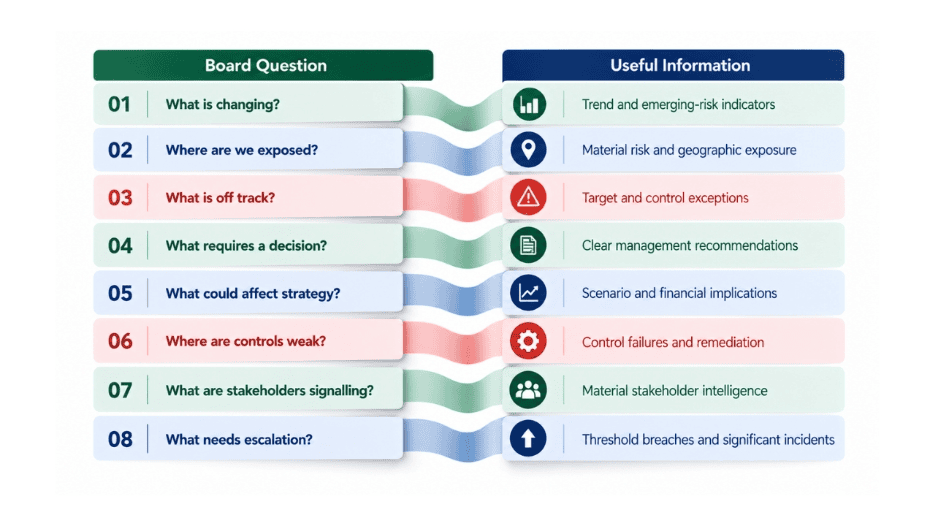
The purpose of board information is not to demonstrate how much sustainability activity occurred.
It is to improve oversight and decision quality.
14. ESG risk needs escalation thresholds
A board cannot oversee every sustainability incident.
Nor should it.
Management needs authority to manage operational issues, while the board requires visibility over matters significant enough to affect strategy, reputation, risk appetite or legal exposure.
That requires escalation criteria.
Triggers might include:
- Serious environmental incidents
- Significant worker fatalities or safety events
- Major human rights allegations
- Material regulatory breaches
- Significant sustainability reporting errors
- Failure of a material ESG control
- Major deviation from a public target
- Serious community disputes
- Greenwashing allegations
- Material supply-chain disruption
Thresholds should reflect the organisation’s risk profile.
The important point is that escalation should not depend entirely on whether somebody happens to recognise an issue as board worthy.
Good governance creates a route before the crisis occurs.
15. Board competence matters more than creating ESG specialists everywhere
Boards need sufficient competence to challenge management on material sustainability issues.
That does not mean every director must become a climate scientist, human rights specialist or sustainability reporting expert.
The objective is collective board competence.
Directors should understand enough to ask:
- What is material?
- What assumptions are we making?
- What could change?
- Who owns the risk?
- How are we controlling it?
- What evidence supports this claim?
- How does it affect strategy?
- What happens if we are wrong?
Specialist expertise can then support the board where necessary.
The nomination committee should also consider whether the board’s collective skills remain appropriate as the company’s ESG risk profile changes.
Sustainability competence is therefore part of board composition and succession planning, not merely director training.
Explore More: Board Skills Audit
16. ESG regulation is becoming more global and more complex
Boards operating internationally face another challenge.
There is no single global ESG regulatory regime.
However, convergence is occurring in important areas.
The IFRS Foundation’s jurisdictional information shows governments and regulators across multiple regions adopting or otherwise using ISSB-aligned sustainability disclosure requirements.
Europe continues to develop its sustainability reporting architecture. In July 2026, the European Commission adopted revised European Sustainability Reporting Standards, reducing mandatory datapoints by more than 60% while retaining the broader objective of high-quality sustainability disclosures.
In the UK, UK SRS S1 and S2 were issued in February 2026, based on the ISSB global baseline.
The regulatory direction may vary by jurisdiction, but one implication is consistent.
Boards need systems capable of identifying which requirements apply to which entities and translating regulatory developments into accountable implementation.
A regulatory update sitting unread in somebody’s inbox is not regulatory governance.
17. ESG assurance begins with governance, not the assurance provider
Boards increasingly want confidence in sustainability information.
External assurance can help.
However, assurance cannot compensate for weak internal governance.
Before asking whether sustainability information should be externally assured, boards should examine:
- Data ownership
- Methodologies
- Systems
- Internal controls
- Evidence
- Management review
- Reporting boundaries
- Estimates
- Assumptions
- Governance approval
If these foundations are weak, assurance becomes harder and more expensive.
The stronger approach builds assurance readiness into the reporting process.
That mirrors the evolution financial reporting experienced over many years.
Sustainability information is now moving in the same direction: from voluntary narrative towards controlled, decision-useful corporate information.
Read More: ESG Reporting and Disclosure
18. ESG governance should challenge inconsistencies between words and decisions
Some of the most revealing ESG governance questions are questions of consistency.
Does the company publicly support a transition that its capital allocation undermines?
Are executive incentives aligned with stated sustainability priorities?
Does procurement contradict the organisation’s human rights policy?
Are sustainability commitments reflected in acquisition due diligence?
Do lobbying activities align with public sustainability positions?
The OECD Principles specifically state that boards should ensure lobbying activities are coherent with sustainability-related goals and targets.
That is a useful wider governance principle.
The board should test whether the organisation behaves consistently with what it says.
Reputational risk frequently begins in the distance between the two.
The ESG risk governance architecture
A mature ESG governance model should connect the entire risk lifecycle.
Weak ESG governance usually involves a break somewhere in this chain.
The sustainability report may look impressive while risk ownership remains unclear.
Alternatively, strong policies may exist while board information remains weak.
Good governance connects the entire system.
Seven warning signs ESG risk governance is weak
1. ESG exists outside enterprise risk management
Material sustainability risks should not operate through a parallel governance system.
2. Nobody can clearly explain board and committee responsibilities
Committee proliferation can disguise accountability gaps.
3. Sustainability targets have no accountable executive owner
A target without ownership is closer to aspiration than governance.
4. The board receives extensive ESG information but few decisions
Reporting volume should not be confused with oversight quality.
5. ESG claims are reviewed mainly by communications teams
Material external claims need appropriate evidence and governance.
6. Sustainability data is assembled manually before reporting
This increases control, consistency and assurance risk.
7. ESG rarely affects capital allocation
If material sustainability risks never influence investment decisions, integration may be superficial.
Several warning signs together suggest the organisation has moved beyond a reporting problem.
It has an ESG governance problem.
A practical ESG risk governance health check for boards
Boards can test their current arrangements by asking:
- Can we identify our most material ESG risks without reading the sustainability report?
- Does each material risk have an accountable executive owner?
- Are material ESG risks integrated into enterprise risk management?
- Do we know which board or committee oversees each significant issue?
- Have we defined appropriate escalation thresholds?
- Can management explain the controls supporting material sustainability disclosures?
- Do ESG considerations affect capital allocation where they are financially material?
- Can we substantiate our most important public sustainability claims?
- Are incentives aligned with the sustainability outcomes we say matter?
- Does the board have sufficient collective competence to challenge management?
- Are stakeholder concerns feeding into risk identification where relevant?
- Could our ESG information withstand regulatory, investor or assurance scrutiny?
A weak answer to one question may be manageable.
Several weak answers usually indicate that sustainability activity has developed faster than the governance architecture surrounding it.
From ESG reporting maturity to ESG governance maturity
Organisations often describe ESG maturity through the quality of their reporting.
Boards should use a broader test.
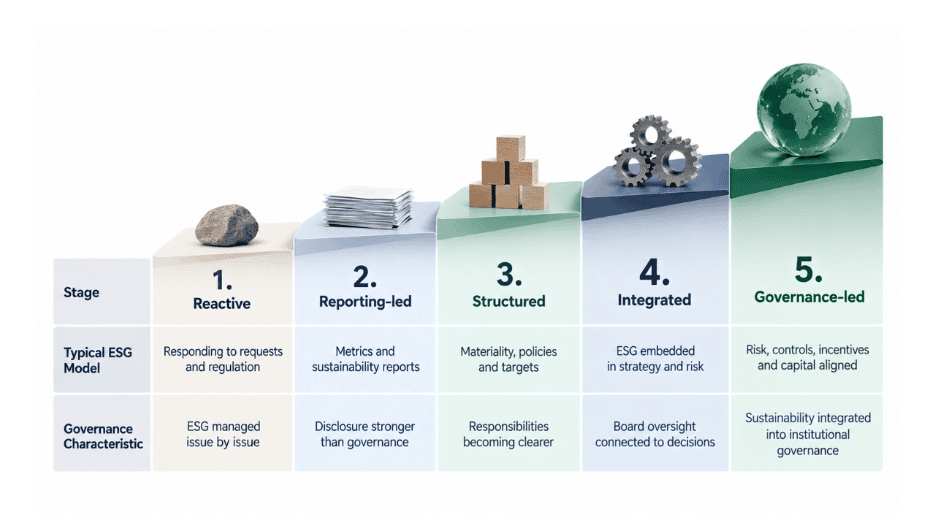
The movement from stage three to stage four is often the most difficult.
It requires ESG to leave the sustainability function and enter finance, risk, operations, remuneration, investment and board decision making.
That is where governance becomes decisive.
What boards should do now
Boards do not need to redesign their entire ESG governance framework overnight.
However, several actions can materially improve oversight.
Clarify materiality
Identify the sustainability risks and opportunities that genuinely matter to the business.
Map accountability
Establish which executives, committees and board bodies own each material issue.
Integrate risk
Bring material ESG risks into enterprise risk management rather than maintaining parallel systems.
Review information
Determine whether board ESG reporting supports decisions rather than simply describing activity.
Test controls
Understand how material sustainability data and claims are produced and verified.
Review incentives
Ensure sustainability metrics used in remuneration are robust and strategically relevant.
Strengthen escalation
Define which events, control failures and performance deviations require board attention.
Build assurance readiness
Create evidence throughout the year rather than reconstructing it during reporting season.
These actions move ESG from programme management towards institutional governance.
How Lumorus approaches ESG risk governance
Lumorus approaches sustainability through a governance lens.
That means beginning not with the report, but with the organisation.
Which ESG risks are material?
Who owns them?
How do they affect strategy?
What information reaches the board?
Which controls support significant disclosures?
How do stakeholder perspectives inform decision making?
Where does accountability sit?
Our sustainability and governance capabilities can support organisations across:
The objective is not to create another ESG layer around the organisation.
It is to embed material sustainability considerations into the governance structures through which the organisation already makes decisions.
The Lumorus View
The most important ESG governance question is not whether the board discusses sustainability. It is whether sustainability risk changes how the organisation is governed.
A mature board should be able to trace a material ESG issue from identification through ownership, controls, information, decisions and accountability.
If climate risk is material, it should affect risk management and strategy.
Where human rights exposure is material, it should influence supply-chain governance and market decisions.
When sustainability information is material, it should operate through reliable reporting controls.
If ESG targets influence executive pay, the metrics should be robust enough to justify that consequence.
Where public claims are made, evidence should exist before the claim reaches the market.
This is the difference between ESG activity and ESG governance.
Boards do not create value by discussing more sustainability topics.
They create value by ensuring that the sustainability issues capable of affecting the organisation are identified early, governed intelligently and connected to real decisions.
ESG becomes credible when accountability catches up with ambition.
The Bottom Line
ESG risk governance is entering a more demanding phase.
The G20/OECD Principles of Corporate Governance now place sustainability and resilience firmly within the international corporate governance framework.
IFRS S1 connects sustainability-related financial disclosure with governance, strategy, risk management, metrics and targets. Meanwhile, jurisdictions around the world are developing or implementing sustainability reporting requirements using the ISSB Standards as an important reference point.
For UK boards within scope, Provision 29 of the UK Corporate Governance Code 2024 brings additional attention to material internal controls, including controls over ESG reporting where material.
Elsewhere, the FCA anti-greenwashing rule demonstrates the regulatory consequences that can arise when sustainability claims move ahead of supporting evidence.
Boards should therefore stop treating ESG governance as an adjunct to sustainability reporting.
The stronger model connects:
- Materiality
- Strategy
- Enterprise risk
- Board accountability
- Internal controls
- Executive ownership
- Incentives
- Capital allocation
- Reporting
- Stakeholders
- Assurance
- Evidence
The real test is not whether the organisation has an ESG strategy.
It is whether the board can answer three questions with confidence:
What are our material sustainability risks?
Who is accountable for managing them?
What evidence tells us the system is working?
If those answers are unclear, the organisation does not primarily have an ESG communications problem.
It has a governance problem.
Continue Exploring
- Identify the sustainability issues that matter most: ESG Materiality & Risk Assessment
- Turn sustainability priorities into strategic direction: ESG Strategy Development
- Integrate ESG into capital and investment decisions: ESG Integration in Investment Decisions
- Strengthen sustainability information and disclosures: ESG Reporting and Disclosure
- Build stronger stakeholder intelligence: Stakeholder Engagement
- Measure and manage social outcomes: Social Impact Measurement and Management
- Strengthen the governance architecture around ESG: Corporate Governance Support
- Assess whether your board has the skills required for emerging sustainability risks: Board Skills Audit
Lumorus: Better Business, Built on Purpose
Lumorus is a UK headquartered global governance, ESG, Company Secretary and advisory firm supporting organisations across Europe, Africa, Asia, the Caribbean, Canada, the Middle East and international markets.
We help boards and leadership teams move sustainability beyond policy and reporting by connecting ESG with governance, strategy, risk, controls, accountability and decision making.
Our sustainability and responsibility capabilities include:
These capabilities are strengthened by our wider corporate governance expertise, helping boards connect sustainability with the structures through which power, risk and accountability are actually managed.
Can your board demonstrate how its most material ESG risks move from identification to ownership, control, decision and evidence?
If not, another sustainability report will not solve the underlying problem.
The governance architecture needs attention.
Explore Lumorus to strengthen ESG risk governance across your organisation.
Lumorus: Better Business, Built on Purpose.
Sources
- IFRS Foundation: IFRS S1 General Requirements for Disclosure of Sustainability-related Financial Information – Global sustainability disclosure standard covering governance, strategy, risk management, metrics and targets for material sustainability-related risks and opportunities.
- IFRS Foundation: Use of ISSB Standards by Jurisdiction – Current jurisdictional profiles and snapshots showing adoption and other use of ISSB Standards around the world.
- G20/OECD Principles of Corporate Governance 2023: Sustainability and Resilience – International corporate governance principles covering board responsibilities for material sustainability risks, opportunities, strategy, risk management, internal controls and disclosure.
- G20/OECD Principles of Corporate Governance 2023: Responsibilities of the Board – Guidance concerning strategic direction, management oversight, board accountability and the consideration of material sustainability matters.
- Financial Reporting Council: UK Corporate Governance Code 2024 – Current UK governance framework, including Provision 29 and the board’s responsibilities concerning material financial, operational, reporting and compliance controls.
- UK Government: UK Sustainability Reporting Standards S1 and S2 – UK sustainability reporting standards issued in February 2026 and based on the ISSB global baseline.
- Financial Conduct Authority: Anti-Greenwashing Rule Guidance – FCA guidance requiring sustainability-related claims about products and services by authorised firms to be fair, clear and not misleading.
- EFRAG: State of Play 2026 – Analysis of 905 assured FY2025 sustainability statements prepared under ESRS, including findings on materiality, targets, transition planning and executive incentives.
- European Commission: Revised European Sustainability Reporting Standards 2026 – July 2026 revisions to ESRS designed to simplify sustainability reporting while maintaining high-quality disclosure.
- IFRS Foundation: ISSB Nature-related Disclosures Work, July 2026 – Current development of the ISSB’s work on nature-related risks and opportunities.