


Most boards do not realise governance infrastructure is a risk until it becomes a crisis
Boards spend significant time discussing risk.
Cybersecurity is reviewed.
Financial performance is monitored.
Regulatory compliance is assessed.
Operational resilience is tested.
Strategic threats are debated.
Yet one of the most significant enterprise risks often receives far less attention than it deserves.
Governance infrastructure.
Many organisations assume governance is functioning because board meetings take place, reports are produced and compliance obligations appear to be under control.
On paper, governance looks healthy.
Beneath the surface, however, a different reality often exists.
Critical information is fragmented.
Entity records sit across multiple systems.
Board actions are tracked inconsistently.
Governance knowledge depends on a small number of individuals.
Decision-making becomes difficult to evidence.
Accountability becomes harder to monitor.
The organisation appears governed.
The infrastructure supporting governance is often far weaker than boards realise.
According to governance experts writing in Forbes, one of the defining governance challenges of the coming decade is that risks are evolving faster than traditional board oversight mechanisms can adapt. Boards increasingly face environments where complexity, uncertainty and information flows move more rapidly than governance systems were originally designed to handle.
Read More: Governance Infrastructure Design
Governance infrastructure is not administration. It is organisational resilience
One of the most common governance misconceptions is that governance infrastructure is largely operational.
It is not.
Governance infrastructure determines how effectively an organisation:
- Allocates authority
- Monitors accountability
- Escalates risks
- Tracks decisions
- Maintains oversight
- Preserves institutional knowledge
Strong governance infrastructure allows organisations to maintain control as complexity increases.
Weak governance infrastructure forces organisations to rely on effort, workarounds and individual experience.
For a period, this may appear effective.
Eventually it creates risk.
Enterprise risk often begins as a visibility problem
Most governance failures do not begin with misconduct.
They begin with limited visibility.
An action is not followed up.
A risk is not escalated.
A filing is missed.
A governance obligation is overlooked.
A board decision is not implemented.
Individually, these may appear insignificant.
Collectively, they create conditions where larger failures become possible.
According to EverPure Data’s analysis of infrastructure complexity, organisations increasingly underestimate the governance risks created by fragmented systems, disconnected information and operational complexity. The more complex an organisation becomes, the more vulnerable it becomes to visibility failures.
Visibility is not a reporting issue.
It is a governance issue.
Most organisations evolve faster than their governance systems
Growth is often celebrated.
Governance maturity is often assumed.
The two are not always connected.
As organisations expand, governance complexity increases.
New entities are established.
New markets are entered.
New regulations emerge.
New stakeholders appear.
New risks develop.
Yet governance systems frequently remain unchanged.
The organisation grows.
The governance architecture does not.
This creates a widening gap between organisational complexity and governance capability.
According to the World Economic Forum, organisational resilience increasingly depends on governance systems capable of adapting to complexity, uncertainty and rapid change.
Growth without governance infrastructure often produces hidden vulnerabilities.
Boards often see the symptoms rather than the cause
Governance discussions frequently focus on visible failures.
Examples include:
- Compliance breaches
- Reporting failures
- Delayed approvals
- Regulatory findings
- Poor board performance
These are symptoms.
The underlying issue is often infrastructure.
A board cannot effectively oversee risks it cannot see.
Management cannot execute governance responsibilities consistently when accountability is unclear.
Company secretaries cannot maintain governance visibility when information is dispersed across multiple systems.
Many governance failures are infrastructure failures before they become compliance failures.
The warning signs are usually visible long before the crisis
Weak governance infrastructure rarely emerges without warning.
Common indicators include:
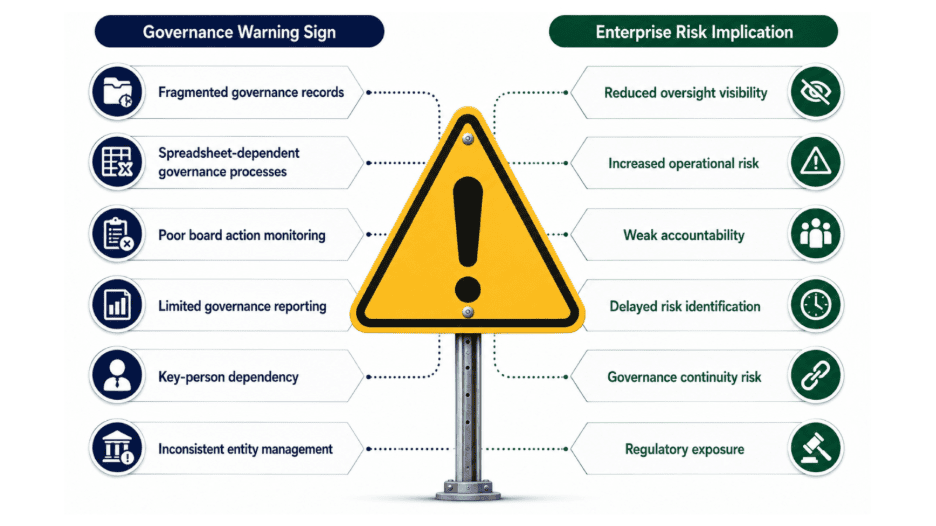
The challenge is that organisations often normalise these weaknesses.
Until something goes wrong.
Information complexity is becoming a governance challenge
Many boards are receiving more information than ever before.
Board packs continue to expand.
Risk reports continue to grow.
Governance reporting becomes increasingly detailed.
Yet visibility often declines.
According to governance research highlighted by Forbes, one of the greatest challenges facing boards is distinguishing between information abundance and genuine oversight capability.
More information does not necessarily improve governance.
Governance improves when information becomes actionable.
That requires governance infrastructure capable of transforming data into accountability and oversight.
Read More: Board Evaluation & Assessment
Why governance infrastructure is becoming a board issue
Historically, governance infrastructure was often viewed as an administrative responsibility.
That perspective is changing.
Boards increasingly recognise that governance infrastructure directly affects:
- Risk management
- Regulatory compliance
- Strategic decision-making
- Organisational resilience
- Stakeholder confidence
- Governance effectiveness
The quality of governance outcomes increasingly depends on the quality of governance systems.
This is why governance infrastructure is moving from the back office to the boardroom.
Read More: Board Decision and Risk Assessment
Good governance depends on systems, not heroes
Many organisations unknowingly rely on individuals rather than governance systems.
The company secretary knows where everything sits.
The governance manager tracks key obligations.
The legal team maintains critical records.
The system works because specific individuals make it work.
This creates fragility.
If governance depends on institutional memory rather than governance infrastructure, resilience becomes vulnerable.
Strong governance should be embedded within systems, processes and accountability mechanisms.
Not dependent on individual effort.
This is one of the most important governance lessons boards often learn too late.
The future belongs to organisations that treat governance as infrastructure
The most effective organisations increasingly view governance differently.
They recognise that governance is not simply compliance.
It is infrastructure.
Just as organisations invest in financial systems, cybersecurity systems and operational systems, governance systems are becoming equally important.
Because governance ultimately determines how decisions are made, risks are monitored, accountability is maintained and power is exercised.
When governance infrastructure is strong, organisations become more resilient, more transparent and better equipped to manage complexity.
When governance infrastructure is weak, risk accumulates quietly.
And risk tends to move faster than boards expect.
Lumorus: Better Business, Built on Purpose
At Lumorus, we believe governance is not paperwork.
It is the allocation, exercise, constraint and accountability of power inside organisations.
Lumorus is a UK-headquartered global governance, ESG, company secretarial and advisory firm supporting organisations across Europe, Africa, Asia, the Caribbean, Canada, the Middle East and international markets.
We help boards and leadership teams strengthen governance infrastructure, improve oversight and build organisational resilience capable of supporting long-term value creation.
Our expertise includes:
To explore how Lumorus can help strengthen governance capability and organisational resilience, visit:
Together, we can build better business: one that performs with purpose, leads with integrity and creates lasting value.