


Every product that gets built exists because someone got tired of watching a problem go unsolved. CoSec Hub is no different.
Lumorus did not build CoSec Hub because the company secretary software market was underserved. It built CoSec Hub because the governance advisory work that Lumorus does with boards and leadership teams across Africa and the UK kept surfacing the same structural failure, in organisation after organisation, sector after sector, jurisdiction after jurisdiction.
The failure was not a lack of intent. The boards Lumorus worked with were serious about governance. The CoSec professionals those boards relied on were capable and diligent. The problem was the infrastructure underneath the function. It was almost universally broken. Statutory registers living in spreadsheets. Board resolutions stored in email folders. Compliance deadlines managed through personal calendar reminders. Institutional knowledge concentrated in one or two individuals whose departure would leave a governance continuity gap that nobody had formally acknowledged.
The tools available to CoSec professionals were not built for the work. They were general purpose tools, assembled into a workflow, and held together by the diligence of the people using them. That diligence was real. The structural fragility it masked was also real. CoSec Hub was built to replace that fragility with infrastructure that the function actually deserves.
The Problem That Made CoSec Hub Necessary
To understand why CoSec Hub exists, it helps to understand the specific governance failures that Lumorus observed repeatedly across its advisory work.
Boards Were Governing on Incomplete Information
One of the most consistent findings in board effectiveness reviews conducted by Lumorus was that boards were making governance decisions on the basis of information they could not verify. The statutory position of the company was held in a spreadsheet maintained by one person. The record of what the board had previously decided was stored in an email archive that nobody had audited. The compliance position across the group’s subsidiaries was, in many cases, unknown to the board because nobody had built the system to know it.
This is not a failure of governance intention. It is a failure of governance infrastructure. A board cannot exercise genuine oversight of the statutory and compliance position of a company if that position is not held in a system that makes it visible, current, and auditable. The board was not failing. The infrastructure was failing the board.
CoSec Professionals Were Carrying Unsustainable Risk
The second observation was about the people doing the work. CoSec professionals across the organisations Lumorus worked with were carrying a level of operational and legal risk that was rarely acknowledged. They were the single point of failure for compliance deadline management. They were the custodians of institutional knowledge that existed nowhere else. They were the people whose departure would trigger a governance continuity crisis, not because they had done anything wrong, but because the infrastructure had been built around them rather than alongside them.
That concentration of risk in individuals is not a sustainable model for a function that carries the legal and regulatory weight that company secretary work carries. It is a risk that manifests at the worst possible moment: when a key person is unavailable, when due diligence surfaces an inconsistency, when a regulatory examination asks for records that cannot be produced.
The Regulatory Environment Was Tightening Around a Function That Had Not Modernised
The third observation was about the external environment. Regulatory requirements across Africa and the UK were becoming more demanding, more specific and more consequential. The Economic Crime and Corporate Transparency Act in the UK, the Companies and Allied Matters Act amendments in Nigeria, expanded beneficial ownership requirements across multiple jurisdictions: all of these were raising the standard that CoSec functions were expected to meet. The infrastructure available to most CoSec teams had not moved to match that standard. The gap was widening.
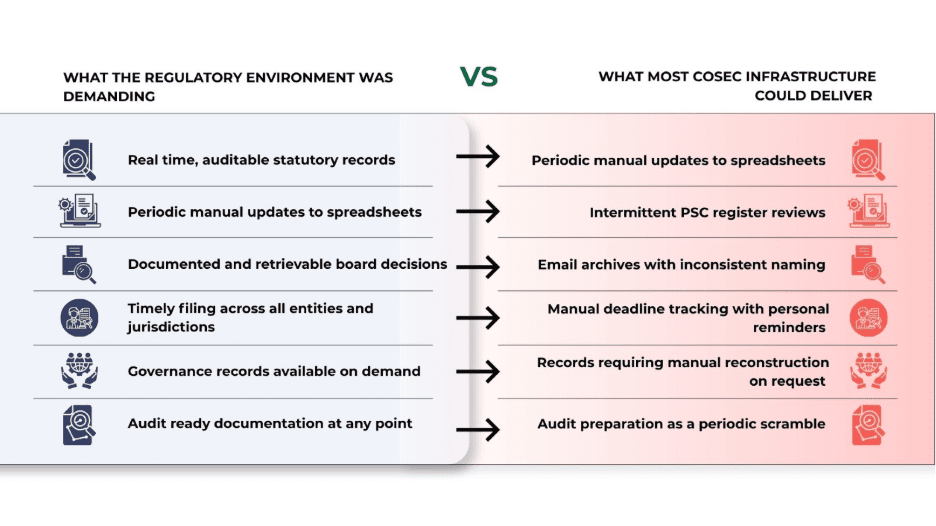
The combination of these three observations produced a clear conclusion: the CoSec function needed infrastructure that was purpose built for the work. Not a better spreadsheet. Not a more disciplined email system. A governance infrastructure platform that encodes process, enforces accountability, preserved institutional knowledge and gives boards the real time visibility into their governance position that genuine oversight requires.
That is what CoSec Hub was built to be.
What Lumorus Believed About Governance Before Building CoSec Hub
CoSec Hub was not built from a technology brief. It was built from a set of convictions about governance that Lumorus had developed over years of working with boards and leadership teams across complex, high stakes environments.
- Governance is infrastructure, not administration. The company secretary function is frequently positioned as an administrative support function. That positioning underestimates what the function does. CoSec work is the infrastructure of governance. It is the system by which a company knows its legal position, meets its statutory obligations, records its decisions, and maintains the accountability chain that makes genuine oversight possible. Infrastructure that is fragile makes governance fragile, regardless of how capable the people running it are.
- Accountability requires systems, not just people. Governance accountability that depends on the diligence of specific individuals is not structural accountability. It is personal accountability, and personal accountability has a well documented tendency to move with the person who holds it. Structural accountability requires systems that enforce process, maintain records, and escalate failures regardless of who is in the room or what else is competing for attention.
- Boards deserve to see the real position. A board that cannot access its company’s statutory position in real time, that must request information and wait for a response; that receives governance updates through curated reports rather than live data, is not exercising genuine oversight. It is receiving management. Lumorus believed, and continues to believe, that boards deserve the infrastructure to see the real governance position of their organisation at any point, without friction and without dependency on an individual’s availability.
- The CoSec professional deserves better tools. The people doing company secretary work are, in many cases, among the most legally exposed professionals in their organisations. They carry compliance obligations that have direct legal consequences if they are not met. They deserve tools that are built for the weight of that responsibility, not tools that require their constant vigilance to compensate for structural inadequacy.
What CoSec Hub Was Built to Do
From those convictions, Lumorus built CoSec Hub around four core design principles.
- Replace the Spreadsheet with a Living System of Record
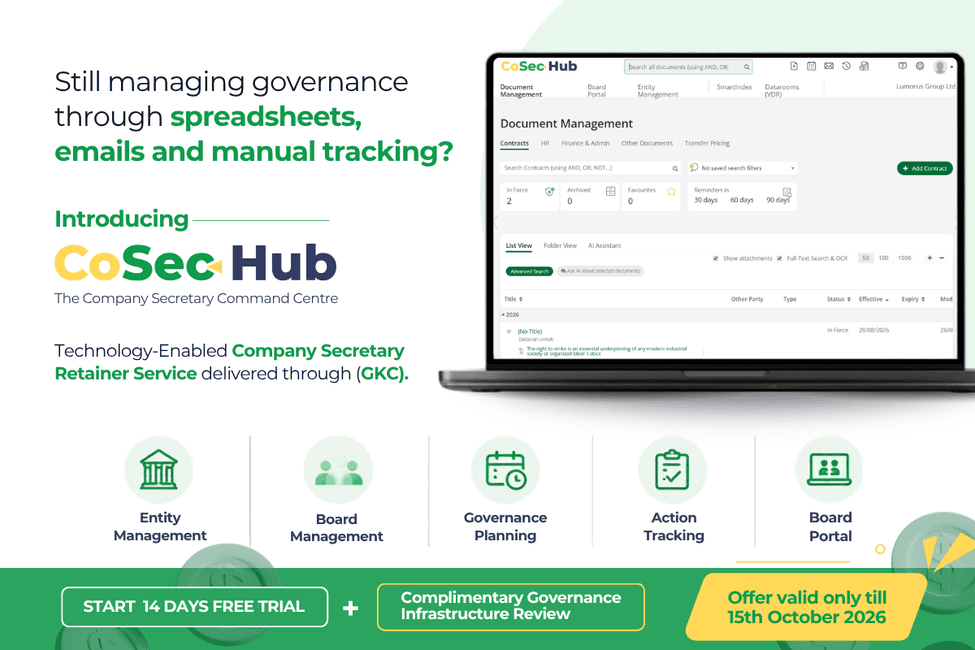
The statutory register is the legal foundation of a company’s governance position. It should not live in a spreadsheet. CoSec Hub maintains statutory registers as live, structured records with full audit trails. Every change is logged, timestamped, and attributed. The register is always current, always auditable, and always ready for inspection, because it was built to be those things, not because a diligent individual happened to update it recently.
- Automate What Should Never Depend on Memory
Compliance deadlines are binary. They are met or they are missed. The consequences of missing them are not proportionate to how busy the team was at the time. CoSec Hub tracks compliance deadlines through an automated engine that monitors obligations across all entities and jurisdictions, generates alerts in advance, and triggers escalation protocols where action is required. The deadline management function does not depend on a personal reminder or a calendar that belongs to one team member. It is structural.
- Give Boards Real Time Visibility
CoSec Hub was built to give boards and authorised stakeholders real time access to the governance position of their organisation. The statutory position of each entity, the status of compliance deadlines, the record of board decisions, the completeness of beneficial ownership filings: all of this is accessible through the platform without requiring a request to the CoSec team and without waiting for a periodic update. The board can see what it needs to see when it needs to see it.
- Encode Institutional Knowledge into the Platform
The knowledge that a CoSec professional carries about the governance history of an organisation is valuable. The risk is that it exists only in that professional’s memory. CoSec Hub encodes institutional knowledge into the platform. Processes are documented in the system. Records are structured and accessible. The governance history of the organisation is held in an infrastructure that persists regardless of staff transitions, rather than in the heads of the people who happened to be there when things happened.
What It Changes for Boards
The practical implications of CoSec Hub for boards are specific and consequential.
From Curated Reports to Live Data
The traditional model of board governance reporting in the CoSec space is the periodic report: a document prepared by the CoSec team, reviewed by management and presented to the board at a scheduled interval. The board receives what the team has chosen to include at the point the team chose to compile it.
CoSec Hub changes that model. Boards and authorised stakeholders have access to live governance data rather than curated reports. The compliance position is visible in real time. The statutory records are accessible on demand. The resolution repository is searchable and current. The board is no longer dependent on the reporting cycle to know the governance position of the organisation.

From Reactive to Proactive Compliance
The traditional CoSec model is reactive. Deadlines are tracked manually. Alerts are generated when someone remembers to check. Problems surface when a deadline has been missed or when due diligence reveals an inaccuracy. The response is remediation.
CoSec Hub makes compliance management proactive. Deadlines are tracked automatically. Alerts are generated in advance. Escalation is triggered before a deadline becomes a problem. The board receives compliance intelligence before the consequences of non-compliance materialise, not after.
From Person Dependent to Structurally Resilient
The governance continuity risk that a person dependent on CoSec operations creates is not hypothetical. It materialises every time a key CoSec professional leaves, every time a team is restructured and every time an organisation goes through due diligence and discovers that its governance records are held in a system that one person understands and nobody else can navigate.
CoSec Hub removes that dependency. The governance infrastructure is held on the platform. It is accessible to authorised team members. It does not degrade with staff transitions. It does not require months of knowledge transfer when someone new joins. The organisation’s governance capability is structural rather than personal.
From Governance as Cost to Governance as Capability
The most significant change that CoSec Hub represents for boards is a shift in how governance infrastructure is understood. In the traditional model, CoSec work is a cost centre: a function that must be resourced to meet legal obligations, and that provides little strategic value beyond compliance. The quality of the infrastructure it runs on is rarely questioned because the function is rarely treated as strategic.
CoSec Hub reframes that relationship. Governance infrastructure that gives a board real time visibility into its statutory position, that maintains auditable records continuously, that scales without degrading as the organisation grows and that does not depend on individuals to remain intact is not a cost. It is capability. It is the foundation on which genuine board oversight is built and the infrastructure that makes governance accountability real rather than ceremonial.
“Governance is not documentation of decisions already made. It is the infrastructure that makes good decisions possible. CoSec Hub was built to be an infrastructure.”
What Lumorus Brings Alongside the Platform
CoSec Hub is the technology infrastructure. Lumorus is the governance expertise that sits alongside it.
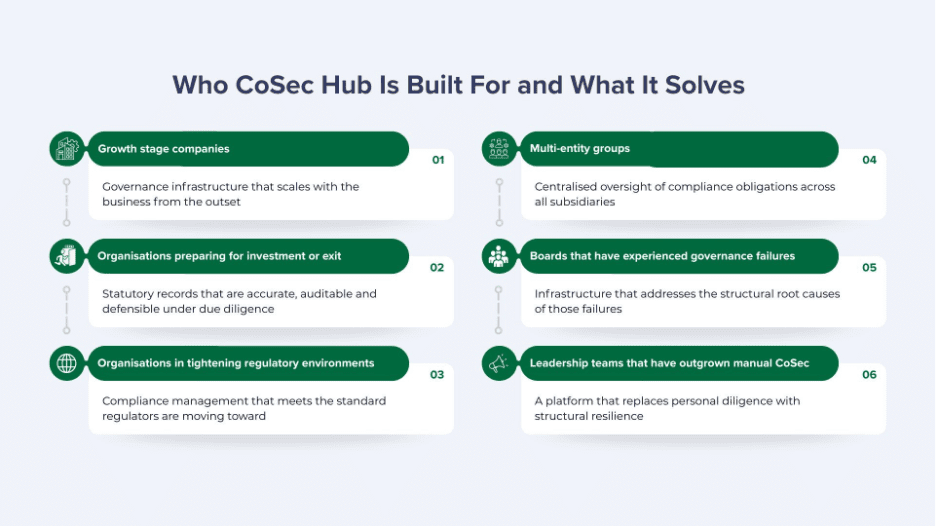
Lumorus is a governance and responsible business firm working with organisations across Africa and the UK. The governance services team brings the regulatory knowledge, board level experience and practical CoSec expertise that the function requires. The firm works with organisations at every stage of their governance journey, from growth stage businesses building governance infrastructure for the first time to established groups that need to modernise a CoSec function that has outgrown its manual infrastructure.
The combination of Lumorus expertise and CoSec Hub infrastructure is the proposition that neither professional expertise alone nor technology alone can match. The platform gives organisations the governance infrastructure they need. The team gives them the expertise to use it well and the advisory support to make governance decisions that hold up under scrutiny.
The Organisations CoSec Hub Was Built For
CoSec Hub was built for organisations that have decided that governance infrastructure matters and are ready to invest in building it properly.
The Reason It Was Built Is the Reason It Matters
CoSec Hub was not built to digitise paperwork. It was not built to make a manual process slightly more efficient. It was built because Lumorus observed, repeatedly and across a wide range of organisations, that the governance function boards depend on was being held together by individual diligence rather than structural infrastructure, and that the consequences of that fragility were both predictable and preventable.
The boards that have adopted CoSec Hub have not simply improved their compliance efficiency. They have changed the nature of their governance capability. They have moved from a model in which governance records were managed by individuals to a model in which they are held in a system. They have moved from reactive compliance management to proactive compliance intelligence. They have moved from person dependent institutional knowledge to encoded, accessible governance history.
That is what Lumorus built CoSec Hub to achieve. The problem it was built to solve has not gone away. The infrastructure to solve it now exists.
cosec.lumorus.com | lumorus.com | [email protected]
Citations & Sources
- Financial Reporting Council. UK Corporate Governance Code and Board Effectiveness Guidance. 2024.
- Institute of Chartered Secretaries and Administrators. Corporate Governance Failures and Board Evaluation Outcomes. 2023.
- Chartered Governance Institute UK & Ireland. Company Secretarial Benchmarking Survey. 2023.
- Economic Crime and Corporate Transparency Act 2023. Companies House.
- Companies and Allied Matters Act 2020. Corporate Affairs Commission Nigeria.