


A board meeting can last two hours, yet the governance work that determines whether it succeeds may begin weeks before the directors enter the room.
Agendas must reflect the decisions that genuinely matter, papers need to reach directors early enough to be useful, conflicts must be identified, resolutions must be properly framed and the meeting itself must satisfy the organisation’s constitutional, legal and regulatory requirements.
Afterwards, the work continues. Minutes need to capture the substance of decisions and challenge, actions require owners and deadlines, statutory records may need updating and decisions must move from the boardroom into execution.
Shareholder meetings introduce another layer of complexity because notice periods, voting arrangements, shareholder communications, proxies, resolutions and regulatory requirements all need to work together.
This is why outsourcing board and shareholder meeting support should never be viewed simply as buying administrative capacity.
The right outsourced partner should strengthen the governance surrounding the meeting, not merely organise the meeting itself.
As WeConvene observes in the context of investor relations outsourcing, external support is most valuable when it supplements internal capability without creating distance between the organisation and its stakeholders. The same principle applies to board and shareholder governance: outsourcing should strengthen internal ownership, continuity and visibility rather than weaken them.
For organisations considering external Board & Shareholder Meeting Support, the important question is therefore not simply whether a provider can schedule meetings.
It is whether the provider can help the organisation govern them properly.
Board meetings are governance events, not diary appointments
It is easy to underestimate how much governance sits behind a well-run board meeting.
The visible event is the meeting itself, but beneath it sits an operating system of information, authority, process and accountability.
A strong meeting process should help directors understand:
- Why an issue is before the board.
- Whether the board is being asked to decide, approve, challenge or simply note it.
- What information is material to that decision.
- Whether the matter falls within the board’s reserved powers.
- What risks and stakeholder interests should be considered.
- What happens after a decision is made.
Consequently, the quality of meeting support can directly affect the quality of board oversight.
A poorly constructed agenda may devote valuable board time to routine updates while compressing discussion of strategic risk. Late papers can prevent directors from preparing properly, while weak minutes may fail to demonstrate how the board reached an important decision.
Good meeting governance does the opposite. It creates the conditions in which directors can focus on judgement rather than administration.
That is why outsourced support should be evaluated as part of the organisation’s wider Corporate Governance Support rather than as a standalone meeting service.
What should an outsourced board meeting partner actually do?
A credible outsourced partner should support the complete meeting lifecycle.
That begins well before invitations are sent and continues long after the meeting closes.
What Effective Meeting Support Should Cover
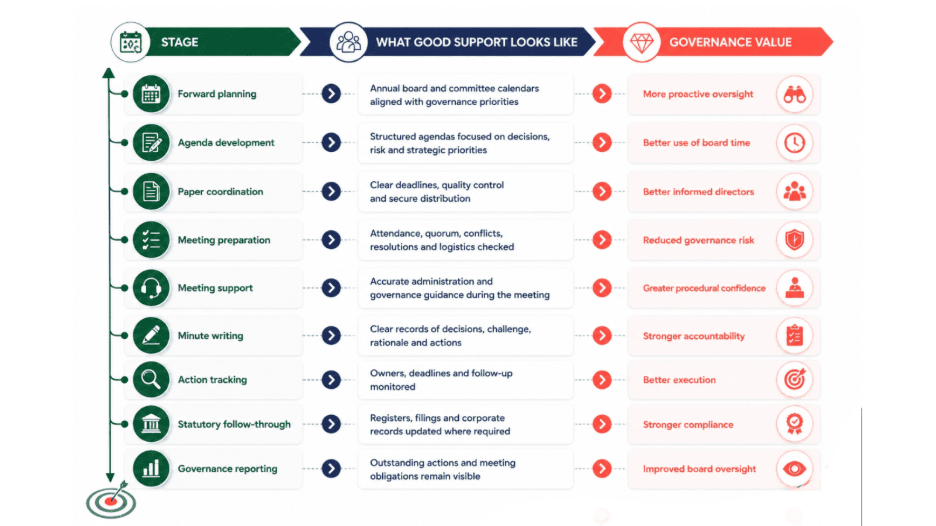
A provider that concentrates only on scheduling and minute taking is supporting an event.
A provider that connects all these activities is supporting governance.
Preparation determines the quality of the meeting
The most valuable board meeting work often happens before the board meets.
An effective outsourced partner should establish a disciplined timetable covering agenda development, paper deadlines, director availability, committee dependencies, required approvals and statutory requirements.
However, good preparation is not simply logistical.
The agenda should reflect the organisation’s governance priorities and decision calendar. Matters requiring board approval should be clearly distinguished from those provided for information, while recurring governance obligations should be planned rather than rediscovered shortly before a deadline.
There should also be clarity about who owns each paper and what the board is being asked to do.
For example, a paper seeking approval should not force directors to search through 30 pages before discovering the decision required of them. The purpose, recommendation, material risks and proposed decision should be clear.
This is where an experienced company secretary partner adds value. The task is not merely assembling documents, but helping management present information in a form that supports effective governance.
Board papers should inform decisions, not overwhelm directors
More information does not automatically produce better oversight.
Indeed, one of the recurring problems in modern boardrooms is information abundance without sufficient clarity.
A board pack can be comprehensive and still be ineffective.
Good outsourced support should therefore introduce discipline around board papers, including:
- Clear submission deadlines.
- Consistent paper templates.
- Defined executive ownership.
- Concise decision summaries.
- Identification of material risks.
- Clear recommendations.
- Version control.
- Secure distribution.
- Appropriate handling of confidential material.
The objective is not to rewrite management’s thinking. Rather, it is to ensure directors receive the information they need, in a form that allows them to understand the issue, challenge assumptions and exercise judgement.
This distinction matters because board effectiveness depends partly on information architecture. If directors receive the wrong information, receive it too late or cannot identify what matters within a large volume of material, the quality of oversight inevitably suffers.
Shareholder meetings require a different level of precision
An annual general meeting or other shareholder meeting is not simply a larger board meeting.
It involves a different set of rights, obligations and stakeholders.
Depending on the organisation and jurisdiction, the process may involve notices, resolutions, voting procedures, proxy arrangements, shareholder questions, regulatory announcements, meeting scripts and post-meeting filings.
Therefore, an outsourced partner should understand both the technical requirements and the wider governance significance of shareholder engagement.
Effective support may include:
- Developing the meeting timetable.
- Coordinating notices and supporting documentation.
- Preparing resolutions.
- Managing proxy processes.
- Supporting voting arrangements.
- Coordinating shareholder communications.
- Preparing chair and company secretary scripts.
- Managing meeting logistics.
- Recording proceedings and voting outcomes.
- Completing post-meeting governance actions.
This becomes particularly important for organisations operating across jurisdictions, where requirements can differ significantly.
The purpose is not simply to make the meeting run smoothly. It is to protect shareholder rights, support proper decision making and ensure the organisation can demonstrate that required governance processes were followed.
Minutes are part of the governance evidence
Minutes are sometimes treated as the final administrative task in the meeting process.
That seriously understates their importance.
Board minutes form part of the organisation’s governance record and, when prepared properly, provide evidence of the matters considered, decisions reached and actions agreed.
They should not become transcripts, nor should they be so brief that they reveal nothing about how a material decision was reached.
The challenge is balance.
Good minutes capture the substance of discussion, material challenge, decisions and agreed actions without producing an unnecessary verbatim record.
They should also be accurate, neutral and capable of standing up to scrutiny long after memories of the meeting have faded.
Professional Minute Taking Solutions can therefore provide more than convenience. They can strengthen the integrity and continuity of the organisation’s governance record.
For regulated organisations in particular, that record can become important when boards need to demonstrate the quality of oversight and decision making.
A board decision is not complete when the meeting ends
One of the clearest tests of governance quality is what happens after the board has made a decision.
Actions should have owners.
Owners should have deadlines.
Progress should be monitored.
Unresolved matters should return to the appropriate governance forum.
Where decisions trigger statutory or regulatory requirements, those requirements should be completed and evidenced.
Otherwise, organisations risk creating a gap between board decision making and organisational execution.
This is where meeting support should connect with Statutory & Regulatory Compliance rather than existing as an isolated service.
For example, a director appointment may require a board resolution, an update to statutory records and a regulatory filing. A corporate restructuring may require several connected approvals and filings, while a shareholder resolution may create further actions after the meeting.
The meeting is therefore one point in a much larger governance process.
Outsourcing should create capacity without surrendering accountability
There is an important distinction between outsourcing governance operations and outsourcing governance responsibility.
Boards remain accountable for their decisions.
Management remains responsible for execution.
Directors retain their duties.
An external provider can strengthen the processes surrounding those responsibilities, but it should never obscure where accountability sits.
This principle is reflected in WeConvene’s discussion of investor relations outsourcing, which argues that external support works best when it augments rather than replaces management’s relationships with investors. It also stresses the importance of organisations retaining access to their own underlying data and engagement history.
The lesson translates directly to board and shareholder meeting support.
Your outsourced partner should improve continuity, but your organisation should retain control of its governance information, records and institutional knowledge.
Similarly, OpsMaven argues that outsourcing relationships can contribute more strategically when they provide expertise, transparent processes, operational continuity and better information for leadership.
That is the standard organisations should expect.
An outsourced governance partner should make the organisation more capable, not more dependent.
What should you expect from the right outsourced partner?
Price matters, but it should not be the first criterion.
Board and shareholder governance involves sensitive information, legal obligations, directors, investors and decisions that can materially affect the organisation. Selecting a provider solely because it offers inexpensive administrative support misunderstands the risk.
Instead, organisations should assess whether the partner offers:
1. Genuine governance expertise
The individuals supporting the board should understand governance, company law, board practice and the organisation’s regulatory environment.
2. Clear accountability
There should be defined responsibilities, service standards, escalation routes and named individuals responsible for delivery.
3. Continuity
The organisation should not have to explain its governance structure from the beginning every time the provider changes personnel.
4. Strong information management
Board papers, minutes, actions and governance records should be controlled, accessible and protected appropriately.
5. Multi-jurisdiction capability
For international groups, the partner should be capable of coordinating governance across different legal entities and regulatory environments.
6. Technology that supports the process
Technology should improve visibility, deadlines, document management and action tracking without becoming a substitute for professional judgement.
7. A proactive approach
The strongest providers identify what is coming rather than waiting to be instructed after an obligation becomes urgent.
Ultimately, organisations should evaluate the people who will actually support their boards, not simply the provider’s brand.
The cheapest meeting support can become expensive governance
Administrative outsourcing is often justified through cost efficiency.
However, the lowest-cost provider is not necessarily the lowest-risk provider.
Poor meeting support can create hidden costs through:
- Repeated corrections to minutes.
- Missed statutory actions.
- Incomplete governance records.
- Poorly coordinated board papers.
- Director frustration.
- Weak action follow-up.
- Internal management time spent correcting external work.
- Loss of institutional knowledge when provider personnel change.
Therefore, the business case should consider governance quality, continuity and risk reduction alongside the headline fee.
An effective outsourced model should release internal capacity while improving the underlying process.
Professional Company Secretary Outsourcing should ultimately give an organisation access to governance capability that would otherwise be difficult or inefficient to maintain internally.
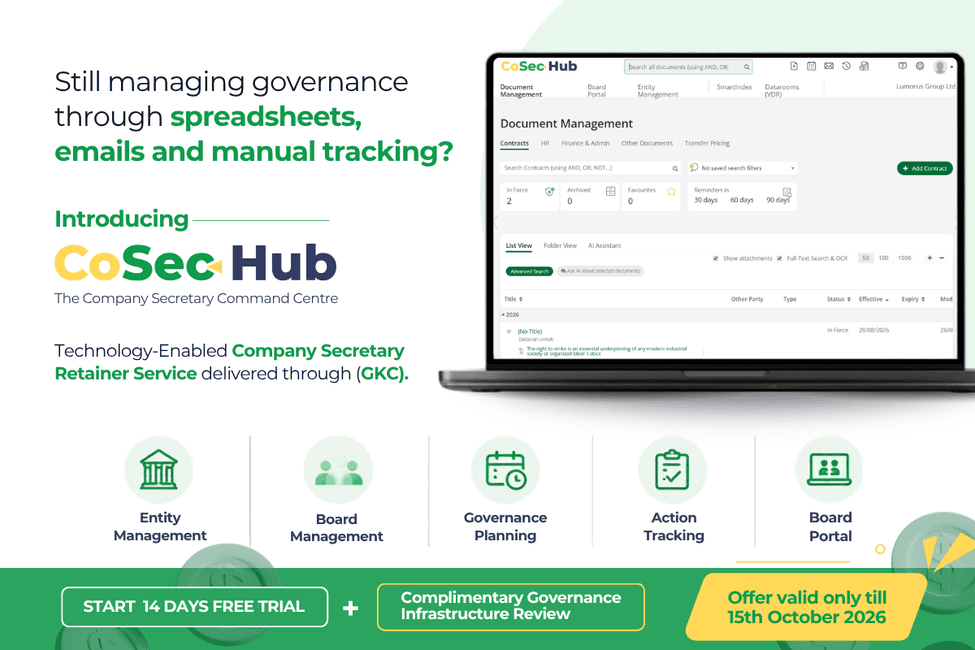
Technology should strengthen the meeting lifecycle
Modern board support increasingly depends on technology, particularly where directors operate across countries and time zones.
However, technology is valuable only when it improves the governance process.
Useful capabilities include:
- Forward calendars.
- Secure board papers.
- Meeting workflows.
- Action tracking.
- Entity information.
- Compliance calendars.
- Statutory records.
- Governance reporting.
- Decision histories.
The value lies in connection.
When the board approves an action, that action should not disappear into meeting minutes. It should enter a visible workflow, receive an owner and remain open until completed.
Likewise, decisions affecting entities or regulatory obligations should connect with the relevant corporate records and compliance processes.
This creates an auditable chain from agenda to decision, and from decision to implementation.
Multi-jurisdiction organisations need consistency without ignoring local law
For organisations operating internationally, meeting governance becomes more complicated because a group may want one governance standard while each legal entity remains subject to local requirements.
A strong outsourced partner should therefore help create consistency without imposing artificial uniformity.
The organisation may standardise its approach to:
- Board calendars.
- Paper templates.
- Meeting protocols.
- Action tracking.
- Governance reporting.
- Document retention.
At the same time, local requirements around notices, quorum, director duties, shareholder approvals and statutory filings must still be respected.
This balance is particularly important during international expansion, acquisitions and corporate restructuring.
Effective Company Formation & Structuring should therefore consider how new entities will actually be governed after incorporation, rather than treating formation as the end of the process.
Meeting support should improve board effectiveness
The ultimate test of outsourced meeting support is not whether every meeting started on time; it is whether the board became more effective.
- Did directors receive better information?
- Was board time used more intelligently?
- Were decisions clearly recorded?
- Did management understand what the board required?
- Were actions completed?
- Did shareholder processes operate properly?
- Was governance information easier to retrieve?
- Did the organisation become less dependent on individual memory?
These are more meaningful measures than the number of agendas distributed or minutes produced.
As outsourcing becomes more strategic, the relationship should increasingly help organisations improve governance quality rather than simply process governance transactions.
That is the difference between a vendor and a governance partner.
The best outsourced partner should make governance feel less outsourced
There is a paradox at the heart of effective outsourcing.
The better the relationship works, the less disconnected it should feel.
The external company secretary team should understand the board calendar, key entities, governance structure and recurring obligations. Internal teams should know who to contact, while directors should experience consistent standards rather than fragmented service.
At the same time, governance information must remain accessible to the organisation.
This combination creates continuity without dependency.
Expertise without distance.
Capacity without loss of control.
That is what good outsourced board and shareholder meeting support should deliver.
Lumorus: Better Business, Built on Purpose
At Lumorus, we believe governance is not paperwork.
It is the allocation, exercise, constraint and accountability of power inside organisations.
Lumorus is a UK headquartered global governance, ESG, company secretary and advisory firm supporting organisations across Europe, Africa, Asia, the Caribbean, Canada, the Middle East and international markets.
For more than 10 years, we have helped boards, leadership teams and organisations strengthen governance, accountability and organisational resilience.
Our company secretary expertise includes:
Whether you need additional capacity for a demanding board cycle, specialist support for an AGM or ongoing company secretary expertise across several entities and jurisdictions, Lumorus can help build a meeting governance process that is organised, compliant and designed around effective decision making.
Is your board and shareholder meeting process strengthening governance, or simply keeping the calendar moving?
Contact Lumorus to explore how our board, shareholder and company secretary support can strengthen your governance infrastructure.
Email: [email protected]
Together, we can build better business: one that performs with purpose, leads with integrity and creates lasting value.
Sources
- WeConvene – Investor Relations Outsourcing: When to Bring In External IR Support
- OpsMaven – How Outsourcing Partners Influence Strategy at the Board Level
- Lumorus – Board & Shareholder Meetings – Board and shareholder meeting support
- Lumorus – Company Secretary Outsourcing – Outsourced company secretary and governance support
- Lumorus – Statutory & Regulatory Compliance – Statutory and regulatory compliance support