


Here is something most governance advisors will not say out loud: the annual board review your organisation just completed (or thinking of completing) probably changed nothing.
Not because the people involved were not serious. Not because the process was not thorough on paper. But because most board reviews are not actually designed to reveal the truth. They are designed to produce a report that everyone can live with.
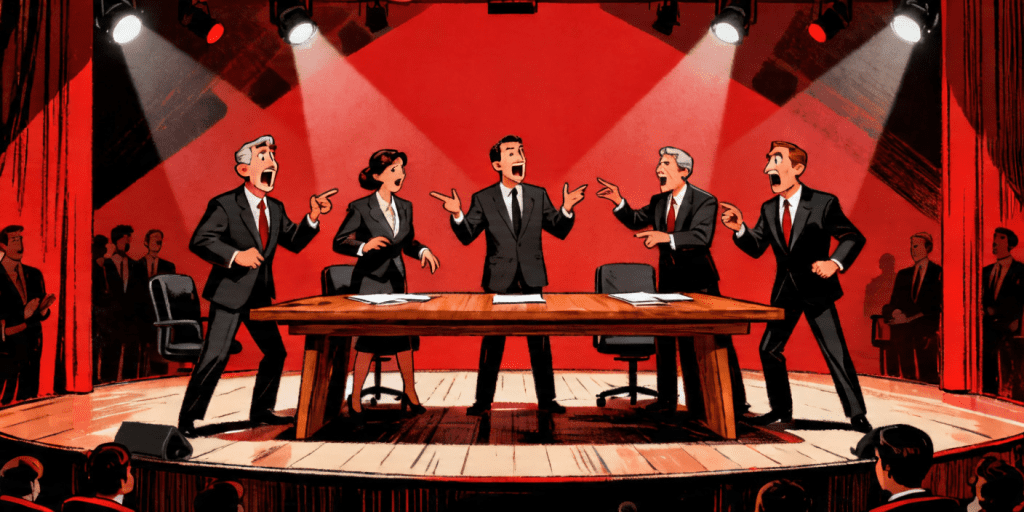
That is not governance. That is merely performative.
And the cost of that performance is not always immediate. But it is always significant.
Research by the Financial Reporting Council found that fewer than 30% of boards that commission external effectiveness reviews implement meaningful structural changes as a result. A separate study of FTSE 350 companies found that board evaluation processes were rated as genuinely effective by only 34% of non-executive directors surveyed. The majority described them as largely procedural.
Those numbers should be uncomfortable. They rarely are. And that is precisely the problem.
Case Study: The Review That Found Everything and Changed Nothing
A financial services organisation commissioned an independent board review following a period of significant strategic underperformance. The review was thorough. The report ran to 47 pages. It identified a dominant chair dynamic, a pattern of unchallenged executive recommendations, and three standing agenda items that had never once generated meaningful board debate. The findings were presented. The board acknowledged them. Twelve months later, a follow up assessment found that none of the structural recommendations had been implemented. The dominant dynamic remained. The unchallenged agenda items remained. The report had become a filing cabinet document rather than a governance tool.
What Board Reviews Typically Produce
At Lumorus, we keep coming back to one uncomfortable truth. Most annual board reviews look rigorous on paper, sound structured in meetings, and end with a polished report. But in practice, they often function more as reassurance than real accountability.
When we look at what typically comes out of these reviews, it usually looks like this:
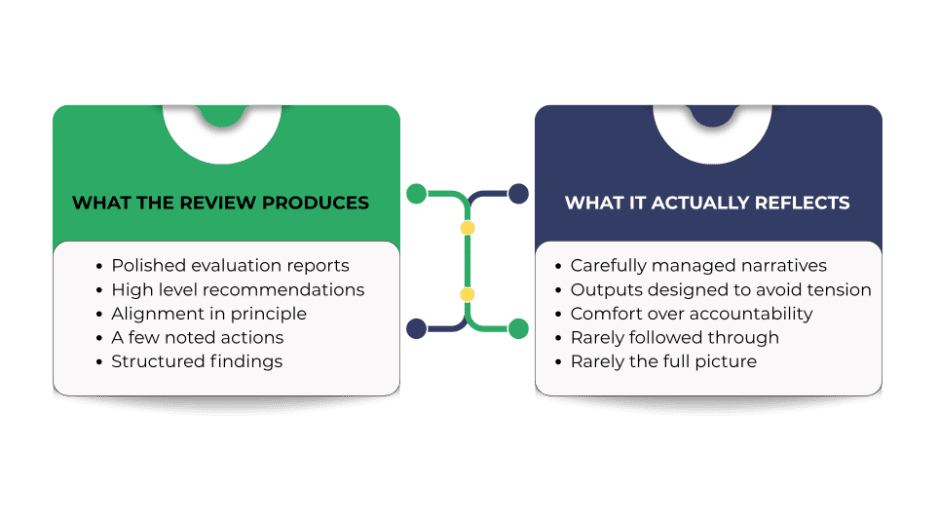
On the surface, this looks like governance maturity. Underneath, it often avoids the real questions that determine whether a board is actually effective.
The Issues That Never Make It into the Report
Real issues rarely appear suddenly. They build slowly, almost invisibly:
A dominant voice that is never really challenging. A dissenting opinion that stays unspoken. A risk that is acknowledged but never deeply interrogated. Decisions that move forward without meaningful scrutiny.
These are the moments that define board effectiveness. And they almost never show up in formal reports.
Most board reviews rely heavily on structured methods: surveys, interviews, and standardised evaluation tools. They create order but they also create distance. Governance is not a scoring exercise. It is lived behaviour, power dynamics, and decision making under pressure.
The numbers support this concern. A governance benchmarking study found that 68% of board members admitted softening feedback during evaluation processes to preserve working relationships. A further 52% said they had withheld a concern during a formal review that they had previously raised informally.
That is not a process of failure. That is a human one. And any evaluation system that ignores the human layer will always fall short.
Case Study: When Independence Is Not Fully Independent
A professional services firm brought in an external reviewer under a mandate of full independence. The reviewer was credible, experienced, and genuinely well-intentioned. But three of the five board members had longstanding professional relationships with the reviewing firm. Certain individuals were not examined deeply enough. Some topics were approached with visible caution. The resulting report was competent but incomplete. The chair later acknowledged privately that the most significant dynamic in the boardroom had not been mentioned once in the final document.
What Happens After the Review
This is where most governance processes quietly fail.
Findings are shared. There is alignment in principle. A few actions are noted. But very little actually shifts.
Without following through, the board review becomes an annual ritual rather than a governance tool.
The cost of that is not immediate, but it is significant. Weak oversight quietly persists. Groupthink becomes stronger. Strategic blind spots remain unchallenged. Risks accumulate until they surface as crises.
By the time issues become visible, the board was never truly tested in the first place.
Research insight: A study of corporate governance failures across 200 organisations found that in 78% of cases, significant governance weaknesses had been identified in prior board reviews but had not been acted upon. (Source: Institute of Chartered Secretaries and Administrators, 2023)
What a Board Review Should Actually Do
The question Lumorus keeps pushing is this: what if board reviews were actually designed to reveal reality instead of reassure stakeholders?
Like a real performance review That would mean asking harder questions:
Who truly influences decisions in the room? Where does meaningful challenge break down? What conversations are consistently avoided? Which risks are acknowledged but never interrogated?
It would also mean going beyond surface level measurement:
Because governance is human. And any system that ignores that will always fall short.
For organisations looking to go deeper, the Lumorus Board Effectiveness Reviews offer a structured way to assess what genuine board performance looks like in practice. The Governance Infrastructure Guide covers how the right systems underpin board accountability over time. And for businesses operating across multiple jurisdictions, the Lumorus Corporate Governance Services page breaks down how to approach those complexities without losing coherence at the centre.
The Standard That Should Follow Every Review
Most importantly, a board review that produces insight without action is not governance. It is a performance.
Real change requires clear ownership of outcomes, genuine behavioural and structural change, and measurable follow through that actually shifts how boards operate.
Case Study: From Theatre to Accountability
A listed holding company with six subsidiaries across three jurisdictions commissioned Lumorus to conduct a full board effectiveness review following investor pressure. Rather than relying solely on surveys, the process included direct observation of two board sessions, structured interviews with all directors and key executives, and a dynamic mapping exercise that identified informal influence patterns invisible in standard evaluation tools. The resulting report named specific structural changes required. Twelve months later, two committee compositions had changed, a new challenge protocol had been adopted for executive recommendations, and the board had formally closed four strategic blind spots identified in the original review. Director satisfaction with board effectiveness increased from 41% to 79% across the same period.
Moving Beyond the Performance
At Lumorus, we exist to help organisations move beyond governance theatre.
If your board review is producing reports but not real change, we can help you uncover what is really happening in your boardroom and turn insight into genuine accountability.
The organisations that get this right do not just avoid governance failures. They build boards that make better decisions, hold leadership to higher standards, and create conditions for sustainable performance.
That is what governance is supposed to do. And it is entirely achievable when the review process is designed to demand it.
Reach out to Lumorus to rethink how your board is evaluated and strengthened.
lumorus.com | [email protected]
Citations
- Financial Reporting Council. UK Corporate Governance Code and Board Effectiveness Guidance. 2024.
- Spencer Stuart. Board Index: Board Effectiveness and Evaluation Practices. 2023.
- Deloitte. The Future of Board Governance: Insight, Accountability and Performance. 2024.
- McKinsey and Company. Board Effectiveness: A Survey of the C Suite. 2023.