


Most boards evaluate performance.
Far fewer evaluate capability.
Every board faces increasingly complex decisions.
Artificial intelligence.
Cybersecurity.
ESG.
Geopolitical uncertainty.
Regulatory change.
Digital transformation.
Capital allocation.
Yet many boards continue to rely on skills and experience developed for yesterday’s challenges rather than tomorrow’s opportunities.
This creates one of the most overlooked governance risks.
A board whose collective capability no longer matches the complexity of the organisation it governs.
A board skills audit helps close that gap.
Done properly, it is not simply an assessment of directors.
It is an assessment of the board’s ability to make informed, independent and strategic decisions.
According to BoardEffect, an effective board skills audit helps organisations identify existing capabilities, recognise future requirements and strengthen board performance through targeted succession planning and director development.
Read More: Corporate Governance Support
A board skills audit is about future capability, not past experience
Many organisations appoint directors because of distinguished careers or industry expertise.
Experience matters.
But governance requires more than experience.
It requires the right combination of skills around the board table.
As organisations evolve, so do the capabilities required to govern them effectively.
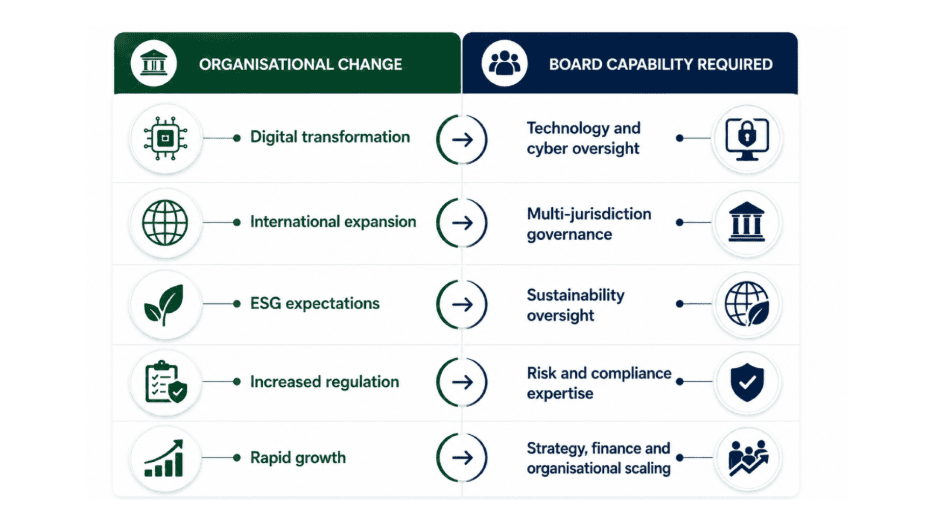
A board skills audit should therefore begin with strategy.
Not CVs.
Good governance depends on collective capability
An effective board is rarely made up of directors with identical backgrounds.
It brings together complementary skills, diverse perspectives and independent judgement.
According to the OECD Principles of Corporate Governance, boards should collectively possess the knowledge, competence and independence necessary to fulfil their oversight responsibilities effectively.
A skills audit should therefore assess more than technical qualifications.
It should evaluate whether the board collectively demonstrates:
- Strategic thinking
- Financial oversight
- Risk governance
- Digital capability
- ESG oversight
- Leadership
- Constructive challenge
- Independent judgement
The objective is not perfect scores.
It is balanced capability.
The biggest governance risk is often the one boards cannot see
Many boards assume they possess the right expertise.
Few test that assumption objectively.
Without a structured assessment, important capability gaps often remain hidden.
These gaps increasingly include:
- Cybersecurity
- Artificial intelligence
- Climate and ESG
- Technology governance
- Data governance
- International regulation
- Geopolitical risk
As organisations become more complex, the consequences of these gaps become more significant.
Governance capability should evolve alongside organisational complexity.
A skills audit should lead to action
Many organisations complete board evaluations every year.
Few use the findings to improve governance.
A board skills audit should inform:
- Director recruitment
- Succession planning
- Committee composition
- Director induction
- Professional development
- Future board strategy
Identifying capability gaps is only the beginning.
Improving governance is the real objective.
According to BoardEffect, organisations derive the greatest value when audit findings directly influence board development and succession decisions.
Read More: Board Evaluation & Assessment
Better decisions begin with better governance
A board skills audit is not simply about filling vacancies.
It is about improving the quality of board decisions.
Boards with the right collective capability are better able to:
- Challenge management constructively.
- Identify emerging risks.
- Exercise effective oversight.
- Make informed strategic decisions.
- Build organisational resilience.
- Support long-term value creation.
Many organisations combine a Board Skills Audit with a Board Decision and Risk Assessment to ensure directors possess not only technical expertise but also the judgement needed to oversee increasingly complex organisations.
Governance is ultimately measured by decisions.
Better governance begins with better judgement.
The strongest boards never stop evolving
The best boards recognise that governance is never static.
Markets change.
Technology evolves.
Risks emerge.
Stakeholder expectations increase.
Boards must evolve with them.
An effective Board Skills Audit provides an opportunity to ask one important question.
Does our board possess the collective capability to govern the organisation we are becoming?
For organisations committed to long-term success, that question should never become an annual compliance exercise.
It should become a strategic discipline.
Lumorus: Better Business, Built on Purpose
At Lumorus, we believe effective governance begins with capable boards.
Lumorus is a UK headquartered global governance, ESG, company secretary and advisory firm supporting organisations across Europe, Africa, Asia, the Caribbean, Canada, the Middle East and international markets.
We help boards strengthen governance capability, improve oversight and build decision-making frameworks that support sustainable long-term value creation.
Our expertise includes:
If your board is facing increasing complexity, now is the time to assess whether its collective capability matches its strategic ambitions.
Visit Lumorus to learn how we help boards improve governance, strengthen decision making and build resilient organisations.
Website: https://www.lumorus.com
Email: [email protected]
Together, we can build better business: one that performs with purpose, leads with integrity and creates lasting value.
Sources
- BoardEffect – How to Carry Out a Board Skills Audit
- OECD – G20/OECD Principles of Corporate Governance
- The Chartered Governance Institute UK & Ireland – Board Effectiveness and Director Development Guidance