


Boards are facing a world in which war, trade coercion and alliance strain are no longer peripheral risks. They now reach into strategy, capital allocation, supply chains, cyber resilience, and legitimacy.
The most dangerous mistake in corporate governance today is to treat the current turmoil as a passing storm. It is not. It is a structural shift in the conditions under which companies operate. Boards that still assume the world is broadly open; rules-based and strategically coherent are overseeing businesses built for an environment that is fading.
The World Your Board Strategy Was Built for No Longer Exists
The signals are no longer subtle. They are structural, simultaneous and accelerating:
- Russia’s full-scale invasion of Ukraine has now passed the four-year mark, with no resolution in sight and energy markets still absorbing the disruption
- Conflict involving Iran has already disrupted the Strait of Hormuz, one of the world’s most critical shipping chokepoints
- Venezuela remains politically unstable and institutionally fragile, a persistent source of regional uncertainty
- Canada’s prime minister is openly arguing that dependence on the United States has become a strategic weakness, an extraordinary statement from one of America’s closest allies
- Greenland has become a genuine flashpoint in transatlantic politics, a development that would have seemed implausible five years ago
- U.S. tariff policy remains extensive, with China tariffs running from 7.5 to 100 per cent on some products, sectoral tariffs of 10 to 50 per cent, and a fresh wave of Section 301 investigations linked to forced labour
- Cyber aggression from state-linked actors is no longer a background threat, it is a routine feature of the operating environment for companies of all sizes
- Export controls on critical technologies are expanding across semiconductors, artificial intelligence infrastructure and advanced manufacturing
- Sanctions regimes are broadening, with secondary sanctions now capable of reaching companies far removed from the original target
Boards should stop reading these as disconnected headlines. They are parts of one governing reality: a more coercive, more fragmented and fundamentally less predictable world economy.
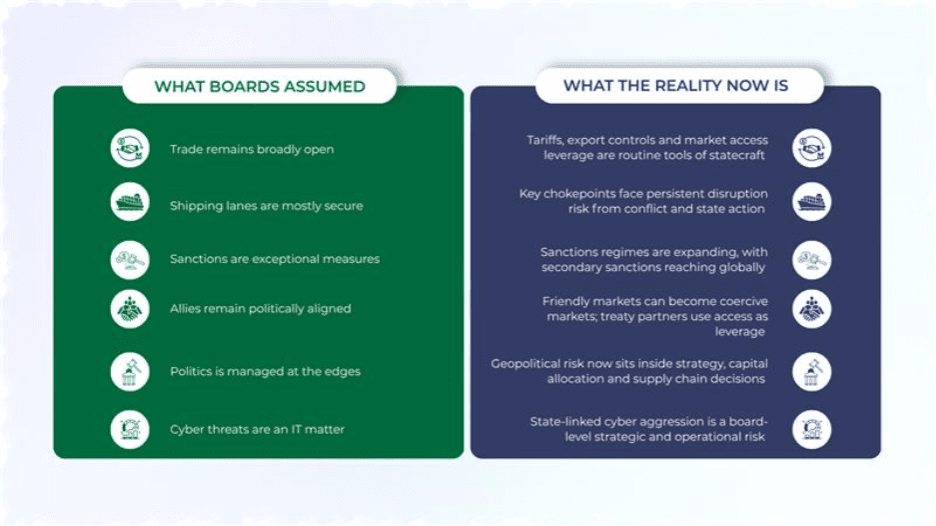
The governance implication is not simply that risk has risen. It is that the background architecture on which many corporate strategies were built is weakening. For years, many boards assumed that trade would remain relatively open, shipping lanes mostly secure, sanctions exceptional, allies broadly aligned, and politics something handled at the edges by public affairs teams. That assumption now looks complacent.
Built for Efficiency, Not Fracture
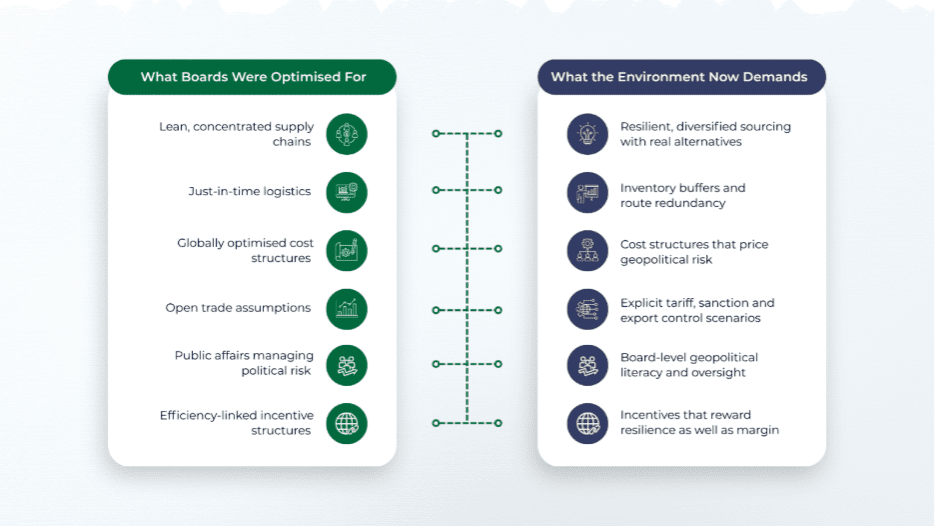
Most boards were designed for efficiency, not fracture. They learned to prize:
- Lean inventories that minimised working capital
- Concentrated manufacturing that captured economies of scale
- Just-in-time logistics that reduced buffer costs
- Globally optimised cost structures built on stable trade assumptions
- Single-source supplier relationships that delivered on price
- Centralised data and technology infrastructure that maximised efficiency
Those choices looked rational in a stable world. In a world of war, tariffs, export controls, cyber aggression, infrastructure stress and alliance ambiguity, they can become hidden sources of fragility. The problem is not merely that shocks are more frequent. It is that low-probability shocks now arrive in clusters and hit multiple control functions at once.
From Risk Management to Resilience Governance
Boards therefore need to shift from risk management to resilience of governance. The distinction matters:
- Risk management asks whether disruption is likely
- Resilience governance asks whether the enterprise can absorb disruption without losing strategic control
That means mapping concentrations properly. Not just first-tier suppliers, but:
- Ports and shipping routes on which the business depends
- Data centres and cloud providers and the jurisdictions they operate in
- Critical minerals and raw material inputs with limited alternative sources
- Financing dependencies and the political assumptions embedded in them
- Regulatory licences and the governments that can revoke or weaponise them
- Jurisdictions that can reach into the business at short notice through law, sanction or market coercion
A company is not diversified if all its alternatives fail under the same geopolitical scenario. Resilience is only real if it holds under the conditions most likely to test it.
The Allied Market Risk Boards Are Still Ignoring
Many companies still assume that North America and Europe sit inside a low-friction political zone. That is increasingly unsafe. Canada is actively trying to reduce excessive U.S. dependence after tariff pressure. The Greenland affair, which would once have been dismissed as political theatre, instead became a real test of sovereignty, trade leverage and allied trust.
Friendly markets can still become coercive markets. Treaty partners can still use market access as leverage. Political alignment can no longer be assumed simply because the flags have historically matched.
The China Question Boards Are Still Getting Wrong
China is where many board discussions remain most confused. Some directors still speak of China as though it were simply a large market and an efficient production base. That is no longer good enough. China is simultaneously:
- A source of significant revenue growth for many sectors
- A concentration risk across inputs, manufacturing and distribution
- A technology and data governance question with national security dimensions
- A forced labour compliance and reputational risk under expanding Western enforcement
- A legitimacy issue with investors, regulators and increasingly with customers
At the same time, Western trade enforcement remains hard-edged, with substantial tariffs on Chinese goods still in place and wider investigations expanding across forced labour and industrial policy concerns.
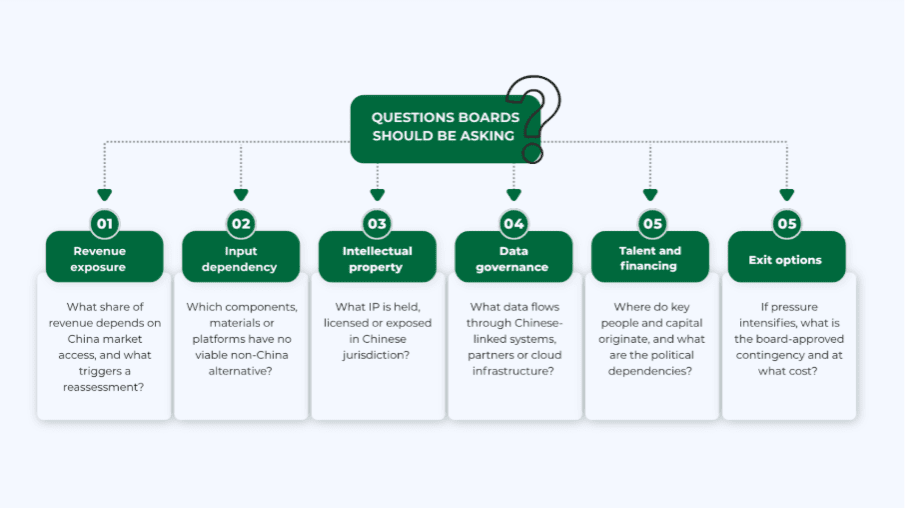
Boards should stop asking only how much money can be made in China. They should ask what terms, at what dependency cost, under what political assumptions, and with what exit options if pressure intensifies.
Board Composition: The Gap No One Wants to Name
This is why board composition now matters more than the slogans in the annual report. A board with deep audit and remuneration experience but no real grasp of trade policy, cyber conflict, state intervention, supply chain fragility or strategic dependence is under-equipped.
Chairs need directors who understand the state as an economic actor, not just the market as an allocation mechanism. Committees need better information flow. Management papers need less reassurance and more scenario truth. Incentives need scrutiny too. If the bonus plan rewards margin gains produced by hidden concentration, the board may be paying management to weaken the enterprise.
What the Board Actually Needs from the CEO
In this environment, the board does not need broad geopolitical lectures. It needs decision-grade answers:
- Where are our hard dependencies?
- What happens if a key route closes, a tariff lands, a sanction broadens, a cyber proxy attacks, or a government demands local control, technology access or political alignment?
- Which assumptions in our strategy rely on a stable Western alliance or benign U.S.-China relations?
- Which incentives are currently rewarding efficiency at the direct expense of resilience?
- What is our board-approved response if a tier-one supplier becomes subject to sanctions within 30 days?
If management cannot answer these plainly, the board does not yet have oversight. It has a ceremony.
What a Geopolitical Operating Model Actually Looks Like
The best boards will not overreact. Not every company needs to redraw its footprint overnight. But every serious board now needs a geopolitical operating model.
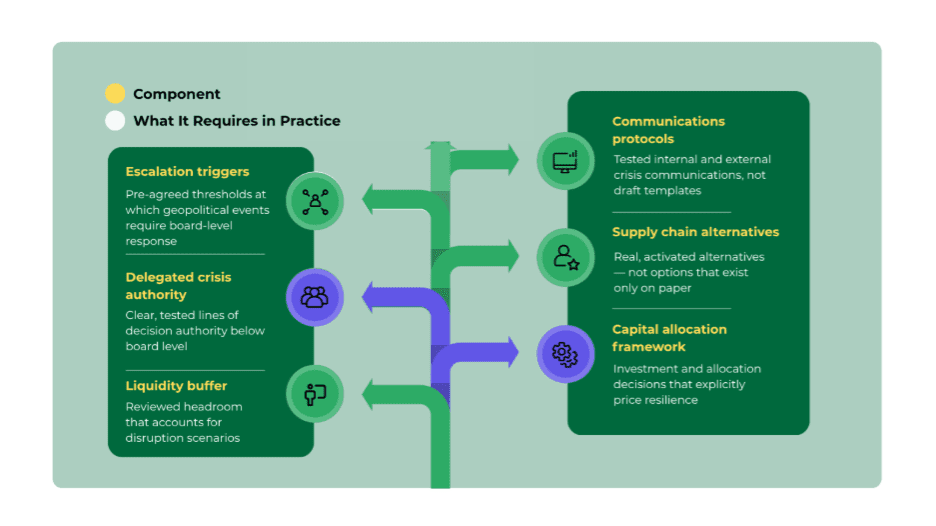
It also means accepting that responsible business is no longer a soft adjunct to strategy. In a fractured world, legitimacy, regulatory trust and continuity of supply increasingly travel together.
“The question is no longer whether geopolitics belongs in the boardroom. The question is whether the board is capable of governing when geopolitics arrives at the table every month.”
What Boards Should Do Now
Questions to Ask Your CEO
- What are our five most material geopolitical dependencies across revenue, sourcing, logistics, finance, data and people?
- Which assumptions in our strategy fail first under a tariff shock, sanction expansion, shipping disruption or cyber-attack?
- What is our true China exposure, not just by sales, but by inputs, intellectual property, data, partnerships, talent and financing?
- Where are we vulnerable to coercive action, including in markets we still regard as politically friendly?
- Which management incentives currently reward efficiency at the expense of resilience?
- What decisions can management take immediately in a crisis, and which decisions come back to the board?
Immediate Risk Mitigation Priorities
- Commission an enterprise-wide dependency map, not a narrow supply chain review
- Run at least three board-level stress tests: war and energy shock, tariff and market access shock, and cyber or infrastructure disruption
- Review liquidity, covenant headroom, insurance, inventory policy, dual sourcing, treasury resilience and crisis communications
- Approve an explicit China policy at board level, including risk appetite, red lines and contingency options
- Put geopolitics on the regular board agenda and strengthen board capability where the current mix is plainly too narrow
Governance Is Now Closer to Its Real Purpose
Corporate governance is the allocation, exercise, and restraint of power under conditions of uncertainty. That is exactly what the environment boards now face. This is no longer about having a better risk register. It is about whether the board can keep control of the company when the world outside stops behaving as yesterday’s strategy assumed.
How Lumorus Helps Boards Govern in a Fractured World
Lumorus is a governance and responsible business firm working with boards and leadership teams across the UK, Europe, South Asia, Canada & Africa. Where most advisory firms offer frameworks, Lumorus builds governance infrastructure, the systems, disciplines and board-level capability that make resilience governance operational rather than theoretical.
On geopolitical risk and board resilience specifically, Lumorus brings a track record that spans:
- Board evaluation reviews that surface geopolitical blind spots in composition, information flows and decision-making architecture, not just procedural compliance
- Governance infrastructure design that encodes resilience into how the board receives, interrogates and acts on management information
- Stress-testing facilitation at board level, running scenario exercises across trade shock, sanctions expansion, cyber disruption and supply chain fracture
- China and allied market risk frameworks that give boards a structured basis for setting risk appetite, red lines and contingency positions
- Incentive structure review to identify where bonus and performance frameworks are quietly rewarding concentration and efficiency at the expense of strategic resilience
- Board capability strengthening through director development, composition review and governance advisory that brings genuine geopolitical and regulatory literacy into the boardroom
Lumorus has worked with organisations navigating regulatory environments across multiple jurisdictions, supporting boards that need governance to function under real pressure, not just pass review. The firm’s approach combines the rigour of professional governance services with the practical insight of advisors who have sat at board tables and understand what decision-grade oversight requires.
If your board is ready to govern the world as it is, rather than the world as it was, Lumorus is the place to start.
lumorus.com | [email protected]
About the Author
Dr. Romeo Effs is the CEO and lead governance consultant at Lumorus, with a PhD in Corporate Ethics and Corporate Governance/ESG and dual master’s degrees from Cass Business School in supply chain operations and finance and trade. He brings board-level experience across the public, private and third sectors, having held senior roles at Accenture, Rosslyn Analytics and Mitie Group PLC. Romeo is a member of The Governance Institute and the Global Corporate Governance Practitioners Association, a qualified executive coach, and a published author in governance and leadership. He is also Chair of Wandsworth Oasis, trustee of Youth Business International, and Founder and Chair of the IBRIE Foundation.