


Many ESG programmes struggle with the same underlying problem.
They generate activity without generating enough measurable accountability.
According to PwC’s Global Investor Survey, more than 70% of investors say companies should improve the credibility and quality of ESG reporting, while regulators globally are increasing scrutiny around sustainability disclosures, governance oversight and measurable impact.
Yet many organisations still struggle to answer basic governance questions:
What changed?
What impact was created?
What worked?
What failed?
Who is accountable?
What should improve next?
This is where many ESG programmes begin losing credibility.
Not because organisations lack ambition, but because governance systems are often too weak to measure, evaluate, and learn effectively over time.
That is why MEAL frameworks are becoming increasingly important inside ESG governance.
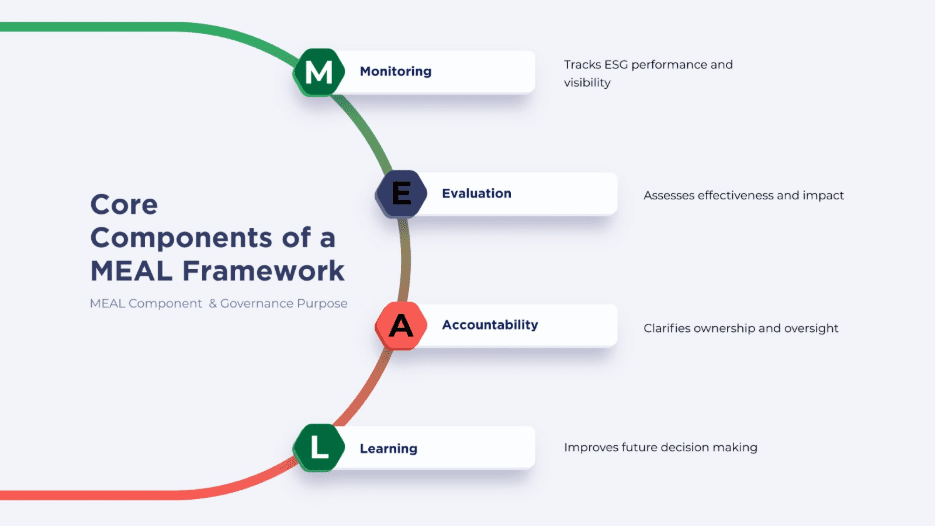
MEAL stands for:
- Monitoring
- Evaluation
- Accountability
- Learning
Originally developed within international development and programme management, MEAL frameworks are now becoming increasingly relevant for ESG governance, sustainability reporting, and organisational accountability.
As ESG expectations become more regulated and data driven, organisations increasingly need governance systems capable of tracking performance, measuring outcomes, strengthening transparency, and improving decision making over time.
Without that structure, ESG programmes often become fragmented, inconsistent, and difficult to govern effectively.
Why ESG Programmes Need Stronger Measurement Frameworks
Many organisations still treat ESG measurement as a reporting exercise rather than a governance capability.
That creates risk.
Research from KPMG found that nearly half of organisations still lack mature ESG data governance structures despite growing regulatory expectations around sustainability disclosures and accountability reporting.
Boards, investors and regulators increasingly expect organisations to demonstrate measurable ESG progress rather than broad commitments or narrative reporting alone.
This is becoming particularly important as ESG governance faces growing scrutiny around:
- Greenwashing risk
- ESG data credibility
- Sustainability disclosure quality
- Governance accountability
- Social impact measurement
- Climate reporting transparency
- Operational resilience
As ESG expectations grow, weak measurement systems create visibility gaps that reduce organisational credibility and weaken governance oversight.
This is why ESG governance increasingly depends on stronger monitoring, accountability, and evaluation structures capable of supporting long term organisational learning and strategic decision making.
The Global Reporting Initiative and IFRS sustainability frameworks increasingly emphasise measurable governance oversight, performance visibility and structured disclosure requirements.
Explore More About Lumorus Governance & ESG Advisory Services:
www.lumorus.com/capabilities/sustainability-responsibility
What a MEAL Framework Actually Does
A MEAL framework helps organisations move ESG governance from activity tracking towards measurable accountability and organisational learning.
This matters because many ESG programmes still focus heavily on outputs while struggling to demonstrate long term outcomes or measurable governance effectiveness.
Strong MEAL systems help organisations:
- Monitor ESG performance consistently
- Evaluate programme effectiveness
- Strengthen accountability structures
- Improve governance visibility
- Identify risks earlier
- Support evidence based decision making
- Improve organisational learning over time
In practice, a MEAL framework creates structured governance visibility across ESG programmes.
It allows organisations to measure not only whether ESG activity occurred, but whether meaningful outcomes were achieved.
That distinction is increasingly important as regulators and investors place greater emphasis on measurable ESG performance and governance transparency.
ESG data quality and governance capability are becoming major differentiators in investor confidence and organisational trust.
The Four Core Components of a MEAL Framework
Monitoring
Monitoring focuses on tracking ESG activities, outputs, and performance indicators consistently over time.
This often includes climate metrics, diversity indicators, governance reporting, compliance tracking, stakeholder engagement data, and operational sustainability performance.
Strong monitoring systems improve governance visibility and allow organisations to identify emerging risks earlier.
Weak monitoring systems create fragmented oversight and inconsistent reporting.
Organisations with stronger ESG monitoring systems are significantly more likely to identify governance and operational risks before they escalate materially.
Evaluation
Evaluation assesses whether ESG programmes are achieving intended outcomes and organisational objectives.
This includes assessing:
- Programme effectiveness
- Strategic alignment
- Impact quality
- Resource efficiency
- Governance effectiveness
- Long term organisational outcomes
Evaluation remains one of the weakest areas inside ESG governance because many organisations still prioritise reporting activity over evaluating actual impact.
This creates governance blind spots that reduce accountability visibility over time.
Accountability
Accountability ensures ESG responsibilities, governance ownership structures and oversight mechanisms remain clear across the organisation.
This includes:
- Defined accountability ownership
- Governance reporting structures
- Escalation processes
- Decision visibility
- Board oversight mechanisms
- Assurance and audit structures
Weak accountability systems create one of the biggest risks inside ESG governance because responsibilities often become fragmented across multiple functions without clear ownership.
Research from the World Economic Forum increasingly highlights governance accountability as one of the defining weaknesses inside ESG execution models.
Learning
Learning ensures organisations continuously improve ESG performance using evidence, governance feedback and operational insights.
This includes:
- Lessons learned reviews
- Governance feedback loops
- ESG performance reviews
- Stakeholder feedback
- Continuous improvement mechanisms
- Strategic adaptation processes
Without learning mechanisms, ESG governance becomes static rather than adaptive.
High performing ESG governance systems continuously evolve based on evidence, performance data, and governance review processes.
Core Components of a MEAL Framework
How to Build a MEAL Framework for ESG Programmes
Many organisations overcomplicate ESG measurement frameworks.
Strong MEAL systems are not built through reporting volume alone. They are built through governance clarity, structured accountability, and disciplined measurement design.
Step 1: Define ESG Outcomes Clearly
Many ESG programmes struggle because objectives are too broad or poorly defined.
Strong MEAL frameworks begin by identifying:
- Strategic ESG priorities
- Intended organisational outcomes
- Material governance risks
- Stakeholder expectations
- Performance indicators
- Accountability ownership
Without clear objectives, ESG measurement quickly becomes fragmented.
According to McKinsey, organisations with clearly defined ESG objectives are substantially more likely to integrate sustainability priorities into strategic decision making successfully.
Step 2: Build Meaningful ESG Indicators
Organisations should avoid measuring only activity volume.
Strong ESG indicators should measure:
- Operational impact
- Behavioural change
- Governance effectiveness
- Risk reduction
- Stakeholder outcomes
- Long term performance trends
This improves governance visibility and creates stronger oversight capability.
Weak ESG indicators often create reporting activity without improving accountability quality.
Step 3: Strengthen Governance Accountability
One of the most common ESG weaknesses is fragmented accountability ownership.
Strong MEAL frameworks clearly define:
- Who owns ESG delivery
- Who monitors performance
- Who reports outcomes
- Who escalates risks
- Who provides oversight
- Who evaluates effectiveness
Without governance clarity, ESG programmes become difficult to scale or govern effectively.
Governance accountability remains one of the weakest dimensions of ESG execution inside many organisations.
Step 4: Create Structured Reporting Systems
Strong ESG reporting should improve board visibility rather than overwhelm stakeholders with excessive data.
Effective reporting structures should support:
- Decision making
- Risk visibility
- Accountability tracking
- Board oversight
- Regulatory disclosure
- Strategic review
This requires reporting systems that are structured, consistent, and governance focused.
As sustainability reporting requirements become more regulated globally, reporting quality is increasingly becoming a governance capability issue rather than simply a communications exercise.
Step 5: Build Continuous Learning Mechanisms
Many organisations fail to create structured ESG learning systems.
High performing MEAL frameworks create feedback loops capable of identifying:
- What works
- What fails
- What requires adjustment
- Where governance gaps exist
- Which risks are emerging
Strong ESG governance depends heavily on continuous institutional learning.
Research from the OECD increasingly highlights adaptive governance and continuous organisational learning as critical to long term sustainability effectiveness.
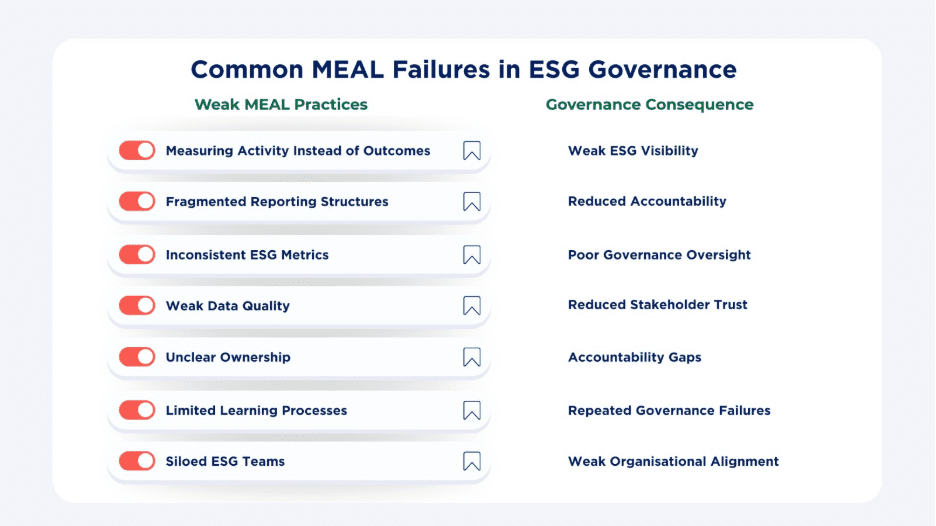
Common MEAL Failures in ESG Governance
Key Insight:
Most ESG governance failures are not caused by lack of ambition. They are caused by weak accountability, fragmented measurement systems, and poor governance visibility.
Why MEAL Is Becoming a Governance Priority
ESG governance is becoming increasingly regulated, scrutinised and performance driven.
Boards now face increasing pressure to demonstrate:
- ESG accountability
- Measurable outcomes
- Reliable reporting
- Governance transparency
- Risk oversight
- Operational resilience
- Stakeholder credibility
This is pushing organisations towards more structured governance and measurement systems.
MEAL frameworks are increasingly important because they help organisations move ESG governance beyond narrative commitments towards measurable organisational accountability.
The European Union Corporate Sustainability Reporting Directive and ISSB standards are accelerating this shift towards measurable ESG governance and structured disclosure expectations.
Explore more: www.lumorus.com/capabilities/sustainability-responsibility
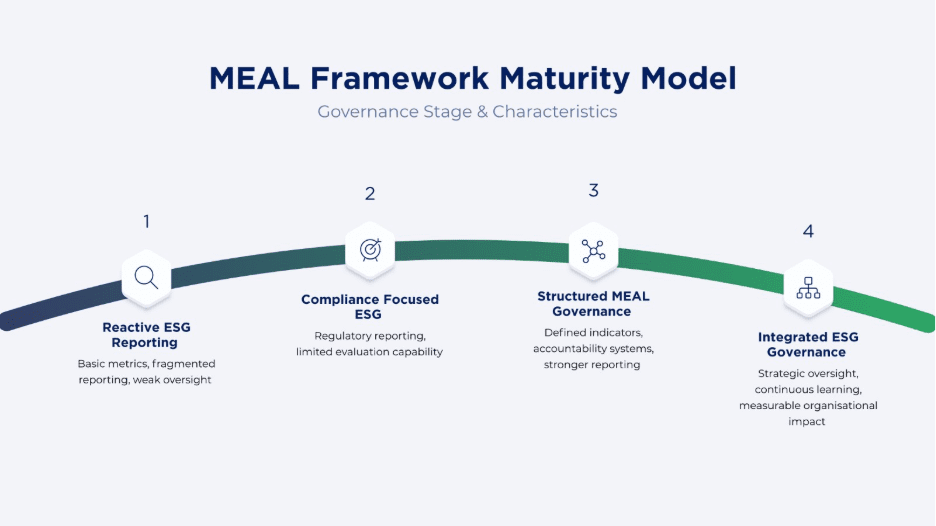
MEAL Framework Maturity Model
High Performing Organisations Treat ESG Measurement as Governance Infrastructure
The strongest organisations increasingly recognise that ESG measurement should function as governance infrastructure rather than a reporting exercise alone.
It must be:
- Structured
- Measurable
- Accountable
- Transparent
- Scalable
- Decision focused
This is particularly important for regulated organisations, investor backed companies, sustainability intensive sectors, international organisations and multi stakeholder programmes where governance credibility increasingly depends on measurable accountability.
Organisations with stronger ESG governance and reporting systems are more likely to strengthen investor confidence, improve stakeholder trust and reduce regulatory exposure.
High performing ESG governance environments are rarely accidental.
They are built intentionally through strong accountability systems, governance visibility, and disciplined measurement structures.
Why Lumorus Focuses on Governance, Measurement and Accountability
Lumorus approaches ESG governance through an accountability and governance infrastructure lens rather than purely narrative sustainability reporting.
Our work focuses on strengthening:
- ESG governance systems
- Accountability structures
- Governance visibility
- Board oversight
- Strategic ESG reporting
- Governance diagnostics
- Measurement frameworks
- Organisational resilience
We believe ESG credibility depends increasingly on governance quality, measurable accountability and institutional transparency.
That is why strong MEAL frameworks matter.
Because ESG governance without measurement eventually weakens organisational trust.
Explore More: www.lumorus.com/capabilities/sustainability-responsibility
CTA
Lumorus is a UK headquartered global governance, ESG and advisory firm supporting organisations across Africa, Europe, Asia, the Caribbean, Canada and other international markets.
For more than 10+ years, Lumorus has helped boards, leadership teams and regulated organisations strengthen governance, ESG accountability, board effectiveness and organisational resilience across multiple industries and jurisdictions.
To explore how Lumorus can support your organisation with ESG governance, MEAL frameworks, governance infrastructure or board advisory solutions, visit: Lumorus.com or book a consultation today: [email protected]
Sources
- International AIDS Society — CLM MEAL Guidebook
- IFRS Foundation — International Sustainability Standards Board
- European Commission — Corporate Sustainability Reporting Directive