


Responsible business is no longer judged by what organisations say. It is judged by what they can prove.
Almost every organisation today claims to be responsible.
Responsible employer.
Responsible investor.
Responsible corporate citizen.
Responsible supply chain partner.
Responsible environmental steward.
The language has become commonplace.
The evidence has not.
As expectations around ESG, sustainability and corporate accountability continue to rise, a growing divide is emerging between organisations that can demonstrate responsible business practices and those that simply communicate them.
That divide is becoming one of the defining governance challenges of our time.
According to the OECD, responsible business conduct requires companies to identify, prevent, mitigate and account for their impacts on people, society and the environment through risk based due diligence. Communication alone is not sufficient.
Read More: ESG Reporting & Disclosure
Responsibility without evidence quickly becomes reputation management
Most organisations do not deliberately mislead stakeholders.
They invest in sustainability.
Support communities.
Develop governance frameworks.
Publish ESG reports.
Introduce responsible business policies.
These initiatives matter.
But they do not automatically demonstrate responsible business.
Evidence does.
Stakeholders increasingly ask different questions.
Can the organisation demonstrate progress?
Can claims be verified?
Can decisions be traced?
Can outcomes be measured?
Can leadership explain what has changed because of its actions?
Responsible business is becoming less about declarations and more about demonstrable performance.
Optics create visibility. Evidence creates trust.
Corporate communication has evolved rapidly.
Sustainability reports are professionally designed.
Impact stories are compelling.
Websites highlight commitments.
Social media amplifies initiatives.
These are valuable communication tools.
They should never become substitutes for evidence.
According to the OECD, misleading or unsubstantiated environmental claims undermine consumer confidence and have become a growing focus for regulators across many jurisdictions.
Trust is rarely built through marketing.
It is built through transparency.
Governance determines whether responsible business is credible
Responsible business is fundamentally a governance issue.
Boards approve strategies.
Executives allocate resources.
Management implements programmes.
Governance ensures accountability.
Without governance, responsible business becomes fragmented.
Without evidence, it becomes difficult to distinguish genuine progress from well presented communication.
The strongest organisations do not ask whether they have published enough information.
They ask whether they have generated enough evidence.
Evidence should exist before communication
One of the most common mistakes organisations make is treating reporting as the final objective.
Reporting is important.
Transparency matters.
But reporting should reflect evidence that already exists.
Not compensate for evidence that does not.
A simple distinction illustrates the difference.
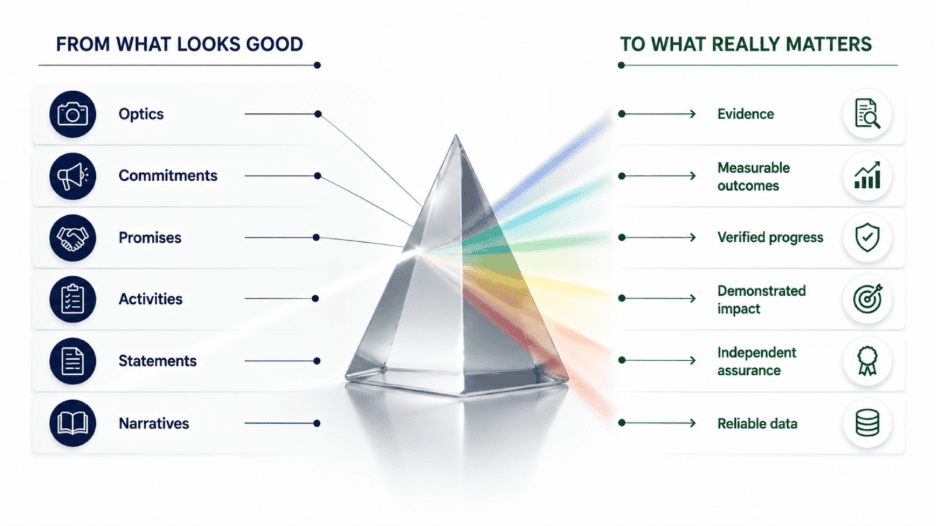
Responsible business becomes credible when evidence supports every significant claim.
The implementation gap is becoming impossible to ignore
Many organisations have adopted responsible business commitments.
Far fewer demonstrate how those commitments influence operational decisions.
The OECD’s Responsible Business Outlook 2026 found a significant implementation gap. While public commitments are now widespread, considerably fewer organisations demonstrate how they identify, mitigate, monitor and report the real impacts of their operations.
This matters.
Stakeholders increasingly evaluate implementation rather than intention.
Policies no longer differentiate organisations.
Execution does.
Measuring impact is harder than measuring activity
Counting activities is relatively simple.
Number of volunteers.
Training sessions delivered.
Policies approved.
Community investments made.
Measuring impact requires more discipline.
It asks different questions.
What changed?
Who benefited?
What evidence supports that conclusion?
Would the outcome have occurred anyway?
How has the organisation learned from the results?
These questions move organisations from reporting to accountability.
Read More: Social Impact Measurement & Management
Boards should ask better questions
Responsible business should be discussed as a governance issue rather than solely an ESG issue.
Boards should challenge management by asking:
- Which responsible business commitments have produced measurable outcomes?
- What evidence supports our public claims?
- Where are the gaps between commitments and implementation?
- Which stakeholders have benefited?
- What independent assurance exists?
These questions strengthen governance.
They also strengthen credibility.
The future belongs to organisations that can prove what they claim
The era of broad sustainability statements is gradually giving way to one of evidence based accountability.
Regulators expect greater transparency.
Investors demand better data.
Customers increasingly question unsupported claims.
Employees want authenticity rather than aspiration.
Organisations that can demonstrate responsible business through governance, evidence and measurable outcomes will earn greater trust than those relying primarily on communication.
Responsible business is no longer defined by good intentions.
It is defined by credible evidence.
That is what stakeholders increasingly expect.
And that is what good governance should deliver.
Explore More
Lumorus: Better Business, Built on Purpose
Lumorus is a UK headquartered global governance, ESG and advisory firm supporting organisations across Africa, Europe, Asia, the Caribbean, Canada and other international markets.
For more than 10+ years, Lumorus has helped boards, leadership teams and regulated organisations strengthen governance, ESG accountability, board effectiveness and organisational resilience across multiple industries and jurisdictions.
Because responsible business is not defined by what organisations promise.
It is defined by what they can prove.
Visit: lumorus.com
Email: [email protected]