



Contract records are often the most fragmented governance asset in an organisation
Every organisation relies on contracts.
Supplier agreements.
Customer contracts.
Service level agreements.
Employment contracts.
Leases.
Licences.
Confidentiality agreements.
Yet despite their importance, contract records are often scattered across shared drives, email inboxes, personal folders and multiple business systems.
The consequence is not merely administrative inefficiency.
It is reduced governance visibility.
When governance teams cannot easily locate contracts, monitor obligations or identify renewal dates, governance risk begins to accumulate.
According to ContractSafe, one of the biggest challenges organisations face is not creating contracts but knowing where they are, who owns them and what obligations they contain.
Why centralising contract records matters
Many organisations underestimate the governance value of a centralised contract repository.
Contract management is not simply about document storage.
It is about maintaining visibility over obligations, approvals and organisational commitments.
A centralised approach enables governance teams to:
- Locate contracts quickly
- Monitor renewal dates
- Track contractual obligations
- Improve compliance oversight
- Reduce operational risk
- Strengthen governance reporting
According to Contract Logix, organisations that centralise contract information improve efficiency by reducing document duplication, strengthening collaboration and improving access to critical information.
Modern governance increasingly depends on having a single source of truth for contractual information rather than fragmented repositories across the business.
The governance risks of fragmented contract records
Contract fragmentation creates governance blind spots.
Contracts may exist across:
- Individual email accounts
- Departmental shared drives
- Local desktop folders
- Procurement systems
- Legal repositories
- Paper filing systems
This creates significant governance challenges.
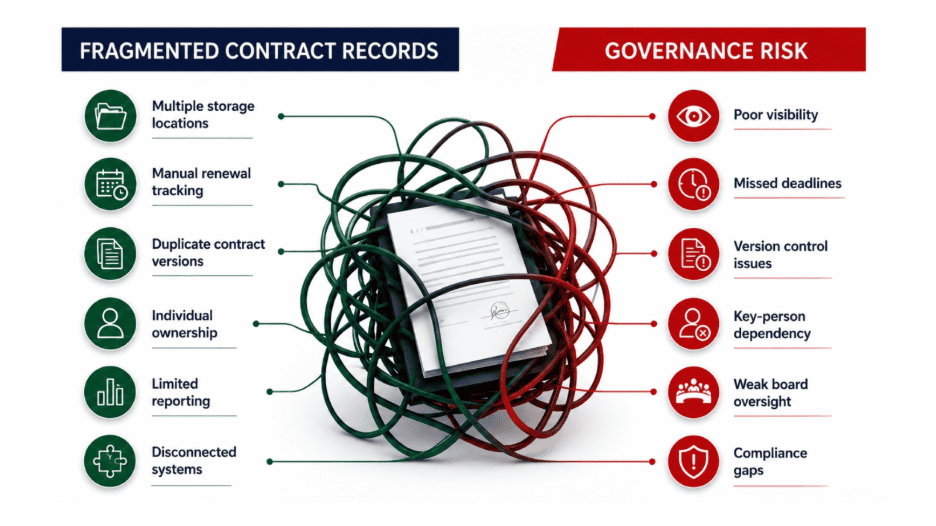
Most governance failures involving contracts do not occur because contracts are missing.
They occur because organisations cannot effectively govern them.
What a centralised contract repository should provide
A centralised repository should become the organisation’s single source of truth for contractual information.
Governance teams should be able to view:
- Active contracts
- Contract owners
- Renewal dates
- Key obligations
- Approval history
- Supporting documents
- Related entities
- Contract status
According to Sirion, centralising contract requests and records improves governance by increasing transparency, reducing bottlenecks and enabling better collaboration across legal, procurement and business teams.
The objective is visibility.
Visibility creates accountability.
Contract management is more than document storage
Many organisations mistakenly believe centralisation simply means placing contracts in one folder.
Effective contract management goes much further.
It should support:
Obligation management
Contracts contain obligations that require ongoing monitoring.
Examples include:
- Reporting commitments
- Payment terms
- Service level agreements
- Regulatory obligations
- Performance requirements
Good governance requires these obligations to remain visible long after the contract is signed.
Renewal management
Missed renewal dates frequently create avoidable financial and operational risks.
Governance teams should have visibility over:
- Upcoming renewals
- Termination windows
- Notice periods
- Review cycles
Manual reminders are rarely sufficient for organisations managing hundreds or thousands of contracts.
Governance reporting
Boards increasingly require visibility over contractual risk.
Good reporting should answer questions such as:
- Which contracts expire this quarter?
- Which agreements require board approval?
- What obligations remain outstanding?
- Where are the organisation’s greatest contractual risks?
Governance reporting transforms contract management from administration into oversight.
Read More: Corporate Governance Supprt
Why company secretaries play a critical role
Contract management is often viewed as the responsibility of legal or procurement teams.
Increasingly, company secretaries are becoming important governance coordinators.
This is because contracts influence:
- Corporate governance
- Regulatory compliance
- Board approvals
- Entity management
- Risk oversight
- Governance reporting
Company secretaries help ensure governance processes connect these activities rather than allowing them to operate in isolation.
This makes contract visibility an increasingly important governance capability.
Centralised contract records support better governance
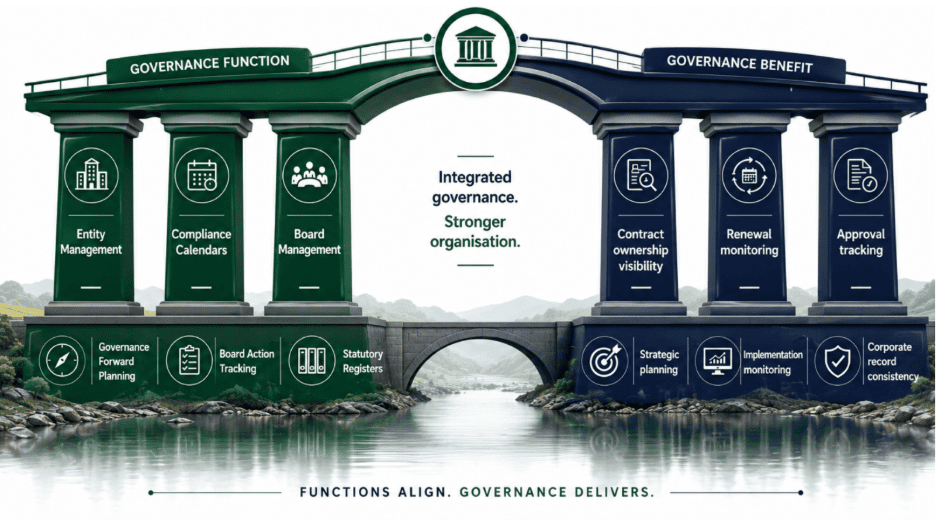
The strongest governance teams increasingly integrate contract management with broader governance processes.
This includes connecting contracts to:
Contracts should not exist separately from governance.
They should form part of governance infrastructure.
Why spreadsheets are no longer enough
Many organisations continue managing contracts through spreadsheets.
For smaller businesses this may be workable.
As organisations grow, however, manual approaches become increasingly difficult.
Challenges include:
- Version control
- Limited visibility
- Manual updates
- Reporting delays
- Human error
- Poor collaboration
According to ContractSafe, organisations with centralised digital repositories spend significantly less time searching for contracts and more time managing contractual performance.
The issue is not simply efficiency.
It is governance resilience.
The future of contract management is governance infrastructure
The strongest governance teams no longer treat contract management as a standalone activity.
They integrate it into governance operations.
This means connecting:
- Contract Management
- Entity Management
- Compliance Calendars
- Governance Forward Planning
- Board Management
- Board Action Tracking
- Governance Intelligence
When these capabilities operate together, governance becomes more transparent, accountable and resilient.
This is what governance infrastructure looks like.
Why CoSec Hub takes a different approach
CoSec Hub was built around a simple belief.
Modern company secretaries need more than software and more than outsourced administration.
They need governance infrastructure.
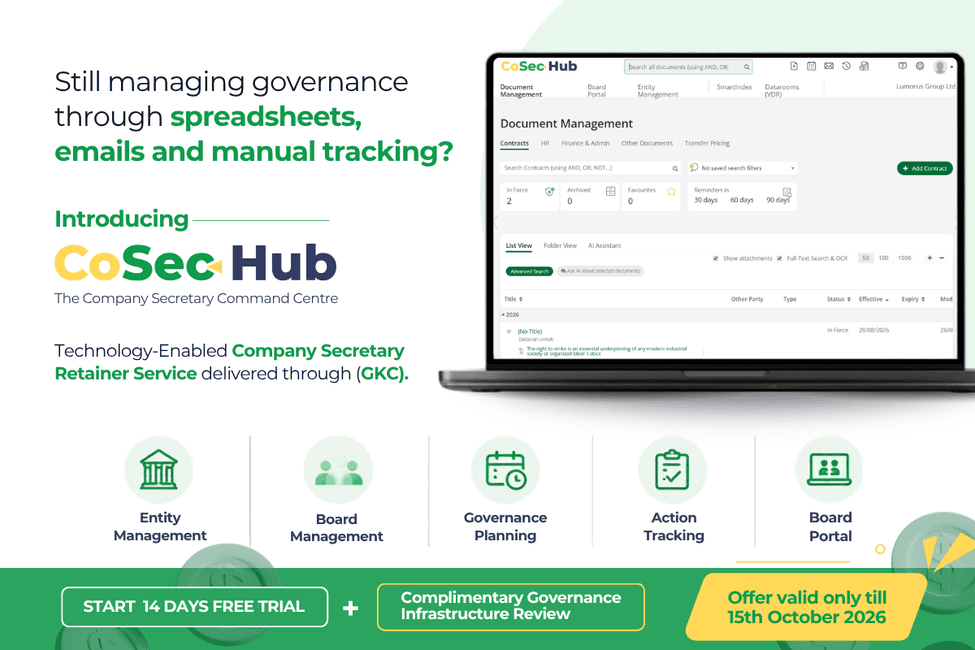
That is why CoSec Hub combines technology and governance expertise through a technology-enabled Company Secretary Retainer Service.
CoSec Hub
The Company Secretary Command Centre supporting:
Governance Knowledge Centre (GKC)
Providing:
- Company Secretary Expertise
- Governance Operations Support
- Compliance Monitoring
- Board Administration
- Governance Intelligence
- Multi-Jurisdiction Governance Support
- Governance Advisory Support
Together, CoSec Hub and the Governance Knowledge Centre (GKC) deliver governance infrastructure designed to help organisations centralise contract records, strengthen governance visibility and improve compliance oversight.
About CoSec Hub
CoSec Hub is the Company Secretary Command Centre.
Built by Company Secretaries for Company Secretaries, CoSec Hub combines technology and governance expertise to support governance operations, compliance oversight, entity management, contract management and board administration.
Delivered through CoSec Hub and the Governance Knowledge Centre (GKC), the service provides technology-enabled Company Secretary Retainer Services designed for modern company secretarial, legal governance and compliance teams.
Lumorus: Better Business, Built on Purpose
Lumorus is a UK-headquartered global governance, company secretarial, ESG and advisory firm supporting organisations across multiple jurisdictions and regulated environments.
We help organisations strengthen governance infrastructure, accountability systems and board oversight capability as governance complexity, regulatory expectations and enterprise risk continue to evolve.
Explore how CoSec Hub and the Governance Knowledge Centre (GKC) can help your organisation move from fragmented administration to connected, auditable and board-ready governance.
CoSec Hub: cosec.lumorus.com
Email: [email protected]
CoSec Hub + Governance Knowledge Centre (GKC): Where Automation Meets Governance Authority.