


Here is an uncomfortable truth many business owners and leadership teams do not want to confront.
Most growing businesses are operating with governance structures that would struggle to withstand serious scrutiny.
Not because the business is unethical. Not because directors are irresponsible. But because governance inside many SMEs still operates informally, reactively and operationally rather than through properly designed governance infrastructure.
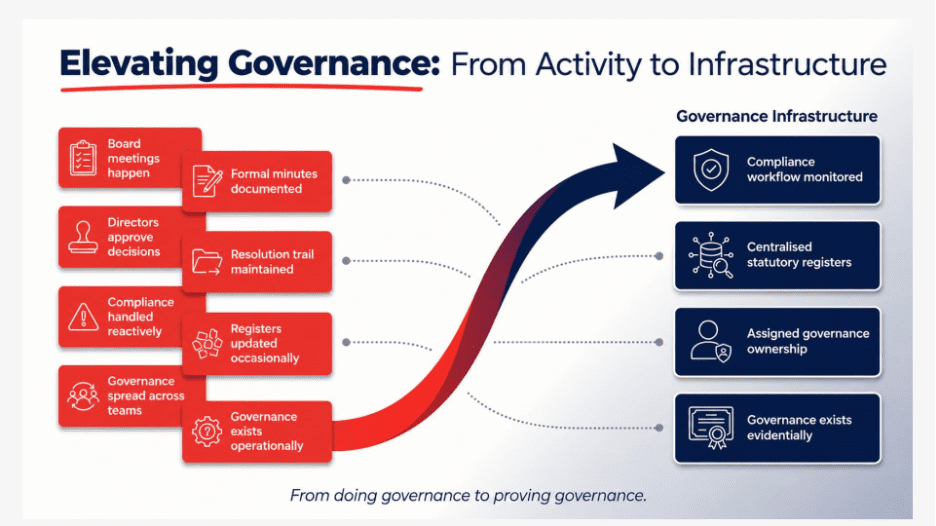
Board meetings happen. Decisions get made. Filings are submitted eventually. Directors approve major actions over email or in conversations. But governance is not measured by whether something happened. It is measured by whether it can be proven.
That distinction matters far more than many organisations realise.
The governance function most SMEs never properly build is the company secretary function. And increasingly, that gap is becoming commercially dangerous.
The Hidden Governance Gap in SMEs
Most SMEs Operate Governance Without Governance Infrastructure
More than 60% of SMEs entering due diligence processes are found to have governance or compliance gaps despite believing governance processes were functioning properly.
Source: The Chartered Governance Institute UK & Ireland
Who Can Act as Company Secretary on Record in the UK?
Under the UK Companies Act 2006, private limited companies are not legally required to appoint a company secretary, although public limited companies must do so.
Where a company secretary is appointed, the individual or corporate entity becomes formally responsible for supporting statutory compliance, governance administration and certain corporate filing obligations.
In practice, a company secretary can be:
- An employee of the business
- A director, unless the company has only one director
- A professional governance adviser
- A chartered governance professional
- A specialist company secretarial services firm
- A corporate entity providing outsourced company secretarial services
The law allows considerable flexibility. The commercial reality is far less flexible.
As businesses scale, governance obligations become more complex. Subsidiary structures grow. Investor expectations increase. Banking scrutiny intensifies. Regulatory exposure expands. The absence of a functioning company secretary capability eventually becomes visible.
This is where many SMEs misunderstand the role entirely.
A company secretary is not merely an administrative support function. Properly designed, it is governance infrastructure.
According to Dynamic Boards, the company secretary plays a central role in governance administration, board support, statutory compliance and organisational accountability. The role increasingly operates as a governance coordination function rather than simply a filing responsibility.
The Governance Work Is Happening. The Evidence Often Is Not
Most organisations believe governance is functioning adequately because governance activity is happening continuously.
Board discussions occur regularly. Directors approve decisions. Shareholder matters are addressed. Compliance obligations are handled when required.
But governance is not defined by intent. It is defined by documentation, accountability and traceability.
A resolution that was never formally documented effectively does not exist during scrutiny. A register that was not updated becomes inaccurate governance data. A filing submitted late becomes regulatory exposure.
This is where governance failures usually emerge. Not during ordinary operations, but during due diligence, refinancing, acquisitions, audits or investor review processes.
The Chartered Governance Institute UK & Ireland has repeatedly highlighted that governance weaknesses inside SMEs frequently arise not from misconduct but from weak governance systems, fragmented oversight and poor documentation discipline.
What Weak Governance Usually Looks Like
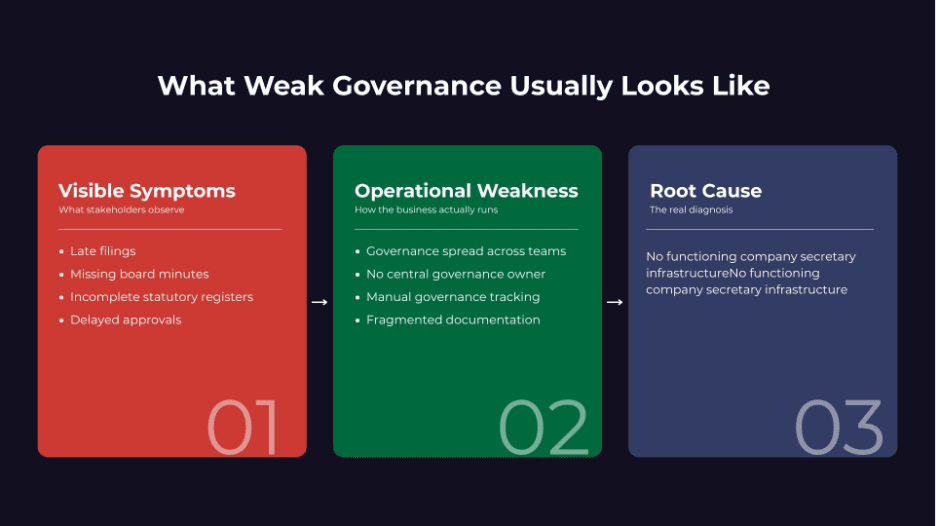
Most governance failures are not caused by misconduct. They are caused by governance functions that were never operationalised properly.
The Company Secretary Function Most Businesses Never Built
Many SMEs assume governance ownership sits collectively across the business.
The finance team manages filings.
The executive assistant organises board meetings.
External lawyers intervene when problems arise.
Directors assume governance is being handled somewhere internally.
This model often appears workable during earlier growth stages. But governance complexity compounds rapidly as organisations scale.
The problem is not that governance work is absent. The problem is that governance infrastructure was never operationalised properly.
This distinction matters enormously.
A functioning company secretary capability includes:
- Centralised statutory records
- Board and committee administration
- Governance workflows
- Resolution management
- Entity management oversight
- Filing controls
- Compliance tracking
- Governance continuity systems
- Audit trails and accountability visibility
Without these systems, governance becomes dependent on fragmented emails, manual reminders and institutional memory.
That is not governance resilience. It is governance fragility disguised as operational normality.
What Due Diligence Usually Reveals
Governance failures rarely appear dramatic initially.
Instead, scrutiny typically exposes cumulative operational weaknesses underneath the surface:
- Confirmation statements submitted late
- Statutory registers not updated
- Board approvals missing formal documentation
- Subsidiaries operating with weak oversight
- Governance records spread across disconnected systems
- Directors unable to evidence decision-making trails
Individually, each issue may appear manageable. Collectively, they reveal something much more serious: the absence of structured governance infrastructure.
Research from governance and compliance benchmarking exercises consistently shows SMEs entering investment or refinancing processes often discover governance deficiencies far later than they should. By then, remediation becomes expensive, disruptive and reputation damaging.
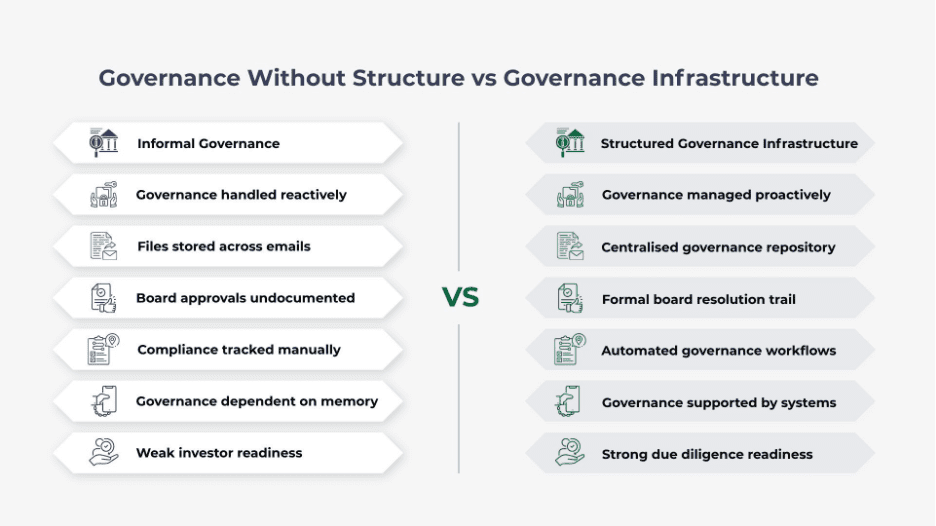
Governance Without Structure vs Governance Infrastructure
Governance is no longer paperwork. It is operational infrastructure.
Case Study: The Funding Round That Stalled
A fast-growing technology company operating across two jurisdictions spent months preparing for a major investment round.
Commercially, the business was performing strongly. Revenue growth exceeded expectations. Investor interest was significant. Leadership assumed the transaction process would proceed smoothly.
During due diligence, governance weaknesses surfaced quickly.
One subsidiary had failed to maintain current statutory filings. Several key board approvals linked to share restructuring and strategic expenditure had never been formally documented through resolutions. Governance records were fragmented across email chains, spreadsheets and external advisers.
The funding process stalled for nearly four months.
Legal remediation costs escalated. Senior management attention shifted away from operations towards reconstructing governance records retrospectively. Investor confidence weakened.
None of the problems related to commercial performance. All of them related to governance infrastructure weakness.
This is how governance failures usually surface. Quietly at first. Then expensively.
Why Informal Governance Eventually Fails
Informal governance models survive because operational pressure often outweighs governance discipline during growth stages.
Commercial activity becomes prioritised. Governance becomes reactive. Documentation follows later if time allows.
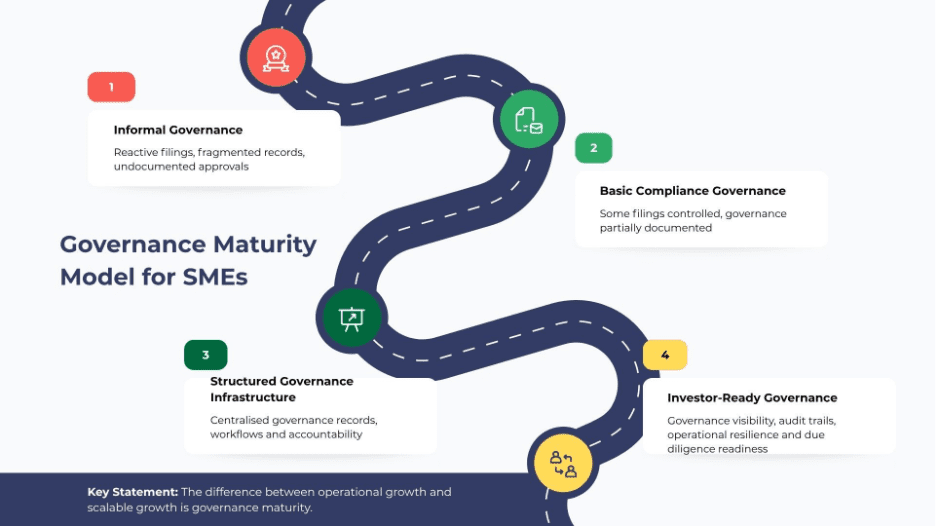
But governance is not a one-time compliance exercise. It is a continuous operational function requiring accountability, structure and visibility.
As businesses expand internationally, onboard investors or enter regulated environments, governance fragmentation becomes increasingly difficult to sustain.
This is particularly relevant in modern operating environments shaped by:
- Increased investor scrutiny
- Regulatory accountability expectations
- Cross-border governance obligations
- AI governance risks
- Banking and refinancing oversight
- Director accountability pressures
The governance expectations placed on scaling businesses are changing rapidly. Many SMEs are still operating governance models designed for busines
Governance Maturity Model for SMEs
Why Lumorus Built CoSec Hub
Lumorus is a UK headquartered global governance, ESG-Social Impact and advisory firm supporting organisations across multiple jurisdictions and regulated environments.
For more than a decade, Lumorus has supported boards, SMEs, multinational organisations and regulated entities across governance, company secretarial operations, board administration and organisational accountability.
CoSec Hub was built because many organisations do not simply need more governance administration. They need governance infrastructure.
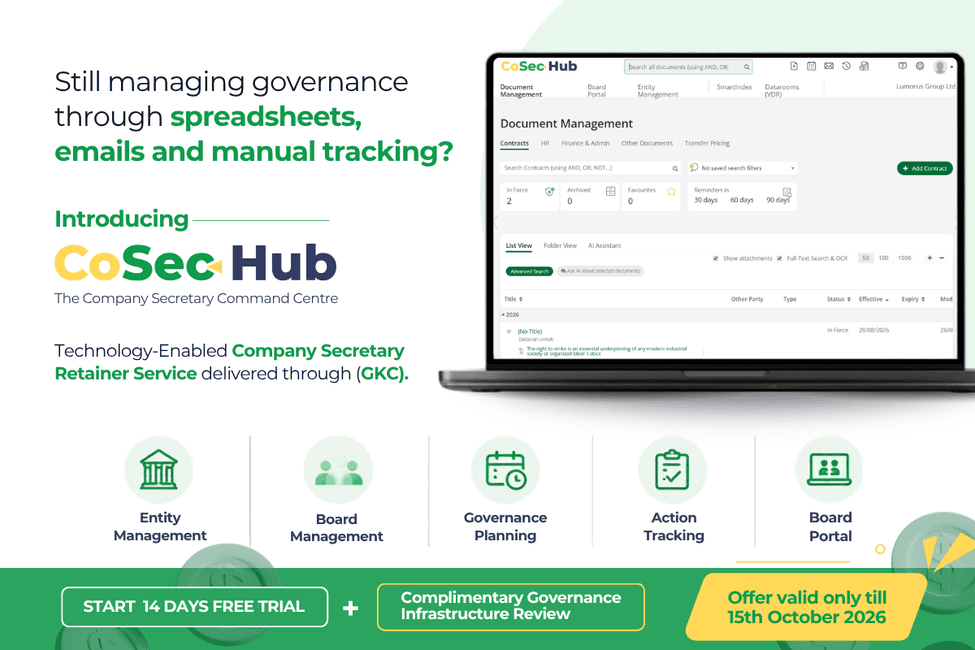
CoSec Hub is the Company Secretary Command Centre.
It combines governance technology with qualified company secretarial professionals across Lumorus Governance Knowledge Centres globally to create an integrated governance operating environment rather than fragmented administration.
Through CoSec Hub, organisations can centralise:
- Board administration
- Statutory registers
- Governance workflows
- Filing oversight
- Resolution management
- Subsidiary governance
- Compliance tracking
- Governance documentation
- Audit trails and accountability visibility
This helps businesses move from reactive governance administration towards structured governance resilience capable of supporting growth, funding readiness and operational continuity.
Explore CoSec Hub: cosec.lumorus.com
The Real Governance Risk Is What Cannot Be Proven
Most governance failures are not caused by fraud or misconduct.
They are caused by governance functions that were never properly built.
When organisations cannot evidence decisions, approvals, oversight or accountability clearly, governance risk moves from operational inconvenience to commercial exposure.
The businesses that scale successfully over the next decade will not simply be commercially ambitious. They will be institutionally organised.
Governance is no longer paperwork. It is infrastructure.
And increasingly, the company secretary function sits at the centre of it.
Lumorus: Better Business, Built on Purpose
At Lumorus, we believe Being Good is Better for Business.
We help organisations lead with integrity, govern with confidence and create value that lasts. Through our work across Governance Advisory, Company Secretary Service and ESG-Social Impact Consulting, we support boards, executives and leadership teams to strengthen accountability, improve decision making and build resilient, responsible organisations.
With offices and expert teams across the UK, Africa, the Caribbean, Latin America and Canada, and clients operating globally, Lumorus brings international perspective, specialist expertise and practical judgement to every engagement.
Whether you are strengthening governance, enhancing board oversight, meeting company secretary responsibilities or building a more purposeful organisation, Lumorus is here to help you move from intention to action.
Together, we can build better business: one that performs with purpose, leads with integrity and creates lasting value for people, planet and profit.
To continue the conversation, visit:
lumorus.com
cosec.lumorus.com
[email protected]
Sources
- Dynamic Boards — Co Sec 101: The Role of the Company Secretary
- The Chartered Governance Institute UK & Ireland
- Companies Act 2006
- Deloitte Governance & Due Diligence Insights
- Financial Conduct Authority