



Outsourcing company secretary work is no longer a decision taken only by small businesses that cannot justify a full time hire. Across the UK, organisations of significant scale, including listed companies, regulated financial institutions, multi-entity groups and fast growing businesses, are choosing to outsource the CoSec function entirely or in part. The reasons vary. Cost efficiency, access to specialist expertise, scalability across jurisdictions and the need for governance infrastructure that a lean internal team cannot build alone are all driving the trend.
The decision to outsource, however, is only as good as the provider chosen to deliver it. Company secretary work is legally consequential. A missed filing, an inaccurate statutory register, an undocumented board resolution or a lapsed beneficial ownership record is not an administrative inconvenience. Each carries regulatory, legal, and reputational consequences for the company and its officers. Choosing the right outsourced CoSec provider is a governance decision, not simply a procurement exercise.
This article sets out what to look for in an outsourced company secretary provider in the UK, reviews the landscape of providers operating in this space and explains why the combination of professional expertise and purpose-built technology infrastructure is the standard that serious organisations should hold their providers to.
What Outsourced Company Secretary Services Should Deliver
Before evaluating specific providers, it is worth establishing what a genuinely capable outsourced CoSec function should deliver. The baseline is not simply the completion of statutory filings. A provider that files confirmation statements on time, and nothing more is not delivering a CoSec service. It is delivering a filing service, and the distinction matters.
A capable outsourced company secretary provider should deliver across the full scope of the function.
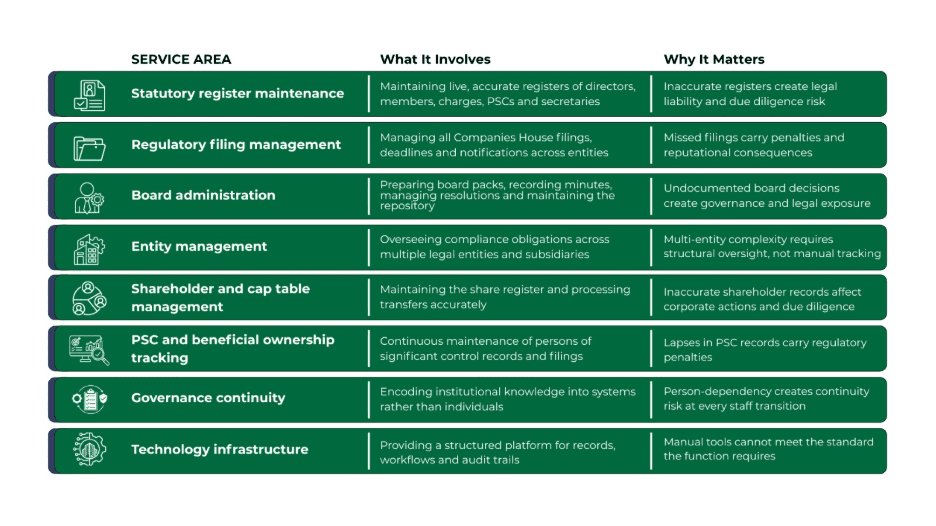
A provider that delivers across all these areas with consistency, accuracy and the technology infrastructure to make the work auditable is a genuinely capable CoSec partner. A provider that delivers some of these areas manually and inconsistently is a managed risk rather than a governance solution.
The UK Outsourced CoSec Market: Who Is Operating and What They Offer
The UK outsourced company secretary market includes a wide range of providers, from large professional services firms and specialist governance practices to boutique CoSec specialists and technology-led platforms. The landscape can be broadly categorised into four provider types.
- Large Professional Services Firms
The major accountancy and professional services networks, including firms such as PwC, Deloitte, KPMG and Grant Thornton, offer company secretary services as part of broader governance, risk and compliance practices. These providers bring significant institutional credibility, deep regulatory knowledge, and the ability to coordinate CoSec work with audit, tax, and legal services within an integrated engagement.
The trade off is that CoSec work within large professional services firms is frequently not the primary service. It sits within a broader offering and may not receive the focused attention and specialist infrastructure that a dedicated CoSec practice can provide. For organisations whose CoSec needs are closely intertwined with audit or tax work, the integrated model has value. For organisations whose primary requirement is specialist CoSec delivery with dedicated governance technology, a more focused provider is likely to serve them better.
- Specialist Governance and CoSec Practices
Several UK firms focus specifically on governance, company secretary and compliance services. These providers bring deep CoSec expertise, dedicated teams and, in the better cases, purpose-built technology platforms that give their clients access to structured governance infrastructure rather than managed manual processes.
Providers in this category include firms such as Vistra, TMF Group, Tricor and Computershare, each of which offers company secretary services with varying degrees of technology integration and geographic coverage. For organisations with multi-jurisdictional requirements, the global reach of these providers is a significant advantage. For organisations focused primarily on UK compliance, the question is whether the technology and service model offered by a large international provider is appropriately calibrated to their specific needs.
- Boutique CoSec Specialists
The UK market includes a number of smaller, specialist CoSec practices that serve specific market segments, whether by company size, sector or jurisdiction. These providers can offer highly personalised service and deep familiarity with the specific regulatory environment their clients operate in. The risk with boutique providers is scalability and technology. A provider that delivers excellent CoSec work manually across a small client base may not have the infrastructure to maintain that standard as the client’s complexity grows.
- Technology-Led Governance Platforms
The most significant development in the UK outsourced CoSec market over the past several years is the emergence of technology-led providers that combine professional CoSec expertise with purpose-built governance infrastructure. These providers do not simply deliver CoSec services manually with better communication. They deliver CoSec services through a structured platform that gives clients live access to their statutory records, automated deadline management, a searchable resolution repository, and auditable governance documentation.
This model represents a structural advance on the traditional outsourced CoSec proposition. The client receives not just a service but an infrastructure, one that is transparent, auditable, and accessible in real time rather than dependent on the responsiveness of an external team.
What Separates Good Providers from the Rest
Across all provider types, the characteristics that distinguish genuinely capable outsourced CoSec providers from the rest cluster around four dimensions.
- Technology Infrastructure
The question to ask any outsourced CoSec provider is not whether they use technology. Every provider uses technology in some form. The question is whether the technology they use is purpose-built for governance, or whether it is a collection of general purpose tools, spreadsheets, document management systems, and calendar applications assembled into a workflow.
Purpose-built governance technology maintains statutory registers as live, structured records with full audit trails. It tracks compliance deadlines through an automated engine with escalation protocols. It stores board resolutions in a searchable repository linked to entity and meeting records. It gives the client real time visibility into the governance status of their entities rather than periodic updates from an account manager.
Providers that deliver CoSec services through purpose-built technology infrastructure offer a fundamentally different proposition from those that deliver the same services manually. The client receives governance infrastructure, not just governance services.
- Regulatory Knowledge and Depth
UK company law is not static. The Companies Act 2006, the Economic Crime and Corporate Transparency Act 2023, the National Security and Investment Act 2021 and the evolving requirements around beneficial ownership, PSC registers and director responsibilities create a regulatory environment that requires current, specialist knowledge to navigate correctly.
A provider whose regulatory knowledge is current, deep, and practically applied is a governance asset. A provider whose knowledge is general and not regularly updated is a compliance risk. The assessment of regulatory knowledge should include direct conversation about recent legislative changes, their practical implications for the client, and how the provider has adapted its service model in response.
- Scalability and Multi-Entity Capability
For organisations with subsidiary structures, planned acquisitions or cross jurisdictional operations, the scalability of the provider’s model is a critical consideration. Adding a new entity should not require starting a new engagement from scratch. It should mean extending an existing infrastructure that already works.
The providers best equipped to support multi-entity complexity are those whose technology infrastructure is designed for it, with a centralised entity registry that maintains consistent standards across every entity in the group rather than managing each entity as a separate engagement.
- Transparency and Client Access
The relationship between an organisation and its outsourced CoSec provider should be characterised by transparency, not opacity. The client should have real time access to their governance records, not be dependent on requesting information, and waiting for a response. They should be able to see the status of their compliance deadlines, the accuracy of their statutory registers, and the completeness of their board resolution repository at any point, not only when the provider chooses to communicate.
Providers that offer genuine transparency through client accessible platforms are demonstrating confidence in the quality and currency of their work. Providers that manage information flow through periodic updates and account manager relationships are managing a dependency rather than delivering a service.
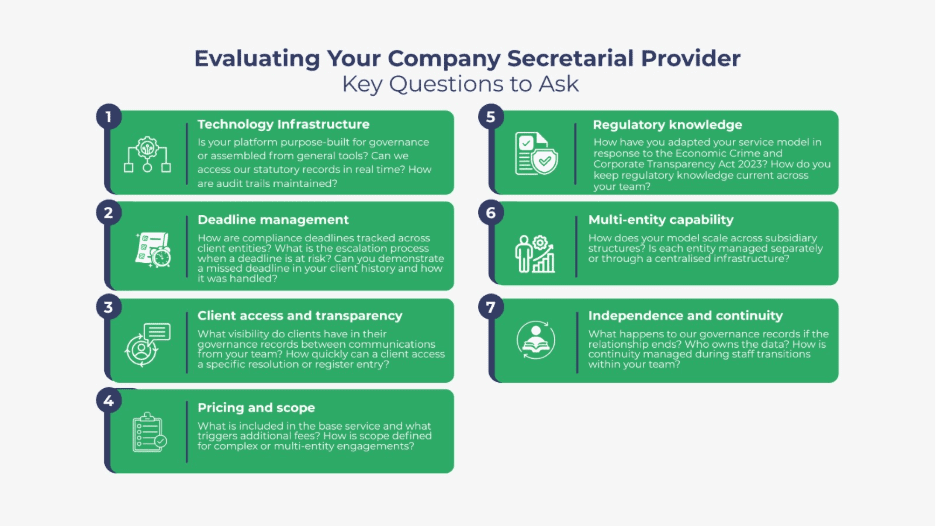
How to Evaluate an Outsourced CoSec Provider: The Right Questions
The procurement process for an outsourced CoSec provider should include direct assessment of each of the dimensions above. These are the questions that surface the most relevant information.
Why Technology and Expertise Must Work Together
The most common mistake organisations make when evaluating outsourced CoSec providers is treating technology and expertise as alternatives rather than complements. A provider with deep regulatory expertise, but no technology infrastructure delivers services manually and creates the same person dependency and audit readiness risk that manual in-house CoSec functions create. A provider with impressive technology but shallow regulatory expertise creates a different risk: governance records that are well organised but incorrectly maintained.
The standard that serious organisations should hold their outsourced CoSec providers to is the combination of both. Deep, current regulatory expertise applied through purpose-built governance technology that gives the client real time access to accurate, auditable records and the confidence that their compliance obligations are being managed with structural rigour rather than individual diligence.
“An outsourced CoSec provider is not a vendor. It is a governance partner. The infrastructure it brings into the relationship either strengthens or weakens the organisation’s governance capability. That distinction should drive the selection decision.”
CoSec Hub by Lumorus: Governance Infrastructure for Serious Organisations
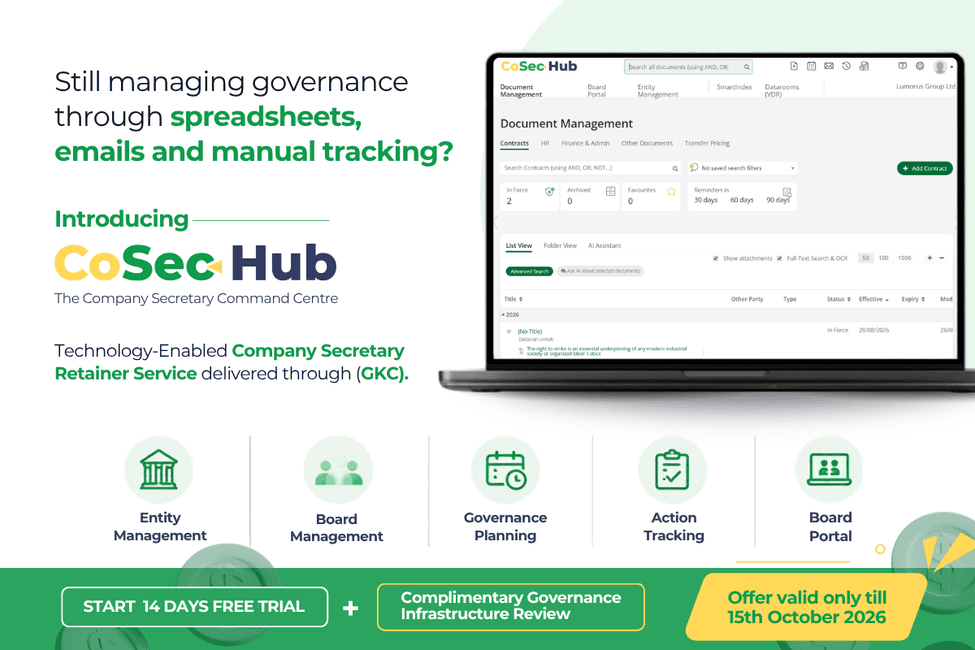
CoSec Hub, powered by Lumorus, represents the technology-led governance infrastructure model at its most developed. It combines the professional company secretary expertise of Lumorus with a purpose-built governance platform that gives clients live access to their statutory records, automated compliance deadline management, a structured resolution repository and the encoded institutional knowledge that manual CoSec functions cannot preserve.
Lumorus brings deep governance expertise across Africa and the UK, working with organisations that range from growth stage businesses building their governance infrastructure for the first time to multi-entity groups that need consistent standards across complex subsidiary structures. The firm’s governance services team combines the regulatory knowledge, board level experience and practical CoSec expertise that the function requires with the technology infrastructure of CoSec Hub to deliver a proposition that neither professional expertise alone nor technology alone can match.
For organisations evaluating outsourced CoSec providers in the UK, the questions set out in this article provide the framework for a rigorous assessment. The answers will quickly distinguish providers that are delivering governance infrastructure from those that are managing a manual process with reasonable efficiency.
The governance of a company is too important to be managed on spreadsheets and good intentions. The organisations that treat CoSec infrastructure as a strategic priority, and choose their outsourced provider on that basis, build something more durable than compliance. They build governance capability that holds under scrutiny, scales with the business and does not depend on any individual to remain intact.
cosec.lumorus.com | lumorus.com | [email protected]
Citations & Sources
- Companies Act 2006. UK Parliament.
- Economic Crime and Corporate Transparency Act 2023. Companies House.
- Financial Reporting Council. UK Corporate Governance Code. 2024.
- Chartered Governance Institute UK & Ireland. Company Secretarial Benchmarking Survey. 2023.
- Institute of Chartered Secretaries and Administrators. Corporate Governance Failures and Board Evaluation Outcomes. 2023.
- National Security and Investment Act 2021. UK Parliament.