


79%: African governance standards are becoming more measurable
In April 2026, Kenya’s Capital Markets Authority reported that the overall corporate governance score for issuers it assessed had risen from 74% to 79% during the 2024/25 financial year. The assessment covered 53 issuers and evaluated how companies applied the principles and recommendations of Kenya’s corporate governance framework.
The direction of travel matters well beyond Kenya. Across Africa, organisations face growing expectations around board accountability, statutory compliance, beneficial ownership, entity records, internal controls, governance disclosure and the quality of evidence supporting board decisions.
South Africa’s King V Report on Corporate Governance, effective for financial years beginning on or after 1 January 2026, has reinforced the emphasis on governance outcomes and standardised disclosure. In Nigeria, the Securities and Exchange Commission requires public companies to comply with the Nigerian Code of Corporate Governance and additional SEC governance guidelines. Meanwhile, Kenya’s governance framework assigns the company secretary an explicit role in supporting the board and coordinating the governance audit process.
For companies operating across several African jurisdictions, this creates a practical challenge: governance must not only be done properly, it must also be capable of being evidenced.
That is where high-quality company secretary services become strategically important.
The strongest providers do more than complete forms or organise meetings. They help build governance records, controls and processes that can withstand scrutiny from auditors, regulators, investors, lenders and boards.
Read More: Statutory & Regulatory Compliance
Executive Takeaway
When selecting company secretary services in Africa, organisations should look beyond basic administration and consider whether the provider can create an audit-ready governance environment.
A strong partner should be able to demonstrate capability across:
- Accurate statutory and beneficial ownership records
- Board and committee meeting governance
- Timely regulatory filings and compliance monitoring
- Reliable minutes, resolutions and decision evidence
- Entity management across multiple jurisdictions
- Conflict-of-interest and director records
- Governance audits and health checks
- Shareholder meeting support
- Clear governance reporting and audit trails
- Technology-enabled record keeping and continuity
Most importantly, the provider should be capable of answering a simple question:
If a regulator, investor or auditor asked tomorrow how a material governance decision was made, could the organisation produce the evidence quickly and confidently?
Audit-ready governance is more than being ready for the financial audit
The phrase audit ready is sometimes understood too narrowly.
A company’s finance function may be thoroughly prepared for its external audit while the wider governance environment remains fragmented. Board approvals may be scattered across email chains, statutory registers may not reflect recent changes and different versions of resolutions may sit across personal folders and shared drives.
That is not audit-ready governance.
Audit-ready governance means the organisation can demonstrate that its governance responsibilities have been carried out consistently and appropriately. Depending on the jurisdiction and organisation, evidence may include:
- Board and committee minutes
- Board and shareholder resolutions
- Statutory registers
- Director appointment and resignation records
- Beneficial ownership information
- Conflict-of-interest registers
- Annual returns and regulatory filings
- Shareholder records
- Governance policies and charters
- Delegated authorities
- Evidence of board approvals
- Action registers
- Governance compliance calendars
The IFC’s corporate governance guidance recognises the company secretary as an important governance professional who supports boards and committees in performing their duties, while also helping organisations maintain appropriate governance processes.
In practice, that makes the company secretary one of the principal custodians of governance evidence.
Explore More: Corporate Governance Support
Why audit-ready governance is becoming more important across Africa
There is no single African governance framework. Companies operating across the continent navigate different company laws, capital-market rules, beneficial ownership regimes, governance codes, reporting expectations and regulatory institutions.
However, several common themes are emerging.
1. Regulators increasingly expect evidence, not intention
Kenya’s Capital Markets Authority Code of Corporate Governance gives the company secretary a significant governance role, including supporting the board, facilitating communication with shareholders, maintaining conflict-of-interest records and coordinating governance audits.
In other words, governance is expected to leave an evidence trail.
2. Disclosure is becoming more structured
South Africa’s King V introduced a dedicated disclosure framework intended to improve consistency and comparability while maintaining a principles-led approach. Its focus is not simply on whether prescribed processes have been completed but on whether governance produces appropriate outcomes.
3. Board accountability remains central
Nigeria’s SEC Corporate Governance Guidelines require public companies to comply with the Nigerian governance framework and contain detailed expectations relating to board structure, audit committees, risk management, internal audit, board papers and disclosure.
These developments point towards a common conclusion: companies need governance systems capable of surviving independent scrutiny.
What does an audit-ready company secretary service look like?
The strongest providers combine local legal knowledge with disciplined governance operations.
Audit-Ready Company Secretary Framework
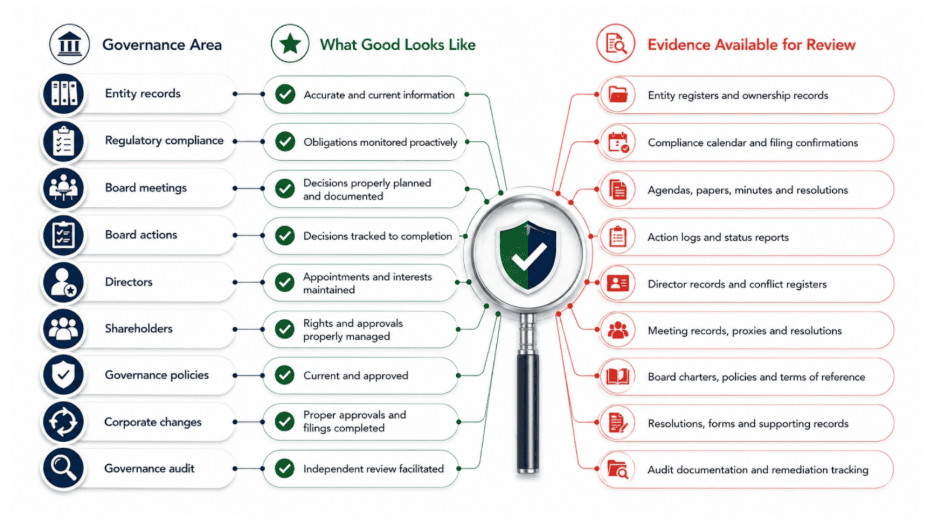
Audit readiness therefore depends on both record quality and process quality.
A provider that stores documents but cannot demonstrate the process behind them is not providing complete governance assurance.
Leading company secretary service providers in Africa
There is no objective league table covering company secretary providers across the African continent. Different organisations require different combinations of local knowledge, multi-jurisdiction coverage, technology, governance advice and board support.
The following providers illustrate several credible models available in the market.
1. Lumorus: Governance-led, multi-jurisdiction company secretary support
Lumorus combines company secretary expertise with broader governance advisory and technology-enabled governance infrastructure.
This can be particularly relevant for multinational companies, financial institutions, growing businesses and organisations that do not simply need filings completed but require greater visibility over their governance environment.
The Lumorus company secretary model covers:
Its model is strengthened by CoSec Hub and the Governance Knowledge Centre, which combine governance technology with company secretary expertise.
For audit-ready governance, that combination matters because the objective is not merely to perform governance activity. It is to create connected, accessible and auditable governance information.
Best suited to: organisations operating across multiple jurisdictions that want technology-enabled company secretary support combined with broader governance expertise.
2. PwC Kenya: Entity governance combined with wider professional services
PwC Kenya provides Entity Governance and Compliance services through a team of governance professionals, qualified company secretaries and lawyers.
Its offering includes entity setup, statutory compliance, beneficial ownership compliance, corporate health checks, meeting management and governance solutions. PwC Kenya also states that it conducts governance audits against frameworks including the Kenyan Capital Markets Authority Code and other recognised governance standards.
A particular strength is integration. Because the governance team operates within a large multidisciplinary professional services network, organisations can combine entity governance with legal, tax, transactions and assurance-related expertise where appropriate.
For organisations with complex corporate structures, this breadth can be useful, although companies should always consider applicable independence requirements where the same professional services network also provides external audit.
Best suited to: larger Kenyan and regional businesses that value multidisciplinary support alongside entity governance.
3. Bowmans and Stamford Corporate Services: Strong East African legal and governance integration
Bowmans provides company secretary, governance advisory and compliance audit services in East Africa through Stamford Corporate Services LLP and Stamford Services Ltd.
Its published offering includes:
- Entity establishment and dissolution
- Board and shareholder meeting management
- Governance audits
- Governance advisory
- Board evaluation
- Compliance management and reporting
- Corporate trustee and administrative services
Bowmans also highlights experience engaging with regulators including the Registrar of Companies, Capital Markets Authority, Nairobi Securities Exchange, central banks and sector regulators.
This combination of legal capability and governance operations can be particularly useful where organisations require technical interpretation alongside ongoing company secretary delivery.
Best suited to: East African businesses seeking company secretary and governance support with strong legal integration.
4. Scribe Services: Specialist Kenyan governance and company secretary support
Kenya-based Scribe Services Registrars provides company secretary, governance, ESG, share registration and related corporate services.
Its specialist model may appeal to businesses seeking local support from a provider focused on governance operations rather than a larger multidisciplinary advisory engagement.
Scribe also offers board evaluation and governance services, which can be helpful where organisations want company secretary support to connect with board effectiveness and broader governance maturity.
Best suited to: Kenyan organisations and international companies requiring local governance and entity support.
5. CorpStat: South African board and company secretary expertise
South Africa’s CorpStat describes itself as a specialist governance advisory and company secretary firm with more than 20 years of experience and clients that include JSE-listed companies.
Its published services extend from Companies and Intellectual Property Commission matters to board and committee meeting support and advanced corporate governance advice.
The South African environment has become particularly relevant following the introduction of King V for financial years beginning on or after 1 January 2026. King V’s emphasis on governance outcomes and disclosure increases the importance of disciplined board processes and governance evidence.
Best suited to: South African companies, including listed organisations, seeking specialist board and company secretary support.
6. Vistra: Global reach for African entities within multinational structures
For international groups whose African entities form part of a much larger global portfolio, Vistra offers governance and entity compliance services across more than 100 countries.
Its model includes statutory compliance, entity records, filings, board support and technology-enabled oversight.
The advantage is scale. A multinational with entities across Africa, Europe, Asia and the Americas may prefer a provider capable of coordinating governance within a single global framework.
However, local depth should still be examined jurisdiction by jurisdiction because governance obligations and corporate practice vary substantially across African markets.
Best suited to: multinational groups seeking broad global entity coverage alongside African operations.
How the provider models compare
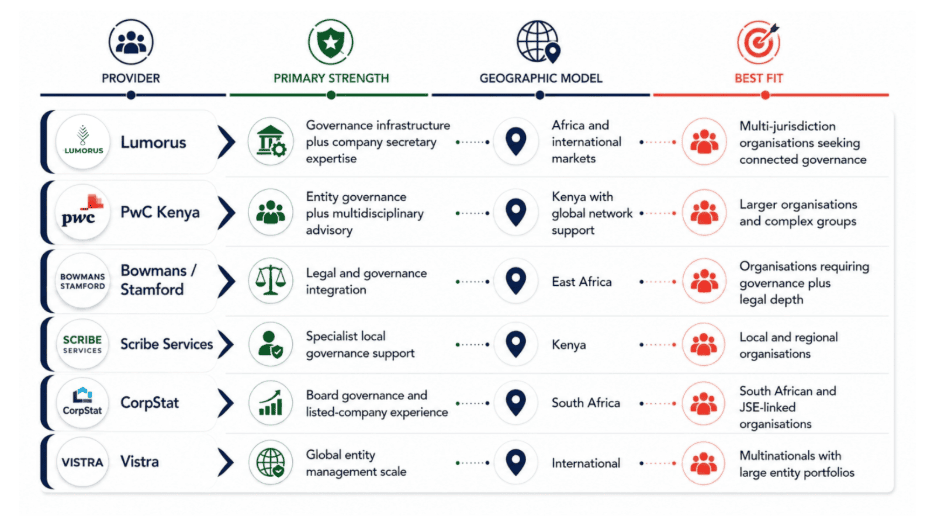
This should not be interpreted as a ranking from best to worst. The appropriate provider depends on the organisation’s footprint, risk profile, regulatory environment and governance maturity.
The real test is whether governance can be reconstructed
One of the clearest tests of audit readiness is reconstruction.
Imagine that an auditor, regulator or investor asks why a major corporate decision was made 18 months ago.
Could the organisation quickly produce:
- The relevant board paper
- The approved agenda
- Evidence that directors received appropriate information
- The meeting minutes
- The signed resolution
- Any recorded conflicts of interest
- The resulting regulatory filing
- The updated statutory register
- Evidence that agreed actions were completed
If gathering this information requires multiple emails, several former employees and a search through shared drives, governance is not truly audit ready.
This is why professional Board & Shareholder Meeting Support and accurate Minute Taking Solutions matter beyond the meeting itself.
Good governance leaves a coherent record.
Audit-ready minutes require judgement, not transcription
Board minutes are among the most important governance records an organisation maintains.
They should capture enough information to demonstrate the substance of discussion, challenge, decisions and actions without turning into a verbatim transcript.
This balance becomes important during governance audits, regulatory reviews, transactions or disputes because minutes often provide the most durable evidence of what the board considered and decided.
Kenya’s CMA governance framework explicitly places responsibility on the company secretary for ensuring timely preparation and circulation of board and committee minutes and papers.
Therefore, minute quality should form part of any assessment of company secretary services.
Read More: Minute Taking Solutions
Beneficial ownership and entity records are becoming harder to treat as back-office matters
Across many jurisdictions, authorities have strengthened requirements relating to beneficial ownership and legal entity transparency.
Consequently, entity information is becoming increasingly important for banking relationships, investor due diligence, transactions, regulatory reviews and group governance.
A high-quality company secretary provider should maintain clear visibility over:
- Legal entity names and registration details
- Directors and officers
- Shareholders
- Beneficial owners
- Share capital
- Registered offices
- Statutory registers
- Annual filing obligations
- Corporate changes
- Constitutional documents
PwC Kenya, for example, includes beneficial ownership registration, ongoing compliance and corporate health checks within its entity governance service.
The underlying principle is broader: governance information should be reliable before somebody asks for it.
Multi-jurisdiction governance requires central control and local knowledge
One of the biggest mistakes international groups make is choosing between centralisation and local expertise as though they are competing approaches.
Effective African governance needs both.
The group needs central oversight so that leadership can see compliance status, entity information and governance risk across the portfolio. However, each jurisdiction still requires local knowledge because company law, filings, governance practice and regulatory expectations differ.
A robust multi-jurisdiction model therefore needs:
- A central governance framework
- Local regulatory expertise
- Standardised reporting
- Defined escalation routes
- Consistent record keeping
- Jurisdiction-specific compliance calendars
- Group visibility over outstanding obligations
- Clear responsibility between headquarters and local entities
PwC’s global entity governance model illustrates this principle through technology-enabled compliance, central reporting and local governance expertise across multiple jurisdictions.
The same logic underpins the Lumorus approach to multi-jurisdiction company secretary support.
Explore More: Company Secretary Outsourcing
The Lumorus View
Audit-ready governance is not created the week before an audit. It is created every time a board meets, a director changes, a filing is completed, a conflict is declared or a governance decision is recorded properly.
This distinction matters.
Organisations sometimes approach governance audits in the same way they approach an examination: gather the files, close the obvious gaps and prepare for the reviewer.
A stronger model treats readiness as an ongoing operating discipline.
- Records remain current.
- Responsibilities remain visible.
- Deadlines are monitored.
- Actions are followed through.
- Evidence is retained.
That makes governance scrutiny less disruptive because the organisation is not recreating history every time somebody asks for proof.
Why CoSec Hub matters for audit-ready governance
Traditional company secretary models can become highly dependent on individual knowledge.
The experienced Company Secretary knows where everything is stored, remembers what is outstanding and understands the history behind previous decisions.
That expertise is valuable, but the organisation also needs institutional continuity.
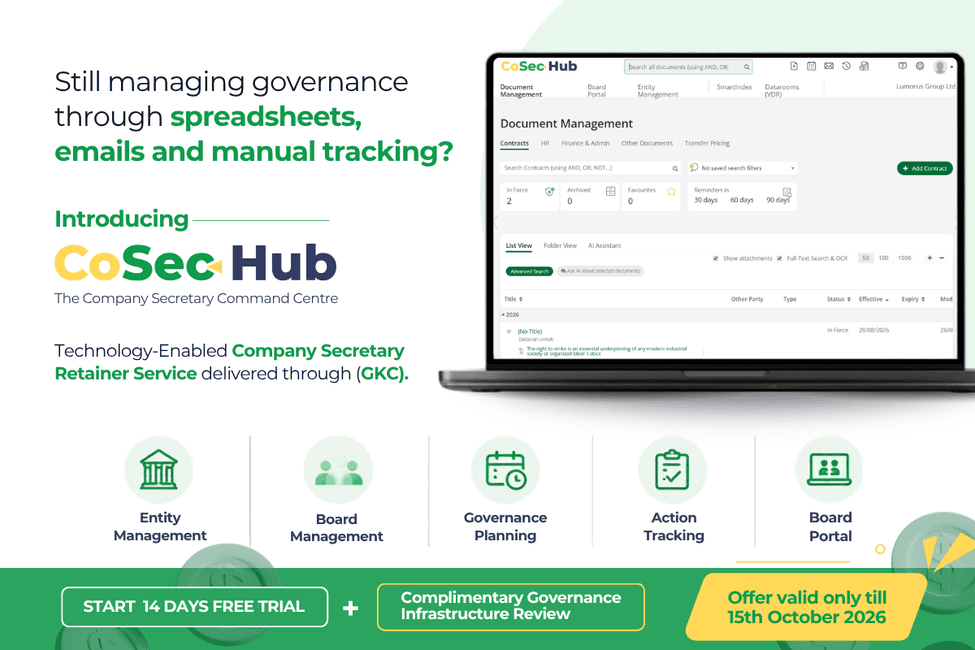
CoSec Hub was built around the principle that modern governance requires both technology and professional expertise.
Its technology layer supports areas including:
- Entity management
- Compliance calendars
- Governance forward planning
- Board management
- Contract management
- Statutory registers
- Board action tracking
- Meeting lifecycle management
This is complemented by governance expertise through the Governance Knowledge Centre, which supports organisations with company secretary expertise, governance operations, compliance monitoring, board administration, governance intelligence and multi-jurisdiction governance support.
For audit readiness, the value lies in connection. Records, obligations, actions and governance information become easier to track and retrieve, while professional judgement remains available where interpretation is required.
Not software alone.
Not outsourced support alone.
Governance infrastructure.
Explore: CoSec Hub
Seven questions to ask before appointing a company secretary provider in Africa
Before selecting a provider, boards and General Counsel should look beyond the fee proposal and test how the service will work in practice.
1. Which African jurisdictions can you genuinely support?
Ask whether services are delivered locally, through network firms or through third-party partners.
2. How will you monitor regulatory obligations?
A credible provider should be able to explain its compliance calendar, escalation process and reporting arrangements.
3. Can you demonstrate governance audit readiness?
Ask how board records, statutory registers, resolutions and filings will be maintained and retrieved.
4. How do you manage multi-jurisdiction entities?
The organisation should receive group-level visibility without losing local regulatory accuracy.
5. What happens when our usual contact is unavailable?
The answer reveals whether service delivery depends on an individual or an institutional process.
6. What technology supports the service?
Technology should improve visibility, record integrity and reporting rather than simply act as a document repository.
7. What governance expertise sits behind the administration?
The provider should be able to advise on governance issues rather than merely process instructions.
These questions help distinguish basic company administration from governance capability.
The Bottom Line
The best company secretary services in Africa for audit-ready governance are not necessarily those that complete the largest number of filings or operate the largest global network.
The stronger providers help organisations create governance that can be demonstrated.
That means accurate entity records, disciplined board processes, reliable statutory compliance, defensible minutes, clear ownership and governance information that remains accessible when scrutiny arrives.
The precise provider will depend on the organisation. A Kenyan listed company may value deep local governance audit capability, while a multinational group may need coordinated support across ten African countries. A South African organisation may be focused on King V implementation, while a Nigerian public company must manage the requirements of the Nigerian Code of Corporate Governance and SEC guidelines.
What they share is the need for evidence.
Governance becomes audit ready when the organisation can demonstrate not simply that processes exist, but that they operate consistently.
The strongest governance record is not the one reconstructed before an audit. It is the one maintained correctly every day.
Continue Exploring
- If your challenge is board governance: Corporate Governance Support
- If your challenge is statutory compliance: Statutory & Regulatory Compliance
- If your challenge is board and shareholder meetings: Board & Shareholder Meetings
- If you are establishing or restructuring African entities: Company Formation & Structuring
- If you need scalable external governance capacity: Company Secretary Outsourcing
- If your challenge is annual reporting: Annual Report Services
- If the quality of your governance record needs strengthening: Minute Taking Solutions
About CoSec Hub
CoSec Hub is the Company Secretary Command Centre.
Built by Company Secretaries for Company Secretaries, CoSec Hub combines governance technology with professional governance expertise to support compliance oversight, entity management, board administration and governance operations.
Delivered alongside the Governance Knowledge Centre, the service provides Technology-Enabled Company Secretary Retainer Services designed for modern company secretary, legal, governance and compliance teams.
For organisations operating across Africa, this model helps move governance from fragmented records and institutional memory towards connected, visible and audit-ready governance infrastructure.
Lumorus: Better Business, Built on Purpose
Lumorus is a UK headquartered global governance, ESG, company secretary and advisory firm supporting organisations across Europe, Africa, Asia, the Caribbean, Canada, the Middle East and international markets.
For more than 10 years, we have helped boards, leadership teams and organisations strengthen governance, accountability and organisational resilience.
For companies operating across Africa, audit-ready governance requires more than keeping entities compliant. It requires reliable records, effective board processes, local regulatory knowledge and governance infrastructure capable of providing group-wide visibility.
Is your governance genuinely audit ready, or would your team need to reconstruct the evidence if scrutiny arrived tomorrow?
Contact Lumorus to discuss how our company secretary services and CoSec Hub can help move your organisation from fragmented administration to connected, compliant and audit-ready governance.
Email: [email protected]
CoSec Hub + Governance Knowledge Centre: Where Automation Meets Governance Authority.
Sources
- Capital Markets Authority Kenya – CMA Reports an Improved Governance Score for Issuers of Securities to the Public, April 2026.
- Capital Markets Authority Kenya – Code of Corporate Governance Practices for Issuers of Securities to the Public.
- Institute of Directors in South Africa – King V Report on Corporate Governance for South Africa.
- Securities and Exchange Commission Nigeria – Corporate Governance Guidelines and Nigerian Code requirements for public companies.
- International Finance Corporation – Guidance on board governance, internal controls and the role of the company secretary.
- PwC Kenya – Entity Governance and Compliance services, including governance audits, statutory compliance and board support.
- Bowmans – East African company secretary, governance advisory and compliance audit services.
- Scribe Services Registrars – Kenyan company secretary and governance services.
- CorpStat – South African company secretary and governance advisory services.
- Vistra – Global entity compliance and company secretary support.