


Could Your Board Prove Its Governance If Scrutiny Started Tomorrow?
European organisations are operating in a more demanding governance environment.
Corporate records are subject to greater scrutiny, beneficial ownership requirements are becoming more exacting and boards are expected to demonstrate that decisions were made through proper processes. At the same time, groups operating across several European jurisdictions must manage different company laws, filing obligations and governance expectations without losing group-wide visibility.
This creates a simple but important question.
If an auditor, regulator, investor or lender asked for evidence of a major governance decision tomorrow, how quickly could your organisation provide it?
For many organisations, the answer depends too heavily on individual knowledge. Someone knows where the latest register is kept, another person remembers which resolution was approved and a third knows whether the filing was completed.
That may keep the organisation functioning, but it does not necessarily make governance audit ready.
The Financial Reporting Council places the company secretary at the centre of board information flows, director support and effective governance processes. This reinforces an important point: the company secretary function is not simply administrative support. It forms part of the organisation’s governance control environment.
Therefore, choosing the right company secretary provider is increasingly a question of governance resilience rather than convenience.
Read More: Corporate Governance Support
Executive Takeaway
Boards seeking audit-ready company secretary support should look for providers that can demonstrate strength across:
- Statutory and regulatory compliance
- Accurate entity records
- Board and committee governance
- Reliable minutes and resolutions
- Beneficial ownership information
- Compliance calendars
- Board action tracking
- Multi-jurisdiction coordination
- Governance reporting
- Technology-enabled record keeping
- Continuity when key individuals are unavailable
- Clear audit trails
Most importantly, the provider should help the organisation move from knowing that governance happened to being able to prove how it happened.
What audit-ready governance really means
Audit-ready governance is not the same as preparing documents shortly before an audit.
Instead, it means that governance records are created, maintained and updated properly as part of normal business activity.
An audit-ready organisation should be able to produce, when required:
- Board and committee papers
- Approved agendas
- Minutes and resolutions
- Conflict-of-interest declarations
- Statutory registers
- Director records
- Shareholder records
- Beneficial ownership information
- Filing confirmations
- Governance policies
- Delegated authorities
- Compliance calendars
- Board action registers
- Corporate transaction records
However, document availability alone is not enough. The records should also tell a coherent story.
For example, if a board approved a share issue, the organisation should be able to show the board approval, supporting papers, any shareholder approval, the filing and the updated statutory register.
When those records are disconnected, the organisation may appear compliant while still carrying governance risk.
Explore More: Statutory & Regulatory Compliance
The 30-minute governance test
Boards can test audit readiness without conducting a full governance review.
Choose one material corporate decision from the past 18 months and ask the governance team to reconstruct the complete record within 30 minutes.
The evidence should include:
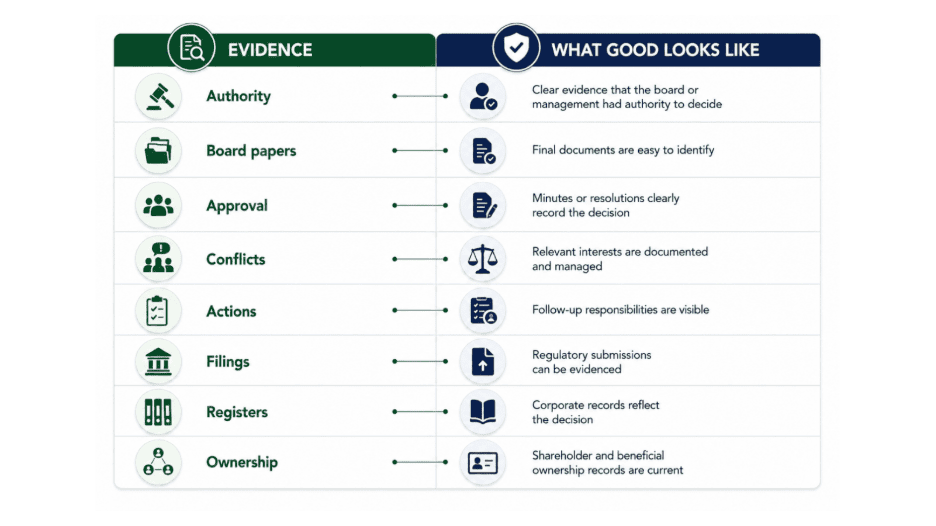
If several people need to search emails, local drives or personal folders to reconstruct the answer, governance is not as resilient as it may appear.
Why Europe makes governance more complex
Europe does not operate under one company law system.
A corporate group may have entities in the UK, Ireland, Luxembourg, the Netherlands, France, Germany and several other jurisdictions. As a result, governance obligations differ across registration requirements, board processes, filing deadlines, beneficial ownership rules and local corporate law.
Meanwhile, transparency expectations continue to increase.
The European Union’s anti-money laundering framework strengthens beneficial ownership requirements and requires Member States to maintain accurate ownership registers. Importantly, authorities can request supporting corporate evidence, including board resolutions, meeting records and other documents.
In the UK, Companies House identity verification reforms have also increased the importance of accurate director and ownership information.
Therefore, European governance increasingly requires two things at the same time:
- Strong local regulatory knowledge
- Central group-wide governance visibility
A provider that delivers one without the other may leave important gaps.
Read More: Company Formation & Structuring
What boards should expect from a leading company secretary provider
The strongest providers should operate across four connected areas.
1. Accuracy
Entity records should remain current and consistent. This includes:
- Directors
- Shareholders
- Beneficial owners
- Share capital
- Registered offices
- Statutory registers
- Constitutional documents
2. Execution
Governance obligations should be completed properly and on time. This includes:
- Filings
- Board approvals
- Annual returns
- Corporate changes
- Shareholder actions
3. Evidence
The organisation should be able to demonstrate what happened, when it happened and who authorised it.
4. Governance intelligence
Boards and leadership teams should receive enough visibility to understand:
- Upcoming deadlines
- Outstanding actions
- Entity changes
- Compliance exceptions
- Governance risks
This final capability is where company secretary services begin to move beyond administration and become part of governance infrastructure.
Top company secretary service providers in Europe
There is no objective ranking that identifies one best provider for every organisation. The appropriate choice depends on jurisdiction, entity complexity, regulatory exposure and the depth of governance support required.
However, several providers illustrate the main service models available.
Lumorus: governance infrastructure combined with company secretary expertise
Lumorus approaches company secretary support as part of the wider governance operating model.
This is particularly relevant for organisations that need more than filings and entity maintenance. Audit-ready governance requires board decisions, compliance obligations, records and accountability to remain connected.
Lumorus supports organisations through:
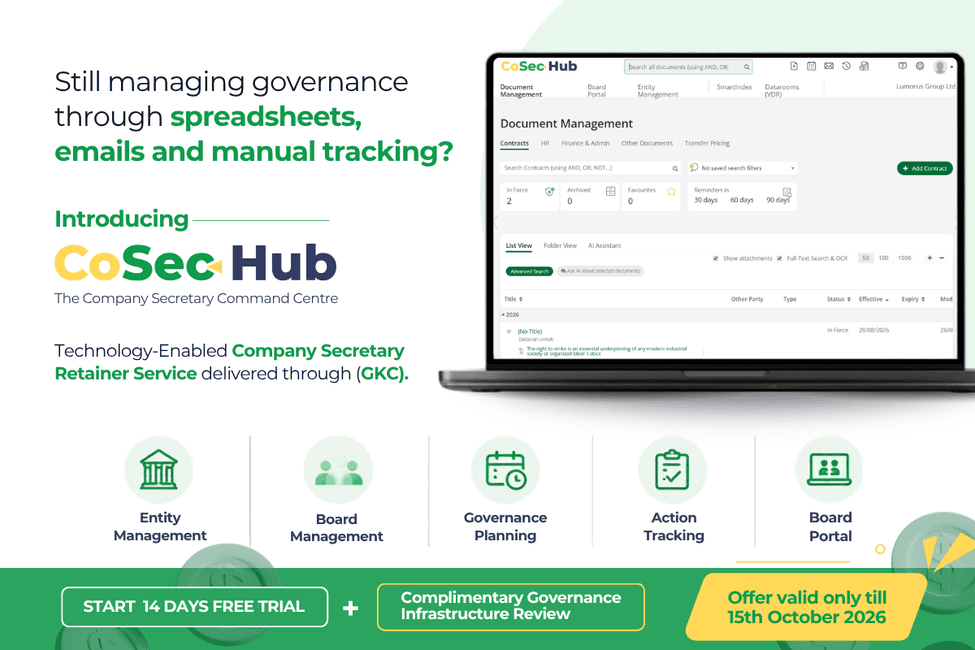
In addition, CoSec Hub combines governance technology with the Governance Knowledge Centre.
This integrated model can help organisations move from fragmented records and manual tracking towards connected governance information.
Best suited to: boards and multi-jurisdiction organisations seeking governance expertise alongside technology-enabled company secretary support.
PwC: strong for large multinational groups
PwC Entity Governance & Compliance combines entity compliance with technology-enabled oversight and wider professional services capability.
Its services include:
- Statutory registers
- Regulatory filings
- Director support
- Annual compliance
- Entity governance reviews
- Central reporting
PwC has also described engagements involving hundreds of entities across multiple jurisdictions, supported through central governance calendars and entity management.
This scale can be useful for complex multinational groups, particularly where company secretary requirements overlap with legal, tax, transactions or restructuring.
However, boards should consider applicable independence restrictions when the same professional network also provides external audit services.
Best suited to: large corporate groups requiring global scale and multidisciplinary support.
TMF Group: strong for local execution across many jurisdictions
TMF Group provides local company secretary and compliance support across an extensive international network.
Its model combines central coordination with local delivery, which is particularly valuable in Europe because the legal requirements of individual entities can differ significantly.
Support includes:
- Annual compliance
- Statutory registers
- Regulatory filings
- Board meeting support
- Entity lifecycle management
- Local governance administration
For organisations operating across many European jurisdictions, this model can reduce reliance on multiple independent advisers.
Best suited to: multinational organisations seeking consistent governance supported by local teams.
Vistra: strong for technology-enabled global entity management
Vistra combines entity governance, statutory compliance, board support and technology.
Its services include maintaining corporate records so that they remain ready for audit or inspection, while its wider operating model supports large international portfolios.
Vistra’s separate Board and Committee Support service also covers:
- Board calendars
- Meeting papers
- Minutes
- Governance compliance
- Evidential follow-through
That last point is particularly relevant because audit readiness depends on what happens after the meeting as much as what happens during it.
Best suited to: international organisations that need centralised entity visibility and strong operational scale.
IQ-EQ: strong for financial services and complex structures
IQ-EQ provides entity governance for international businesses, investment groups, funds and special purpose structures.
Its services include:
- Board coordination
- Statutory records
- Regulatory filings
- Beneficial ownership
- Entity lifecycle management
- Central governance oversight
The firm reports administering tens of thousands of entities and coordinating thousands of board meetings each year.
For regulated and investment structures, this experience can be valuable because the governance burden often extends across many entities and decision-making forums.
Best suited to: financial services groups, funds, investment structures and organisations with large numbers of SPVs.
Provider comparison
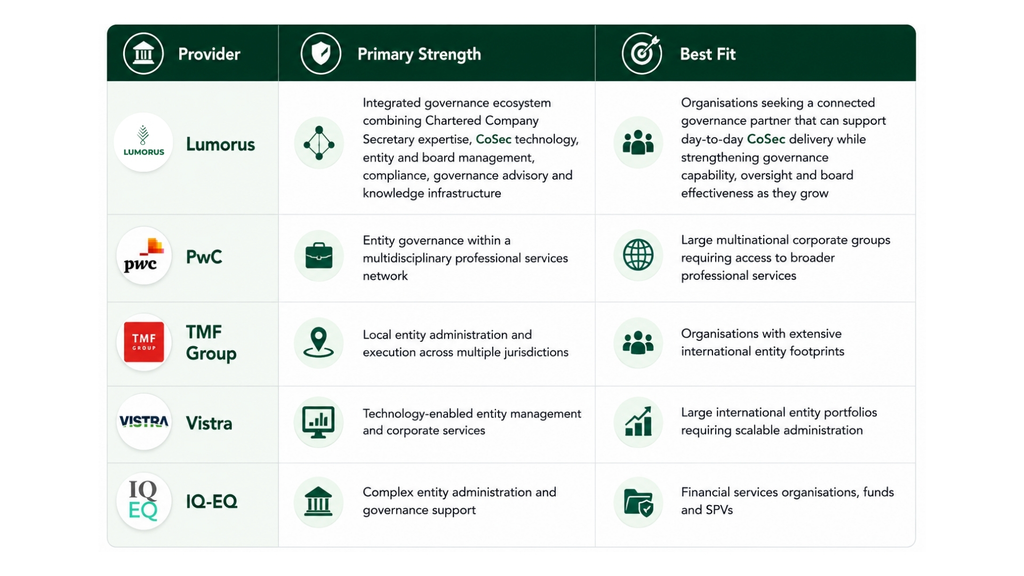
The comparison should not be treated as a league table. Instead, boards should focus on whether the provider’s operating model fits the organisation’s risk, scale and governance needs.
Red flags when choosing a provider
Boards should be cautious where:
- The service focuses almost entirely on filings
- Different countries maintain separate records with little group visibility
- One relationship manager holds most institutional knowledge
- Minutes are treated as basic meeting notes
- Compliance reports show completed work but not outstanding risk
- Technology acts mainly as document storage
- Records are updated retrospectively
- The provider waits for instructions rather than planning ahead
By contrast, stronger providers usually demonstrate:
- Central governance visibility
- Clear accountability
- Local regulatory expertise
- Forward planning
- Reliable record keeping
- Action tracking
- Governance reporting
- Professional judgement
This distinction helps separate administration from governance capability.
Board meetings sit at the centre of audit readiness
Many changes to corporate records begin with a board decision.
For example, the board may approve:
- A director appointment
- A share issue
- A subsidiary formation
- A major contract
- An acquisition
- A restructuring
Each decision can create several further obligations.
Minutes need to be prepared, resolutions may be required, filings may need to be completed and statutory records must often be updated.
Therefore, professional Board & Shareholder Meeting Support should connect the meeting with the governance actions that follow.
Otherwise, the organisation risks creating a gap between decision and execution.
Good minutes should tell the governance story clearly
Board minutes are one of the most important pieces of governance evidence.
A good minute should allow someone who was not in the room to understand:
- What was considered
- What information directors received
- What material issues were challenged
- Whether conflicts existed
- What decision was made
- What actions followed
However, minutes should not become transcripts.
The purpose is to capture governance substance, not every word spoken.
Professional Minute Taking Solutions can strengthen audit readiness by creating accurate and balanced records that support accountability.
Beneficial ownership raises the evidence standard
European beneficial ownership requirements are becoming more demanding.
Under the EU anti-money laundering framework, Member States must maintain accurate ownership registers, while authorities may request supporting corporate records.
As a result, organisations should be able to demonstrate:
- Who owns the entity
- Who ultimately controls it
- How that conclusion was reached
- Which records support the conclusion
- Whether changes have been filed correctly
This is another reason why statutory records, board resolutions and shareholder documentation should remain connected.
A correct answer without supporting evidence may not be enough when scrutiny increases.
The Lumorus View
Audit-ready governance is not about maintaining more documents. It is about ensuring that authority, decisions, actions and corporate records remain connected.
This matters because an organisation can have sophisticated technology and still operate weak governance.
A register can be easy to access but out of date. A board minute can be stored correctly while the resulting filing remains incomplete. Likewise, a compliance dashboard can appear healthy while unresolved actions sit elsewhere.
Therefore, technology should support governance rather than substitute for it.
The strongest company secretary models combine:
- Technology
- Professional judgement
- Clear ownership
- Reliable processes
- Visible accountability
Why CoSec Hub was built differently
CoSec Hub was designed around the view that modern governance teams need both technology and professional company secretary expertise.
The technology layer supports
- Entity Management
- Compliance Calendars
- Governance Forward Planning
- Board Management
- Contract Management
- Statutory Registers
- Board Action Tracking
- Meeting Lifecycle Management
The Governance Knowledge Centre provides
- Company Secretary Expertise
- Governance Operations Support
- Compliance Monitoring
- Board Administration
- Governance Intelligence
- Multi-Jurisdiction Governance Support
- Governance Advisory
Together, they form a Technology-Enabled Company Secretary Retainer Service.
The value of this model is that technology creates visibility while experienced professionals apply judgement.
That combination helps organisations build governance that is easier to manage, easier to evidence and more resilient when complexity increases.
Eight questions to include in your next RFP
Before appointing a company secretary provider for European entities, boards and General Counsel should ask:
- How do you define audit-ready governance?
- How will we obtain one group view across multiple jurisdictions?
- How do you keep statutory and beneficial ownership records current?
- How are board decisions linked to resulting filings and actions?
- What happens if our usual adviser is unavailable?
- Can we retrieve our complete governance record without depending on your team?
- How do you report exceptions before they become compliance breaches?
- What professional governance advice sits behind your technology and administration?
These questions provide more insight than simply comparing fee schedules.
The Bottom Line
European organisations have several strong company secretary service models available to them.
Large multidisciplinary firms provide scale and access to wider advisory services. Global entity specialists offer local execution across many jurisdictions, while financial services providers bring experience with complex regulated structures. Specialist governance firms can offer deeper integration between company secretary support and board governance.
The right choice depends on the organisation.
However, the standard should remain consistent.
Governance records should be accurate, decisions should be traceable, compliance should be visible and corporate history should not depend on individual memory.
The real question is not simply whether your entities are compliant today.
It is whether your organisation could prove how they have been governed if scrutiny started tomorrow.
Continue Exploring
- For stronger board governance: Corporate Governance Support
- For compliance visibility: Statutory & Regulatory Compliance
- For board and shareholder processes: Board & Shareholder Meetings
- For entity expansion or restructuring: Company Formation & Structuring
- For scalable external governance capability: Company Secretary Outsourcing
- For annual governance reporting: Annual Report Services
- For stronger board records: Minute Taking Solutions
Lumorus: Better Business, Built on Purpose
Lumorus is a UK headquartered global governance, ESG, company secretary and advisory firm supporting organisations across Europe, Africa, Asia, the Caribbean, Canada, the Middle East and international markets.
For more than 10 years, we have helped boards, leadership teams and organisations strengthen governance, accountability and organisational resilience.
For European groups, audit-ready governance requires more than keeping individual entities compliant. It requires reliable local records, strong board processes and governance information that provides leadership with a clear view across the whole organisation.
If an auditor, regulator or investor asked for the complete governance history of a material European entity tomorrow, how quickly could your organisation produce it?
Contact Lumorus to request a Governance Infrastructure Assessment and explore how CoSec Hub can help move your organisation from fragmented administration to connected, compliant and audit-ready governance.
Email: [email protected]
CoSec Hub + Governance Knowledge Centre: Where Automation Meets Governance Authority.
Sources
- Financial Reporting Council – Corporate Governance Code Guidance on board processes, information flows and the role of the company secretary.
- Companies House – Identity verification requirements for directors and people with significant control.
- European Union – EU anti-money laundering framework and beneficial ownership requirements.
- PwC – Global entity governance and compliance services.
- TMF Group – Global compliance, governance and entity management.
- Vistra – Entity governance and compliance services.
- IQ-EQ – Global entity management and board coordination.