



The UK may be your headquarters, but your governance risk is rarely confined to the UK
For many international groups, the UK is where governance comes together.
The parent board may sit in London, while operating companies, holding entities and subsidiaries are spread across Europe, Africa, Asia, the Caribbean, Canada, the Middle East and other markets. Directors may hold appointments across several jurisdictions, local filings follow different timetables and beneficial ownership requirements may vary from one entity to another.
That creates a governance problem that is easy to underestimate.
A group can have strong governance at headquarters while its wider entity structure remains fragmented. Local advisers may keep individual companies compliant, yet the board may still lack a reliable group view of upcoming obligations, director changes, subsidiary decisions and governance risks.
The UK regulatory environment itself is also becoming more demanding. Companies House made identity verification a legal requirement for directors and people with significant control from 18 November 2025, while overseas companies registered in the UK must also confirm that their directors have completed identity verification.
By the end of the transition year in November 2026, Companies House expects six to seven million individuals to have completed identity verification. As at 31 March 2026, three million had verified through GOV.UK One Login and a further 783,000 through Authorised Corporate Service Providers.
For cross-border groups, these reforms are another reminder that governance increasingly depends on accurate information, clear ownership and reliable systems.
The challenge is no longer simply finding a UK company secretary provider.
It is finding one capable of connecting UK governance with the wider international group.
Read More: Corporate Governance Support
A quick cross-border governance test
Before comparing providers, boards and General Counsel should ask whether their current model can answer five questions quickly:
- Which entities across the group have regulatory obligations due in the next 90 days?
- Which directors hold appointments across multiple jurisdictions, and are all required records current?
- Which subsidiaries have material board or shareholder actions outstanding?
- Are beneficial ownership and statutory records consistent between headquarters and local entities?
- Can the group reconstruct a material subsidiary decision without contacting several local advisers?
If those answers require multiple spreadsheets, inbox searches or separate advisers, the problem is not simply administrative complexity.
It is limited governance visibility.
What cross-border governance actually requires
Cross-border company secretary support is sometimes presented as a larger version of domestic compliance.
That is too simplistic.
The difficulty is not simply doing more filings. It is managing the tension between group consistency and local legal requirements.
A multinational group needs common governance standards, but individual entities remain subject to local law. Therefore, a strong operating model should provide central oversight without assuming that every jurisdiction operates identically.
The provider should help connect:
- UK parent and subsidiary governance
- Local statutory obligations
- Board and shareholder approvals
- Director appointments
- Beneficial ownership
- Corporate changes
- Compliance calendars
- Entity records
- Local advisers
- Group governance reporting
- Escalation of exceptions
This principle is reflected in the global entity governance market. PwC says multinational governance is difficult precisely because organisations must keep pace with regulatory changes and compliance requirements across countries. Its global model combines local expertise with central governance reporting, compliance calendars and entity management systems.
Similarly, TMF Group describes consistent governance across multiple jurisdictions as a challenge requiring local company secretaries alongside central oversight.
The strongest cross-border governance model therefore does not choose between centralisation and localisation.
It uses both.
Explore More: Company Formation & Structuring
Why the UK is becoming a more demanding governance hub
The UK remains one of the most important jurisdictions for international corporate groups, yet reforms to Companies House are changing the level of control organisations need over director and ownership information.
According to Companies House guidance, a director who holds appointments at more than one company must provide their personal code for each company. Overseas companies must also ensure all directors have verified their identities by the relevant anniversary of the UK establishment’s registration.
This can create operational complexity for multinational groups where one executive sits on boards across several companies.
The organisation needs to know:
- Which directors have completed verification
- Which appointments have been linked correctly
- Which entities still require action
- Whether overseas company obligations have been completed
- Which personal codes need to be used for which appointments
- Whether local and central records agree
Furthermore, organisations using an external provider should understand whether that provider is an Authorised Corporate Service Provider where relevant. Companies House maintains a public list and requires ACSPs to be supervised by a UK anti-money laundering supervisory body.
The direction is clear.
UK entity governance is becoming more closely connected with identity, ownership transparency and the reliability of the public register.
For cross-border groups, that strengthens the case for central governance coordination.
The parent board needs subsidiary visibility
Subsidiary governance is one of the weakest points in many multinational governance models.
The parent board may receive high-quality information about group strategy and financial performance while knowing surprisingly little about how individual subsidiaries are governed.
Local boards may operate effectively, but their information is often reported upwards only when something requires approval.
That creates blind spots.
A better governance model should provide the parent organisation with visibility over material subsidiary matters without turning every local decision into a group-board issue.
What group leadership should be able to see
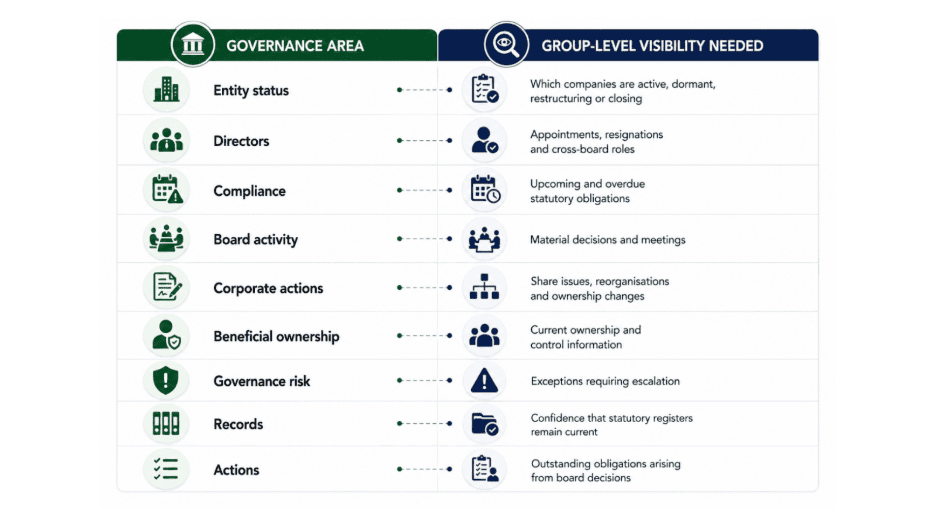
This does not mean headquarters should micromanage subsidiaries.
Rather, it means group governance should provide enough information for leadership to distinguish normal local activity from issues requiring intervention.
The FRC’s UK Corporate Governance Code reinforces the wider principle that boards need effective systems of risk management and internal control, with Provision 29 applying from 1 January 2026.
Cross-border subsidiary governance should sit within that broader control environment.
What should you expect from a UK cross-border company secretary provider?
The service needs to go beyond maintaining a UK registered office and submitting Companies House filings.
A credible cross-border provider should demonstrate capability across four areas.
1. UK technical competence
The provider should understand current UK Companies House requirements, director and PSC verification, board processes and corporate record obligations.
2. International coordination
It should be able to manage or coordinate governance activity across multiple jurisdictions rather than leaving the client to reconcile separate local advisers.
3. Governance reporting
The organisation should receive useful information about obligations, exceptions and risks rather than only confirmation that work has been completed.
4. Professional governance advice
Technology and administration are useful, but boards also need experienced Company Secretaries capable of identifying when a matter requires judgement, escalation or wider governance consideration.
A different way to compare UK providers
Rather than ranking providers from first to fifth, it is more useful to identify the governance problem each operating model is designed to solve.
If you need governance expertise plus connected infrastructure: Lumorus
Lumorus approaches cross-border company secretary support as a governance infrastructure issue.
This matters because international governance can become fragmented even when every individual entity appears compliant. A central team may track UK requirements, regional advisers may manage local filings and board records may sit somewhere else entirely.
The Lumorus model connects services including:
Alongside these services, CoSec Hub provides the technology layer, while the Governance Knowledge Centre provides professional Company Secretary expertise and governance operations support.
This approach is particularly relevant where the organisation wants to connect local entity compliance with board governance, action tracking and group-level visibility.
Best suited to: UK headquartered or internationally connected organisations seeking both governance expertise and technology-enabled multi-jurisdiction support.
If you need large-scale multinational governance transformation: PwC
PwC Entity Governance & Compliance combines global governance specialists, regulatory assessments, entity compliance and technology-enabled reporting.
Its published experience includes serving as company secretary provider to a diversified global manufacturer with more than 200 entities across over 40 jurisdictions, supporting a detailed global compliance calendar and central entity database.
PwC has also published a case study describing its work with bp, where governance professionals from more than 80 countries reviewed subsidiary governance and compliance arrangements before implementing a more centrally coordinated model.
That makes the model particularly relevant where cross-border governance forms part of a major global transformation or rationalisation programme.
Best suited to: large multinational groups with significant entity portfolios and multidisciplinary legal, tax or transaction requirements.
If you need local teams across a broad international network: TMF Group
TMF Group UK provides UK company secretary and related compliance services alongside a wider international network. Its UK office specifically highlights support for transactions involving multi-jurisdiction requirements and organisations undergoing restructuring or change.
Globally, TMF Group’s compliance and governance services cover statutory records, annual filings, board meetings and directorship support through local company secretaries and legal professionals.
Its wider entity management proposition is based on central oversight combined with in-country execution, which can work well for international groups entering jurisdictions where they do not have their own local governance team.
Best suited to: organisations that require extensive local delivery while retaining one global provider relationship.
If you need global entity scale and technology-led oversight: Vistra
Vistra provides entity management, global compliance, company secretary services, registered office support, board meeting support and risk monitoring across a broad international footprint.
Vistra’s recent commentary on real-time governance makes an important point for cross-border organisations: dashboards only improve governance if the underlying entity data is accurate. The firm argues that governance information needs a reliable single source of truth rather than being distributed across spreadsheets, shared drives and inboxes.
That is particularly relevant to multinational groups because fragmented data tends to become more damaging as the number of entities increases.
Best suited to: international businesses prioritising entity technology, operational scale and central governance visibility.
What the provider landscape looks like at a glance
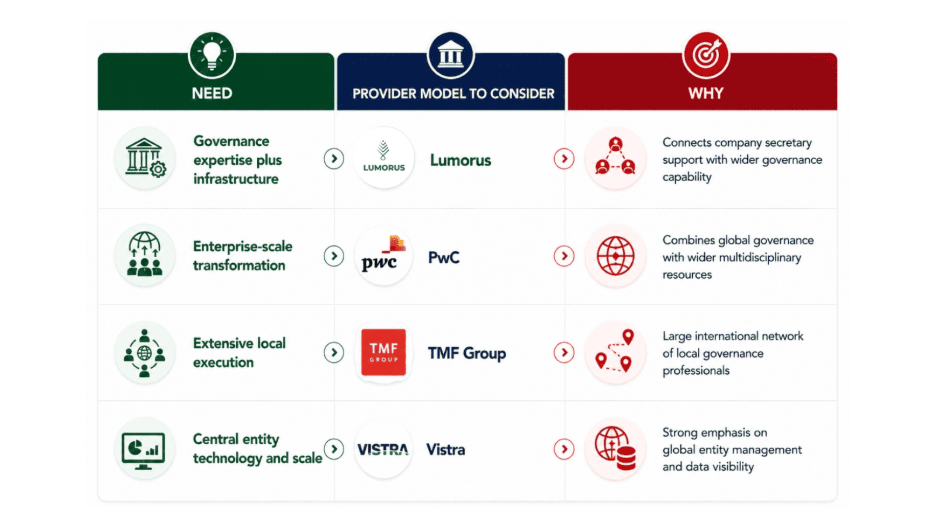
There is no universally best provider.
The right choice depends on whether the organisation’s problem is local compliance, international coordination, governance architecture, data quality or some combination of all four.
Cross-border governance often fails at the handover points
The greatest governance risks do not always sit inside one jurisdiction.
They sit between jurisdictions and functions.
For example, a UK parent board may approve the creation of an overseas subsidiary. The legal team manages the transaction, a local adviser incorporates the entity, finance establishes the bank account and a regional director joins the board.
Several months later, headquarters discovers that the local statutory information does not match the central entity database.
No single individual necessarily made a serious mistake.
The operating model failed at the handovers.
Common failure points include:
- UK headquarters to local adviser
- Board decision to statutory filing
- Director appointment to group register update
- Transaction completion to governance records
- Local filing to central reporting
- Beneficial ownership change to compliance records
- Board action to management implementation
A good cross-border company secretary provider should therefore manage the connections between processes, not merely complete isolated tasks.
Board decisions should travel through the governance system
Cross-border governance is strongest when a material board decision triggers the correct downstream activity automatically or through clearly defined workflow.
Consider a group approving an international restructuring.
That single decision may create:
- Board and shareholder resolutions
- Entity formations
- Director changes
- Share transfers
- Beneficial ownership updates
- Regulatory filings
- Bank mandate changes
- Local legal documentation
- New compliance obligations
Professional Board & Shareholder Meeting Support should therefore connect the meeting itself with the actions that follow.
Otherwise, the organisation risks having a well-run board process but poor governance execution.
Cross-border minutes need enough context to travel
Board minutes become more important when decisions cross jurisdictions.
Local advisers, regulators and future directors may need to understand decisions taken by people who are no longer involved with the company.
Therefore, minutes should provide enough information to establish:
- The authority for the decision
- Material issues considered
- Relevant conflicts
- The board’s conclusion
- Actions required
- Who owns those actions
However, good minutes remain concise. They should not become transcripts simply because the organisation operates internationally.
Professional Minute Taking Solutions can help organisations maintain a clear decision record that remains useful beyond the meeting itself.
The hidden risk is key-person dependency
International governance becomes fragile when too much knowledge sits with one individual.
An experienced Company Secretary may know:
- Which Luxembourg entity requires an approval next week
- Which director has not completed a UK verification requirement
- Which local adviser is waiting for documentation
- Which subsidiary register still needs updating
- Which board action has become overdue
That expertise is extremely valuable.
However, if the organisation cannot access the same information without that person, then the system is weaker than the professional holding it together.
Vistra’s 2026 analysis similarly argues that modern Company Secretaries increasingly operate in an always-on environment where regulatory scrutiny and technology expectations are rising simultaneously.
Cross-border governance should therefore reduce dependency on institutional memory through:
- Central records
- Clear process ownership
- Compliance calendars
- Documented local requirements
- Shared governance reporting
- Action tracking
- Defined escalation routes
Technology supports this shift, but it cannot replace professional judgement.
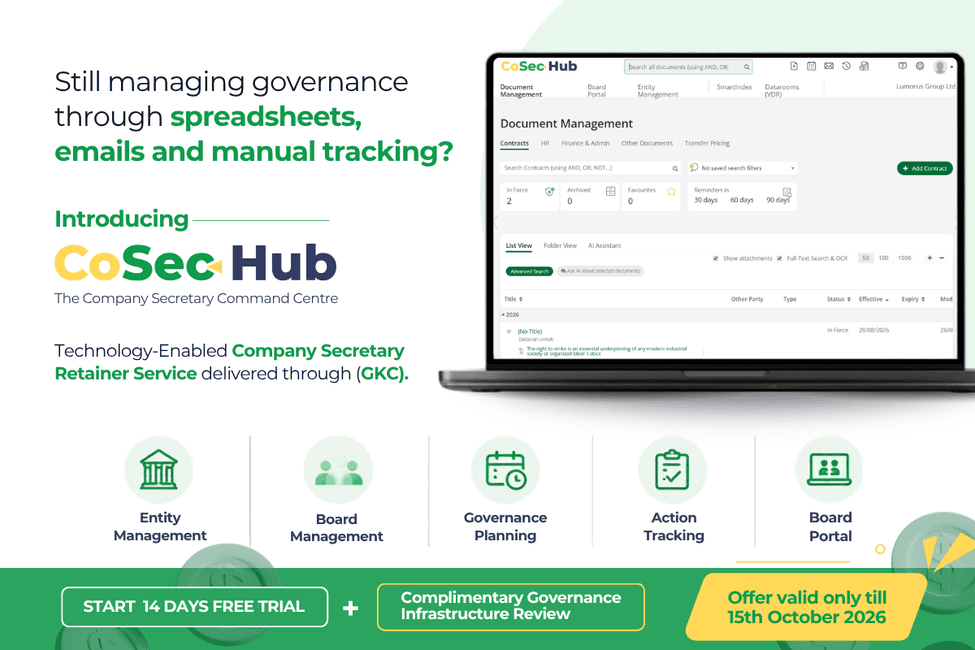
Why CoSec Hub takes a different approach
Many entity platforms solve one part of the cross-border governance problem.
They centralise data.
CoSec Hub is built around the view that organisations also need the professional capability required to act on that information.
The technology layer supports
- Entity Management
- Compliance Calendars
- Governance Forward Planning
- Board Management
- Contract Management
- Statutory Registers
- Board Action Tracking
- Meeting Lifecycle Management
The Governance Knowledge Centre provides
- Company Secretary Expertise
- Governance Operations Support
- Compliance Monitoring
- Board Administration
- Governance Intelligence
- Multi-Jurisdiction Governance Support
- Governance Advisory
Together, they form a Technology-Enabled Company Secretary Retainer Service.
This matters in cross-border governance because technology can tell the organisation that an action is overdue, while an experienced Company Secretary can determine why it matters, who should act and whether the issue needs escalation.
That is the difference between information management and governance.
The cross-border RFP: nine questions worth asking
Instead of asking providers only how many jurisdictions they cover, boards and General Counsel should test how the operating model actually works.
- Which jurisdictions do you support directly, and where do you rely on partners?
- Who remains accountable when local advisers are involved?
- Can we see all group entities and obligations through one governance view?
- How do you monitor regulatory change across jurisdictions?
- How do UK board decisions flow into overseas entity actions?
- How do you keep director and beneficial ownership information consistent across the group?
- What happens when our regular Company Secretary contact is unavailable?
- Can we export and retain our complete governance history if the relationship ends?
- What governance advice sits behind your technology and compliance administration?
The answers will reveal whether the provider offers global governance or simply a network of separate local services.
Four warning signs your cross-border governance model is becoming fragile
1. Headquarters and local advisers hold different information
This usually indicates that entity changes are not feeding reliably into the group governance record.
2. Local compliance is strong, but group visibility is weak
Every entity may be compliant while leadership lacks the information needed for effective oversight.
3. The governance team spends too much time chasing updates
If information has to be requested repeatedly, the operating model is still largely reactive.
4. International expansion creates disproportionate governance effort
Growth should add complexity, but it should not force the organisation to rebuild its governance model every time it enters a new market.
These are signs that the organisation needs stronger governance infrastructure rather than simply additional administrative capacity.
The Lumorus View
Cross-border governance is not successful because every subsidiary meets its local filing deadlines. It is successful when local compliance, group oversight and board accountability operate as one connected system.
That distinction is important.
A multinational can have excellent advisers in every jurisdiction and still be poorly governed as a group if information remains fragmented.
The parent board needs enough visibility to understand where obligations sit, where exceptions are emerging and which issues require intervention.
At the same time, local boards need room to fulfil their own responsibilities rather than becoming procedural extensions of headquarters.
The strongest model therefore combines:
- Local accountability
- Group standards
- Central visibility
- Professional judgement
- Reliable governance data
- Proportionate escalation
That is what makes cross-border governance scalable.
The Bottom Line
The best UK company secretary service for cross-border governance is not necessarily the provider with the longest list of countries.
Geographic coverage matters, but operating model matters more.
A multinational organisation needs confidence that UK requirements are managed correctly, local jurisdictions are understood and the board can see enough of the wider group to maintain effective oversight.
For some organisations, that means choosing a large global entity management provider. Others may need a multidisciplinary professional services network, while groups seeking deeper governance integration may prefer a specialist model combining Company Secretary expertise with governance infrastructure and technology.
Whatever the provider, the questions remain the same.
Are local records accurate?
Can headquarters see what matters?
Are board decisions followed through across jurisdictions?
Does governance survive personnel changes?
Can the organisation identify emerging problems before they become compliance failures?
If the answer is yes, cross-border governance becomes an enabler of international growth.
If the answer is no, every additional entity increases the amount of risk hidden inside the structure.
Continue Exploring
- For stronger governance across group entities: Corporate Governance Support
- For multi-jurisdiction compliance visibility: Statutory & Regulatory Compliance
- For board and shareholder processes: Board & Shareholder Meetings
- For international entity formation and structuring: Company Formation & Structuring
- For scalable external governance capacity: Company Secretary Outsourcing
- For stronger annual governance reporting: Annual Report Services
- For defensible board records: Minute Taking Solutions
Lumorus: Better Business, Built on Purpose
Lumorus is a UK headquartered global governance, ESG, company secretary and advisory firm supporting organisations across Europe, Africa, Asia, the Caribbean, Canada, the Middle East and international markets.
For more than 10 years, we have helped boards, leadership teams and organisations strengthen governance, accountability and organisational resilience.
For UK headquartered and internationally connected organisations, effective cross-border governance requires more than local compliance. It requires clear group oversight, reliable entity information, experienced Company Secretaries and governance infrastructure capable of keeping pace as organisations expand.
Is your governance model giving the board one reliable view of the group, or are different jurisdictions still operating in separate governance worlds?
Contact Lumorus to request a Governance Infrastructure Assessment and explore how CoSec Hub can help your organisation move from fragmented multi-jurisdiction administration to connected, compliant and board-ready governance.
Email: [email protected]
CoSec Hub + Governance Knowledge Centre: Where Automation Meets Governance Authority.
Sources
- Companies House – Identity verification requirements for UK directors, PSCs and overseas company directors.
- Companies House Annual Report and Accounts 2025 to 2026 – Current identity verification rollout statistics and implementation.
- Companies House – Registration and ongoing obligations for overseas companies operating UK establishments.
- Financial Reporting Council – UK Corporate Governance Code 2024, including Provision 29.
- PwC – Global Entity Governance and Compliance services and multinational governance case examples.
- PwC – Global subsidiary governance transformation case study.
- TMF Group UK – UK company secretary and multi-jurisdiction administration services.
- TMF Group – Cross-border compliance, governance and board support.
- Vistra – Global entity management and company secretary services.
- Vistra – 2026 analysis of governance data quality and real-time entity oversight.