


Consumer Duty is sometimes treated as another layer of financial services compliance.
For bank boards, that interpretation is too narrow.
The Financial Conduct Authority has established a regime in which firms must not simply demonstrate that policies, controls and processes exist. They must assess whether retail customers are actually receiving good outcomes.
That distinction changes the governance conversation.
A product can comply with its technical terms and still offer poor value. A customer communication can contain every required disclosure and still be difficult to understand. A bank can operate a functioning complaints process while failing to address the underlying causes of customer harm.
Consumer Duty therefore asks boards to look beyond process and examine outcomes.
Moreover, the requirement is not abstract. At least annually, the governing body must review and approve its Consumer Duty report, confirm whether it is satisfied that the firm is complying with the Duty, assess whether future business strategy remains consistent with those obligations and agree action where customer outcomes are inadequate.
This makes Consumer Duty more than a conduct requirement.
It is a test of whether governance can connect strategy, products, pricing, customer experience, data and accountability.
Read More: Board Decision & Risk Assessment
Consumer Duty changes what boards are accountable for
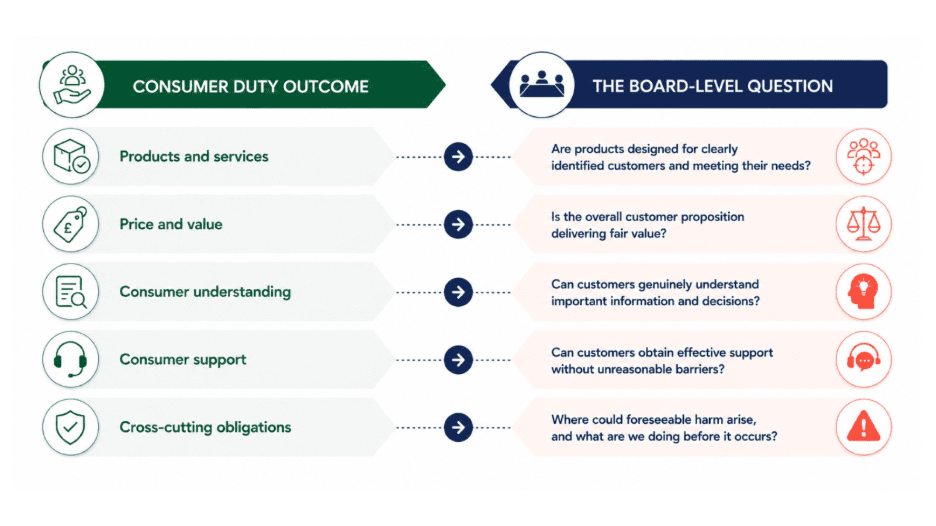
The central principle of Consumer Duty is deliberately outcome-focused: firms must act to deliver good outcomes for retail customers.
The FCA supports this through three cross-cutting rules requiring firms to act in good faith, avoid foreseeable harm and enable customers to pursue their financial objectives.
These sit alongside four outcomes:
- Products and services.
- Price and value.
- Consumer understanding.
- Consumer support.
For bank boards, these requirements create an important shift.
Traditional governance can become heavily focused on whether management followed the approved process.
Consumer Duty demands another question:
What happened to the customer?
That requires boards to understand not simply whether controls operated, but whether the combined effect of products, pricing, communications and service produced acceptable outcomes.
This is a considerably more demanding form of oversight.
Explore More: Governance Review
The annual board report should not become a compliance ritual
The annual Consumer Duty board report creates an obvious governance risk of its own.
Ritualisation.
Management prepares a substantial document, committees review it, directors receive assurances, the board approves it and everybody moves on to the next agenda item.
That would satisfy the mechanics while missing the point.
The FCA’s review of 180 first-year board reports found both good practice and areas requiring improvement. Stronger reports used relevant quantitative and qualitative data, considered the root causes of poor outcomes and demonstrated clearer governance processes. The regulator also expects the assessment to identify groups experiencing worse outcomes and evaluate why those differences exist.
By April 2026, the FCA reported that second-year reports showed stronger governance and clearer board oversight, with boards more actively shaping and scrutinising the work. However, it also said further progress was required to make reporting genuinely outcome-focused.
Therefore, directors should resist treating the report as evidence that management has dealt with Consumer Duty.
The report is evidence for a decision the board itself must make.
Is the board satisfied?
- On what evidence?
- Where are outcomes weak?
- What remains uncertain?
- What needs to change?
Those questions should drive the discussion.
Read More: Board Evaluation & Assessment
Data is now central to conduct governance
Boards cannot govern customer outcomes they cannot see.
That makes data one of the most important governance issues arising from Consumer Duty.
A bank may have enormous quantities of customer information while still lacking meaningful evidence about whether customers are receiving good outcomes.
The difference lies in how the information is interpreted.
Useful Consumer Duty evidence may include:
- Complaints and root cause analysis.
- Product usage and customer behaviour.
- Customer support waiting times.
- Abandonment rates.
- Product cancellation and switching data.
- Fees and charges.
- Vulnerable customer outcomes.
- Communication testing.
- Customer satisfaction.
- Product performance.
- Differences between customer groups.
- Fair value assessments.
The FCA has emphasised that firms need to identify appropriate data sources and use judgement to demonstrate whether the Duty’s outcomes are being achieved.
However, boards should be careful.
More metrics do not automatically produce better governance.
A dashboard containing fifty green indicators can provide less insight than three well-designed measures revealing that a particular customer group is consistently receiving worse outcomes.
The board needs decision-useful evidence, not data abundance.
Explore More: Governance Infrastructure
Fair value is a governance question, not simply a pricing question
Price is commercially sensitive, particularly in banking.
Consumer Duty does not require every product to be cheap. Instead, the FCA expects firms to assess whether the price customers pay is reasonable relative to the benefits they receive, taking account of fees, charges, limitations and other relevant factors.
This brings customer value closer to board-level commercial decisions.
For example, directors may need to challenge:
- Whether legacy customers receive materially different value from new customers.
- Whether charges remain justified by the benefits provided.
- Whether profitability depends disproportionately on particular customer groups.
- Whether fees create foreseeable harm.
- Whether distribution arrangements affect customer value.
- Whether commercial targets create incentives inconsistent with good outcomes.
This does not mean the board should become a pricing committee.
It means directors should understand the assumptions on which management concludes that the bank’s products deliver fair value.
That distinction matters.
Boards do not need to reproduce management’s work.
They need sufficient evidence to challenge its conclusions.
Product governance can no longer end at product approval
Banks have long operated product approval and governance processes.
Consumer Duty makes ongoing monitoring more important.
The FCA expects firms to define target markets, ensure products and services are appropriate for those markets and monitor whether they continue to meet customer needs.
Consequently, approval should not be viewed as the end of governance.
A product can perform differently once it enters the market.
Customer behaviour may reveal problems that were not anticipated during design, distribution channels may reach customers outside the intended target market, while economic conditions can alter the way products affect customers.
Boards therefore need confidence that management can identify when:
- Products are reaching the wrong customers.
- Actual outcomes differ from expected outcomes.
- Particular groups experience disproportionately poor outcomes.
- Product features create unexpected harm.
- Changes in circumstances undermine previous assumptions.
- Remediation is required.
The governance question moves from Did we approve this product correctly? to Is this product continuing to work as intended for the customers using it?
That is a much stronger standard.
Read More: Board Decision & Risk Assessment
Consumer understanding exposes the limits of disclosure-based compliance
Financial services regulation has traditionally placed substantial emphasis on disclosure.
Provide customers with the correct information and they can make informed decisions.
Consumer Duty goes further.
The FCA expects communications to be clear, timely and accessible, while firms should test whether customers understand important information.
This has significant governance implications.
A technically accurate document can still produce a poor outcome if customers cannot understand it.
Boards should therefore be interested in questions such as:
- How does the bank test important customer communications?
- What happens when testing reveals poor understanding?
- Are digital journeys designed to inform or merely convert?
- Are significant risks presented clearly?
- Do vulnerable customers experience different outcomes?
- Is information provided at the point when customers actually need it?
The Chartered Banker Institute has described Consumer Duty as an elevation of standards within banking, with implications extending across the customer relationship rather than remaining confined to formal compliance.
For boards, the principle is important.
Disclosure does not prove understanding.
Customer outcomes do.
Culture becomes harder to separate from compliance
Consumer Duty cannot be delivered by the compliance function alone.
- Product teams influence outcomes.
- Pricing teams influence outcomes.
- Marketing influences outcomes.
- Technology influences outcomes.
- Operations influence outcomes.
- Customer service influences outcomes.
- Executive remuneration can influence all of them.
This makes Consumer Duty a cultural and governance issue.
As Harper James explains, the Duty has broad implications for FCA-regulated firms, requiring organisations to consider customer outcomes across products, services, communications and support rather than treating compliance as a narrow regulatory exercise.
Boards should therefore examine whether incentives reinforce the behaviour the Duty requires.
If management is told to deliver good customer outcomes while remuneration depends overwhelmingly on aggressive sales or margin targets, the governance architecture is sending conflicting instructions.
Culture is revealed by what happens when commercial pressure and customer interests collide.
A mature board should want to know which side normally wins.
Explore More: Governance Review
Foreseeable harm requires boards to think before the complaint arrives
One of the most important ideas within Consumer Duty is the requirement to avoid causing foreseeable harm.
That changes the timing of accountability.
Traditional compliance can become reactive.
- A complaint is received.
- A trend emerges.
- A breach is investigated.
- Remediation follows.
Consumer Duty expects firms to identify and mitigate foreseeable risks before harm materialises.
For boards, that means asking forward-looking questions.
- Where might customers struggle if economic conditions deteriorate?
- Could a digital process disadvantage particular customers?
- What happens when vulnerable customers need to contact the bank?
- Could artificial intelligence or automated decision making produce unintended customer outcomes?
- Are there products whose complexity creates predictable misunderstanding?
- What customer harms could emerge from the next strategic initiative?
This is where Consumer Duty connects directly with enterprise risk management.
Customer outcomes should not sit in a separate regulatory box.
They should form part of how boards assess strategic and operational decisions.
Read More: Board Strategy Sessions
Consumer Duty reaches directly into strategy
Perhaps the most consequential governance requirement is also one of the easiest to underestimate.
The governing body must assess whether the firm’s future business strategy is consistent with its Consumer Duty obligations.
That language matters.
Consumer Duty is not something management should apply after the strategy has been agreed.
It should influence the strategy itself.
Consider decisions involving:
- New products.
- Branch closures.
- Digital transformation.
- Artificial intelligence.
- Customer service restructuring.
- Pricing changes.
- Outsourcing.
- Acquisitions.
- Cost reduction.
- Distribution strategy.
Each can affect customer outcomes.
Therefore, a board considering a major transformation programme should not ask about Consumer Duty only during final compliance approval.
The customer outcome implications belong within the original decision.
This is governance by design rather than governance by remediation.
Explore More: Board Strategy Sessions
The board needs challenge, not reassurance
Consumer Duty reporting can easily produce comfortable language.
- Overall outcomes are positive.
- No material concerns have been identified.
- Management remains satisfied.
- Actions are progressing.
Directors should be wary of conclusions that contain reassurance without evidence.
A stronger board conversation asks:
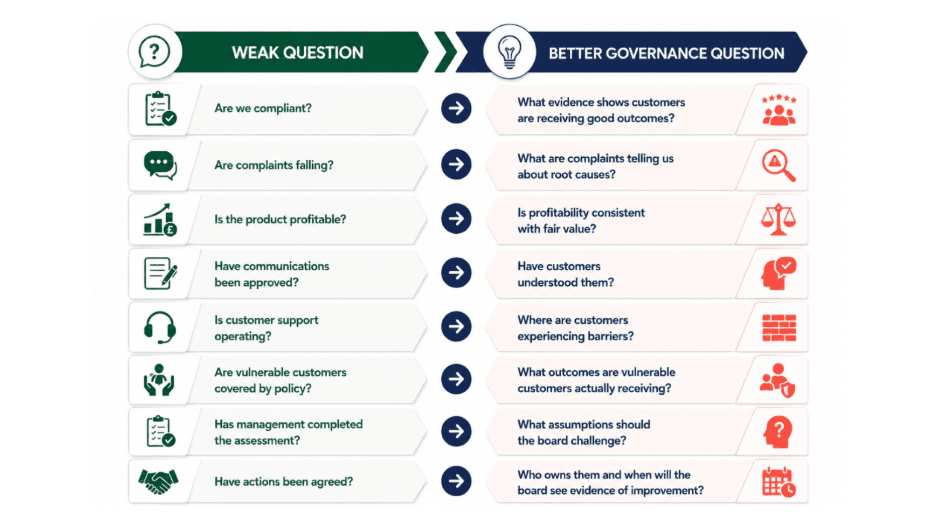
This is where board effectiveness becomes critical.
Consumer Duty cannot be governed through passive acceptance of management assurance.
Directors need enough knowledge to recognise weak evidence and ask better questions.
Read More: Board Skill Audit
What good Consumer Duty governance looks like
Consumer Duty should ultimately become embedded within normal governance rather than existing as a parallel regulatory programme.
For a bank board, strong governance increasingly looks like this:
Clear ownership
Senior leaders understand who owns customer outcomes, while accountability between the board, management and control functions is explicit.
Outcome-focused information
Board reporting explains what customers are experiencing rather than simply describing processes completed.
Effective challenge
Directors interrogate assumptions, anomalies and differences between customer groups.
Strategic integration
Customer outcomes are considered when major business decisions are made.
Visible remediation
Poor outcomes generate named actions, deadlines and accountability.
Strong assurance
The board receives credible evidence that management’s conclusions are supported.
Continuous learning
Complaints, testing, customer behaviour and other evidence influence product and service design.
Governance evidence
The organisation can demonstrate not merely that the board discussed Consumer Duty, but how that discussion affected decisions.
That final point matters.
Regulatory governance increasingly depends on evidence of effectiveness.
The real test is what happens when customer outcomes conflict with commercial pressure
Consumer Duty is easiest when commercial interests and customer outcomes point in the same direction.
The real governance test comes when they do not.
- What happens when a profitable product appears to offer weak value?
- What happens when removing a customer barrier increases operating costs?
- What happens when clearer communications reduce conversion?
- What happens when a growth strategy creates foreseeable harm for a customer group?
Those are not compliance questions alone.
They are questions about how the organisation exercises power and makes trade-offs.
The board’s responsibility is not to eliminate commercial ambition. Banks must remain profitable, competitive and capable of investing.
However, the FCA has made clear that customer outcomes cannot sit outside that commercial model.
By 2026, the regulatory direction is increasingly clear. The FCA says boards are becoming more active in shaping and scrutinising Consumer Duty reporting, while firms are improving their use of data and insight. Yet the regulator continues to push for reporting that is genuinely focused on outcomes rather than process.
The next stage is therefore not simply better Consumer Duty documentation.
It is deeper integration into governance.
Because the strongest evidence that a bank takes Consumer Duty seriously is not the quality of its annual report.
It is the quality of the decisions the board makes when customer outcomes are at stake.
Lumorus: Better Business, Built on Purpose
At Lumorus, we believe governance is not paperwork.
It is the allocation, exercise, constraint and accountability of power inside organisations.
Lumorus is a UK headquartered global governance, ESG, company secretary and advisory firm supporting organisations across Europe, Africa, Asia, the Caribbean, Canada, the Middle East and international markets.
For more than 10 years, we have helped boards, leadership teams and organisations strengthen governance, accountability and organisational resilience.
For banks and other regulated financial institutions, Consumer Duty creates an important governance challenge: boards need credible evidence that customer outcomes, commercial strategy, risk oversight and accountability are working together.
Our governance expertise includes:
Is your board receiving enough evidence to know whether customers are genuinely receiving good outcomes?
Contact Lumorus to explore how our governance advisory services can help strengthen board oversight, Consumer Duty governance, decision making and organisational accountability.
Email: [email protected]
Together, we can build better business: one that performs with purpose, leads with integrity and creates lasting value.
Sources
- Financial Conduct Authority – About the Consumer Duty.
- FCA Consumer Duty Board Reports – Good Practice and Areas for Improvement.
- FCA – Year 2 Consumer Duty Board Reports: Progress and What Comes Next, April 2026.
- Chartered Banker Institute – Consumer Duty: Elevating Standards in Banking.
- Harper James – Consumer Duty Compliance: What FCA-Regulated Firms Need to Do.