



For financial services firms, poor governance rarely arrives with an invoice marked governance failure.
The cost appears elsewhere.
A regulatory investigation absorbs management time, a control failure exposes the firm to losses, an executive decision escapes effective challenge, conduct problems damage customer confidence or a board discovers too late that the risks being taken were materially different from those it thought it had approved.
By then, the cost is no longer theoretical.
Financial services firms operate on confidence as much as capital. Banks, insurers, investment firms, asset managers, fintech businesses and other regulated institutions depend on customers, investors, regulators and counterparties believing that those entrusted with power are exercising it competently and responsibly.
Consequently, governance weakness can destroy value long before it appears clearly in the financial statements.
As Grant Thornton argues, weak oversight can expose organisations to fraud, breaches of legal and regulatory requirements, poor decision making and substantial financial and reputational costs. By the time weaknesses become obvious, repairing the damage may already be expensive and difficult.
The real question for financial services boards, therefore, is not how much good governance costs.
It is how much poor governance the institution can afford.
Explore More: Governance Infrastructure
The visible cost of governance failure is only the beginning
When governance fails, attention naturally focuses on the most obvious consequences;
- Regulatory fines.
- Legal costs.
- Customer remediation.
- Financial losses.
- Consultancy and investigation fees.
These matter, but they represent only part of the economic damage.
Governance failures also consume executive attention, distract boards from strategy, weaken employee confidence, increase regulatory scrutiny and damage relationships with investors and other stakeholders.
For financial services firms, there may be further consequences. Regulators can demand remediation programmes, question senior management capability, require stronger controls or intensify supervisory engagement.
Meanwhile, customers may leave, counterparties may become more cautious and investors may reassess the institution’s risk profile.
This creates a multiplier effect.
The Cost of Poor Governance
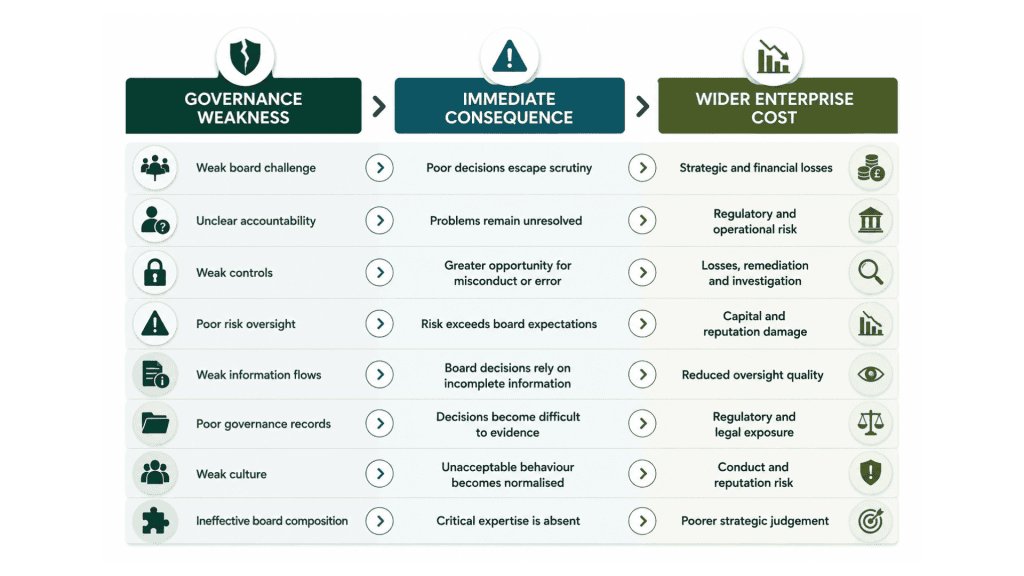
The important point is that these costs interact.
A weak control environment can produce a conduct problem, which becomes a regulatory problem, which becomes a reputational problem, which ultimately becomes a commercial problem.
Governance risk rarely remains contained within governance.
Read More: Board Decision Risk Assessment
Financial services firms cannot separate governance from risk
In financial services, risk management is sometimes discussed as though it sits alongside governance.
In reality, effective risk management is an outcome of governance.
The board determines risk appetite, management takes decisions within that framework, risk and compliance functions provide challenge, while internal audit provides independent assurance.
However, the architecture works only when responsibilities are clear and challenge is credible.
As Grant Thornton notes, risk appetite must be agreed and understood by the board, then monitored so that decision makers know when activity moves outside the level of risk the organisation intended to accept.
This matters enormously in financial services because risks can accumulate faster than conventional reporting reveals.
Credit decisions made across thousands of customers can change a bank’s exposure.
- Pricing decisions can alter an insurer’s risk profile.
- A new product can create unexpected conduct risks.
- Technology outsourcing can create operational dependencies.
- Artificial intelligence can introduce new model, data and accountability risks.
Therefore, boards need more than risk reports. They need governance mechanisms capable of identifying when the assumptions behind those reports are changing.
Strong governance does not eliminate risk.
It ensures that risk is understood, authorised, monitored and challenged.
Explore More: Board Decision Risk Assessment
Weak challenge can be more dangerous than weak information
Boards often focus on whether they receive enough information.
That is important, although information alone does not create effective oversight.
A board can receive excellent reports and still govern badly if directors do not challenge what they are being told.
Indeed, one of the most dangerous environments is not necessarily a failing business. It can be an apparently successful one.
When performance is strong, scrutiny can weaken.
- Revenue is growing.
- Targets are being exceeded.
- Customers are increasing.
- Returns appear attractive.
- Management seems confident.
Yet strong performance should sometimes generate more questions, not fewer.
- Why is one division significantly outperforming its peers?
- What risks are supporting those returns?
- Are incentives encouraging behaviour outside the firm’s stated risk appetite?
- Are controls keeping pace with growth?
- Could apparently exceptional performance be masking conduct, valuation or reporting problems?
Grant Thornton makes a similar point, arguing that unusually positive performance deserves challenge as much as poor performance because unexpected trends and anomalies may reveal issues requiring deeper investigation.
For financial services boards, constructive scepticism is not pessimism.
It is part of the job.
Read More: Board Evaluation & Effectiveness Review
The cost of unclear accountability compounds quietly
Governance failures often begin with a deceptively simple question.
Who was responsible?
If several people believe somebody else owns a risk, control or decision, accountability becomes diluted. Conversely, if responsibility is concentrated too heavily in one executive, challenge may become ineffective.
Financial services firms are particularly vulnerable because responsibility is distributed across boards, committees, executives, risk functions, compliance teams, internal audit and business units.
The structure can look sophisticated while still containing important gaps.
Effective governance therefore requires clarity around:
- Who owns the decision.
- Who executes it.
- Who challenges it.
- Who monitors the resulting risk.
- Who provides independent assurance.
- Which matters must be escalated.
- When the board must intervene.
This is governance architecture.
When these relationships are poorly designed, accountability can disappear between organisational boundaries.
Moreover, when something eventually goes wrong, reconstructing who knew what and when becomes considerably harder.
Explore More: Governance Infrastructure
Poor governance increases the opportunity for misconduct
- Most financial institutions have policies.
- They have controls.
- Codes of conduct.
- Risk frameworks.
- Compliance functions.
- Approval procedures.
Yet misconduct still occurs because governance is not determined by the existence of controls alone. It depends on whether those controls operate effectively when commercial pressure increases.
Grant Thornton highlights the importance of opportunity when considering fraud risk, noting that organisations may not be able to control every pressure or rationalisation affecting an individual, but they can implement controls that reduce opportunities for misconduct.
The same principle applies more broadly to conduct.
Poor segregation of duties, weak approval processes, ineffective escalation channels and excessive executive discretion can create environments in which inappropriate behaviour becomes easier.
Incentives matter too.
If remuneration rewards revenue aggressively while penalties for poor conduct are remote or weak, governance sends conflicting messages.
Culture follows what institutions reward, tolerate and fail to challenge.
Therefore, boards should not simply ask whether policies exist. They should examine whether incentives, controls and accountability mechanisms reinforce the behaviours those policies require.
Read More: Governance Review
The regulatory cost is not just the fine
Regulatory penalties attract headlines because they provide an easily understood number.
However, the fine may be one of the least complicated consequences.
After a serious governance failure, a financial services firm may need to undertake investigations, strengthen controls, redesign governance frameworks, recruit additional specialists, improve data systems, revisit customer outcomes and demonstrate progress to regulators.
Senior executives may spend months responding to the consequences.
Board agendas become dominated by remediation.
Strategic initiatives slow down because leadership capacity has been redirected towards fixing weaknesses that should have been identified earlier.
In other words, poor governance creates an opportunity cost.
The organisation spends its resources repairing yesterday’s governance instead of building tomorrow’s business.
This is why prevention is commercially important, not merely prudent.
Explore More: Governance Review
Reputation is an economic asset in financial services
Trust can sound intangible until it disappears.
Financial services firms depend on customers entrusting them with money, data and long-term financial decisions. Investors provide capital because they believe leadership can manage risk, while regulators permit institutions to operate because minimum standards of competence, integrity and control are expected.
Governance therefore underpins the institution’s licence to operate.
Once stakeholders begin questioning whether senior leaders understand what is happening inside the business, the consequences can move quickly.
- Customers reconsider relationships.
- Employees question leadership.
- Investors demand explanations.
- Regulators intensify scrutiny.
- Counterparties reassess exposure.
The cost of rebuilding confidence can exceed the original financial loss.
A 2026 Forbes Councils article similarly argues that weak governance can create costs that accumulate quietly through regulatory exposure, litigation, weaker access to capital and other consequences rather than appearing as one dramatic event. Although its focus is small businesses rather than financial institutions, the underlying principle is relevant: governance weaknesses compound.
For regulated financial firms, that compounding effect can be particularly severe because confidence itself is part of the business model.
Read More: Board Evaluation & Effectiveness Review
Board composition has a financial consequence
A board can satisfy formal independence requirements and still lack the capability required to govern a complex financial institution.
The important question is not simply who sits around the table.
It is whether the board collectively possesses the knowledge, judgement and independence required to understand the business it oversees.
Financial services boards may need meaningful capability across areas including:
- Financial and prudential risk.
- Regulation.
- Technology and cyber risk.
- Customer and conduct matters.
- Data and artificial intelligence.
- Operational resilience.
- Strategy and transformation.
- Audit and financial reporting.
- People, culture and remuneration.
Not every director needs to be an expert in everything.
However, the board collectively needs enough competence to know when management’s assumptions should be challenged.
Without that capability, independence can become formal rather than substantive.
A director cannot effectively challenge a risk they do not understand.
That is why regular assessment of board capability should be treated as risk management rather than a governance formality.
Explore More: Board Evaluation & Effectiveness Review
Poor governance makes growth more dangerous
Growth can conceal governance weaknesses because commercial success creates confidence.
A financial services firm enters new markets, launches new products, acquires customers, expands through acquisition or adopts new technology, yet its governance model may remain largely unchanged.
- Eventually, complexity overtakes oversight.
- Reporting becomes harder.
- Accountability becomes blurred.
- Committees accumulate.
- Decision rights become unclear.
Risks appear in places the original governance framework was never designed to oversee; this is where governance infrastructure becomes critical.
The governance operating model should evolve alongside the business, which means reviewing committee structures, delegated authorities, reporting lines, risk escalation, board information and assurance arrangements as complexity increases.
Growth without governance maturity is not simply ambitious.
It can be dangerous.
Read More: Governance Infrastructure
Governance technology cannot compensate for governance weakness
Financial institutions increasingly use sophisticated technology to manage risk, compliance and board information; that is necessary. However, technology does not resolve weak accountability.
- A dashboard can show that a risk indicator has moved outside tolerance, but somebody must decide what happens next.
- A board portal can distribute papers efficiently, but directors still need to challenge their contents.
- An automated compliance system can identify a deadline, but the organisation must remain accountable for meeting it.
Artificial intelligence may help identify patterns, yet boards must still determine which risks matter and what action is proportionate.
Technology improves visibility; governance determines what organisations do with that visibility. The strongest firms therefore combine digital infrastructure with clear decision rights, capable directors, professional judgement and effective challenge.
Explore More: Board Decision Risk Assessment
Good governance should be measured by decisions, not documentation
Financial services firms produce enormous quantities of governance documentation.
- Policies.
- Committee papers.
- Risk reports.
- Compliance reports.
- Board minutes.
- Frameworks.
- Terms of reference.
The volume can create an impression of control, yet paperwork is not governance .The real test is whether the system changes behaviour and improves decisions.
Boards should therefore ask:
- Are material risks reaching us early enough?
- Do we understand the assumptions behind management recommendations?
- Is challenge changing decisions where necessary?
- Are responsibilities genuinely clear?
- Do incentives support our stated risk appetite?
- Are actions completed after meetings?
- Can we demonstrate why significant decisions were made?
- Does assurance tell us whether controls work in practice?
- Are we learning from near misses as well as failures?
These questions move governance away from compliance theatre and towards institutional effectiveness.
Read More: Governance Review
The economics of good governance are often misunderstood
Governance is frequently treated as overhead because its benefits are difficult to isolate.
- A prevented scandal does not appear as revenue.
- A risk challenged before approval never becomes a loss.
- A control that prevents misconduct does not generate an obvious return.
A capable director asking the right question may save millions without anyone ever knowing what would otherwise have happened.
- This creates a dangerous asymmetry.
- The cost of governance is visible.
- The value of governance is often invisible until governance fails.
Grant Thornton captures this problem clearly, arguing that good governance should be regarded as an investment in long-term stability rather than an administrative burden.
For financial services firms, this distinction is fundamental.Governance is part of the institution’s risk infrastructure, it protects capital, reputation, strategic flexibility and stakeholder confidence.
The question is therefore not whether governance produces a return that can be neatly placed into a spreadsheet.
The question is what value the organisation is protecting by governing well.
Explore More: Governance Infrastructure
What should financial services boards do now?
The answer is not another governance policy.
Boards should examine whether the governance architecture actually works.
That means testing:
- Board capability
Does the board have the skills required for the risks and strategy ahead?
- Decision rights
Is it clear which decisions belong to management, committees and the board?
- Risk appetite
Does risk appetite genuinely influence decisions, or does it exist mainly in documentation?
- Information flows
Is the board receiving decision-useful information rather than simply more information?
- Challenge
Can directors challenge management effectively without damaging constructive relationships?
- Accountability
Can the organisation identify who owns every material risk and governance obligation?
- Assurance
Does the board have independent evidence that controls operate as intended?
- Culture and incentives
Do remuneration and promotion decisions reinforce the behaviours the board claims to expect?
- Governance infrastructure
Can decisions, actions, risks and accountability be tracked consistently?
A board that cannot answer these questions confidently has identified an enterprise risk, whether or not a regulator has raised it yet.
Read More: Governance Review
The most expensive governance failure is the one the board could have prevented
Financial institutions will always face risk.
That is unavoidable.
Poor governance is different because many of its consequences arise from failures that institutions have some ability to prevent: unclear authority, weak challenge, inadequate information, poorly aligned incentives, insufficient oversight or governance arrangements that have failed to evolve with the organisation.
These weaknesses can remain invisible during periods of strong performance.
- Then pressure arrives.
- A market shock.
- A liquidity event.
- A cyber incident.
- A conduct problem.
- A regulatory investigation.
- A major strategic decision.
At that point, the organisation discovers whether its governance framework was real or merely documented.
Strong governance cannot guarantee that financial services firms will never fail.
What it can do is make failure less likely, challenge dangerous assumptions earlier and ensure accountability does not disappear when pressure increases.
That is why the real cost of poor corporate governance cannot be measured only in regulatory fines.
It must also be measured in lost opportunities, damaged trust, management distraction, strategic mistakes and risks that should never have been allowed to grow unchecked.
Good governance has a cost. Poor governance usually costs considerably more.
Explore More: Board Decision Risk Assessment
Lumorus: Better Business, Built on Purpose
At Lumorus, we believe governance is not paperwork.
It is the allocation, exercise, constraint and accountability of power inside organisations.
Lumorus is a UK headquartered global governance, ESG, company secretary and advisory firm supporting organisations across Europe, Africa, Asia, the Caribbean, Canada, the Middle East and international markets.
For more than 10 years, we have helped boards, leadership teams and organisations strengthen governance, accountability and organisational resilience.
Our corporate governance expertise includes:
For financial services firms, governance should provide more than evidence of compliance. It should give boards confidence that decision rights are clear, risks are visible, challenge is effective and accountability operates throughout the institution.
Is your governance infrastructure strong enough for the complexity, scrutiny and accountability your financial services firm now faces?
Contact Lumorus to explore how our governance advisory services can help strengthen board oversight, risk governance and organisational resilience.
Website: Lumorus
Email: [email protected]
Together, we can build better business: one that performs with purpose, leads with integrity and creates lasting value.
Sources
- Grant Thornton Gibraltar – The Cost of Poor Governance and Why Oversight Matters
- Forbes Councils – The Real Cost of Weak Corporate Governance for Small Businesses
- Lumorus – Board Decision Risk Assessment – Board-level decision and risk governance.
- Lumorus – Governance Infrastructure – Governance framework and infrastructure design.
- Lumorus – Board Evaluation & Effectiveness Review – Independent assessment of board effectiveness.
- Lumorus – Governance Review – Independent review of governance arrangements.