



For listed companies, governance has never been more visible.
Annual reports explain board structures, committee responsibilities, director independence, remuneration, risk management and shareholder engagement. Governance statements are longer, disclosure expectations are higher and boards operate under sustained scrutiny from investors, regulators and proxy advisers.
Yet there is a danger in equating more governance disclosure with better governance.
A board can comply extensively with a governance code and still make poor decisions.
It can satisfy independence requirements while lacking genuine challenge, publish an impressive skills matrix while carrying significant capability gaps, or conduct an annual board evaluation that produces little meaningful change.
For FTSE 350 and AIM listed companies, the real test of governance is therefore not whether the board can demonstrate that processes exist.
It is whether those processes improve the exercise and accountability of power.
Recent evidence reinforces that distinction. Grant Thornton reported that 69% of FTSE 350 companies in its 2025 review claimed full compliance with the UK Corporate Governance Code, up from 65% in the previous year. However, the same research identified weaknesses around succession planning and board-level disclosure of AI and cyber expertise.
Compliance is improving; the harder question is whether board effectiveness is improving with it.
Read More: Governance Review
FTSE 350 and AIM governance should not look identical
Good governance is contextual.
A large FTSE 100 financial institution does not face the same governance challenges as an AIM listed technology company led by its founder. Their ownership structures, regulatory exposure, resources, business models and board requirements may be fundamentally different.
For companies within the scope of the UK Corporate Governance Code, the 2024 Code applies to financial years beginning on or after 1 January 2025, with Provision 29 taking effect for financial years beginning on or after 1 January 2026.
AIM operates differently. The current framework requires AIM companies to disclose the recognised corporate governance code they apply and explain how they comply with it and any departures. The London Stock Exchange has historically emphasised that good governance is not simply about codes or rules, but also leadership, culture, systems, risk management and meaningful investor disclosure.
Importantly, the Exchange is consulting in 2026 on changes that would give AIM companies greater flexibility over their governance approach, while focusing disclosure on areas such as board composition, directors’ responsibilities, remuneration, risk and controls, and investor relations. These are proposals rather than current requirements.
The principle behind good governance, however, remains remarkably consistent across both markets.
Governance should be proportionate to the complexity and risk of the company, but never weaker than the accountability its circumstances require.
Good governance starts with the board’s ability to make difficult decisions
A board exists to exercise judgement; that sounds obvious, yet governance reporting can easily become dominated by structures rather than decisions.
These measures matter, but none establishes whether the board made good decisions.
A more serious assessment asks:
- Did directors receive the right information?
- Were assumptions challenged?
- Were alternative options considered?
- Were conflicts identified and managed?
- Was risk understood before the decision?
- Did the board understand stakeholder consequences?
- Was responsibility for implementation clear?
- Did the board revisit major decisions after implementation?
These questions become particularly important when boards face acquisitions, capital allocation decisions, CEO appointments, restructurings, major technology investments or significant changes in strategy.
Strong governance should improve the quality of judgement before the decision is made, not merely document what happened afterwards.
Explore More: Board Decision & Risk Assessment
The Chair remains one of the most consequential governance positions
Board composition matters, but board leadership determines how that composition works in practice.
A capable Chair creates the conditions for constructive challenge, manages the relationship between executive and non-executive directors, draws quieter voices into discussion and prevents dominant personalities from controlling the room.
The Chair also has to know when consensus is valuable and when it is dangerous.
Recent research discussed by Law Debenture illustrates how the role is changing. Modern FTSE 350 Chairs increasingly require capabilities beyond traditional executive credentials, including facilitation, stakeholder management, emotional intelligence and the ability to navigate technology, AI and geopolitical uncertainty.
This has implications for succession.
Boards that begin thinking about Chair succession six months before departure have already left it late. Chair succession should form part of a continuing assessment of board capability, tenure and future strategic requirements.
Moreover, boards should resist the assumption that the best Chair must automatically be a former chief executive. Leadership of a board is different from leadership of a business.
The strongest Chair is not necessarily the person with the most impressive executive CV, it is the person capable of making the collective intelligence of the board work.
Read More: Board Skill Audit
Board composition should follow strategy, not convention
Many listed boards can demonstrate impressive biographies.
The more important question is whether those biographies add up to the capabilities the company needs.
Grant Thornton’s 2025 analysis provides a useful warning. Although 62% of the FTSE 350 companies reviewed identified AI as an opportunity, board-level expertise and disclosure relating to AI and cyber remained limited at 7%; this illustrates a broader governance problem.
Board composition often reflects yesterday’s business model, strategy reflects tomorrow’s.
A company undergoing digital transformation may need deeper technology capability. An organisation expanding internationally may require geopolitical and cross-border experience, while a heavily regulated company may need stronger regulatory expertise.
A meaningful board skills audit should therefore begin with strategy and risk.
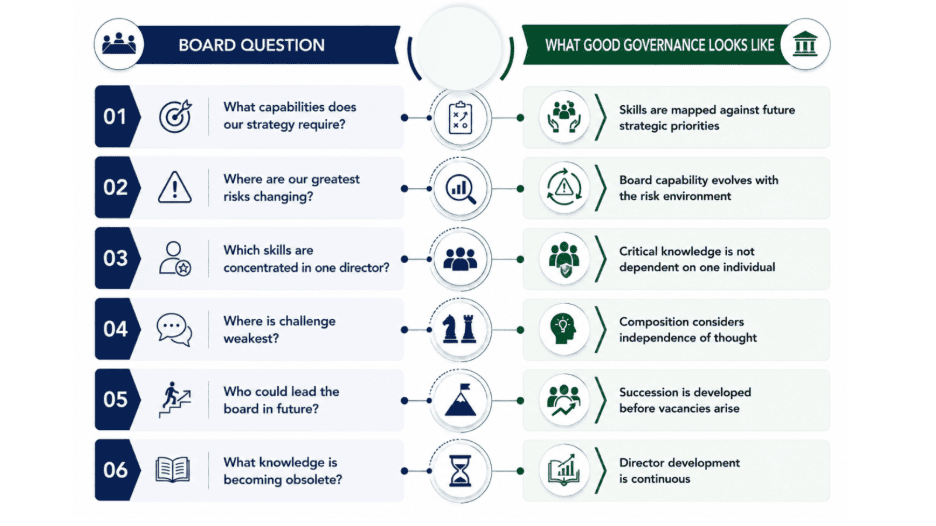
A skills matrix should not exist simply because investors expect one, it should influence recruitment, succession, induction and director development.
Explore More: Board Skill Audit
Independence is behavioural before it is structural
Listed companies devote considerable attention to director independence, and rightly so; however, formal independence is not enough.
A director may satisfy every technical independence criterion while rarely challenging management. Conversely, an experienced director with deep knowledge of the business may provide valuable independent judgement when the board needs it most.
The governance question is therefore not simply whether directors qualify as independent.
It is whether independent judgement exists in the room.
- Can directors challenge the chief executive?
- Can the Chair challenge a powerful founder?
- Can the audit committee challenge optimistic assumptions?
- Can the remuneration committee resist pressure when executive pay is difficult to justify?
- Can directors disagree without relationships deteriorating?
Good boards do not manufacture disagreement for its own sake. However, they create enough psychological safety for disagreement to occur when it matters.
That is where independence becomes real.
Read More: Board Evaluation & Assessment
Shareholder votes are governance intelligence
Investor dissent should never be treated as a public relations inconvenience, it is information.
Voting against a Chair, committee chair or other director can indicate concern about remuneration, succession, independence, board composition, oversight or broader governance performance.
This is why boards should analyse voting patterns before opposition becomes entrenched.
A company may receive sufficient votes to pass a resolution while still facing a significant minority of dissatisfied shareholders. Technically, the resolution succeeds. From a governance perspective, the result may deserve serious attention.
This is especially important because institutional investors increasingly assess individual directors through the responsibilities attached to their roles.
The broader lesson is straightforward.
Shareholder support should not be measured only by whether resolutions pass.
Boards should understand where dissent is concentrated, what investors are signalling and whether repeated concerns point to a deeper governance weakness.
Good investor engagement therefore involves listening before the AGM, not explaining after it.
Provision 29 changes the conversation on internal controls
For companies applying the UK Corporate Governance Code, 2026 is particularly significant.
Provision 29 applies to financial years beginning on or after 1 January 2026 and requires boards to monitor and review their risk management and internal control framework, including financial, operational, reporting and compliance controls. The annual report must include a declaration concerning the effectiveness of material controls at the balance sheet date and identify material controls that have not operated effectively, together with remedial action.
This should not be treated as another disclosure project, it is fundamentally a board assurance question.
Directors need sufficient evidence to support the declaration they make.
That requires clarity around:
- What constitutes a material control.
- Who owns each control.
- How effectiveness is assessed.
- What assurance reaches the board.
- How deficiencies are escalated.
- Who determines whether remediation is sufficient.
- How the board evidences its review.
The FRC has deliberately avoided prescribing a single control framework because proportionality matters. The responsibility remains with boards to determine what is material for their businesses.
That flexibility increases rather than reduces the importance of board judgement.
Explore More: Governance Infrastructure
AIM boards should resist governance minimalism
AIM companies often have smaller boards, concentrated ownership, entrepreneurial leadership and fewer internal governance resources; that can make proportionality sensible, it can also make weak governance easier to rationalise.
Founder influence may be substantial, independent directors may have long relationships with management and board processes may remain informal because they worked when the business was private.
However, admission to a public market changes the accountability environment.
- Outside shareholders are providing capital.
- Information asymmetry matters more.
- Related-party transactions can attract scrutiny.
- Disclosure becomes market sensitive.
- Board independence becomes more consequential.
Therefore, good AIM governance should not ask:
What is the minimum governance we need?
It should ask:
What governance does this company need at its current stage of development, ownership structure and risk profile?
The London Stock Exchange itself has emphasised that disclosure alone does not constitute good corporate governance and that investors must be able to evaluate whether governance arrangements are appropriate to the company’s circumstances; that is an important distinction.
Proportionate governance should mean governance designed for purpose, not governance designed to minimise effort.
Read More: Governance Review
Succession planning should begin before somebody announces their departure
Succession is one of the areas where governance quality becomes visible very quickly.
Grant Thornton found succession planning reporting remained an improvement area among the FTSE 350 companies it reviewed, with reporting at 40% in 2025 compared with 38% in 2024.
Law Debenture’s analysis also identifies succession planning as an important lever for strengthening the future FTSE 350 Chair pipeline.
Yet succession is often treated as recruitment, it is broader than that.
Boards should maintain visibility over:
- Chair succession.
- CEO succession.
- Senior Independent Director succession.
- Committee chair succession.
- Critical board capability gaps.
- Emergency succession arrangements.
- Executive pipeline quality.
- Director tenure.
- Future diversity requirements.
The nomination committee should therefore look beyond the next vacancy.
Good succession planning asks what leadership the organisation will need three, five or even seven years from now.
It then starts building that capability before the need becomes urgent.
Explore More: Board Strategy Sessions
Board evaluation should change something
A board evaluation that identifies no meaningful weaknesses should make directors curious.
Every board has areas where it can improve, the question is whether the evaluation process is capable of finding them.
Too often, effectiveness reviews become annual governance rituals: questionnaires are completed, interviews conducted, observations summarised and recommendations accepted, then little changes.
A strong Board Evaluation & Assessment should test issues that matter to performance, including:
- Quality of board challenge.
- Chair effectiveness.
- CEO and Chair dynamics.
- Board information.
- Committee effectiveness.
- Decision quality.
- Skills and capability.
- Succession readiness.
- Culture and behavioural dynamics.
- Risk oversight.
- Implementation of previous recommendations.
Law Debenture’s analysis makes a useful related point: effectiveness reviews can help boards test succession readiness and develop credible, company-specific explanations where governance circumstances justify departures from Code provisions.
The value of evaluation lies in what changes afterwards, a recommendation without accountability is simply an observation.
Good governance reporting explains outcomes, not architecture
Governance reports often tell shareholders a great deal about how governance is structured and surprisingly little about what governance achieved.
- Committee terms of reference are described.
- Meeting attendance is disclosed.
- Policies are summarised.
- Responsibilities are repeated.
However, investors increasingly need something more useful.
- What did the board spend time on?
- What changed because directors challenged management?
- How did the board respond to a material risk?
- How did stakeholder concerns influence a decision?
- What did the evaluation identify?
- What action followed?
The FRC continues to emphasise outcomes-focused reporting and meaningful explanations rather than boilerplate disclosure. Its reviews have also identified internal controls reporting and explanations for departures from the Code as areas requiring improvement.
The strongest governance reporting therefore does not attempt to prove that the board is perfect, it demonstrates that the board is thinking, challenging, learning and acting.
Director development cannot stop at induction
Listed company directors govern businesses in an environment changing faster than traditional board knowledge cycles.
- Artificial intelligence.
- Cybersecurity.
- Geopolitical instability.
- Climate transition.
- Changing investor expectations.
- New regulatory requirements.
- Digital business models.
- Supply chain disruption.
A director appointed because of expertise gained ten years ago cannot assume that expertise remains sufficient indefinitely.
Continuous professional development should therefore be connected to the board skills audit, strategic priorities and emerging risk profile.
Where gaps exist, boards should decide whether they can be addressed through development or whether new capability is required.
Strong Director CPD Training therefore strengthens the board’s capacity to challenge management intelligently as the business environment evolves.
Likewise, effective Director Induction should accelerate a new director’s understanding of the organisation, its governance architecture, strategy, stakeholders, culture and material risks.
Board capability is not fixed at appointment; it must be maintained.
What does good governance actually look like?
For FTSE 350 and AIM boards, the strongest governance is rarely the most elaborate; it is the most effective.
A Practical Governance Test for Listed Boards
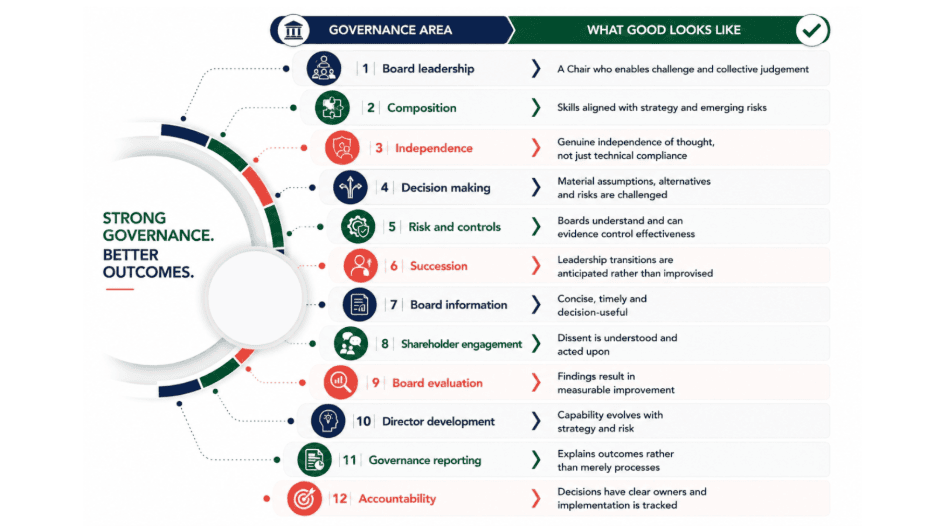
No governance code can guarantee these outcomes.
Boards have to create them.
The best governed companies do not treat governance as a compliance department
There is a fundamental difference between being compliant and being well governed; compliance asks whether requirements have been met, governance asks whether power has been exercised responsibly and effectively, the best listed boards understand both.
They comply where appropriate, explain intelligently where circumstances justify a different approach and continually test whether governance arrangements remain suitable for the organisation they are becoming.
That matters particularly as the UK governance environment evolves.
Provision 29 raises expectations around internal controls, investors continue to scrutinise individual director accountability, AI and cyber risks demand new board capabilities, and succession challenges are forcing companies to think more seriously about where tomorrow’s Chairs and directors will come from.
Against that backdrop, governance cannot become an annual reporting exercise; it must operate every time a board allocates capital, challenges management, appoints leadership, accepts risk or decides whose interests matter.
A listed company does not demonstrate good governance by describing its governance framework.
It demonstrates good governance through the quality of the decisions that framework produces.
Explore More
Lumorus: Better Business, Built on Purpose
At Lumorus, we believe governance is not paperwork.
It is the allocation, exercise, constraint and accountability of power inside organisations.
Lumorus is a UK headquartered global governance, ESG, company secretary and advisory firm supporting organisations across Europe, Africa, Asia, the Caribbean, Canada, the Middle East and international markets.
For more than 10 years, we have helped boards, leadership teams and organisations strengthen governance, accountability and organisational resilience.
For FTSE 350, AIM listed and other complex organisations, effective governance requires more than compliance with a code. It requires capable directors, effective challenge, strong decision processes, credible assurance and governance infrastructure capable of standing up to investor and regulatory scrutiny.
Is your board simply meeting governance requirements, or can you demonstrate that governance is improving decisions and accountability?
Contact Lumorus to explore how our governance advisory services can help strengthen board effectiveness, governance infrastructure and organisational resilience.
Email: [email protected]
Together, we can build better business: one that performs with purpose, leads with integrity and creates lasting value.
Sources
- Grant Thornton UK – Corporate Governance Moves Up Boards’ Agendas
- ISS-Corporate – FTSE 350 Board Committee Chair Shareholder Support Can Signal Governance Concerns
- Law Debenture – The Future of FTSE 350 Chairs: Turning Pipeline Barriers into Practical Opportunities
- Financial Reporting Council – UK Corporate Governance Code 2024 and Guidance
- London Stock Exchange – AIM Rules and Corporate Governance Guidance