


The ESG reporting problem is not disclosure. It is credibility.
ESG reporting has become a boardroom priority.
Annual reports contain more sustainability information than ever before.
ESG disclosures continue to expand.
Organisations publish climate commitments, social impact initiatives and governance frameworks with increasing sophistication.
On the surface, this appears to be progress.
Yet a difficult question is emerging.
How much of what is being reported can actually be evidenced?
This question matters because stakeholders are becoming more sceptical.
Investors are demanding greater transparency.
Regulators are increasing scrutiny.
Communities are asking tougher questions.
And boards are discovering that ESG reporting alone is no longer enough.
The issue is not whether organisations are reporting.
The issue is whether they can prove what they are reporting.
According to PwC, reputation is increasingly influenced by how organisations manage and communicate ESG performance. However, growing stakeholder expectations mean organisations must move beyond claims and demonstrate evidence of progress, accountability and outcomes.
Read More: ESG Reporting & Disclosure
ESG reporting has become easier than proving ESG performance
Over the past decade, ESG reporting frameworks have expanded significantly.
Organisations now have access to:
- Sustainability reporting standards
- ESG ratings frameworks
- Disclosure guidance
- Materiality methodologies
- Stakeholder reporting tools
Reporting has become more structured.
What remains difficult is demonstrating impact.
Many organisations can report:
- Carbon reduction targets
- Community investment programmes
- Diversity initiatives
- Governance commitments
- Sustainability objectives
Far fewer can demonstrate:
- Outcomes achieved
- Risks reduced
- Behaviours changed
- Value created
- Long-term impact delivered
This creates a growing credibility challenge.
Because stakeholders increasingly want evidence, not simply statements.
The difference between reporting and evidence
One of the biggest misconceptions in ESG is that disclosure automatically creates accountability.
It does not.
Reporting tells stakeholders what an organisation says it is doing.
Evidence demonstrates what has actually happened.
The distinction is significant.
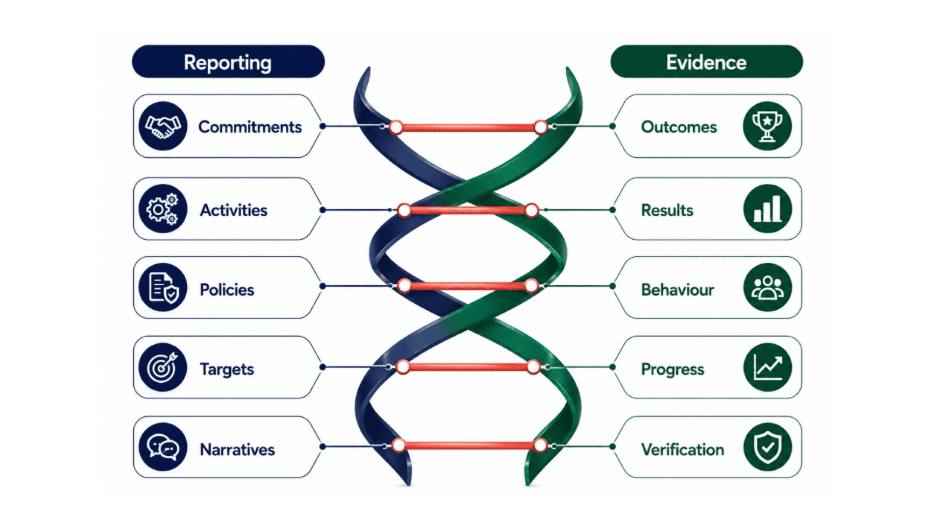
Many ESG reports contain extensive information regarding commitments and activities.
The strongest ESG programmes provide evidence of outcomes.
According to the World Economic Forum, stakeholder trust increasingly depends on organisations demonstrating measurable progress rather than relying solely on commitments and disclosures.
Stakeholders are becoming more sophisticated
A decade ago, ESG reporting itself was often viewed as a sign of progress.
Today, expectations have evolved.
Investors increasingly ask:
- What evidence supports these claims?
- How are outcomes measured?
- What governance systems exist?
- Who is accountable for performance?
- How is progress verified?
The conversation is shifting.
The focus is moving from disclosure towards credibility.
According to PwC’s research on ESG and reputation, organisations face increasing scrutiny because stakeholders are becoming more sophisticated in how they evaluate ESG performance and sustainability claims.
The era of reporting without verification is becoming increasingly difficult to sustain.
ESG without evidence creates reputational risk
One of the greatest ironies in ESG is that reporting designed to strengthen reputation can sometimes increase risk.
This occurs when claims cannot be substantiated.
Organisations may face questions regarding:
- Greenwashing
- Social washing
- Governance washing
- Inconsistent disclosures
- Weak performance evidence
In many cases, reputational damage does not occur because organisations lack ambition.
It occurs because expectations created through reporting exceed the available evidence.
The stronger the claim, the stronger the evidence required to support it.
This is becoming a critical governance issue.
Read More: Strategy & Development
Why governance matters more than reporting
Many organisations treat ESG reporting as a communications exercise.
The strongest organisations treat ESG as a governance discipline.
This distinction is important.
Good ESG governance requires:
- Clear accountability
- Defined responsibilities
- Board oversight
- Performance monitoring
- Outcome measurement
- Independent challenge
Without governance, ESG reporting often becomes disconnected from organisational performance.
According to the OECD Principles of Corporate Governance, transparency and disclosure are important, but they must be supported by accountability, oversight and effective governance structures.
Governance creates credibility.
Reporting communicates it.
The sequence matters.
Most ESG challenges are measurement challenges
One of the biggest barriers to credible ESG reporting is measurement.
Many organisations struggle to answer fundamental questions:
- What outcomes are being measured?
- What constitutes success?
- How is impact assessed?
- What evidence exists?
- How is progress monitored?
The challenge becomes particularly significant in areas such as:
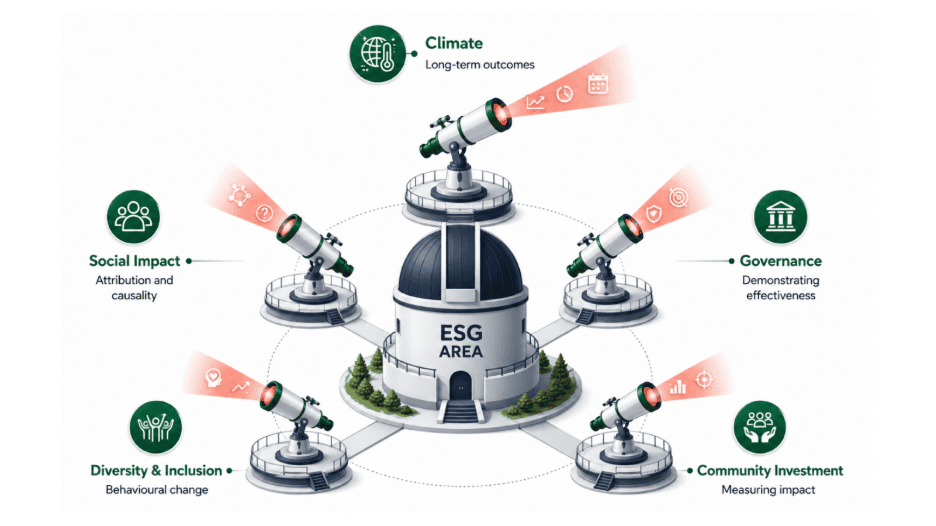
According to the International Finance Corporation (IFC), organisations frequently find impact measurement more challenging than impact reporting because outcomes are often complex, long-term and influenced by multiple factors.
Yet this complexity does not remove the need for evidence.
It reinforces it.
Read More: Social Impact Measurement & Management
Boards should be asking different ESG questions
Many boards continue to focus heavily on reporting outputs.
The more important questions relate to evidence.
Questions worth asking include:
- How do we know this initiative is working?
- What evidence supports these claims?
- What outcomes have been achieved?
- What risks remain unresolved?
- How is performance independently assessed?
- What information would challenge our assumptions?
Good governance depends on good questions.
Boards that focus only on disclosures may overlook significant performance gaps.
Boards that focus on evidence are more likely to strengthen accountability and oversight.
The future of ESG belongs to organisations that can prove impact
The direction of travel is clear.
Stakeholder expectations are increasing.
Regulatory scrutiny is growing.
ESG reporting standards are evolving.
Trust is becoming harder to earn and easier to lose.
In this environment, organisations that can demonstrate measurable outcomes will have a significant advantage.
Because credibility is becoming the new ESG currency.
The organisations that succeed will not necessarily be those that publish the longest reports.
They will be those that can provide the strongest evidence.
Ultimately, ESG reporting should not exist to enhance reputation.
It should exist to demonstrate performance.
And performance requires proof.
Lumorus: Better Business, Built on Purpose
At Lumorus, we believe Being Good is Better for Business.
Lumorus is a UK-headquartered global governance, ESG, social impact and advisory firm supporting organisations across Europe, Africa, Asia, the Caribbean, Canada, the Middle East and international markets.
For more than a decade, we have helped organisations strengthen governance, improve accountability and build ESG frameworks capable of delivering measurable outcomes and credible reporting.
Our expertise includes:
We help organisations move beyond ESG activity towards ESG accountability, evidence-based reporting and long-term value creation.
To explore Lumorus ESG and sustainability solutions, visit:
Together, we can build better business: one that performs with purpose, leads with integrity and creates lasting value for people, planet and profit.