


For years, sustainability reporting largely operated as a disclosure exercise.
Organisations published ESG reports, highlighted commitments and communicated sustainability ambitions to investors, regulators and stakeholders.
That environment is changing rapidly.
A new wave of sustainability reporting is emerging globally, one that places far greater emphasis on governance, measurable impact, materiality and organisational accountability.
This shift is fundamentally changing how organisations approach ESG and social impact.
The conversation is moving away from broad sustainability narratives and towards much harder questions:
- Can ESG claims be evidenced?
- How are sustainability risks governed?
- What measurable social outcomes exist?
- How is ESG integrated into strategy?
- What governance systems support reporting credibility?
- How are material sustainability risks identified and managed?
The result is that ESG is becoming far more operational, governance driven and evidence based.
According to the Centre for Social Impact, organisations are entering a new era where sustainability reporting increasingly requires credible governance structures, measurable impact frameworks and stronger alignment between ESG commitments and organisational decision making.
Sustainability reporting is becoming a governance issue
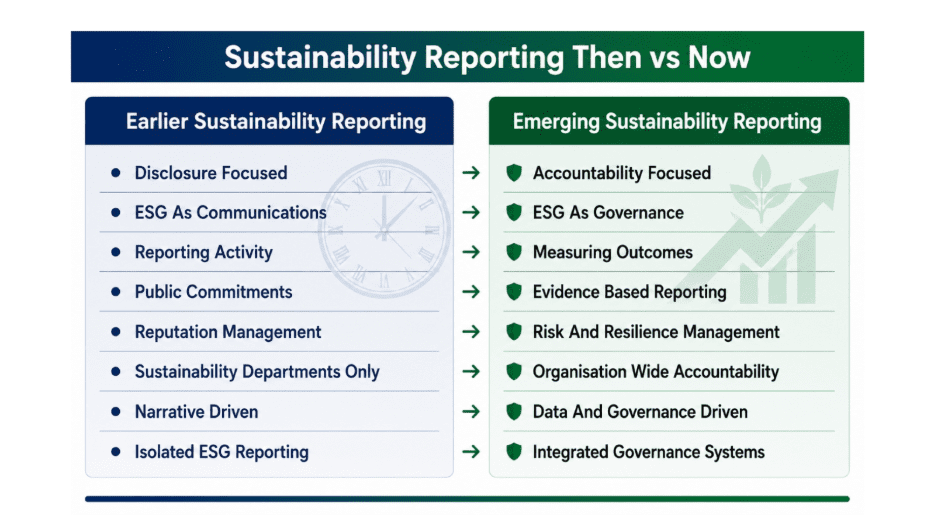
One of the most important developments inside ESG today is the growing recognition that sustainability reporting is no longer just a communications function.
It is increasingly a governance function.
Boards and leadership teams are now expected to oversee not only financial performance, but also:
- ESG Risk Exposure
- Sustainability Governance
- Social Impact Accountability
- Climate Related Risk
- Stakeholder Trust
- Reporting Integrity
- Long Term Resilience
- Ethical Decision Making
This changes the role ESG plays inside organisations.
Sustainability reporting is becoming part of broader governance and accountability systems rather than isolated disclosure activity.
That is forcing many organisations to rethink how ESG is managed operationally.
Read more:
https://www.lumorus.com/capabilities/sustainability-responsibility/
Sustainability reporting then vs now
Why materiality is becoming critical
A major feature of the new sustainability reporting environment is materiality assessment.
Stakeholders increasingly expect organisations to identify which ESG and social impact issues create the most significant operational, financial, stakeholder and governance risks.
This matters because generic ESG reporting is losing credibility.
Strong sustainability reporting now depends on understanding:
- Which ESG risks are materially significant
- Which social issues create operational exposure
- Which sustainability factors affect long term resilience
- Which governance gaps require oversight
- Which stakeholder concerns require prioritisation
Materiality assessment allows organisations to focus ESG efforts where they matter most strategically and operationally.
Without this, ESG activity often becomes fragmented, symbolic and disconnected from real organisational risk.
The Centre for Social Impact notes that sustainability reporting frameworks are increasingly demanding stronger materiality assessment processes linked directly to governance, risk management and strategic planning.
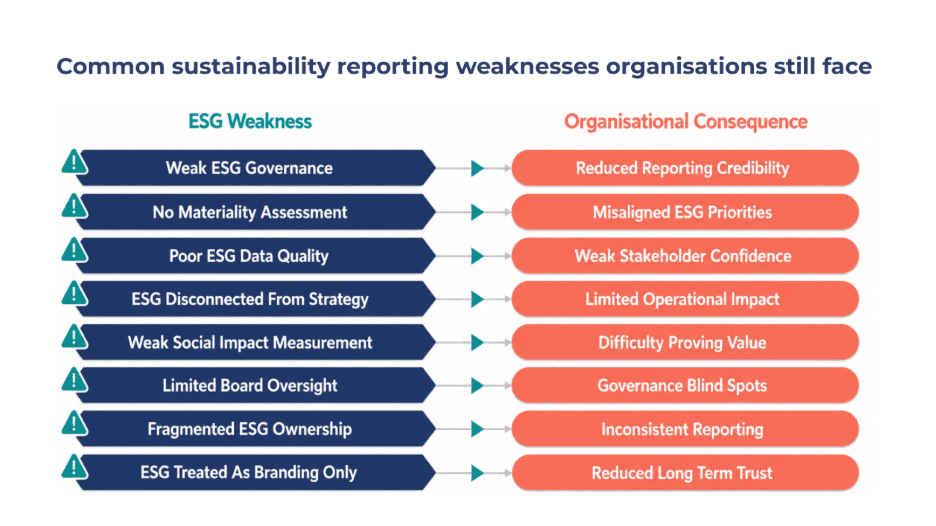
Common sustainability reporting weaknesses organisations still face
Social impact reporting is becoming measurable
Another major shift is happening around social impact itself.
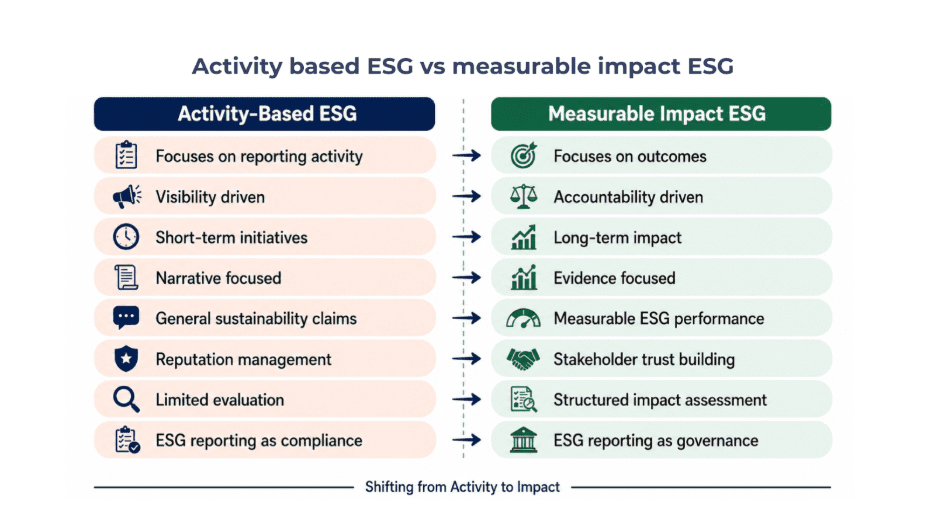
Historically, many organisations focused on reporting activities rather than outcomes.
For example:
- Donations Made
- Volunteer Hours
- Community Programmes
- Sponsorship Initiatives
- Employee Participation
Those metrics still matter, but they no longer provide sufficient evidence of impact on their own.
Stakeholders increasingly want organisations to demonstrate measurable social outcomes and long term value creation.
This means organisations now require stronger systems for:
- Social Impact Measurement
- Outcome Evaluation
- Stakeholder Engagement
- Impact Reporting
- Programme Assessment
- Community Accountability
The organisations building the strongest reputations today are often the organisations capable of evidencing real impact rather than simply reporting activity.
Read more: Social impact measurement and management
Activity based ESG vs measurable impact ESG
ESG is increasingly influencing investment decisions
The new sustainability reporting environment is also reshaping how investors assess organisations.
Investors increasingly evaluate:
- Governance Quality
- Sustainability Risk Exposure
- ESG Integration
- Reporting Credibility
- Organisational Resilience
- Long Term Accountability
- Climate Risk Preparedness
- Social Impact Performance
This means ESG reporting now influences:
- Investment Decisions
- Lending Assessments
- Investor Confidence
- Organisational Valuation
- Strategic Risk Analysis
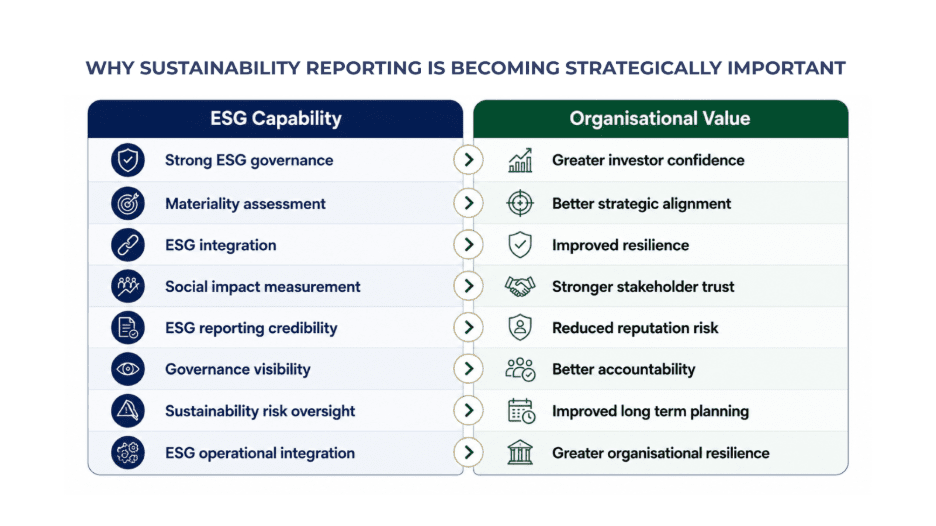
Weak ESG governance increasingly creates commercial risk.
Strong ESG integration increasingly supports long term confidence and resilience.
This is why ESG reporting is becoming much more closely connected to governance infrastructure and enterprise oversight.
Why sustainability reporting is becoming strategically important
Why Lumorus approaches ESG differently
At Lumorus, ESG and sustainability reporting are not viewed as standalone reporting exercises.
We view ESG as part of broader governance, accountability and organisational resilience.
That means helping organisations build ESG systems capable of supporting:
- Governance Accountability
- ESG Visibility
- Materiality Assessment
- Social Impact Measurement
- ESG Reporting Credibility
- Stakeholder Confidence
- Sustainability Risk Oversight
- Long Term Value Creation
Through our ESG, sustainability and governance capabilities, Lumorus supports organisations in building practical, measurable and commercially relevant ESG frameworks designed for modern operational realities.
Because increasingly, the organisations that succeed will not simply be the organisations talking about responsibility.
They will be the organisations capable of governing it properly.
Sustainability reporting is entering a more serious phase
The sustainability reporting environment is maturing rapidly.
Organisations are being pushed beyond symbolic commitments and towards measurable accountability, governance integration and evidence based reporting.
This creates both pressure and opportunity.
The organisations that adapt early will build stronger trust, better resilience and greater long term legitimacy.
The organisations that continue treating ESG primarily as disclosure and communications will increasingly struggle under scrutiny.
Because ultimately, sustainability credibility is no longer built through statements alone.
It is built through governance, evidence and measurable outcomes.
Lumorus: Better Business, Built on Purpose
At Lumorus, we believe Being Good is Better for Business.
We help organisations lead with integrity, govern with confidence and create value that lasts. Our work supports boards, executives and leadership teams to strengthen governance infrastructure, improve accountability and build resilient organisations capable of operating effectively in increasingly complex environments.
Across our Governance Advisory, Company Secretary Service and ESG Social Impact Consulting practices, we combine strategic insight with practical governance delivery. We work collaboratively with organisations to build governance systems that are proportionate, operationally effective and designed for long term value creation.
With offices and expert teams across the UK, Africa, the Caribbean, Latin America and Canada, and clients operating globally, Lumorus brings international perspective, specialist expertise and practical judgement to every engagement.
Whether you are strengthening ESG governance, improving social impact measurement or building more credible sustainability reporting frameworks, Lumorus is here to help you move from intention to action.
Together, we can build better business: one that performs with purpose, leads with integrity and creates lasting value for people, planet and profit.
To continue the conversation, visit:
www.lumorus.com
[email protected]
Sources & Citations
- Centre for Social Impact — Corporate Social Impact and ESG: Navigating the New Wave of Sustainability Reporting