


For listed companies, ESG reporting has become too important to be treated as a communications exercise.
- Investors expect credible information.
- Regulators expect consistency.
- Boards need reliable evidence.
Stakeholders increasingly compare what companies say with what they can demonstrate; that means the quality of ESG reporting now depends on much more than producing a polished annual sustainability report.
Listed companies need advisers who can connect governance, materiality, data, disclosure, stakeholder expectations and long-term business strategy.
According to ASUENE, organisations choosing an ESG consulting partner should look for three things in particular: alignment with recognised ESG frameworks, end-to-end capability across the reporting lifecycle and the ability to operate across multiple jurisdictions.
Meanwhile, Sustainable Stories Africa highlights another important dimension: firms operating across frontier and emerging markets often need advisers who can translate global standards into local execution.
That is especially relevant for listed companies with operations across Europe, Africa, Asia, the Caribbean, Canada, the Middle East and other international markets; the right consultant should therefore do more than help you report, they should help you build a reporting system the market can trust.
Read More: ESG Reporting and Disclosure
The best ESG consultant is not the one who produces the longest report
Many listed companies still judge ESG reporting by volume.
- More pages.
- More indicators.
- More frameworks.
- More disclosures.
Yet volume does not guarantee credibility.
A 120-page sustainability report can still fail if material issues are poorly defined, data is inconsistent or the board cannot explain how ESG affects strategy and risk.
Good ESG reporting should answer five questions clearly:
- What matters most?
- Why does it matter?
- How is it governed?
- What evidence supports the disclosure?
- What is changing because of management action?
These questions are more useful than simply asking whether the company has reported against another framework.
That is why the strongest ESG reporting consultants begin with governance and materiality before turning to narrative.
Explore More: ESG Materiality & Risk Assessment
Materiality should drive the reporting architecture
Listed companies generate enormous quantities of ESG information, not all of it matters equally.
A credible reporting process starts by identifying which environmental, social and governance issues are genuinely material to long-term performance and stakeholder decision making.
Without that discipline, companies often report what is easiest to measure rather than what is most important to understand.
A robust ESG Materiality & Risk Assessment should therefore help companies prioritise the issues that influence strategy, risk, capital allocation and stakeholder confidence; for some organisations, climate and transition risk may dominate, for others, workforce issues, community impact, supply chain exposure or governance quality may be more significant.
The consultant’s job is not to force every company into the same template, it is to help the company identify the issues that matter most and build reporting around them.
Data quality is now a board issue
ESG disclosure depends on data, if that data is weak, the report is weak.
Listed companies often collect sustainability information from multiple functions, business units, jurisdictions and systems. That creates obvious risks around consistency, completeness and verification.
A strong consultant should therefore help the company establish:
- Defined data owners.
- Consistent methodologies.
- Clear reporting boundaries.
- Documented assumptions.
- Review and approval controls.
- Audit trails.
- Assurance readiness.
This matters because reporting is becoming increasingly scrutinised.
According to Lumorus, effective ESG reporting requires not only alignment with recognised frameworks but also robust data collection, analysis and consistency across environmental, social and governance indicators.
Reliable disclosure begins long before the report is written.
Read More: ESG Reporting and Disclosure
What listed companies should expect from an ESG reporting consultant
A strong ESG reporting partner should support the full reporting lifecycle rather than only the final publication.
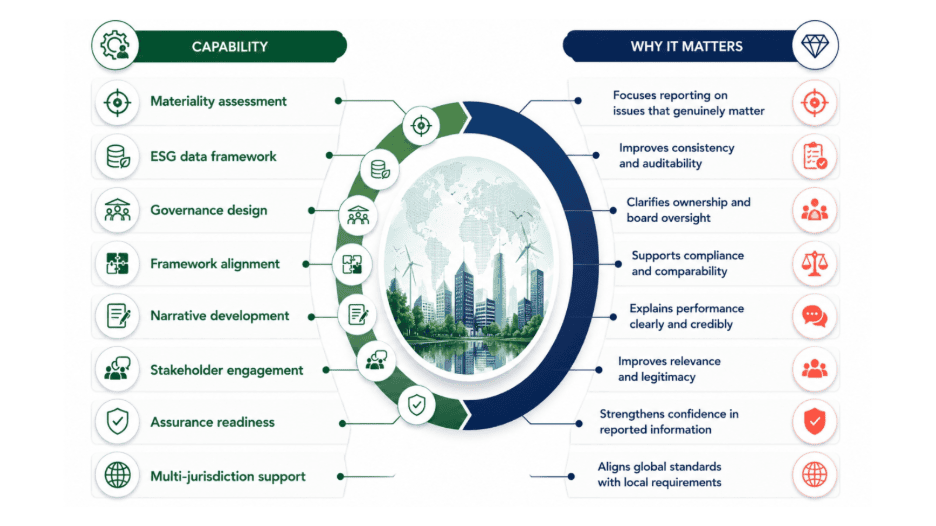
The objective should be to create a reporting process that is repeatable, credible and useful to investors.
Not simply impressive once a year.
Framework expertise matters, but framework chasing does not
Listed companies operate in an environment crowded with reporting standards and frameworks.
- GRI.
- SASB.
- ISSB.
- TCFD legacy disclosures.
- CSRD-linked requirements.
- Jurisdiction-specific regulations.
- Investor requests.
- Sector-specific expectations.
This complexity can encourage framework chasing, where companies add more disclosures without asking whether the overall reporting architecture remains coherent.
ASUENE’s 2025 overview of ESG consultants emphasises the importance of advisers being able to navigate multiple global standards, particularly as regulatory expectations tighten across jurisdictions; that capability matters; however, framework expertise should serve strategy.
The consultant should help the organisation understand which standards apply, where they overlap and how the company can avoid duplicating effort unnecessarily; good reporting architecture creates consistency, poor reporting architecture creates disclosure fatigue.
Explore More: ESG Strategy Development
Investor communication should shape the reporting approach
Listed companies report because markets need information; that means investor relevance matters.
Investors are not looking only for broad statements of commitment. They want to understand how ESG issues influence enterprise value, risk, resilience and future performance.
A strong consultant should therefore help companies connect ESG reporting with questions investors already ask:
- Where are the material risks?
- How is the board overseeing them?
- What are the key performance indicators?
- Are targets credible?
- What progress has been made?
- What are the financial implications?
- What assumptions remain uncertain?
This is where ESG Integration in Investment Decisions becomes important.
ESG reporting should not sit outside investor relations.
It should help investors understand how sustainability issues affect long-term business performance.
Stakeholder engagement improves reporting quality
Investors are important, they are not the only audience. Employees, customers, communities, regulators, suppliers and civil society may all have legitimate interests in the company’s ESG performance.
Meaningful Stakeholder Engagement helps companies understand what stakeholders are experiencing, what issues matter to them and where management’s assumptions may be incomplete.
- This can improve materiality assessments.
- It can reveal emerging risks.
- It can strengthen reporting credibility.
- It can also expose areas where the company’s narrative is stronger than its evidence.
For listed companies, that matters because reputational risk often begins where stakeholder experience and corporate disclosure diverge.
The consultant should therefore help the organisation listen before it reports.
Social impact reporting is becoming harder to fake
Many companies report social initiatives.
Fewer demonstrate;
- Social outcomes.
- Donations.
- Volunteering hours.
- Training programmes.
- Community investments.
These are activities.
They are not necessarily impact.
A credible ESG adviser should help listed companies distinguish between outputs and outcomes, particularly where social claims are material to the corporate narrative.
That is where Social Impact Measurement and Management becomes valuable.
Lumorus’ approach includes impact frameworks, qualitative and quantitative data analysis, stakeholder engagement and recognised methodologies such as Theory of Change and Social Return on Investment.
If a company claims to create social value, it should be able to explain what changed and how it knows.
Emerging markets require more than imported ESG templates
For listed companies with operations across emerging and frontier markets, reporting complexity increases.
International frameworks may set the benchmark, but implementation takes place in very different regulatory, institutional and social contexts.
Sustainable Stories Africa notes that sustainability advisers are increasingly acting as intermediaries between global reporting standards and local execution, particularly across banking, energy and manufacturing sectors in emerging markets.
This is an important point.
A reporting framework designed in London, New York or Brussels may not translate neatly into operating realities across Nairobi, Lagos, Kingston, Dubai or other international markets.
Listed companies therefore need advisers who understand both global expectations and local context.
That includes:
- Local regulation.
- Data availability.
- Stakeholder expectations.
- Institutional capacity.
- Cultural context.
- Market maturity.
- Sector-specific risk.
Global reporting credibility increasingly depends on local execution quality.
How leading ESG consultants differ
The market includes major global firms, specialist sustainability advisers, technology-led platforms and regional experts.
ASUENE’s 2025 review highlights global players such as BCG, PwC, Deloitte, ERM, South Pole and Accenture alongside its own integrated ESG offering, noting that different firms bring different strengths across strategy, assurance, technical environmental work, carbon markets and digital transformation.
That diversity is useful because the best consultant depends on the company’s needs.
- A large multinational preparing for complex assurance may prioritise global scale.
- A listed company operating across emerging markets may need stronger regional execution.
- A business beginning its ESG journey may need strategy, materiality and reporting design.
- Another may need help turning fragmented ESG data into investor-ready disclosure.
The important question is therefore not:
Who is the biggest consultant?
It is:
Who can solve the governance, reporting and execution problem we actually have?
What to look for when selecting an ESG reporting consultant
Listed companies should assess advisers against practical criteria.
1. Reporting expertise
Can the firm work confidently across the frameworks relevant to your company?
2. Governance capability
Can it help clarify board oversight, executive ownership and internal accountability?
3. Materiality discipline
Does it help identify what matters rather than encouraging indiscriminate disclosure?
4. Data capability
Can it strengthen ESG data collection, controls and assurance readiness?
5. Investor understanding
Does it understand what capital markets need from ESG disclosure?
6. Stakeholder capability
Can it incorporate meaningful stakeholder perspectives?
7. Multi-jurisdiction experience
Can it operate effectively across countries and regulatory systems?
8. Social impact expertise
Can it evaluate outcomes rather than simply report activity?
9. Strategic integration
Can it connect ESG with strategy, risk and investment decisions?
The best consultant should make reporting more credible and the underlying business more governable.
The strongest ESG reporting consultants improve the business, not just the report
There is an important test listed companies should apply.
After the reporting engagement ends, is the organisation better equipped to manage ESG?
Or does it simply possess a better-looking report?
A strong engagement should leave behind:
- Clearer ESG ownership.
- Better data controls.
- Stronger materiality discipline.
- More effective board oversight.
- Improved stakeholder intelligence.
- Better links between ESG and strategy.
- Greater assurance readiness.
- More credible investor communication.
That is the difference between reporting support and ESG capability building.
The report matters.
The system behind it matters more.
Why Lumorus takes an integrated approach
At Lumorus, ESG reporting is treated as part of a wider governance and sustainability system.
The objective is not simply to help organisations disclose more.
It is to help them disclose better.
That means connecting reporting with materiality, strategy, investment decisions, stakeholder engagement and impact measurement.
Our sustainability expertise includes:
This integrated approach helps listed companies move from fragmented ESG activity towards governance-led reporting that investors, regulators and stakeholders can understand.
The best ESG report is one the board can defend
Listed companies are entering a period in which sustainability claims will face greater scrutiny, not less.
That means ESG reporting must be capable of standing up to questions.
- Where did the data come from?
- Who approved it?
- Why was this issue considered material?
- What changed?
- What did not?
- What is the board doing about it?
- Can the company support the claim?
The strongest advisers will help listed companies answer those questions before publication, rather than after the market asks them.
Because good ESG reporting is not about saying more.
It is about being able to stand behind what you say.
Lumorus: Better Business, Built on Purpose
Lumorus is a UK headquartered global governance, ESG, company secretary and advisory firm supporting organisations across Europe, Africa, Asia, the Caribbean, Canada, the Middle East and international markets.
For more than 10 years, we have helped boards, leadership teams and organisations strengthen governance, accountability and organisational resilience.
For listed companies, credible ESG reporting now requires more than good narrative. It requires materiality, reliable data, board oversight, stakeholder insight and evidence that disclosure reflects how sustainability is actually managed.
Whether your organisation is preparing its first ESG report, strengthening an established reporting framework or responding to increasing investor and regulatory scrutiny, Lumorus can help build a reporting approach that is credible, proportionate and ready for scrutiny.
Is your ESG report describing activity, or demonstrating how sustainability is governed and managed?
Contact Lumorus to explore how our sustainability and ESG advisory services can strengthen reporting, disclosure and long-term value creation.
Email: [email protected]
Together, we can build better business: one that performs with purpose, leads with integrity and creates lasting value.
Sources
- ASUENE – Top 7 ESG Consulting Firms in 2025.
- Sustainable Stories Africa – Top Sustainability Consultants Driving ESG Execution Across Frontier and Emerging Markets.
- Lumorus – ESG Reporting and Disclosure – ESG reporting frameworks, data analysis and disclosure support.
- Lumorus – Sustainability & Responsibility – Integrated ESG and responsible business services.
- Lumorus – Social Impact Measurement and Management – Impact measurement, evaluation and stakeholder engagement.