



Trust has become one of the most valuable and fragile assets in responsible business.
Companies make ambitious commitments on climate, diversity, communities, human rights and responsible governance, while sustainability reports grow more sophisticated and ESG data becomes increasingly visible to investors, customers, employees and regulators.
Yet disclosure alone does not create trust, in fact, poorly designed ESG reporting can achieve the opposite.
When claims are vague, positive performance is highlighted while difficult information disappears, methodologies change without explanation or headline commitments cannot be reconciled with underlying evidence, stakeholders become more sceptical rather than more confident.
The central challenge is therefore not simply transparency, it is credible transparency.
According to Zampa Partners, effective ESG reporting can strengthen credibility and accountability by giving stakeholders clearer insight into environmental, social and governance performance. However, transparency creates value only when disclosure is sufficiently meaningful to support informed judgement rather than merely corporate communication.
Similarly, Evalueserve argues that ESG disclosure can reduce information asymmetry between companies and investors, strengthen accountability and support better investment decisions.
The lesson for boards and sustainability leaders is straightforward.
Stakeholder trust is not built by saying more. It is built by making it easier for stakeholders to understand what is true.
Read More: ESG Reporting and Disclosure
Transparency is not the same as disclosure volume
There is an assumption in ESG reporting that more information equals greater transparency.
It does not.
A sustainability report can contain hundreds of indicators and still leave stakeholders unable to answer basic questions about performance.
What are the company’s most significant ESG impacts?
- Which commitments are on track?
- Which are not?
- Who is accountable?
- What evidence supports the claims?
- Where are the limitations?
- What has changed since last year?
Transparency depends on clarity, relevance and comparability, not simply disclosure volume.
This is why good reporting requires judgement. Companies need to distinguish between information that is technically available and information that is genuinely useful to stakeholders.
For example, publishing dozens of workforce metrics may appear comprehensive, yet if the organisation does not explain why employee turnover has increased materially in a critical business unit, the most important information may still be missing.
Likewise, a detailed climate section can create an impression of sophistication while avoiding discussion of whether the organisation’s capital expenditure is aligned with its stated transition ambitions.
The stronger approach is to focus disclosure around material issues and explain both performance and context.
That makes an effective ESG Materiality & Risk Assessment central to credible reporting.
Materiality determines what deserves attention.
Transparency determines whether stakeholders can understand it.
Trust depends on the quality of the underlying ESG data
An ESG report is only as credible as the information beneath it.
That sounds obvious, although many organisations still build sustainability reporting on data processes that are far less mature than their financial reporting systems.
Environmental information may sit with operations.
Workforce data may sit with HR.
Supplier information may be collected by procurement.
Community data may come from individual projects.
Governance measures may be maintained by legal or company secretary teams.
When those sources are combined at year end, inconsistencies quickly appear.
- Different definitions.
- Different reporting periods.
- Different units.
- Incomplete audit trails.
- Manual adjustments.
- Unclear ownership.
The Global Finance & Technology Network notes that ESG data can become unreliable when collection processes depend heavily on fragmented manual sources, particularly across complex businesses with multiple geographies, business lines and supply-chain participants. It argues that accuracy, consistency, transparency and credibility are fundamental to trust in ESG disclosures.
Therefore, companies should treat ESG data architecture as governance infrastructure.
That means defining:
- Who owns each material data point.
- How the metric is calculated.
- Which entities and operations are included.
- What assumptions are used.
- How estimates are distinguished from measured data.
- Who reviews the information before disclosure.
- What evidence is retained.
- How changes in methodology are documented.
Once these disciplines exist, ESG reporting becomes easier to defend because evidence can be traced from the published statement back to its source.
Explore More: ESG Reporting and Disclosure
Transparent reporting includes uncomfortable information
Trust is tested most seriously when performance disappoints.
It is easy to report a target that has been exceeded.
It is harder to explain one that has been missed.
Yet stakeholders often learn more about an organisation from how it reports failure than from how it celebrates success.
Imagine two companies that miss the same emissions reduction target.
The first quietly changes the baseline, removes the previous target from its headline reporting and replaces it with a new long-term aspiration.
The second explains that the target was missed, identifies the operating factors responsible, quantifies the shortfall and describes what management will change.
Neither company achieved its objective.
However, the second is far more likely to retain credibility because it treats stakeholders as capable of understanding complexity.
Transparent ESG disclosure should therefore distinguish between:
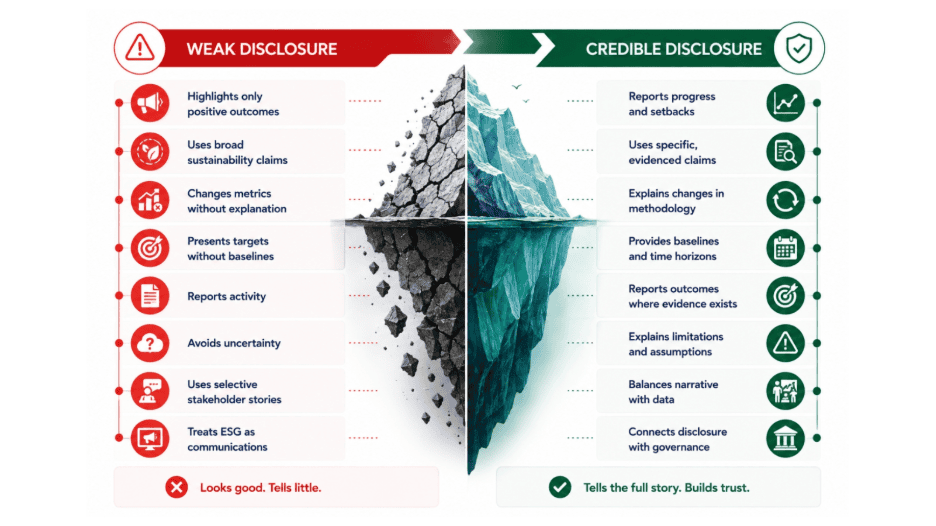
Transparency does not require organisations to publish every piece of internal information.
It requires them to avoid creating a misleading picture through selective disclosure.
That distinction matters enormously for stakeholder trust.
Materiality protects reporting from becoming noise
Not every ESG issue deserves equal space in every report.
A mining company and a software business do not have identical environmental exposures.
A bank and a manufacturer do not create the same social impacts.
A global retailer and an investment fund have fundamentally different supply chains, workforces and stakeholder relationships.
Good ESG disclosure therefore begins with materiality rather than generic reporting templates.
A robust ESG Materiality & Risk Assessment helps management determine which sustainability issues are sufficiently important to influence strategy, risk, stakeholder decisions and long-term value.
Once those priorities are clear, reporting becomes more focused.
For example, if workforce safety is a material issue, the organisation should explain performance, incidents, controls and management action with sufficient depth.
If biodiversity is not materially connected to the business model, adding pages of generic biodiversity language may create volume without insight.
Materiality therefore improves transparency by reducing noise.
It also forces leadership to make choices about what matters most, which is ultimately a governance exercise.
Read More: ESG Materiality & Risk Assessment
Stakeholder engagement should shape disclosure before publication
Many companies seek stakeholder feedback after publishing their sustainability report.
By then, one of the most valuable opportunities has already passed.
Stakeholder engagement is most useful when it helps determine what the organisation should report in the first place.
Investors may want greater clarity on transition risk and capital allocation.
Employees may care about development, pay fairness and organisational culture.
Communities may prioritise environmental impacts, local procurement or employment.
Customers may be concerned with sourcing, product responsibility or data privacy.
These perspectives help companies understand whether their internal definition of ESG performance matches what stakeholders actually consider important.
A strong Stakeholder Engagement process can therefore strengthen:
- Materiality assessments.
- Risk identification.
- ESG strategy.
- Reporting priorities.
- Performance indicators.
- Trust and legitimacy.
- Future programme design.
Zampa Partners similarly emphasises stakeholder expectations as an important driver of transparent ESG reporting and argues that credible disclosure can strengthen relationships with investors, customers and employees.
However, engagement must be substantive.
A survey sent to stakeholders shortly before the report is finalised is not the same as incorporating their concerns into governance and decision making.
Stakeholders build trust when they can see that their input affects what organisations do, not simply what organisations publish.
Explore More: Stakeholder Engagement
ESG strategy and ESG reporting must tell the same story
A common credibility problem appears when the sustainability report describes priorities that seem disconnected from how the organisation allocates capital.
The report may say climate is strategically important, yet investment decisions show little evidence of transition planning.
Management may emphasise workforce wellbeing, while employee turnover and engagement deteriorate.
The organisation may highlight community impact, yet there is no consistent framework for understanding social outcomes.
When reporting and decision making diverge, stakeholders notice.
This is why ESG Strategy Development and ESG disclosure should be closely connected.
A credible strategy should establish:
- Material ESG priorities.
- Clear objectives.
- Accountability.
- Metrics and targets.
- Investment requirements.
- Governance arrangements.
- Reporting responsibilities.
Disclosure then explains how the organisation is performing against that strategy.
This creates coherence.
Instead of sustainability reporting being produced separately from the business, it becomes a transparent account of how the organisation is managing material ESG issues.
That is much more useful to investors and other stakeholders.
Read More: ESG Strategy Development
Investors need decision-useful ESG information
For investors, ESG disclosure has value when it improves the quality of investment analysis.
A glossy report may strengthen corporate reputation, although investors ultimately need information that helps them assess risk, resilience, management quality and future value creation.
Evalueserve notes that stronger ESG disclosure can reduce information asymmetry between companies and investors and contribute to more informed investment decisions.
This means investor-focused ESG reporting should help answer questions such as:
- Which ESG issues could materially affect the business model?
- How are those risks governed?
- What investment is required?
- Are management targets credible?
- What indicators show progress?
- How could regulatory change affect performance?
- What trade-offs is management making?
- How do sustainability priorities influence capital allocation?
This is where ESG Integration in Investment Decisions becomes particularly relevant.
If ESG factors are genuinely material, they should influence investment and strategic decisions.
If they never affect decisions, stakeholders may reasonably question whether they are material at all.
Social impact claims require more than compelling stories
Stories matter in ESG reporting because they make complex information human.
However, stories can also become a substitute for evidence.
A company may feature an individual beneficiary whose life changed dramatically after a programme, yet that example does not necessarily show whether the programme created meaningful outcomes at scale.
Credible social disclosure should therefore distinguish between activity, output, outcome and impact.
A business may report that:
- £1 million was invested in communities.
- 5,000 people received training.
- 200 schools received equipment.
- 10,000 employee volunteer hours were completed.
These numbers demonstrate activity.
They do not automatically establish social impact.
Strong Social Impact Measurement and Management asks what changed as a result of those activities and what evidence supports the conclusion.
- Did employment improve?
- Did educational outcomes change?
- Did community resilience increase?
- Were benefits sustained?
- Were there unintended consequences?
The more significant the public claim, the stronger the evidence should be.
That principle protects organisations from turning responsible business into reputation management.
Explore More: Social Impact Measurement and Management
Assurance readiness is becoming part of disclosure credibility
As ESG reporting matures, stakeholders increasingly expect information to be capable of verification.
This does not mean every ESG metric will immediately receive external assurance.
However, organisations should build systems that could withstand it.
The Global Finance & Technology Network notes that independent verification can strengthen the credibility of ESG disclosures, while also pointing out that many organisations have historically lacked the systems, processes and controls needed to support robust assurance.
Assurance readiness therefore begins before an assurance provider arrives.
Companies should be able to demonstrate:
- Clear data ownership.
- Documented methodologies.
- Consistent reporting boundaries.
- Evidence supporting calculations.
- Change controls.
- Review and approval processes.
- Audit trails.
- Explanation of estimates and judgements.
Technology can support this by improving data collection and maintaining evidence trails, particularly where organisations operate across several geographies or business lines.
Yet technology alone cannot determine whether the disclosed information is balanced, material or strategically meaningful.
That still requires governance and judgement.
Read More: ESG Reporting and Disclosure
Boards should govern the disclosure, not merely approve the report
The board’s role in ESG reporting should extend beyond approving the final sustainability report.
Directors should understand the reporting architecture behind it.
That includes knowing:
- Which ESG issues management considers material.
- How those issues connect with strategy.
- Who owns the underlying data.
- Where significant estimates are used.
- Which commitments create reputational or financial exposure.
- What stakeholder concerns have emerged.
- Where performance is materially off track.
- Whether public claims are supported by evidence.
This is particularly important because public ESG commitments can create expectations long before the organisation has built the systems required to deliver them.
Boards should therefore challenge ambitious commitments before they are announced.
- Can the organisation measure progress?
- Is management accountable?
- Does the target have a credible pathway?
- What investment is required?
- Are assumptions sufficiently robust?
- What happens if the target becomes unrealistic?
Governance should protect organisations from both under-ambition and overclaiming.
The objective is credible ambition.
Transparency should make organisations more accountable internally
One of the most valuable effects of ESG disclosure happens inside the organisation.
Once management commits publicly to a target, the organisation must decide who owns it, how it will be measured and what resources are required.
Disclosure can therefore create internal discipline.
Evalueserve argues that ESG disclosure can act as a catalyst for internal change while strengthening accountability and information flows.
This is particularly powerful when reporting becomes integrated into management rather than treated as an annual publishing exercise.
A strong reporting cycle might therefore involve:
- Reviewing material ESG risks.
- Updating stakeholder intelligence.
- Assessing performance against targets.
- Challenging data quality.
- Escalating underperformance.
- Adjusting strategy where necessary.
- Reporting transparently.
- Using stakeholder feedback to improve the next cycle.
The report then becomes the visible output of a deeper management system.
That is a much stronger foundation for trust.
The most trusted ESG reports explain uncertainty
- Sustainability involves uncertainty.
- Climate pathways change.
- Regulations evolve.
- Data can be incomplete.
- Social outcomes are difficult to attribute.
- Supply-chain information may depend on third parties.
Responsible reporting acknowledges this.
Rather than presenting every ESG metric with artificial precision, organisations should explain where estimates, limitations and uncertainty exist.
For example:
- Scope 3 emissions may depend heavily on supplier data and estimation.
- Long-term climate targets may rely on technologies that are still developing.
- Social impact outcomes may have multiple contributing causes.
- Forward-looking projections may depend on policy assumptions.
- Data quality may vary across jurisdictions.
Explaining these limitations does not automatically weaken the report.
Often, it increases confidence because stakeholders can see where management’s knowledge ends.
Transparency is not pretending to know everything.
It is being clear about what is known, what is estimated and what remains uncertain.
A practical trust test for ESG disclosure
Before publishing, boards and sustainability leaders should test the report against a small number of demanding questions.
- Evidence
Can every material claim be supported?
- Balance
Does the report explain setbacks as clearly as successes?
- Materiality
Is the organisation reporting what genuinely matters?
- Consistency
Can stakeholders compare performance over time?
- Accountability
Is it clear who owns the major commitments?
- Stakeholder relevance
Does the disclosure address the concerns of those affected?
- Decision usefulness
Can investors and other stakeholders use the information to make better judgements?
- Assurance readiness
Could the evidence withstand independent scrutiny?
- Strategic alignment
Does the report reflect how the organisation actually makes decisions?
If the answer to several of these questions is no, the organisation may be communicating ESG without yet demonstrating it.
Trust is earned between reports
No sustainability report can manufacture stakeholder trust once experience contradicts disclosure.
Employees compare workforce claims with how the organisation treats them.
Customers compare responsible business statements with the products they buy.
Communities compare corporate commitments with what happens locally.
Investors compare targets with capital allocation.
Regulators compare disclosures with evidence.
Therefore, transparent ESG reporting works only when it reflects organisational reality.
The report can strengthen trust, but it cannot substitute for performance.
This is the central discipline responsible organisations need to understand.
Disclosure should make reality more visible, not make the narrative more attractive.
The companies that earn durable stakeholder trust will not necessarily publish the most ambitious ESG commitments or the longest sustainability reports.
They will be the companies whose stakeholders repeatedly discover that the evidence broadly matches what management said.
That consistency is how trust is built.
- Slowly.
- Repeatedly.
- And through proof.
Lumorus: Better Business, Built on Purpose
At Lumorus, we believe credible responsible business begins with evidence.
Lumorus is a UK headquartered global governance, ESG, company secretary and advisory firm supporting organisations across Europe, Africa, Asia, the Caribbean, Canada, the Middle East and international markets.
For more than 10 years, we have helped boards, leadership teams and organisations strengthen governance, accountability and organisational resilience.
Our sustainability and ESG expertise includes:
Our ESG Reporting and Disclosure work supports organisations with reporting frameworks, ESG data, recognised reporting standards, materiality, stakeholder engagement, narrative development and assurance readiness.
Whether your organisation is strengthening an existing sustainability report, preparing for greater scrutiny or trying to rebuild stakeholder confidence in ESG claims, Lumorus can help create disclosure that is transparent, evidence-led and connected to how the organisation is actually governed.
Can your stakeholders verify the ESG story you are telling them?
Contact Lumorus to explore how our ESG and sustainability services can help strengthen reporting credibility, stakeholder trust and long-term value creation.
Email: [email protected]
Together, we can build better business: one that performs with purpose, leads with integrity and creates lasting value.
Sources
- Zampa Partners – Transparency & Disclosure: Building Trust through ESG Reporting.
- Evalueserve – Building Trust and Driving Growth through ESG Disclosure.
- Global Finance & Technology Network – How to Build Trust in ESG Data and Disclosures.
- Lumorus – ESG Reporting and Disclosure – ESG reporting frameworks, stakeholder engagement, data analysis and assurance support.