


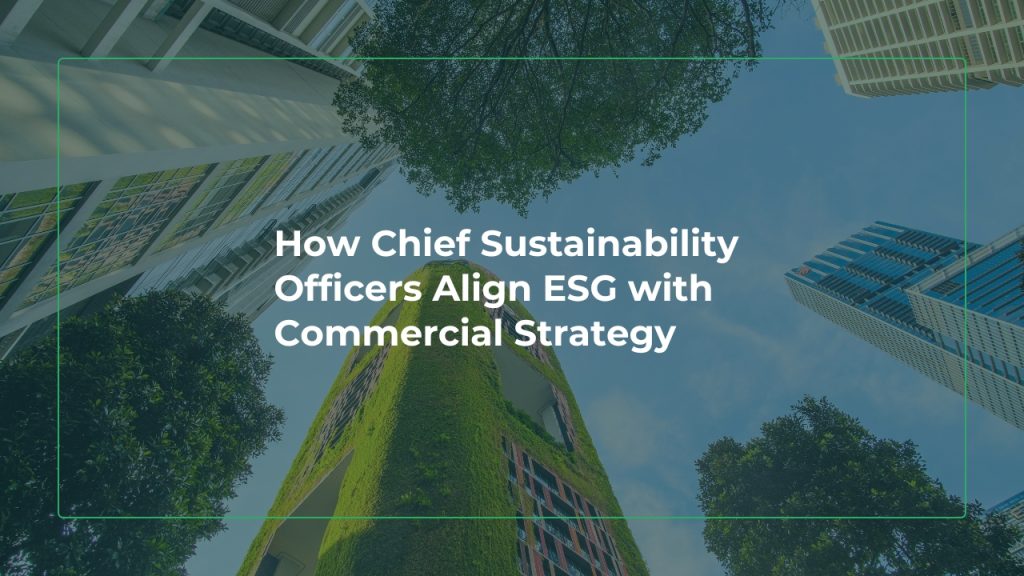
Sustainability has entered the boardroom; not as a public relations initiative, or a regulatory exercise, but as a strategic business imperative.
Today’s Chief Sustainability Officer (CSO) is expected to help organisations reduce environmental impact, strengthen social responsibility, improve governance and create long-term value, all while navigating economic uncertainty, geopolitical instability and increasing regulatory expectations.
It is one of the most demanding executive roles in modern business. The challenge is no longer defining ambitious ESG goals. It is delivering them without compromising commercial performance.
The most effective Chief Sustainability Officers understand that sustainability cannot operate alongside the business.
It must operate within the business.
According to IMD, the CSO has evolved from being a sustainability advocate into a strategic leader responsible for embedding sustainability into organisational strategy, innovation and long-term value creation.
ESG ambition must be aligned with business strategy
Many organisations continue to treat ESG as a separate function.
- The sustainability team develops environmental targets.
- Finance focuses on profitability.
- Operations pursue efficiency.
- Risk manages compliance.
The board receives multiple reports that are rarely connected; the result is fragmented decision making. Successful organisations take a different approach; they integrate sustainability into corporate strategy, capital allocation, enterprise risk management and governance.
ESG becomes part of how the organisation creates value rather than another reporting obligation.
Strong governance ensures sustainability objectives are aligned with commercial priorities rather than competing against them.
The Chief Sustainability Officer cannot deliver ESG alone
Delivering meaningful ESG outcomes requires collaboration across the organisation.
No single executive can achieve this independently.
According to EY, the relationship between the board, the Chief Sustainability Officer and the Chief Financial Officer is becoming increasingly important in helping organisations integrate sustainability into business decisions, investment planning and long-term value creation.
- Finance provides commercial discipline.
- Operations deliver implementation.
- Risk manages emerging threats.
- Legal ensures regulatory compliance.
- Governance provides accountability.
The Chief Sustainability Officer brings these functions together to create a coherent strategy that balances ambition with commercial reality.
Governance transforms ESG ambition into measurable outcomes
Many sustainability programmes struggle because governance receives less attention than environmental commitments.
Ambitious targets alone do not deliver results.
Without effective governance:
- Accountability becomes unclear.
- ESG responsibilities become fragmented.
- Sustainability data lacks consistency.
- Board oversight weakens.
- Reporting credibility declines.
Strong governance creates clear ownership, effective oversight and transparent reporting.
It enables boards to monitor progress, challenge assumptions and ensure sustainability commitments translate into measurable business outcomes.
Organisations with robust governance frameworks are better positioned to respond to changing regulation, investor expectations and stakeholder scrutiny.
Boards should challenge ESG in the same way they challenge strategy
Effective boards do not simply approve sustainability initiatives.
Nor do they reject them based solely on short-term financial considerations.
Their responsibility is to ensure ESG supports long-term organisational success.
Directors should ask:
- Does this initiative support corporate strategy?
- How does it improve organisational resilience?
- What risks does it reduce?
- How will success be measured?
- Is capital being allocated effectively?
- What governance mechanisms will monitor progress?
Strong governance strengthens sustainability by making it more credible, measurable and commercially sustainable.
Technology supports sustainability. Leadership delivers it.
Organisations are investing heavily in ESG reporting platforms, carbon accounting software and sustainability data systems.
Technology has become an essential enabler;
- It improves data quality.
- Supports regulatory reporting.
- Enhances transparency.
- Strengthens decision making.
But technology cannot replace executive judgement;
- It cannot determine strategic priorities.
- It cannot balance competing stakeholder expectations.
- It cannot build organisational culture.
Successful ESG programmes combine technology with experienced leadership, governance expertise and effective board oversight.
Technology improves information; people make decisions.
The future Chief Sustainability Officer is an enterprise leader
The role of the Chief Sustainability Officer continues to evolve.
Tomorrow’s CSOs will spend less time advocating for sustainability and more time integrating it into every major business decision.
They will understand:
- Corporate governance.
- Finance.
- Enterprise risk.
- Strategy.
- Innovation.
- Capital allocation.
- Regulatory change.
- Investor expectations.
Their influence will extend well beyond sustainability reporting.
They will help shape how organisations create resilient, responsible and profitable businesses.
Those who successfully balance ESG ambition with commercial reality will become some of the most influential executives in modern organisations.
Strong governance makes sustainable business possible
Sustainability is no longer measured by the number of commitments organisations make.
It is measured by their ability to deliver them.
That requires;
- Governance.
- Clear accountability.
- Integrated decision making.
- Reliable reporting.
- Board oversight.
- Commercial discipline.
The organisations that succeed will not be those with the boldest sustainability ambitions.
They will be those with the strongest governance systems capable of turning ambition into measurable performance.
Lumorus: Better Business, Built on Purpose
At Lumorus, we believe sustainability succeeds when it is supported by strong governance.
ESG is not a standalone initiative. It is a governance, strategy and leadership challenge.
Lumorus is a UK headquartered global governance, ESG, company secretary and advisory firm supporting organisations across Europe, Africa, Asia, the Caribbean, Canada, the Middle East and international markets.
We help organisations integrate ESG into governance, strengthen board oversight, improve organisational accountability and develop sustainability frameworks that create long-term value.
Our governance and ESG expertise includes:
Whether your organisation is developing its first ESG strategy or embedding sustainability into enterprise governance, Lumorus helps boards and executive teams create practical governance solutions that balance ambition with business reality.
Website: lumorus.com
Email: [email protected]
Together, we can build better business: one that performs with purpose, leads with integrity and creates lasting value.
Sources
- IMD – The Chief Sustainability Officer – Examines the evolving role of the Chief Sustainability Officer as a strategic business leader responsible for integrating sustainability across the organisation.
- EY – The Board, CSO and CFO Dynamic for Sustainability – Explores how boards, Chief Sustainability Officers and Chief Financial Officers collaborate to embed sustainability into corporate strategy and value creation.
- World Economic Forum – Discusses the leadership capabilities required of modern Chief Sustainability Officers.
- G20/OECD Principles of Corporate Governance – Highlights the importance of governance, accountability and effective board oversight in creating long-term organisational value.