


A failed governance audit is an uncomfortable moment for any organisation. The instinct in the immediate aftermath is to manage the optics: prepare a response, brief the board, reassure the regulator, and move on as quickly as possible. That instinct is understandable. It is also the reason many organisations fail the same audit twice.
The findings of a governance audit are not primarily a communications problem; they are a structural signal. They are telling you something specific about the infrastructure underneath the function, about the systems, processes, records and accountability mechanisms that were either absent, inadequate or not operating as designed. Responding to that signal with a public relations exercise rather than a structural intervention is how organisations end up back in the same position twelve months later.
The organisations that recover well from a failed governance audit are not the ones that respond fastest. They are the ones that respond most honestly.
What a Failed Governance Audit Is Actually Telling You
Before deciding what to do, it is worth understanding what the findings are communicating. Governance audit failures cluster around a predictable set of structural weaknesses and identifying which category your findings fall into determines the right response.
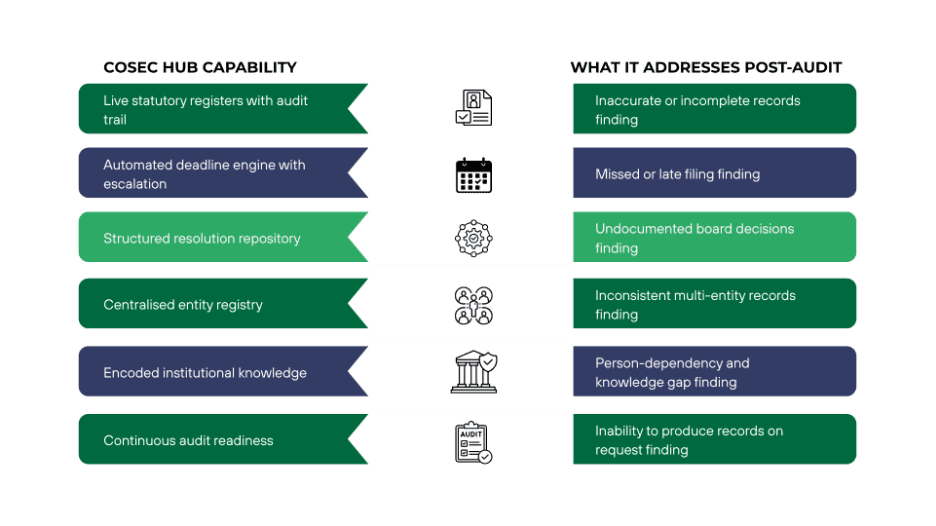
Most governance audit failures are not the result of bad intent. They are the result of good people working with infrastructure that was never capable of meeting the standard the function requires. That distinction matters because it determines where the fix needs to happen.
The Immediate Steps That Actually Matter
The first seventy two hours after receiving audit findings set the tone for everything that follows. The priority is not to minimise the findings. The priority is to understand them precisely and respond to them structurally.
Step One: Read the Findings Without Defensiveness
Every finding in a governance audit report is specific. It names a control that failed, a record that was absent, a process that did not operate as required, or a standard that was not met. The temptation is to contest findings that feel unfair or to contextualise failures in ways that reduce their apparent severity. Resist both.
Read the findings as a map of where the infrastructure is weak. Each finding is a data point. Together, they describe the shape of the structural problem. The response that addresses the shape of the problem is the one that prevents recurrence.
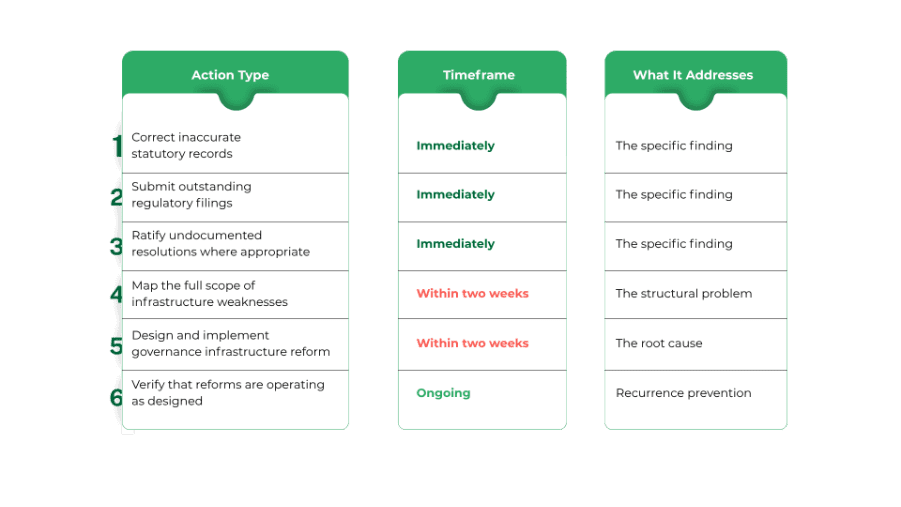
Step Two: Separate Immediate Remediation from Structural Reform
Not all findings carry the same urgency. Some require immediate action: a statutory register that is inaccurate needs to be corrected now, not at the next planning cycle. A missing PSC filing needs to be submitted. A board resolution that was not properly documented needs to be ratified.
Immediate remediation addresses the specific failures the audit identified. Structural reform addresses the infrastructure that allowed those failures to occur. Both are necessary. Doing only the former produces a clean audit next time through a manual scramble, not through genuine capability improvement.
Step Three: Brief the Board Honestly
The board needs to understand what the audit found, why it happened, and what is being done about it. That briefing should be honest about the structural nature of the failures, not a presentation designed to reassure. A board that understands the root cause of a governance failure can provide genuine oversight of the remediation. A board that has been reassured is not.
The briefing should cover four things: what the findings were, what they indicate about the underlying infrastructure, what immediate remediation has been taken, and what structural reform is planned and on what timeline.
Step Four: Communicate with the Regulator Proactively
Where a governance audit failure has regulatory implications, proactive communication with the relevant body is almost always the right approach. Regulators distinguish between organisations that surface problems and respond to them structurally and organisations that minimise and manage. The former generates credibility. The latter generates scrutiny.
A clear, factual communication that acknowledges the findings, confirms immediate remediation steps and commits to a structural improvement plan on a defined timeline demonstrates the governance culture that regulators are looking for. It does not eliminate consequences, but it shapes the context in which those consequences are determined.
The Structural Conversation That Most Organisations Avoid
The most important conversation that follows a failed governance audit is the one about infrastructure. It is also the conversation that most organisations are reluctant to have, because it requires acknowledgement that the function has been running on tools that were never adequate for the work.
“A governance audit does not fail because of a bad quarter. It fails because the infrastructure underneath the function was not capable of meeting the standard the function requires.”
The infrastructure question has three components.
The system of record. Where do statutory registers, board resolutions, entity records and compliance documentation actually live? In a spreadsheet that one person maintains? In a shared drive with no version control? In an email archive that belongs to whoever sent the messages? Each of these is a structural failure waiting to be surfaced. A governance audit simply surfaces it on a schedule.
The workflow and accountability system. How are compliance tasks assigned, tracked and confirmed as complete? If the answer involves forwarding emails, setting up personal calendar reminders, or relying on the memory of an experienced team member, the function does not have a workflow system. It has a collection of individual habits that degrade with staff turnover and collapse under volume.
The knowledge architecture. Where does institutional knowledge live? If the answer is in the heads of two or three people who have been in the role the longest, the function is one resignation away from a governance of continuity failure. Institutional knowledge that is not encoded into systems is not institutional. It belongs to individuals.
What Fit for Purpose Governance Infrastructure Looks Like
The organisations that recover from governance audit failures and do not repeat them are the ones that use the findings as the mandate to build infrastructure that should have been in place already.
Fit for purpose governance infrastructure has four characteristics.
- It maintains a single source of truth. Statutory registers, entity records, board resolutions, and compliance documentation are held in one structured environment with a full audit trail. There is no version of risk, no reconciliation requirement, and no question about which record is current.
- It enforces the process rather than relying on individuals. Compliance deadlines are tracked by an automated system that generates alerts and escalations. Workflows are built into the platform rather than managed through email. Accountability is structural, not personal.
- It scales without degrading. Adding a new entity, onboarding a new team member or absorbing an acquisition does not break the system. The infrastructure is designed to grow with the organisation rather than buckling under it.
- It is always audit ready. The records are current, structured, and accessible at any point. Audit preparation is not a scramble to reconstruct documentation from fragmented sources. It is the production of records that have been maintained continuously.
How CoSec Hub Supports Governance Recovery and Reform
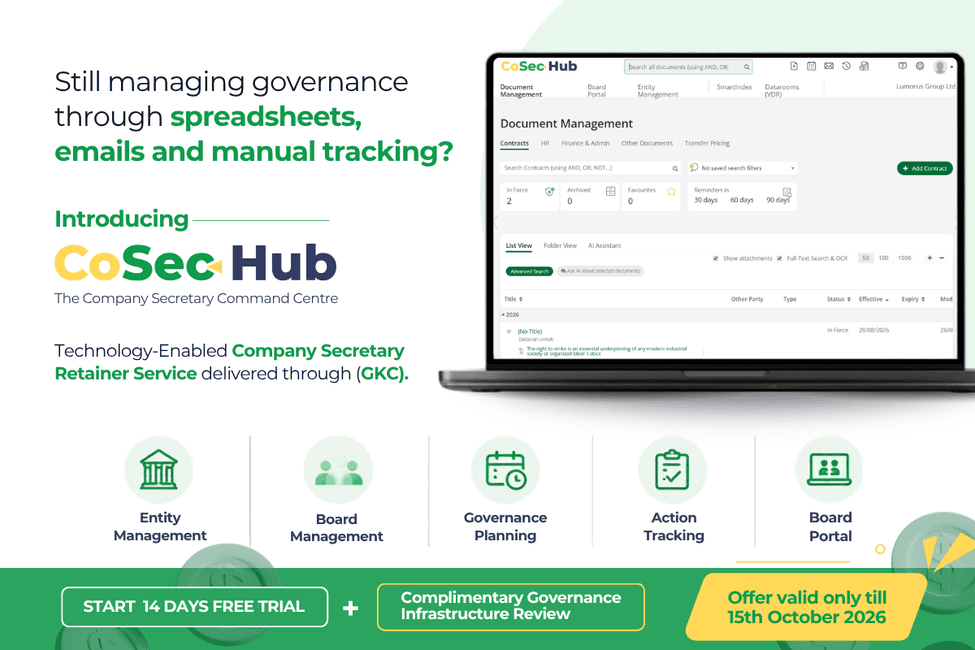
CoSec Hub, powered by Lumorus, is built specifically for the structural challenges that governance audit failures expose.
For organisations in the immediate aftermath of a failed audit, CoSec Hub provides the infrastructure to correct records accurately, establish a defensible system of record and demonstrate to regulators and boards that the structural remediation is real rather than cosmetic.
For organisations that have completed immediate remediation and are building toward a sustainable governance infrastructure, CoSec Hub provides the platform on which that infrastructure is built: live statutory registers with full audit trails, automated compliance deadline management, a structured resolution repository, centralised entity management and encoded institutional knowledge that does not depend on any individual.
Lumorus brings the professional governance expertise that complements the platform. The governance services team works with organisations to assess the full scope of infrastructure weaknesses surfaced by an audit, design the remediation plan, and support its implementation with the rigour that a genuine structural reform requires.
The Organisations That Get This Right
The organisations that recover from governance audit failures and build durable governance capability share a common approach. They treat the audit findings as a structural diagnosis rather than a reputational problem. They invest in infrastructure reform rather than process patching. They brief their boards honestly and give their regulators a credible remediation story. They do not stop at immediate remediation.
The result is not just a clean audit next time. It is a governance function that is genuinely capable of meeting the standard the function requires, one that does not depend on the memory of key individuals, the reliability of manual processes or the hope that nothing critical will fall through the gaps.
A failed governance audit is not the end of anything. It is the clearest possible signal that the infrastructure underneath the function needs to change. The organisations that act on that signal build something more durable than a passing score. They build governance infrastructure that holds.
Take the Next Step
CoSec Hub, powered by Lumorus, supports organisations at every stage of governance recovery, from immediate remediation through to the structural reform that prevents recurrence.
cosec.lumorus.com | lumorus.com | [email protected]
Citations & Sources
- Financial Reporting Council. UK Corporate Governance Code and Board Effectiveness Guidance. 2024.
- Institute of Chartered Secretaries and Administrators. Corporate Governance Failures and Board Evaluation Outcomes. 2023.
- Chartered Governance Institute UK & Ireland. Company Secretary Benchmarking Survey. 2023.
- Companies House. UK Economic Crime and Corporate Transparency Act 2023.
- Corporate Affairs Commission Nigeria. Companies and Allied Matters Act 2020.