


Most boards do not suffer from a lack of meetings. They suffer from weak meeting effectiveness.
Board packs become overloaded, strategic discussions get compressed, directors spend too much time reviewing operational detail, and too little time exercising judgement, challenge and oversight. Important risks receive insufficient scrutiny, decisions become unclear, and accountability weakens over time.
None of this initially appears catastrophic.
That is precisely why it becomes dangerous.
Weak board meeting effectiveness rarely creates immediate governance failure. Instead, it quietly reduces governance quality through weaker visibility, slower decision making, and declining board discipline. Many boards underestimate how quickly ineffective meetings can weaken organisational oversight because the problem rarely looks dramatic in the beginning. It looks procedural, operational, and manageable until governance quality starts deteriorating underneath.
That is why improving board meeting effectiveness matters far more than many organisations realise.
Research from the Chartered Governance Institute increasingly highlights that strong board performance depends heavily on effective governance structures, disciplined board processes and high quality information flows.
Why Board Meeting Effectiveness Matters More Than Most Boards Admit
Many organisations assume their board meetings are effective because meetings happen regularly, agendas are circulated, board packs are distributed, committees operate and minutes are recorded.
But governance activity is not the same as governance effectiveness.
Strong board meetings are not measured by duration or frequency alone. They are measured by whether boards can consistently sustain strategic oversight, effective challenge, decision accountability, risk visibility, governance discipline and organisational oversight under pressure.
That gap is becoming increasingly important as boards now operate in environments shaped by AI governance, cybersecurity risk, ESG accountability, regulatory pressure, operational resilience and investor scrutiny.
As governance complexity increases, weak board meeting structures become far more dangerous because governance effectiveness ultimately depends on the quality of discussion, oversight and decision making happening inside the boardroom.
Explore More About Lumorus Governance & Board Advisory Services:
/www.lumorus.com/capabilities/governance-and-board-advisory
The Fastest Ways to Improve Board Meeting Effectiveness
Many boards assume improving meeting effectiveness requires major governance transformation. In reality, the fastest improvements usually come from improving governance discipline and meeting structure.
The most effective boards focus on five areas first.
- Reduce Agenda Overload
Many board agendas are overcrowded with operational updates, low priority discussion items, and excessive reporting. The result is predictable. Strategic oversight gets compressed while directors experience information fatigue.
High performing boards focus meeting time on strategic risk, organisational performance, regulatory exposure, capital allocation and major decisions requiring board judgement. Everything else should support those discussions rather than dilute them.
- Improve the Quality of Board Papers
Poor board papers quietly weaken board effectiveness because directors cannot provide effective oversight when information is unclear, excessively detailed or poorly structured.
Weak board reporting commonly includes excessively long board packs, operational detail without strategic analysis, weak risk visibility, inconsistent reporting structures, and unclear decision requests.
Strong board papers help directors answer three questions quickly:
- What matters?
- What has changed?
- What requires board judgement or decision?
Board reporting should improve governance visibility rather than overwhelm directors with unnecessary information volume.
- Protect More Time for Strategic Discussion
One of the clearest signs of weak board effectiveness is when meetings become dominated by operational reporting instead of strategic discussion.
Boards exist to provide oversight, challenge and long term direction, yet many spend disproportionate time reviewing historical operational updates rather than discussing future organisational risk, resilience and performance.
High performing boards intentionally protect time for discussions around strategic threats, organisational resilience, leadership capability, regulatory change and long term value creation because strong governance discussions rarely happen accidentally. They require deliberate agenda discipline.
Strengthen Chair Leadership and Meeting Discipline
Board effectiveness is heavily influenced by the chair.
Strong chairs create focused, disciplined and accountable discussion environments while weak chairs often allow agenda drift, repetitive discussion, dominant personalities, unclear conclusions and weak participation dynamics to undermine governance quality.
High performing chairs improve governance effectiveness by ensuring discussions remain focused, challenge remains constructive, directors contribute effectively, and accountability is clearly assigned at the end of discussions.
In many organisations, improving meeting discipline alone can materially improve governance effectiveness within a short period.
- Improve Decision Visibility and Follow Through
Many boards discuss issues extensively but fail to maintain visibility around decisions once meetings conclude. This creates accountability gaps and weakens governance continuity.
Boards become less effective when actions are unclear, follow up is inconsistent, escalation processes are weak and previous decisions disappear into committee structures.
Strong governance depends on decisions remaining visible, traceable and accountable after meetings end.
High performing boards therefore maintain structured oversight around decision tracking, action ownership, escalation timelines and governance accountability.
What Weak Board Meetings Usually Look Like
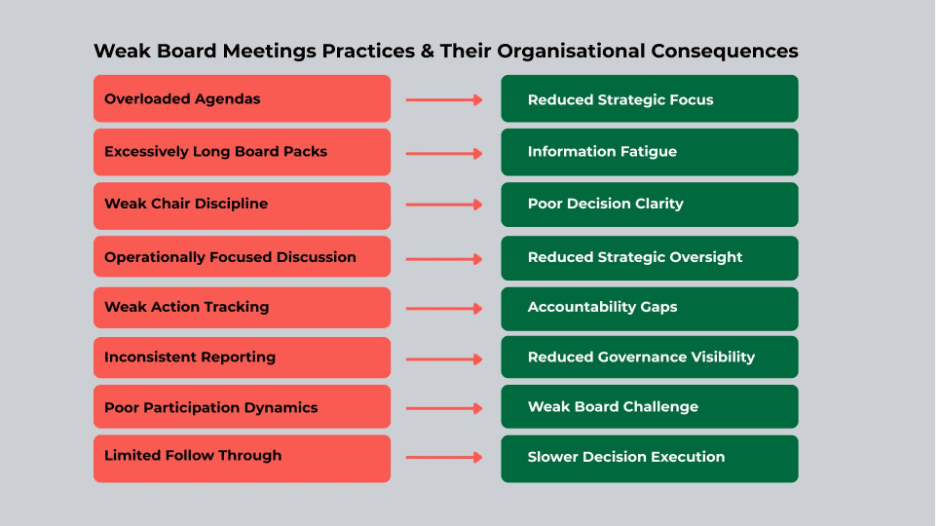
Key Insight:
Weak board meetings rarely fail dramatically. They gradually weaken governance quality through reduced visibility, weaker challenge and declining accountability discipline.
STATISTICS SNAPSHOT
70%+ of directors say boards spend insufficient time on long term strategy while many boards still spend the majority of meeting time reviewing operational reporting rather than discussing future organisational risk and organisational resilience.
Strong board effectiveness increasingly depends on strategic focus, governance visibility, and disciplined decision making.
Source: Chartered Governance Institute UK & Ireland
Why Many Board Meetings Become Ineffective
Weak board meetings are rarely caused by one issue alone. They usually reflect wider governance strain across the organisation.
Common causes include weak governance infrastructure, poor information flows, excessive operational reporting, limited strategic focus, fragmented oversight structures, weak accountability systems and inconsistent governance reporting.
Over time these weaknesses compound.
Meetings become reactive rather than strategic. Discussion replaces decision making while reporting replaces governance judgement.
This is how governance effectiveness quietly deteriorates inside many organisations.
The Hidden Cost of Poor Board Meeting Effectiveness
Weak board meetings create far more than administrative inefficiency.
They create governance risk.
Poor board effectiveness can contribute to delayed strategic decisions, weak risk escalation, reduced accountability, governance blind spots, slower organisational responsiveness, reduced board visibility and audit vulnerability.
The most dangerous aspect is that many of these weaknesses remain invisible until pressure exposes them publicly.
By the time governance problems become visible externally, board effectiveness may already have deteriorated significantly internally.
Research increasingly shows that weak governance structures reduce institutional performance and organisational resilience long before visible crisis emerges.
How Strong Boards Structure Better Meetings
High performing boards treat meetings as governance infrastructure rather than administrative routines.
They intentionally structure meetings around clear governance priorities, strategic oversight, accountability visibility, effective challenge, and disciplined decision making.
This often includes tighter agenda discipline, shorter and clearer board papers, stronger use of dashboards and summaries, more focused strategic sessions and better governance reporting structures.
Strong board meetings are rarely accidental.
They are intentionally designed to improve governance effectiveness.
Governance Technology Alone Will Not Fix Weak Meetings
Many organisations attempt to improve board effectiveness through governance technology alone.
Board portals and governance platforms can improve efficiency and reporting visibility, but technology cannot compensate for weak governance discipline.
Board effectiveness ultimately depends on governance structure, information quality, chair leadership, accountability systems, board culture and strategic focus.
Technology should support governance effectiveness.
It cannot replace governance judgement.
Board Meeting Effectiveness Is Becoming a Governance Priority
Boards increasingly face pressure to demonstrate governance accountability, effective oversight, strategic responsiveness, decision transparency and organisational resilience.
As organisational complexity grows, board meeting effectiveness is becoming a much more important governance capability issue because ineffective meetings eventually weaken governance itself.
Boards cannot govern complex organisations effectively if meetings lack structure, discipline or strategic focus.
That is why high performing organisations increasingly treat board effectiveness as part of core governance infrastructure.
Read More About Lumorus Governance Infrastructure & Board Effectiveness Advisory:
https://www.lumorus.com/capabilities/governance-and-board-advisory/
Board Meeting Effectiveness Maturity Model
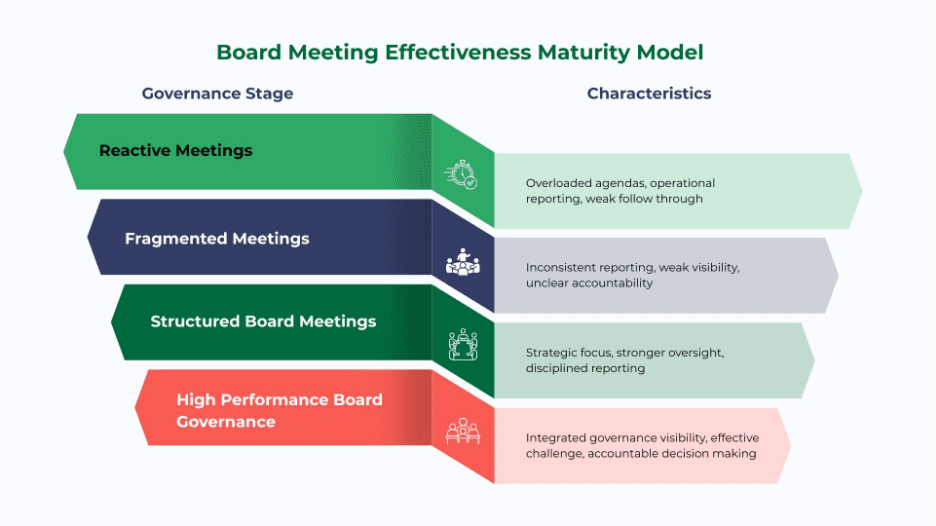
High Performing Organisations Treat Board Effectiveness as Strategic Infrastructure
The strongest organisations increasingly recognise that board meetings should function as strategic governance infrastructure.
They must be structured, focused, accountable, strategic, disciplined and visible.
This is particularly important for regulated organisations, investor backed companies, multi entity businesses, scaling organisations and governance intensive industries where board effectiveness directly shapes governance quality and organisational resilience.
High performing governance environments are rarely accidental.
They are built intentionally through governance systems, accountability structures and disciplined board leadership.
Why Lumorus Focuses on Board Effectiveness
Lumorus approaches board effectiveness through a governance infrastructure and accountability lens rather than purely administrative governance support.
Our work focuses on strengthening:
- Board effectiveness
- Governance visibility
- Strategic oversight
- Governance systems
- Accountability structures
- Governance diagnostics
- Decision discipline
- Organisational resilience
We believe weak board performance rarely begins with one failed meeting. It usually develops gradually through fragmented oversight, weak governance discipline and declining decision visibility over time.
That is why strong board effectiveness matters.
Because governance quality depends heavily on what happens inside the boardroom.
CTA
Lumorus is a UK headquartered global governance, ESG and advisory firm supporting organisations across Africa, Europe, Asia, the Caribbean, Canada and other international markets.
For more than 10+ years, Lumorus has helped boards, leadership teams and regulated organisations strengthen board effectiveness, governance visibility, strategic oversight and organisational accountability across complex operating environments.
We help organisations improve governance discipline, strengthen board reporting, enhance decision visibility and build governance systems capable of supporting stronger oversight, accountability and long term organisational resilience.
To explore Lumorus board effectiveness and governance advisory solutions, visit or book a consultation today:
Lumorus.com | [email protected]
Sources
- The Chartered Governance Institute UK & Ireland — How to Improve Board Performance
https://www.cgi.org.uk/resources/blogs/2025/how-to-improve-board-performance/
- Lumorus — Governance & Board Advisory
https://www.lumorus.com/capabilities/governance-and-board-advisory/