


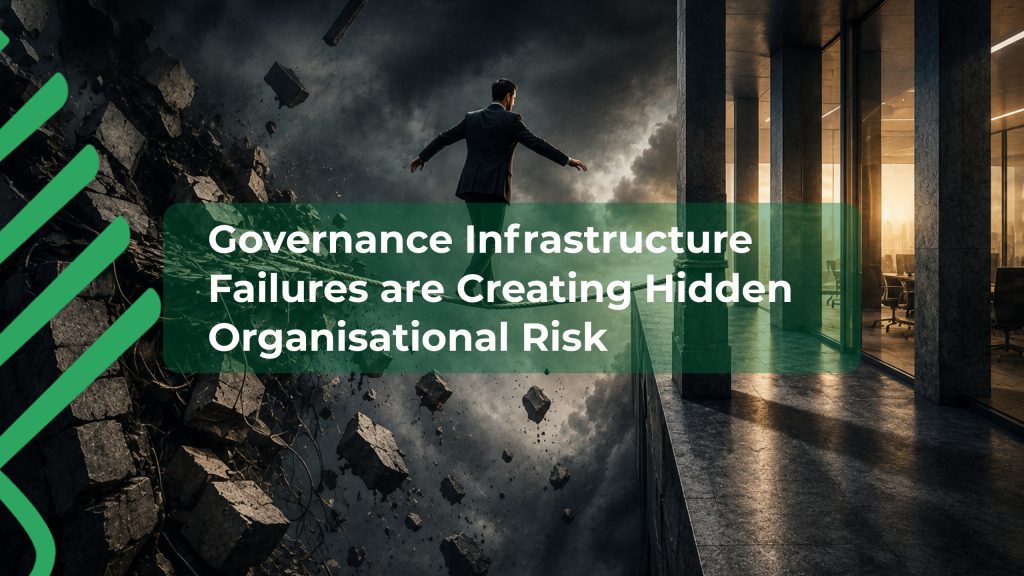
Most governance failures do not begin with scandals.
They begin with weak infrastructure.
Long before organisations experience regulatory investigations, operational breakdowns, audit failures or public scrutiny, governance systems often start deteriorating quietly beneath the surface.
Records become fragmented. Oversight weakens. Accountability becomes unclear. Critical decisions lose visibility.
Compliance monitoring becomes inconsistent, and governance increasingly depends on individuals rather than systems. Most boards underestimate how dangerous this becomes over time because governance infrastructure problems rarely appear dramatic in the early stages.
They appear operational, administrative, technical, and manageable until suddenly they are not.
That is why weak governance infrastructure is far more dangerous than many boards admit.
Research on governance failure increasingly shows that weak governance structures often create operational vulnerability long before visible failure emerges.
The Governance Readiness Gap Is Much Worse Than Most Organisations Realise
Many organisations believe they are governance ready because governance activity exists; meetings happen, policies exist, committees operate, and reports are circulated, but governance readiness is not measured by visible activity alone.
It is measured by whether governance systems can sustain accountability, oversight, and operational resilience under pressure.
That gap is becoming increasingly dangerous.
Recent governance research found that while 93% of organisations are already using advanced technologies like AI, only 7% have fully embedded governance frameworks into operational systems.
At the same time, only 4% of organisations believe they are fully prepared to support governance and compliance infrastructure at scale.
This highlights a growing governance contradiction:
Organisational complexity is accelerating faster than governance infrastructure maturity.
Explore More About Lumorus Governance & Board Advisory Services:
www.lumorus.com/capabilities/governance-and-board-advisory
Most Governance Failures Start Long Before the Crisis
Governance collapse is rarely sudden.
In most organisations, governance failure develops gradually through accumulated operational weakness.
This often includes:
- Fragmented Governance Systems
- Weak Oversight Structures
- Inconsistent Compliance Monitoring
- Poor Documentation Control
- Limited Board Visibility
- Weak Accountability Frameworks
- Manual Governance Processes
- Delayed Decision Escalation
Over time, these weaknesses compound.
The organisation may still appear compliant externally while governance capability deteriorates internally.
This creates what many governance professionals underestimate:
Invisible governance risk.
The World Bank’s Infrastructure Governance Framework highlights how weak governance arrangements undermine accountability, operational effectiveness and institutional resilience over time.
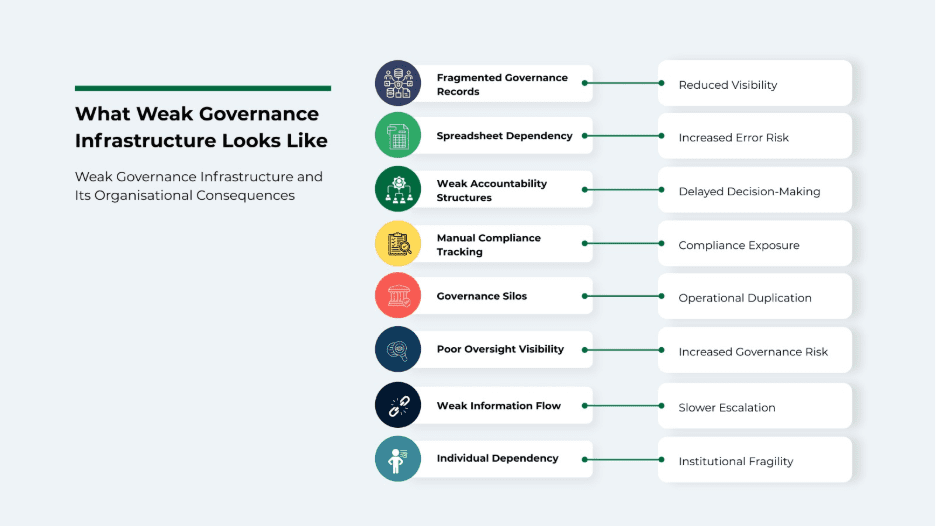
What Weak Governance Infrastructure Looks Like
Key Insight:
Governance failure rarely starts with scandal. It starts with fragmentation.
STATISTICS SNAPSHOT
93% of organisations already use AI technologies.
Only 7% have fully embedded governance frameworks.
97% of UK business leaders now believe organisations require dedicated trust and governance leadership structures.
Only 4% Of organisations feel fully prepared to support governance infrastructure at scale.
Governance Infrastructure Failures Create Hidden Organisational Risk
Weak governance infrastructure affects far more than compliance.
It directly impacts organisational resilience.
When governance systems become fragmented, organisations often experience:
- Reduced Oversight Visibility
- Slower Decision-Making
- Increased Compliance Risk
- Weak Risk Escalation
- Audit Vulnerability
- Operational Duplication
- Accountability Gaps
- Institutional Dependency on Individuals
The most dangerous aspect is that many of these risks remain invisible until pressure exposes them.
By the time regulators, auditors or stakeholders identify governance weakness publicly, the operational damage has often existed internally for years.
Research from governance and infrastructure studies increasingly shows that weak governance structures reduce institutional performance, delay decision making and increase operational fragility.
Weak Governance Infrastructure Is Usually a Systems Problem
Many boards approach governance problems as behavioural issues alone.
But governance weakness is often structural.
The issue is not simply whether leadership behaves responsibly.
The issue is whether governance systems are capable of sustaining accountability under pressure.
Weak infrastructure commonly includes:
- Disconnected Governance Records
- Manual Compliance Tracking
- Spreadsheet Dependency
- Poor Information Flow
- Weak Governance Reporting
- Fragmented Risk Oversight
- Inconsistent Governance Ownership
- Limited Cross-Functional Visibility
As organisations grow, these weaknesses become exponentially more dangerous.
What worked during early growth stages often becomes unsustainable once organisations expand across:
- Multiple Entities
- Regulatory Jurisdictions
- Investor Structures
- Governance Committees
- International Operations
- Complex Stakeholder Environments
Governance complexity grows faster than most governance systems evolve.
That creates infrastructure strain many boards fail to recognise early enough.
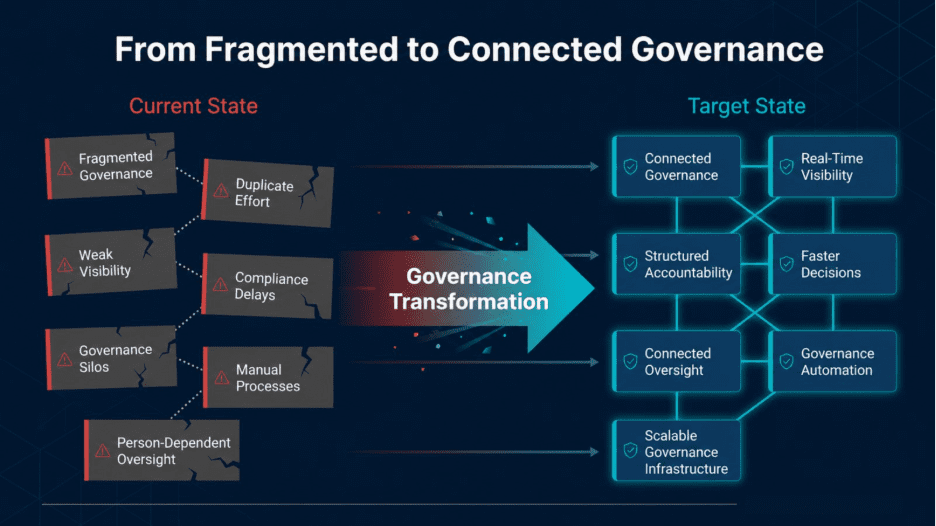
The Hidden Cost of Governance Fragmentation
Governance Infrastructure Failure Is Increasingly a Regulatory Issue
Regulators globally are placing greater emphasis on governance effectiveness, operational resilience and accountability infrastructure.
This shift reflects growing recognition that governance failures are rarely isolated incidents.
They are usually symptoms of deeper infrastructure weakness.
KPMG recently identified regulatory fragmentation across AI, cybersecurity, sustainability and governance oversight as one of the defining operational risks facing modern organisations.
The collapse of Silicon Valley Bank, for example, highlighted how governance and risk oversight failures can quietly escalate inside institutions despite apparent external stability.
Similarly, regulatory scrutiny of the Australian Securities Exchange (ASX) identified weak governance, poor accountability structures and inadequate risk management as systemic organisational risks.
These examples reinforce a broader reality:
Weak governance infrastructure creates institutional fragility long before operational failure becomes public.
Governance Risk Increases When Organisations Depend Too Heavily on Individuals
One of the clearest warning signs of weak governance infrastructure is excessive dependence on individuals.
This often appears when:
- Governance Knowledge Sits with One Person
- Compliance Tracking Depends on Manual Oversight
- Governance Processes Lack Standardisation
- Reporting Visibility Is Inconsistent
- Critical Records Are Difficult to Retrieve
- Oversight Functions Become Person-Dependent
This creates institutional vulnerability.
Because governance continuity should never rely entirely on institutional memory or individual operational discipline.
Strong governance infrastructure creates systems capable of sustaining organisational oversight regardless of personnel changes, operational pressure or organisational growth.
Weak governance infrastructure does the opposite.
It amplifies organisational fragility.
Research on operational governance resilience consistently shows that organisations become more vulnerable when governance processes rely heavily on individuals rather than structured systems.
The Real Cost of Weak Governance Infrastructure
Most organisations underestimate the actual cost of governance weakness because they evaluate governance too narrowly.
The cost is not limited to compliance fines.
Weak governance infrastructure can create:
- Strategic Delays
- Regulatory Exposure
- Reputational Damage
- Reduced Investor Confidence
- Operational Inefficiency
- Increased Audit Costs
- Weak Decision Accountability
- Reduced Organisational Agility
Governance fragmentation is increasingly recognised as a structural performance issue rather than simply an administrative problem.
Research shows fragmented governance environments create duplicated effort, inconsistent reporting and operational inefficiency that quietly reduce organisational performance over time.
The longer governance infrastructure remains fragmented, the harder it becomes to scale organisational oversight effectively.
Why Governance Infrastructure Is Becoming a Board level Priority
Boards increasingly face pressure to demonstrate:
- Governance Accountability
- Operational Visibility
- Risk Oversight
- Organisational Resilience
- Governance Transparency
- Compliance Control
This is pushing governance infrastructure closer to the centre of strategic organisational oversight.
Governance is no longer simply an administrative support function.
It is becoming core operational infrastructure.
Governance accountability is becoming so critical that 97% of UK business leaders now believe organisations require dedicated trust and governance leadership structures.
That means boards increasingly need governance systems capable of supporting:
- Real time visibility
- Structured accountability
- Connected governance
- Compliance monitoring
- Governance continuity
- Decision transparency
Without those systems, governance oversight weakens as organisational complexity grows.
Read More About Lumorus Governance Infrastructure Solutions:
https://www.lumorus.com/capabilities/governance-and-board-advisory/
Governance Infrastructure Maturity Model
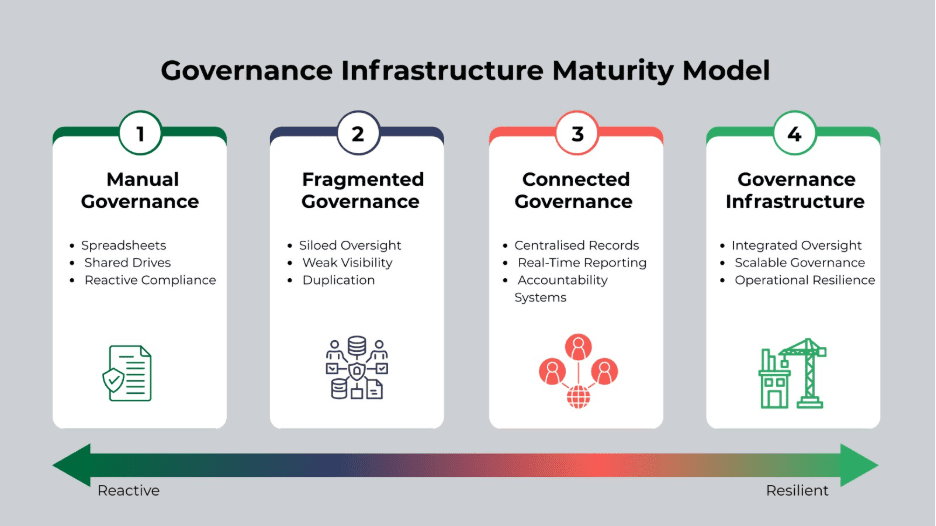
High performing Organisations Treat Governance Infrastructure as Strategic Infrastructure
The strongest organisations increasingly recognise that governance infrastructure should function like operational infrastructure.
It must be:
- Scalable
- Connected
- Visible
- Resilient
- Structured
- Accountable
This is particularly important for:
- Regulated organisations
- Multi-entity Businesses
- Investor backed Companies
- Scaling Organisations
- Governance-Intensive Industries
High performing governance environments are rarely accidental.
They are built intentionally through systems, governance architecture and accountability infrastructure.
Why Lumorus Focuses on Governance Infrastructure
Lumorus approaches governance through an infrastructure and accountability lens rather than purely administrative governance support.
Our work focuses on strengthening:
- Governance Systems
- Board Effectiveness
- Governance Visibility
- Compliance Infrastructure
- Governance Accountability
- Governance Risk Oversight
- Organisational Resilience
- Governance Continuity
We believe governance failure rarely begins with one catastrophic decision.
It usually begins with governance systems becoming fragmented, inconsistent and operationally weak over time.
That is why strong governance infrastructure matters.
CTA
Lumorus is a UK headquartered global governance, ESG and advisory firm supporting organisations across Africa, Europe, Asia, the Caribbean, Canada and other international markets.
For more than 10+ years, Lumorus has helped boards, leadership teams and regulated organisations strengthen governance infrastructure, board effectiveness, governance visibility, compliance oversight and organisational resilience across complex operating environments.
We help organisations move beyond fragmented governance processes by building connected governance systems capable of supporting accountability, operational resilience, regulatory readiness and long term organisational growth.
To explore Lumorus governance infrastructure and board advisory solutions, visit or book a Consultation today:
Lumorus.com | [email protected]
Sources
- Medium: The 30% Problem: Why Poor Governance Is Bleeding Organizations Dry
- TechRadar — The Rise of the Chief Trust Officer
- World Bank — Infrastructure Governance Assessment Framework
- Harvard / Academy of Management Perspectives — Governance Failure and Governance Under Failure
- The Australian — ASIC Says ASX Broken: Can the Exchange Fix Itself?
- DVMS Institute — Cyber Operational Resilience Through Integrated Governance
- Lumorus — Governance & Board Advisory