


Many organisations describe their governance as controlled because they have board calendars, statutory registers, approval processes, governance policies, committee structures and experienced Company Secretaries.
On paper, everything appears to be in place. However, beneath that apparent control, much of the governance system may still depend on people remembering what needs to happen next.
An experienced Company Secretary may know which approval is outstanding, where the latest register is stored, which version of a board paper is final and which statutory deadline cannot be missed. A governance manager may understand which director still needs to sign, which committee action remains open and which process will fail unless someone follows up manually.
That knowledge is valuable, but it can also create vulnerability; the problem is not that governance professionals are failing. In many organisations, the opposite is true: experienced professionals are compensating for structural weakness through personal discipline, memory, judgement and commitment, this creates a serious governance question:
Does governance rely on systems, or on the people holding the system together?
That question sits at the heart of an increasingly important conversation for boards, Company Secretaries, governance teams and General Counsel.
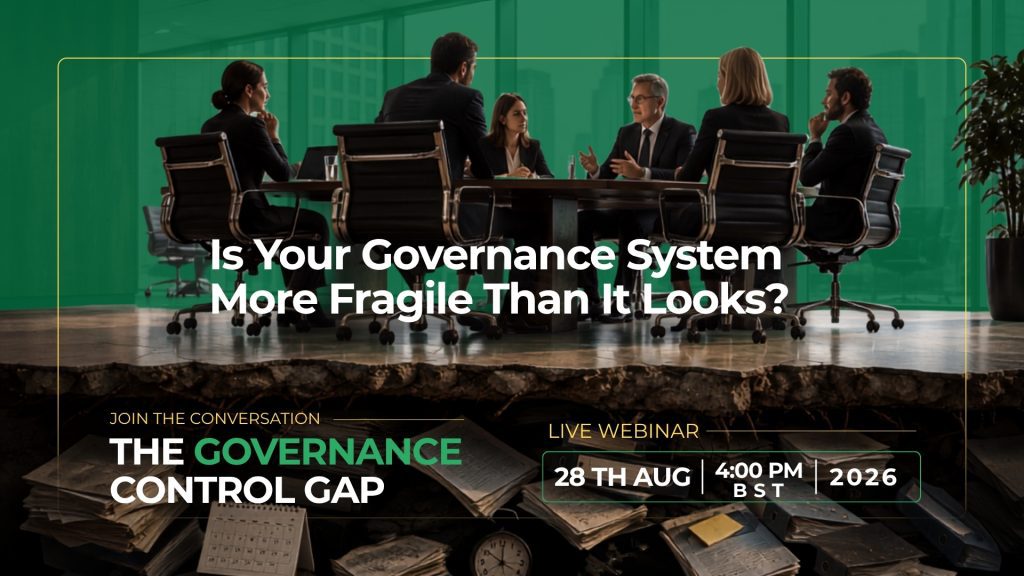
It is also the focus of an upcoming Lumorus webinar:
The Governance Control Gap: Why Most Company Secretary Models Are Structurally Broken
This is not a webinar about filing dates, minutes or routine administration. It is a discussion about governance operating models, organisational resilience and whether the infrastructure supporting governance has evolved at the same pace as the responsibilities now placed on the profession.
Professional excellence can hide structural weakness
One of the most uncomfortable truths in governance is that highly capable professionals can make weak systems look strong.
A Company Secretary who has been with an organisation for years often understands the governance environment instinctively. They know the history, the personalities around the board table, which approvals require additional attention and which obligations sit outside the formal calendar.
That experience creates enormous value, but it can also conceal the fact that the organisation itself may not have sufficiently resilient governance infrastructure; if the process works because one person remembers it, the process is not fully controlled, if the organisation depends on one individual knowing where key records are stored, governance knowledge has not been fully institutionalised, if approvals are monitored through personal follow-up rather than visible workflow, accountability remains vulnerable.
Boards can therefore confuse the competence of governance professionals with the strength of the governance operating model. Those are not the same thing.
Explore More: Governance Infrastructure
Governance risk often appears first as dependency
Key-person dependency is usually discussed in relation to leadership succession or operational resilience, but it should also be considered a governance risk.
A useful test is to ask what would happen if the person with the deepest knowledge of the governance process became unavailable.
Would the organisation still be able to:
- Run the board and committee cycle effectively?
- Meet statutory and regulatory obligations?
- Locate current statutory records?
- Track approvals and board actions?
- Retrieve governance history?
- Support directors with reliable information?
- Maintain continuity across entities and jurisdictions?
If the answer is uncertain, the organisation has identified a governance vulnerability; this does not diminish the value of the individual. It reveals how much the organisation depends on them.
The risk becomes more significant as the organisation grows because complexity multiplies:
- More entities create more obligations.
- More jurisdictions create more variation.
- More directors create more governance coordination.
- More committees create more reporting.
- More regulation creates more interpretation.
- More stakeholders create greater accountability.
The organisation may look increasingly sophisticated while becoming more fragile beneath the surface.
Read More: Corporate Governance Support
The real problem is not people. It is unsupported people
It would be easy to frame this debate as technology versus people, but that would miss the point, governance will always require professional judgement.
Boards need experienced advisers, Company Secretaries need to interpret obligations and support directors, while General Counsel and governance leaders must understand context, risk and institutional history; no technology can replace that.
The real issue is whether governance professionals are being forced to carry operational risk personally because the supporting infrastructure is weak.
A strong governance model should allow professionals to spend more time on:
- Board judgement and decision support.
- Director advice.
- Regulatory interpretation.
- Risk escalation.
- Strategic governance.
- Stakeholder accountability.
- Governance improvement.
It should reduce the time spent reconstructing information, chasing versions, remembering deadlines and manually connecting disconnected processes; good infrastructure does not replace governance expertise, it protects it.
What the governance control gap looks like in practice
The governance control gap is rarely dramatic. In fact, it often appears through small symptoms that organisations gradually normalise.
Common Signs of the Governance Control Gap
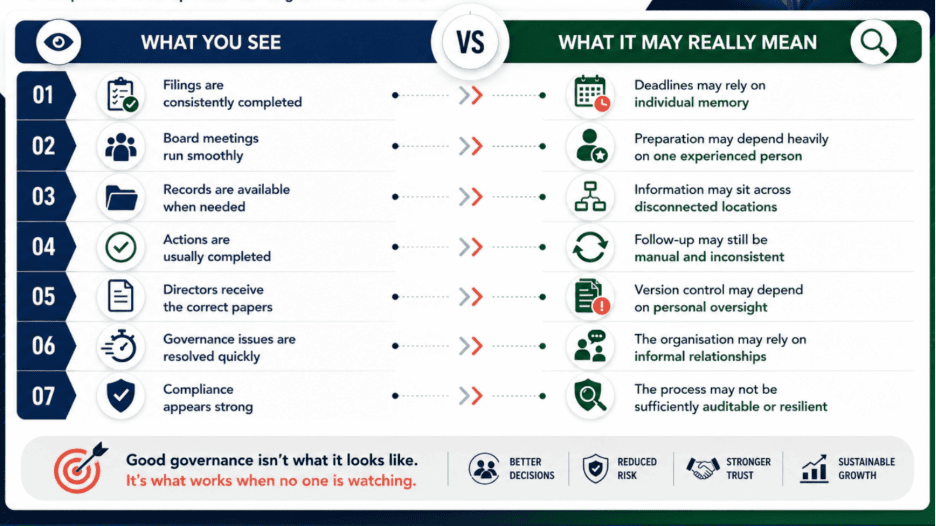
These are not necessarily governance failures, but they are warning signs; the real test is whether governance success can be reproduced consistently regardless of who is in the role, if it cannot, the organisation may have professional excellence without structural resilience.
Governance infrastructure should make control visible
Strong governance infrastructure creates visibility across the organisation.
At any point, leadership should be able to understand:
- Which obligations are outstanding.
- Who owns each obligation.
- Which approvals remain incomplete.
- Which actions are overdue.
- Which entity records require updating.
- Which board decisions require follow-through.
- Which regulatory deadlines are approaching.
- Which governance risks require escalation.
This is not simply about efficiency; visibility strengthens accountability.
When information is centralised and responsibility is explicit, governance becomes less dependent on institutional memory and more capable of withstanding change.
That is a resilience issue as much as a process issue.
Explore More: Statutory & Regulatory Compliance
Boards should ask whether governance can survive absence
A simple board-level question can reveal a great deal:
What happens if the most experienced governance professional is unavailable for three months?
If the answer exposes uncertainty around records, approvals, deadlines, committee cycles or regulatory obligations, then the organisation has identified a structural risk.
Strong governance should not require heroics; it should be supported by systems, documented processes, clear responsibilities and visible accountability.
That does not remove the importance of experienced people. Instead, it ensures the organisation is not dependent on invisible knowledge that disappears when someone leaves, takes extended absence or changes role.
Technology can reduce fragility, but only if the operating model is clear
Technology is often presented as the solution to governance complexity; sometimes it helps significantly; sometimes it simply digitises fragmentation.
A governance platform can centralise records, track deadlines, automate workflows and improve reporting. However, if responsibilities remain unclear, the organisation has simply made confusion faster. Technology works best when it supports a clear governance operating model.
Before introducing a platform, organisations should understand:
- Who owns each governance responsibility.
- Which decisions belong to the board.
- Which decisions are delegated to management.
- What must be escalated.
- How governance information flows.
- Where records are maintained.
- How actions are monitored.
- How assurance is provided.
The sequence matters.
Operating model first. Technology second.
The strongest Company Secretary models combine people and systems
The future Company Secretary model should not be built around software alone, nor should it rely entirely on experienced individuals.
It should combine the strengths of both.
- People provide judgement, while systems provide continuity.
- People interpret, while systems provide visibility.
- People challenge, while systems provide evidence.
- People advise, while systems reduce dependency.
That combination creates governance resilience.
For growing organisations, this matters because complexity can outpace the capacity of traditional Company Secretary operating models.
A model that worked for five entities may not work for fifty. A governance team designed for one jurisdiction may struggle across ten, while a process that depends on personal familiarity may fail during leadership transition, the infrastructure must evolve alongside the organisation.
This is the conversation Lumorus is opening
At Lumorus, we have found ourselves returning to the same question:
Why do so many organisations describe governance as controlled when so much still depends on individual knowledge?
This is not a criticism of the profession; it is a recognition of how much the profession is being asked to carry.
Experienced Company Secretaries, governance teams and General Counsel quietly bridge operational gaps every day. They ensure that obligations are met, records are maintained, boards remain informed and decisions continue to move forward, often without the wider organisation fully appreciating the complexity involved.
That dedication is one of the profession’s greatest strengths, it may also be one of its greatest vulnerabilities, that is why we are hosting:
The Governance Control Gap: Why Most Company Secretary Models Are Structurally Broken
The webinar will explore:
- Why governance resilience is often overstated.
- Where key-person dependency creates hidden risk.
- How governance operating models fail to scale.
- Why technology alone is not enough.
- What stronger governance infrastructure looks like.
- How boards and Company Secretaries can reduce structural dependency.
- How governance teams can move from manual continuity to institutional resilience.
This discussion is designed for Company Secretaries, governance professionals, General Counsel, board advisers and leaders responsible for organisational accountability.
Why this matters now
Governance expectations are rising, regulatory obligations are expanding and boards face increasing scrutiny, yet many governance operating models have not fundamentally changed.
Instead, governance teams compensate; they work harder, remember more, create workarounds and quietly ensure that the system continues to function, that can work for years. The danger is that organisations begin to interpret continuity as evidence of resilience.
In reality, continuity may simply reflect the extraordinary commitment of a small number of professionals. Resilient governance should not depend on extraordinary effort, it should be designed to work consistently.
A stronger question for boards
Boards often ask whether governance is working, a better question is:
Would governance still work if the people who know the system best were suddenly unavailable?
That question tests more than process, it tests whether:
- Knowledge has been institutionalised.
- Responsibilities are clearly documented.
- Information is accessible.
- Accountability remains visible.
- Governance can continue without relying on individual memory.
Those are the questions that reveal whether governance is genuinely controlled.
Join the conversation
If you are a Company Secretary, governance professional, General Counsel or board adviser, your perspective matters.
The best governance conversations rarely happen in isolation. They happen when experienced professionals compare what is working, where systems are under strain and what needs to evolve next.
We would be delighted to have you join us.
The Governance Control Gap: Why Most Company Secretary Models Are Structurally Broken
If you know colleagues who are equally passionate about the future of governance, please share the invitation with them.
Lumorus: Better Business, Built on Purpose
Lumorus is a UK headquartered global governance, ESG, company secretary and advisory firm supporting organisations across Europe, Africa, Asia, the Caribbean, Canada, the Middle East and international markets.
For more than 10 years, we have helped boards, leadership teams and organisations strengthen governance, accountability and organisational resilience.
We believe governance should not depend on memory, heroics or invisible workarounds. It should be supported by systems, processes and accountability structures that allow experienced professionals to focus on judgement, leadership and effective governance.
Does your governance rely on systems, or on the people holding the system together?
Join the conversation.
Email: [email protected]