


Most boards do not see governance infrastructure as a risk until it is too late
Boards spend significant time discussing enterprise risk.
Cybersecurity is reviewed.
Financial risks are assessed.
Regulatory exposures are monitored.
Operational resilience is scrutinised.
Strategic threats are debated.
Yet one of the fastest-growing enterprise risks often receives surprisingly little attention.
Governance infrastructure.
Many boards assume governance is functioning because meetings are taking place, reports are being produced and compliance obligations appear to be under control.
From the outside, governance looks healthy.
Beneath the surface, however, a different picture often emerges.
Critical information is fragmented.
Entity records are scattered across multiple systems.
Board actions are inconsistently monitored.
Compliance obligations depend on spreadsheets and individual knowledge.
Decision-making is difficult to evidence.
Accountability is unclear.
The organisation appears governed.
In reality, governance may be significantly more fragile than directors realise.
According to the Financial Reporting Council (FRC), effective governance depends on high-quality information, clear accountability and robust oversight processes. When these foundations weaken, governance effectiveness can deteriorate rapidly.
Read More: Governance Infrastructure Design
Governance infrastructure is not an administrative issue
One of the most persistent governance misconceptions is that governance infrastructure is primarily an operational concern.
It is not.
Governance infrastructure determines how effectively an organisation allocates authority, monitors accountability, manages risk and supports decision-making.
Strong governance infrastructure provides:
- Clear decision rights
- Reliable information flows
- Accountability mechanisms
- Oversight processes
- Governance visibility
- Organisational memory
Weak governance infrastructure creates the opposite.
Information becomes fragmented.
Responsibilities become unclear.
Oversight becomes inconsistent.
Decision-making becomes difficult to evidence.
Risk becomes harder to identify.
What begins as an operational weakness can quickly become an enterprise-wide issue.
Enterprise risk often starts with governance visibility failures
Many governance failures begin with seemingly minor issues.
A board action is not tracked.
A regulatory filing is delayed.
A subsidiary record is not updated.
A committee decision is not properly documented.
A risk escalation never reaches the board.
Individually, these events may appear insignificant.
Collectively, they create conditions where larger failures become possible.
According to the OECD Principles of Corporate Governance, effective governance requires transparency, accountability and timely information flows to support informed oversight and decision-making.
Without visibility, boards often discover governance problems only after they have evolved into operational, regulatory or reputational risks.
Most organisations grow faster than their governance systems
Growth creates complexity.
Complexity creates governance pressure.
Many organisations invest heavily in:
- Technology infrastructure
- Operational systems
- Financial controls
- Commercial capability
Governance systems often receive less attention.
As organisations expand, new entities are created.
Boards become larger.
Operations cross jurisdictions.
Regulatory obligations increase.
Stakeholder scrutiny intensifies.
Yet governance processes frequently remain largely unchanged.
The organisation becomes more sophisticated.
The governance infrastructure does not.
This gap creates hidden risk.
The warning signs often appear long before the crisis
Governance failures rarely emerge without warning.
The indicators are usually visible.
Common warning signs include:
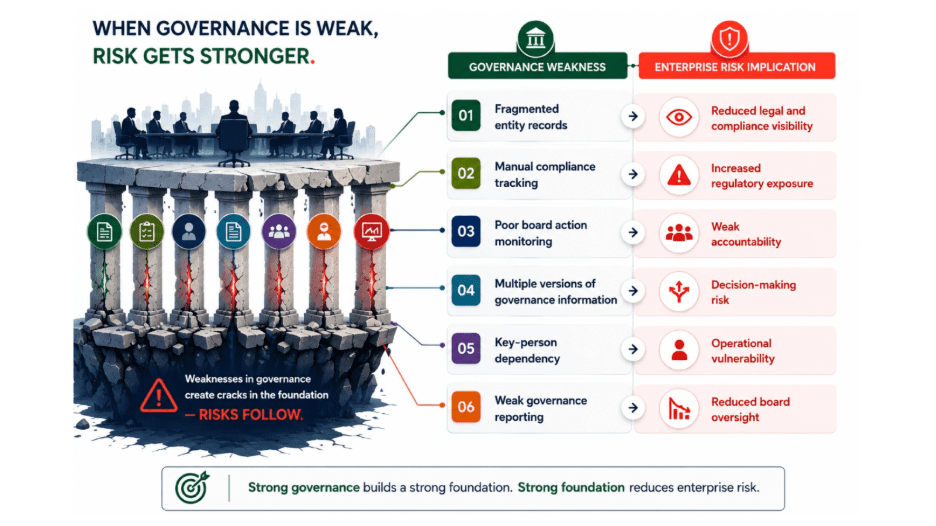
According to the Chartered Governance Institute UK & Ireland, governance effectiveness depends heavily on the quality of information available to decision-makers and the systems used to support governance activities.
The challenge is that these issues are often viewed as administrative concerns until they become strategic problems.
Boards often see the symptoms rather than the root cause
When governance issues emerge, organisations often focus on visible failures.
Missed filings.
Delayed approvals.
Compliance breaches.
Board effectiveness concerns.
Regulatory findings.
These are symptoms.
The root cause is frequently infrastructure.
A board cannot govern effectively if governance information is fragmented.
Management cannot execute governance responsibilities consistently if accountability is unclear.
Risk oversight becomes weaker when information flows are unreliable.
The problem is not necessarily the quality of people.
The problem is often the quality of the governance system supporting them.
Read More: Board Evaluation & Assessment
Weak governance infrastructure undermines board decision-making
Good decisions depend on good information.
Boards rely on governance infrastructure to provide visibility into:
- Risks
- Obligations
- Actions
- Accountability
- Compliance status
- Strategic issues
When governance infrastructure is weak, information quality often deteriorates.
Reports become reactive.
Risks emerge unexpectedly.
Board discussions focus on symptoms rather than causes.
Decision-making becomes more difficult.
According to the World Economic Forum, resilient organisations increasingly depend on governance systems capable of providing timely, reliable and decision-useful information to leadership and boards.
Without this capability, oversight quality inevitably suffers.
Read More: Board Decision and Risk Assessment
The board capability challenge
Governance infrastructure alone is not enough.
Boards also require the capability to use governance information effectively.
Many organisations focus heavily on governance processes while paying insufficient attention to board capability.
Questions worth asking include:
- Does the board possess the skills required to oversee emerging risks?
- Are directors equipped to challenge management effectively?
- Is the board composition aligned with organisational complexity?
- Are governance discussions focused on strategic risks or administrative matters?
According to research from Spencer Stuart and various board effectiveness studies, board capability remains one of the strongest predictors of governance quality.
Infrastructure and capability must work together.
Read More: Board Skill Audit
Read More: Director CPD Training
Governance resilience depends on preparation
Many governance weaknesses become visible during periods of disruption.
Leadership transitions.
Regulatory investigations.
Mergers and acquisitions.
Operational crises.
Cyber incidents.
Reputational challenges.
These events test governance systems.
Organisations with strong governance infrastructure typically recover faster because accountability, information and decision-making processes remain intact.
Organisations with weak infrastructure often struggle.
Governance resilience is rarely built during a crisis.
It is built beforehand.
Read More: Director Induction
Strong governance infrastructure creates strategic advantage
Governance infrastructure is often viewed through a risk lens.
It should also be viewed through a performance lens.
Strong governance infrastructure helps organisations:
- Improve oversight
- Accelerate decision-making
- Strengthen accountability
- Increase organisational resilience
- Enhance stakeholder confidence
- Support sustainable growth
Good governance does not merely reduce risk.
It improves organisational performance.
This is why leading organisations increasingly view governance infrastructure as a strategic asset rather than an administrative function.
Read More: Board Strategy Sessions
The future belongs to organisations that treat governance as infrastructure
Many organisations continue to view governance as compliance.
The strongest organisations view governance differently.
They view governance as infrastructure.
Just as no organisation would operate without financial systems or technology systems, governance systems are becoming equally important.
This matters because governance ultimately determines how power is exercised, monitored, challenged and held accountable.
When governance infrastructure is strong, organisations become more resilient, more transparent and better equipped to manage complexity.
When governance infrastructure is weak, risk accumulates quietly.
And by the time the board notices, the problem is often much larger than expected.
Because weak governance infrastructure is rarely an administrative problem.
It is an enterprise risk.
Lumorus: Better Business, Built on Purpose
At Lumorus, we believe governance is not paperwork.
It is the allocation, exercise, constraint and accountability of power within organisations.
Lumorus is a global governance, ESG, company secretarial and advisory firm helping boards, executives and organisations strengthen governance effectiveness, accountability systems and long-term organisational resilience.
Our governance expertise includes:
We help organisations move beyond governance compliance towards governance capability.
To learn more, visit:
Together, we can build better business: one that performs with purpose, leads with integrity and creates lasting value.