


Most organisations believe they have governance because they have meetings, policies, directors, and compliance processes.
Many do not actually have governance infrastructure.
That distinction matters far more than most leadership teams realise.
Governance infrastructure is one of the least understood but most important foundations of organisational resilience. It determines whether accountability functions properly, whether oversight is effective, whether decisions are traceable, and whether governance can operate under pressure.
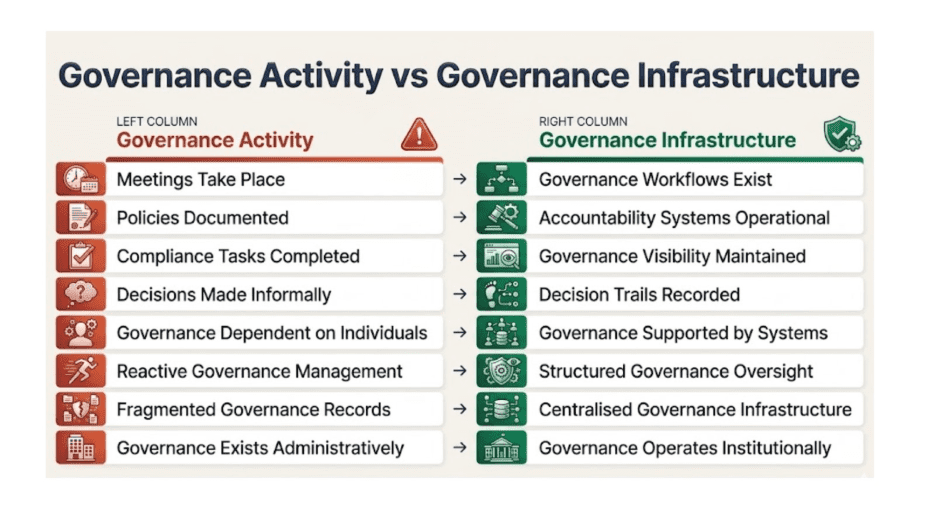
The problem is that many organisations mistake governance activity for governance capability.
Board meetings happen. Committees exist. Policies are documented. Compliance obligations are addressed eventually. But governance infrastructure is not simply the existence of governance components. It is the system that connects governance into a functioning operational architecture.
Without that architecture, governance becomes fragmented, reactive, and heavily dependent on individuals rather than systems.
This is why many organisations appear governable during normal operations but struggle during crises, audits, rapid growth, investor scrutiny or regulatory review.
The issue is not usually the absence of governance intentions. It is the absence of governance infrastructure.
What Governance Infrastructure Actually Means
Governance infrastructure refers to the systems, structures, workflows, accountability mechanisms, and operational processes that allow governance to function consistently, visibly, and effectively across an organisation.
It is the underlying operating architecture that supports:
- Board Oversight
- Accountability
- Compliance
- Decision making
- Risk Governance
- Reporting
- Governance Continuity
- Institutional Transparency
Governance infrastructure is not a single policy or department.
It is the operational ecosystem that makes governance work in practice rather than merely on paper.
According to the OECD, effective governance infrastructure requires coherent systems of accountability, institutional coordination, transparency, oversight and decision-making capability capable of supporting long-term organisational and strategic performance.
Governance Activity vs Governance Infrastructure
Why Most Companies Think They Have Governance Infrastructure
Most organisations mistake governance components for governance systems.
For example:
- Having a Board Is Not Governance Infrastructure
- Having Policies Is Not Governance Infrastructure
- Having Committees is not Governance Infrastructure
- Having Compliance Activity is not Governance Infrastructure
Governance infrastructure exists only when these elements operate together through clear accountability structures, information flows, workflows, and operational governance discipline.
This is where many organisations fail.
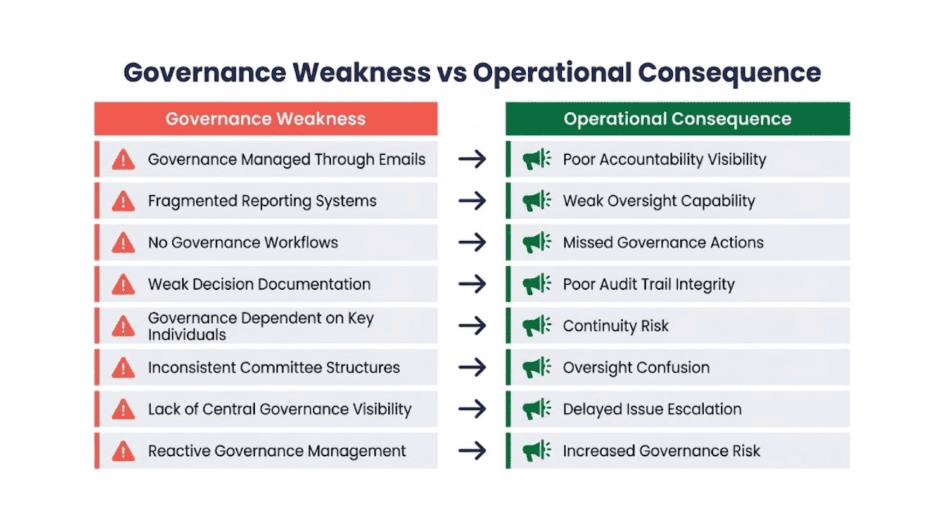
Governance responsibilities become spread across departments without central visibility. Governance actions are tracked manually. Decision-making records become fragmented. Reporting structures evolve inconsistently over time.
As organisations grow, governance complexity increases faster than governance capability.
The result is governance that appears functional externally while operating inefficiently internally.
The Governance Design Problem Most Organisations Ignore
Most companies build operational infrastructure seriously.
They invest in:
- Finance Systems
- IT Systems
- Operational Systems
- Customer Systems
- Cybersecurity Systems
- Workflow Systems
Governance is often treated differently.
Instead of structured infrastructure, governance evolves organically through informal processes, legacy practices, and fragmented ownership.
This creates several hidden weaknesses simultaneously:
- Accountability Ambiguity
- Weak Oversight Visibility
- Governance Duplication
- Operational Silos
- Delayed Escalation
- Inconsistent Governance Records
- Governance Continuity Risk
The organisation grows operationally faster than its governance architecture evolves.
This is one reason governance failures frequently emerge during periods of growth, restructuring, or external scrutiny.
Common Signs an Organisation Lacks Governance Infrastructure
Governance Infrastructure Is About Operational Visibility
One of the most important functions of governance infrastructure is visibility.
Strong governance infrastructure allows organisations to answer critical questions quickly:
- Who Owns This Governance Issue?
- Was The Decision Formally Approved?
- Which Actions Remain Outstanding?
- What Risks Require Escalation?
- Which Subsidiary Is Non-Compliant?
- Where Are Governance Bottlenecks Emerging?
- What Evidence Supports This Decision?
Without governance infrastructure, organisations often struggle to answer these questions clearly.
This becomes particularly dangerous during:
- Investor Due Diligence
- Regulatory Reviews
- Audits
- Acquisitions
- Refinancing Exercises
- Governance Investigations
- Organisational Crises
Weak governance infrastructure usually remains invisible until scrutiny intensifies.
Then the operational gaps surface quickly.
Why Governance Infrastructure Is Becoming More Important
The governance expectations placed on organisations are expanding rapidly.
Boards are now expected to oversee increasingly complex areas including:
- ESG And Sustainability Governance
- AI Governance And Technology Ethics
- Cyber Resilience
- Stakeholder Accountability
- Cross-Border Operations
- Operational Risk
- Culture And Conduct Risk
- Regulatory Compliance
This level of complexity cannot be managed effectively through fragmented governance administration alone.
Organisations increasingly require governance infrastructure capable of supporting institutional accountability at scale.
According to the World Bank framework on infrastructure governance, effective governance systems require institutional coordination, clear accountability structures, transparency mechanisms and long-term operational capability to support resilience and sustainable performance.
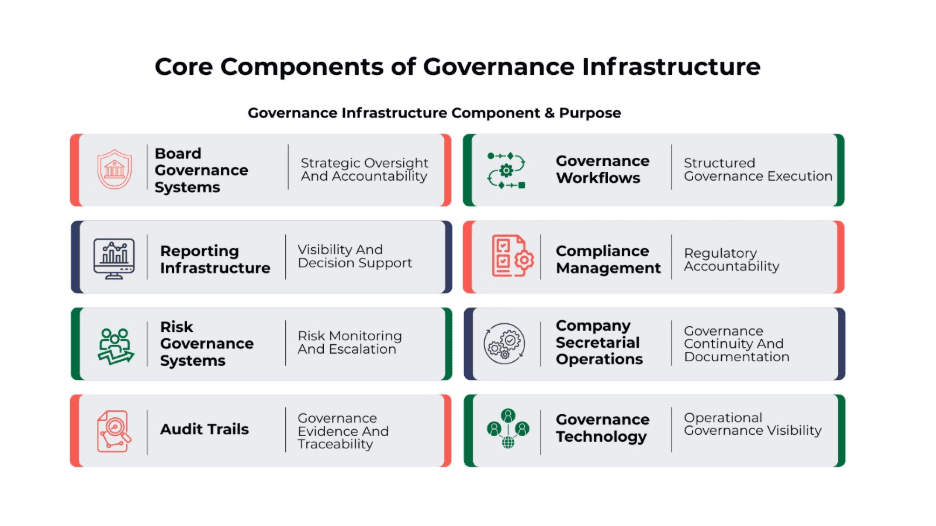
Core Components of Governance Infrastructure
The Hidden Cost of Weak Governance Infrastructure
Weak governance infrastructure creates costs many organisations underestimate initially.
These include:
- Delayed Decisions
- Duplicated Governance Effort
- Compliance Inefficiencies
- Weak Accountability
- Investor Concern
- Operational Disruption
- Governance Remediation Costs
- Reputational Exposure
In many cases, organisations only recognise these weaknesses after operational pressure increases.
This is why governance infrastructure often becomes most visible during organisational stress.
The businesses that appear highly effective during stable periods may reveal serious governance fragility during scrutiny or disruption.
Strong governance infrastructure improves organisational resilience because accountability and visibility continue functioning even under pressure.
Case Study: The Organisation That Outgrew Its Governance Systems
A fast-growing regional organisation expanded rapidly across several jurisdictions over five years.
Commercially, performance was strong. New subsidiaries were added quickly. Leadership focused heavily on operational growth.
However, governance systems failed to scale alongside the organisation.
Governance responsibilities became fragmented across departments. Reporting structures evolved inconsistently. Board approvals were difficult to track centrally. Governance records sat across multiple systems and individuals.
During an external investment review, governance weaknesses became immediately visible.
The issue was not misconduct. The issue was infrastructure.
The organisation had operational scale without governance scale.
Following a governance redesign process, the organisation centralised governance workflows, clarified accountability structures and implemented stronger governance visibility systems.
Governance became measurable and operationally coordinated rather than fragmented and reactive.
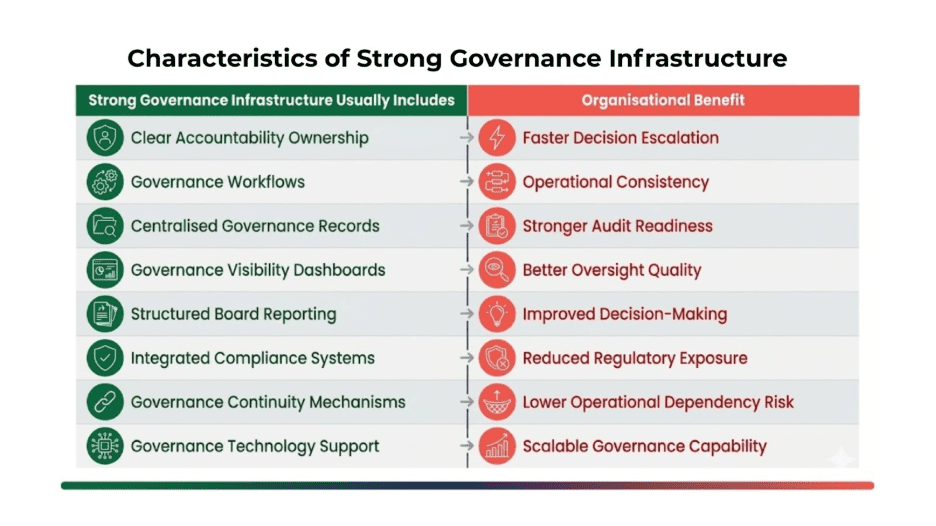
Characteristics of Strong Governance Infrastructure
Governance Infrastructure Is No Longer Optional
Many organisations still treat governance as a support activity.
Increasingly, governance functions more like institutional operating infrastructure.
It shapes:
- How Accountability Works
- How Decisions Are Governed
- How Risks Escalate
- How Oversight Functions
- How Trust Is Maintained
- How Organisations Respond Under Pressure
The strongest organisations understand this clearly.
They invest in governance systems before governance weaknesses become commercially visible.
Because ultimately, governance infrastructure determines whether governance exists merely as administration or operates as institutional capability.
And increasingly, that distinction separates resilient organisations from vulnerable ones.
Lumorus: Better Business, Built on Purpose
At Lumorus, we believe Being Good is Better for Business.
We help organisations lead with integrity, govern with confidence, and create value that lasts. Through our work across Governance Advisory, Company Secretary Service and ESG-Social Impact Consulting, we support boards, executives and leadership teams to strengthen accountability, improve decision making and build resilient, responsible organisations.
With offices and expert teams across the UK, Africa, the Caribbean, Latin America and Canada, and clients operating globally, Lumorus brings international perspective, specialist expertise and practical judgement to every engagement.
Whether you are strengthening governance infrastructure, improving board oversight, operationalising governance workflows or building more resilient accountability systems, Lumorus is here to help you move from intention to action.
Together, we can build better business: one that performs with purpose, leads with integrity and creates lasting value for people, planet and profit.
To continue the conversation, visit:
www.lumorus.com
[email protected]
Sources
- OECD — Infrastructure Governance \nhttps://www.oecd.org/en/topics/sub-issues/infrastructure-governance.html
- World Bank — Towards a Framework for the Governance of Infrastructure \nhttps://ppp.worldbank.org/sites/default/files/2022-03/Towards-a-Framework-for-the-Governance-of-Infrastructure.pdf