


Financial services firms operate in one of the most highly regulated and scrutinised sectors in the world.
Risk is monitored continuously.
Capital adequacy is measured.
Compliance obligations continue to grow.
Technology is transforming how firms operate.
Yet one of the greatest risks facing financial institutions is often underestimated.
Poor corporate governance.
Governance failures rarely begin with a major scandal.
They begin with small weaknesses.
Unclear accountability.
Poor board oversight.
Ineffective challenge.
Weak decision making.
Fragmented governance processes.
Over time, these weaknesses accumulate.
Eventually, they become financial, operational and reputational risks.
According to Grant Thornton, organisations often underestimate the true cost of governance and oversight until governance failures result in regulatory intervention, operational disruption or significant financial consequences.
Read More: Corporate Governance Support
Poor governance is expensive long before regulators become involved
Many firms associate governance costs with compliance.
The real costs are far greater.
Weak governance affects how decisions are made, risks are managed and accountability is exercised.
The consequences often include:
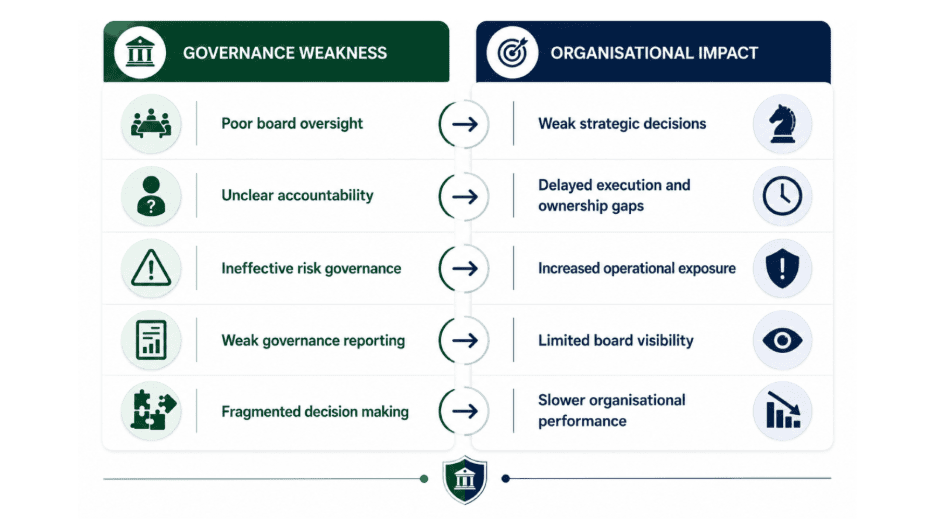
These costs rarely appear as a single line within financial statements.
They emerge through reduced resilience, slower decisions and missed opportunities.
Governance failures are rarely isolated events
When governance breaks down, the consequences rarely remain confined to one area of the business.
A missed oversight responsibility can affect risk management.
Weak governance information can affect strategic decisions.
Poor committee reporting can affect regulatory compliance.
Limited board challenge can allow risks to escalate unnoticed.
According to the OECD Principles of Corporate Governance, effective governance depends on clear accountability, sound oversight and informed board judgement.
Governance is a system.
When one part weakens, the entire organisation becomes more vulnerable.
The financial services sector faces unique governance challenges
Financial institutions operate within an environment of continuous change.
New regulations emerge.
Cyber threats evolve.
Artificial intelligence introduces new opportunities and new risks.
Customer expectations continue to rise.
Boards are expected to oversee increasingly complex organisations while making timely strategic decisions.
This requires governance systems capable of supporting effective oversight rather than simply documenting compliance.
Strong governance enables firms to respond confidently to uncertainty.
Weak governance magnifies it.
Good governance improves the quality of decision making
The strongest financial services firms understand that governance is not an administrative function.
It is a strategic capability.
Good governance improves:
Strategic oversight.
Risk management.
Regulatory readiness.
Decision quality.
Board effectiveness.
Stakeholder confidence.
Resilience.
When governance information is timely, accurate and actionable, boards are better equipped to make informed decisions.
Better governance produces better outcomes.
Governance infrastructure is becoming a competitive advantage
Historically, governance was often viewed as a compliance obligation.
Today, it is becoming a source of organisational strength.
Financial institutions with mature governance frameworks are better positioned to:
Respond to regulatory change.
Manage emerging risks.
Strengthen board oversight.
Improve investor confidence.
Support sustainable growth.
This is why leading organisations increasingly invest in governance capability rather than waiting for governance failures to expose weaknesses.
Read More: Governance Infrastructure Design
Boards should measure the cost of weak governance before it becomes visible
Many governance failures remain hidden until an external event exposes them.
A regulatory inspection.
An internal control failure.
A customer complaint.
A cyber incident.
A strategic decision that should have been challenged.
The question boards should ask is not whether governance is working.
It is whether governance is capable of supporting the organisation’s future.
Regular Board Evaluation & Assessment exercises and Board Decision and Risk Assessment reviews help organisations identify governance weaknesses before they become enterprise risks.
Preventing governance failures is significantly less costly than recovering from them.
The strongest financial institutions invest in governance before problems emerge
The most resilient organisations do not wait for governance to fail.
They continuously strengthen it.
They recognise that governance is not simply about satisfying regulators.
It is about improving decisions.
Clarifying accountability.
Strengthening oversight.
Protecting long-term value.
In financial services, trust is one of the most valuable assets an organisation possesses.
Strong governance protects that trust.
Weak governance quietly erodes it.
Lumorus: Better Business, Built on Purpose
At Lumorus, we believe governance is not paperwork.
It is the allocation, exercise, constraint and accountability of power inside organisations.
Lumorus is a UK headquartered global governance, ESG, company secretary and advisory firm supporting organisations across Europe, Africa, Asia, the Caribbean, Canada, the Middle East and international markets.
We help boards, regulated firms and leadership teams strengthen governance capability, improve oversight and build resilient governance frameworks that support long-term value creation.
Our expertise includes:
If your organisation is navigating increasing regulatory expectations, operational complexity or strategic transformation, now is the time to assess whether your governance framework is equipped to support the future.
Visit Lumorus to discover how we can help strengthen governance, improve board effectiveness and build lasting organisational resilience.
Website: lumorus.com
Email: [email protected]
Together, we can build better business: one that performs with purpose, leads with integrity and creates lasting value.
Sources
- Grant Thornton – The Cost of Governance and Oversight
- OECD – G20/OECD Principles of Corporate Governance
- Financial Stability Board – Resources on financial sector governance and resilience
- The Chartered Governance Institute UK & Ireland – Guidance on board effectiveness and governance