


Most organisations already use ticketing systems to manage IT support, procurement workflows and operational incidents.
Very few use them properly for governance.
That is becoming a major weakness.
As organisations scale, governance complexity expands rapidly. Board actions multiply. Regulatory obligations increase. Subsidiary oversight becomes harder to coordinate. Compliance requests arrive continuously across different teams, jurisdictions and timelines.
Yet governance inside many organisations is still managed through fragmented emails, spreadsheets, calendar reminders and disconnected conversations.
This creates a dangerous operational illusion. Leadership teams believe governance is functioning because governance activity is happening. But governance is not measured by activity alone. It is measured by visibility, accountability, traceability and evidence.
Without structured governance workflows, organisations often lose visibility over who is responsible for what, whether actions were completed properly and whether governance obligations can be evidenced under scrutiny.
That is precisely why governance ticketing systems are becoming increasingly important.
Governance Is a Workflow Problem Before It Becomes a Governance Failure
Most governance failures do not begin as dramatic ethical collapses.
They begin operationally.
A filing deadline is missed because ownership was unclear. A board action remains incomplete because no escalation process existed. A policy review stalls because governance tasks were spread across multiple departments without visibility.
Individually, these failures appear administrative. Collectively, they reveal weak governance infrastructure underneath the organisation.
This is the core governance problem many businesses fail to recognise. Governance is not simply policy oversight. It is workflow management.
Every governance obligation involves:
- An action
- An owner
- A timeline
- A review process
- An accountability trail
- Evidence of completion
Without structured governance workflows, governance becomes dependent on memory and manual coordination. That approach eventually fails under complexity.
According to Meegle’s compliance workflow analysis, ticketing frameworks improve operational accountability by centralising requests, assigning ownership and creating visible audit trails across governance and compliance activities.`
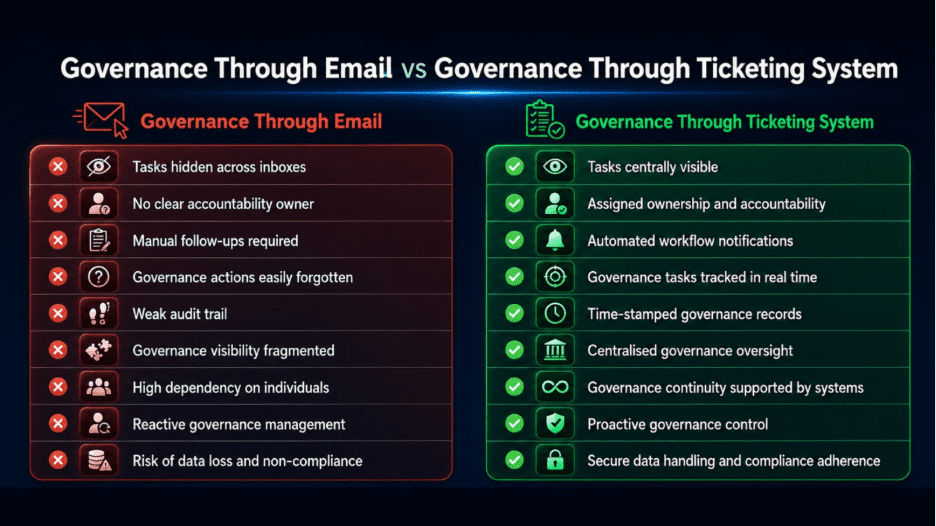
Governance Through Email vs Governance Through Ticketing Systems
What Is a Governance Ticketing System?
A governance ticketing system is a structured workflow environment used to manage governance, compliance and company secretarial activities through assigned tasks, accountability controls and centralised tracking.
Rather than governance requests disappearing across emails or informal discussions, each governance activity becomes a trackable workflow item.
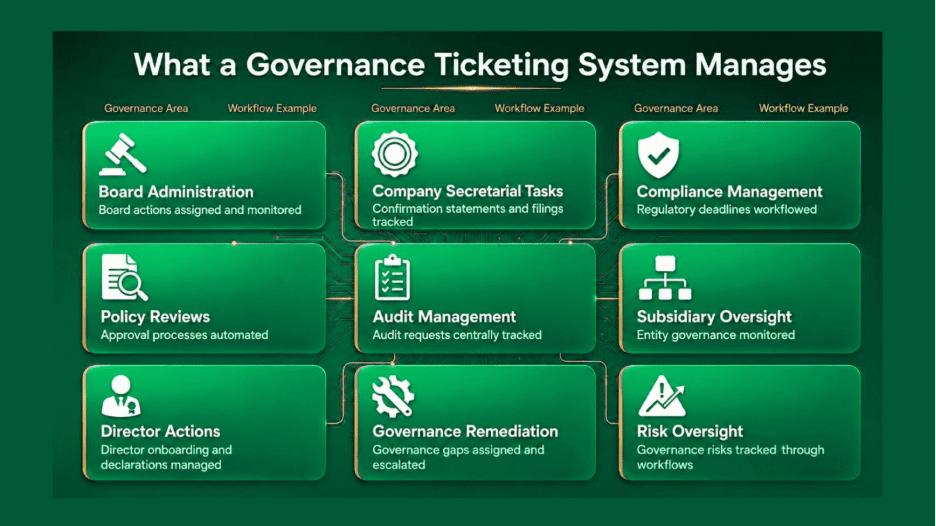
This could include:
- Board approval requests
- Statutory filing deadlines
- Compliance reviews
- Policy approvals
- Governance actions arising from board meetings
- Subsidiary governance tasks
- Director onboarding requirements
- Regulatory submissions
- Governance remediation actions
- Audit requests
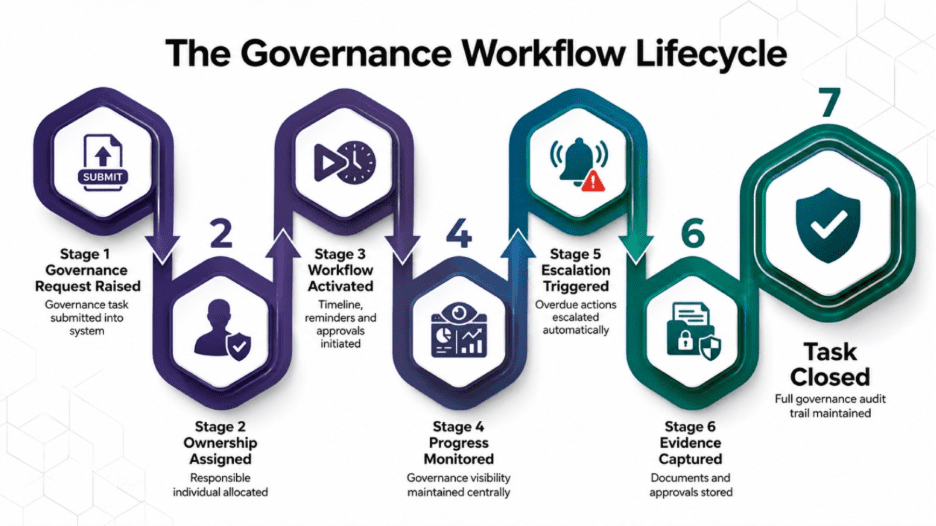
Each request becomes assigned, monitored, escalated and documented through a structured governance process.
This transforms governance from fragmented administration into operational infrastructure.
What a Governance Ticketing System Manages
Why Governance Visibility Matters More Than Ever
The governance expectations placed on organisations are changing rapidly.
Investors increasingly expect governance maturity. Regulators expect stronger accountability visibility. Financial institutions expect evidential governance records. Boards expect operational assurance.
This means governance can no longer operate as a loosely coordinated support function.
Modern governance requires structure, workflow discipline and operational visibility.
The difference between informal governance administration and governance infrastructure is significant. One depends on individuals remembering governance obligations. The other creates institutional governance continuity.
That distinction becomes critically important during:
- Investor due diligence
- Regulatory reviews
- Audits
- Acquisitions
- Refinancing exercises
- Cross-border expansion
- Governance investigations
When scrutiny arrives, organisations without governance workflow visibility often struggle to prove governance effectiveness clearly.
According to Deloitte governance and compliance insights, organisations with fragmented governance processes are significantly more likely to experience operational disruption and compliance inefficiencies during periods of organisational growth and regulatory scrutiny.
The Governance Workflow Lifecycle
The Governance Risks Hidden Inside Email based Governance
Many organisations still manage governance through inboxes, spreadsheets and informal follow-ups.
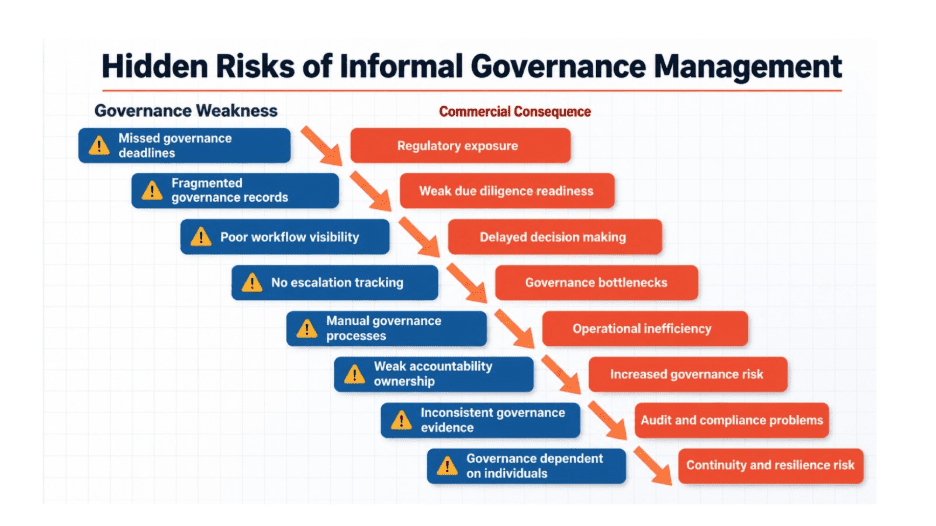
This creates several operational risks simultaneously.
No Clear Accountability
Governance actions become shared responsibilities without defined ownership. Everyone assumes someone else is managing the issue.
No Governance Visibility
Leadership teams cannot easily determine:
- Which governance actions remain outstanding
- Which deadlines are approaching
- Which subsidiaries are non-compliant
- Which approvals remain incomplete
- Where governance bottlenecks exist
Weak Audit Trails
When governance requests are handled informally, evidence becomes fragmented across conversations and systems. This creates serious exposure during audits or due diligence exercises.
Governance Continuity Risk
When governance knowledge sits with individuals rather than systems, staff turnover creates operational vulnerability. Institutional governance memory disappears.
Hidden Risks of Informal Governance Management
Case Study: The Compliance Review That Exposed Workflow Failure
A professional services organisation operating across three jurisdictions believed its governance systems were functioning effectively.
Board meetings occurred regularly. Compliance tasks were addressed. Directors received reporting updates.
During an external compliance review, however, significant governance weaknesses surfaced.
Multiple governance actions arising from previous board meetings remained incomplete because ownership had never been assigned formally. Regulatory filing responsibilities were duplicated across teams. Several policy reviews had stalled without escalation visibility.
The issue was not governance intent. The issue was governance workflow failure.
The organisation implemented a centralised governance ticketing system with structured accountability workflows and escalation controls. Within six months, governance visibility improved significantly while overdue governance actions reduced materially.
The governance function became measurable rather than assumed.
Why Governance Ticketing Is Becoming Essential for SMEs
Large organisations have historically invested more heavily in governance systems because operational complexity demanded it. SMEs are now facing similar pressures.
Growth-stage organisations increasingly operate across:
- Multiple legal entities
- Multiple jurisdictions
- Investor reporting obligations
- Regulatory frameworks
- Distributed leadership teams
- External stakeholders requiring governance assurance
Without governance workflow infrastructure, complexity grows faster than governance capability.
This creates hidden operational risk long before leadership teams recognise it.
The businesses that scale successfully are rarely the businesses with the most informal governance. They are usually the businesses that operationalise governance early.
The Chartered Governance Institute UK & Ireland continues to emphasise the importance of governance systems, accountability visibility and governance record integrity as organisations scale and face greater stakeholder scrutiny.
How CoSec Hub Uses Governance Workflow Infrastructure
At Lumorus, we recognised that governance failures often emerge not because organisations lack capable people, but because governance systems lack operational structure.
This is one reason CoSec Hub was designed around workflow visibility and governance accountability infrastructure.
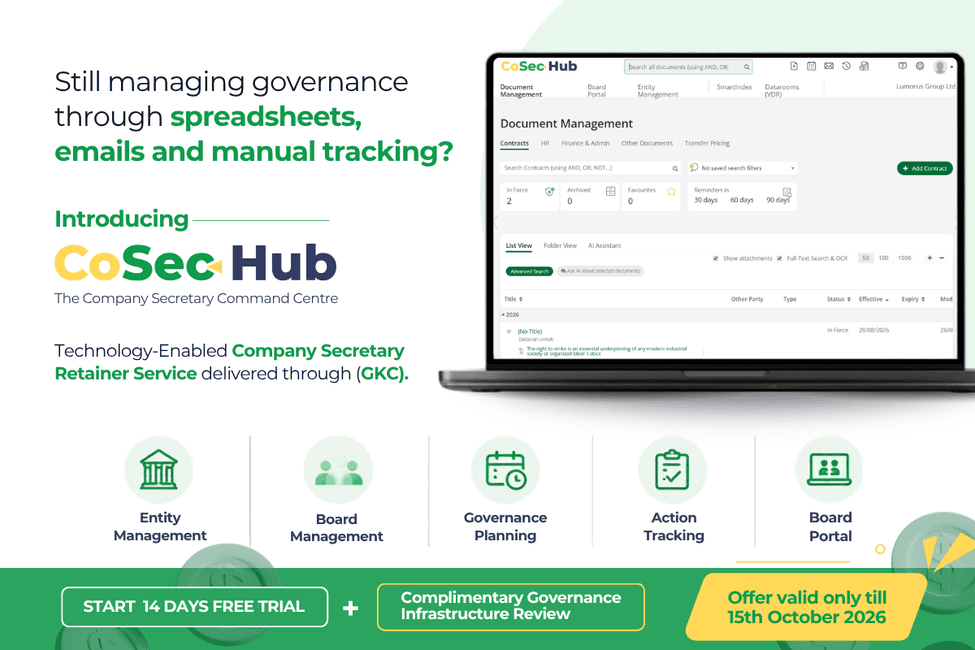
CoSec Hub functions as a governance command centre where governance requests, board actions, statutory obligations and compliance workflows can be managed through structured governance processes.
Through workflow-based governance management, organisations gain:
- Centralised governance visibility
- Assigned accountability
- Workflow monitoring
- Escalation management
- Governance audit trails
- Entity-level governance oversight
- Compliance deadline tracking
- Governance continuity support
This helps organisations move beyond reactive governance administration towards structured governance operations capable of supporting growth, investor readiness and regulatory resilience.
Explore CoSec Hub:
cosec.lumorus.com
Governance Infrastructure Is Becoming a Competitive Advantage
Governance is often discussed as a compliance obligation. Increasingly, it is becoming an operational differentiator.
Organisations with structured governance infrastructure move faster during investment processes, audits, acquisitions and regulatory reviews because governance information is visible, accessible and defensible.
Organisations operating governance informally often experience the opposite: delays, remediation costs, operational disruption and weakened stakeholder confidence.
The difference increasingly comes down to governance systems.
Not governance rhetoric.
Not governance policies alone.
Operational governance infrastructure.
And increasingly, workflow visibility sits at the centre of it.
Lumorus: Better Business, Built on Purpose
At Lumorus, we believe Being Good is Better for Business.
We help organisations lead with integrity, govern with confidence and create value that lasts. Through our work across Governance Advisory, Company Secretary Service and ESG-Social Impact Consulting, we support boards, executives and leadership teams to strengthen accountability, improve decision making and build resilient, responsible organisations.
With offices and expert teams across the UK, Africa, the Caribbean, Latin America and Canada, and clients operating globally, Lumorus brings international perspective, specialist expertise and practical judgement to every engagement.
Whether you are strengthening governance, enhancing board oversight, improving governance workflows or operationalising company secretarial infrastructure, Lumorus is here to help you move from intention to action.
Together, we can build better business: one that performs with purpose, leads with integrity and creates lasting value for people, planet and profit.
To continue the conversation, visit:
lumorus.com
cosec.lumorus.com
[email protected]
Sources
- Meegle — Ticketing System for Compliance Management
- The Chartered Governance Institute UK & Ireland
- Deloitte Governance & Compliance Insights